Leviticus 10 — The Mister Translation
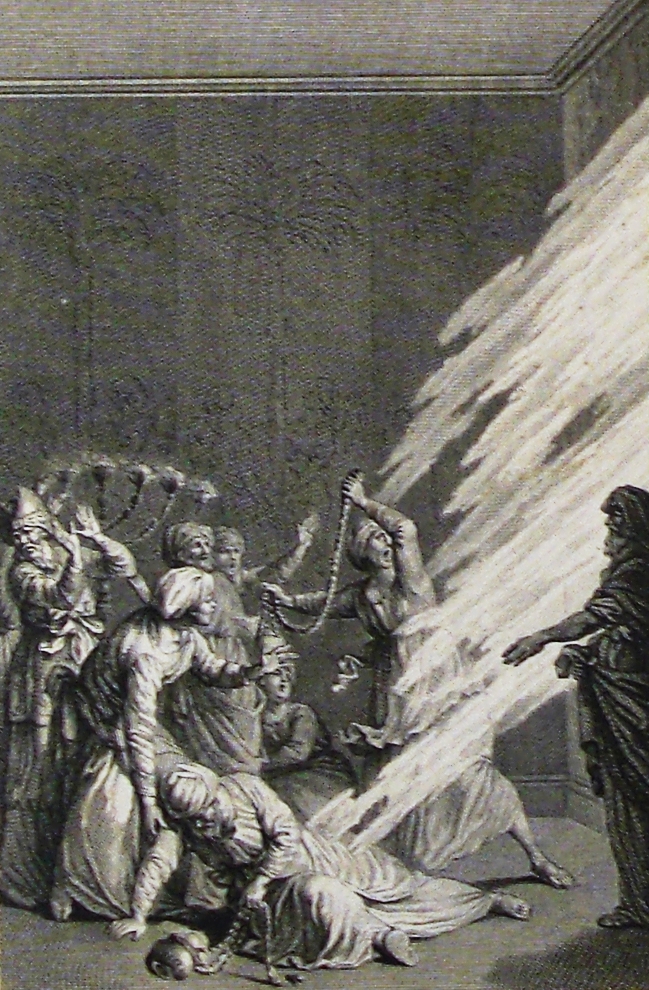
The moment of vv1–2 itself: fire striking down the instant the strange fire is offered, one priestly figure already falling with his censer knocked loose, the other still reeling — an engraving after Clément-Pierre Marillier (1740–1808), one of 252 illustrations he made for an illustrated edition of the Sainte Bible (Lemaistre de Sacy's French translation) published in Paris around the turn of the 19th century, now held in the Phillip Medhurst Collection. Unlike the wide, crowd-filled scene Leviticus 9's own art (already on these pages) uses for the celebration one chapter earlier, Marillier frames this moment tight and close — the menorah just visible behind them is the only clue this is even happening inside the sanctuary at all, which is exactly how fast and how privately the text says it happened.

The same fire, the opposite outcome
The chapter that begins in triumph ends, within two verses, in catastrophe — and the Hebrew makes the reversal audible, not just narrated. ‘Fire came out from before Jehovah, and consumed’ (v2) is the identical clause, word for word, that closed Leviticus 9:24 (already on these pages), where it consumed the OFFERING on the altar while the whole camp shouted for joy. Here it consumes NADAB AND ABIHU themselves, and no one shouts anything at all. Same fire, same source, same verb — the only thing that has changed is what is standing where the offering used to be.
⚠ ‘Strange’ translates zarah — foreign, unauthorized, not-belonging — the identical adjective Exodus 30:9 (already on these pages) used to forbid ANY incense but the one prescribed recipe on the altar of incense: ‘you shall offer no strange incense on it.’ That earlier verse names no penalty for breaking it; this one IS the penalty. The shelf splits on how to carry the word into modern English: KJV and NASB keep ‘strange fire’; NIV moves to ‘unauthorized fire’; NLT flattens furthest, to ‘a different kind of fire.’ This translation keeps ‘strange’ specifically to preserve the identical word already planted at Exodus 30:9 — an echo that an ‘unauthorized’ or ‘different’ substitute would erase. The text is notably careful about what it does not say: it never specifies whether the fire was taken from an unauthorized source, the incense recipe was wrong, or the timing was wrong — only that Jehovah ‘had not commanded’ it. The prohibition that follows almost immediately (v9, wine and strong drink before entering the tent) has long invited readers to fill that gap with drunkenness; the text itself never makes the connection explicit.
Sanctified, glorified, silent
Moses answers the deaths with a citation, not a comfort — and the citation is built on the exact root that has just appeared before their eyes. ‘Before all the people I will be glorified’ uses the same root, kavod, as the glory that had appeared to the whole congregation one chapter earlier (Leviticus 9:23, already on these pages) — the word for the visible weight of Jehovah's presence is now the word for what his own nearness demands. Both verbs, ‘I will be shown holy’ and ‘I will be glorified,’ are passive in the Hebrew (the grammatical niphal): not Jehovah acting to display himself, but something that simply happens through those closest to him — whether they intend it or not.
⚠ Aaron's entire recorded response is one word: ‘vayidom,’ and he was silent. No protest, no question, no grief spoken aloud — the single starkest silence in the whole Torah. The same root resurfaces, generations later, as formal counsel for how to bear an affliction God himself has laid on a person: ‘let him sit alone and keep silent, for he has laid it on him’ (Lamentations 3:28, already on these pages) — what is, here, one father's wordless reaction to his sons' deaths becomes, in exile, deliberate instruction.
Kinsmen, not brothers — and the work Aaron cannot do
‘Your brothers’ (v4) is the plain sense of the Hebrew, but the two men Moses summons are actually first cousins, not siblings. Mishael and Elzaphan are sons of Uzziel, who is Aaron's own uncle — grandsons, with Aaron, of a common grandfather. Biblical Hebrew regularly stretches ‘brother’ to cover any close kinsman, not only a literal sibling, and this translation keeps the wider, plainer word rather than substituting the narrower ‘cousins,’ which the text itself never specifies.
The two men who ARE the literal brothers of the dead — Eleazar and Ithamar, Aaron's surviving sons — do not touch the bodies at all. It is their more distant kinsmen who carry Nadab and Abihu out, ‘still in their tunics’ (v5), and the chapter's own logic makes clear why: three verses later Moses forbids Aaron, Eleazar, and Ithamar to so much as leave the entrance of the tent of meeting, ‘lest you die’ (v7) — a restriction that would make carrying bodies outside the camp themselves impossible. Aaron's silence in the previous verse is not only grief withheld; it is a man bound to the doorway, unable to perform the one task closest kin would ordinarily do for their own.
Two places to eat, and the rule the next dispute turns on
After eleven verses of death and instruction, the text turns almost startlingly ordinary: who eats what, and where. The leftover grain-offering (v12–13) is priests-only, eaten unleavened, specifically ‘in a holy place’ — beside the altar itself. The wave-breast and heave-thigh from peace-offerings (v14–15) are a wider grant: not just the priests but their SONS AND DAUGHTERS may eat them, and only ‘in a clean place’ — a lower bar than ‘holy.’ Two portions, two levels of holiness, two different circles allowed to eat.
That distinction is not incidental. It is the exact rule Moses will accuse Eleazar and Ithamar of breaking four verses later: the sin-offering, he says, needed to be eaten specifically ‘in the holy place’ (v17) — the stricter of the two categories just defined here, not the more permissive ‘clean place’ of v14. ‘For so I have been commanded’ (v13) is itself a callback: the identical formula of compliance that closes instruction after instruction across Leviticus 8 and 9, now repeated once more before the one dispute in the whole ordination narrative where compliance is actually in question.
Two kinds of mourning, and a rare direct word to Aaron alone
The working priests are forbidden the ordinary marks of grief — loosened hair, torn clothes — while everyone else is explicitly permitted them. ‘Your brothers, the whole house of Israel, may weep for those whom Jehovah's fire has burned’ (v6) draws a hard line: the nation mourns Nadab and Abihu; the priesthood, still mid-ordination and still wearing the anointing oil, is not allowed to. Grief itself is not the problem — its outward, ritual marks are, on men whose bodies are, for the moment, sacred property.
⚠ Verse 8 is easy to read past, but it marks something unusual: Jehovah speaks to Aaron directly, with no mention of Moses at all. Nearly every instruction in Leviticus so far has come ‘to Moses, saying,’ even when the content concerns Aaron specifically. Here, for one of the only times in the whole book, Aaron receives the word himself — and what he receives is a ban on wine and strong drink before entering the tent of meeting (v9), immediately followed by the reason: so that the priesthood can distinguish holy from common, unclean from clean, and teach Israel the same (v10–11). The verb is the identical one creation itself ran on — God's own first act was separating light from darkness (Genesis 1:4, already on these pages) — now handed to a mortal priesthood as its daily discipline, on the very day that priesthood has just shown, catastrophically, how easily the line can be missed.
The father who was silent finally speaks
Moses ‘inquired carefully’ (v16) renders a doubled Hebrew construction — darosh darash, the infinitive absolute stacked onto its own finite verb, a standard intensifier this translation has flagged elsewhere as Hebrew's own way of underlining a verb. Darash is the ordinary word for consulting an oracle or seeking Jehovah (compare 2 Kings 1:2, already on these pages); here its object is far more mundane — a missing goat — but the intensity is the same, and it finds a real problem: the sin-offering that should have been eaten by the priests has instead been burned. Moses is angry, and the men he confronts are not Aaron but Eleazar and Ithamar, his two surviving sons.
Aaron is the one who answers. This is the chapter's real turn: the man who had nothing to say when his sons died (v3) speaks now, in their defense, unprompted. His argument is not procedural but personal — ‘things like these have happened to me’ (v19), a spare, almost evasive way of naming the deaths without describing them — and his question echoes the very phrase Moses had just used to explain the tragedy: would eating a festive priestly meal today have been ‘good in the eyes of Jehovah’? ⚠ Moses hears it, and the chapter closes by handing Aaron's own words back to him: ‘it was good in his eyes’ (v20) — the identical phrase Aaron had just used, now describing Moses' verdict. The chapter that opened with a son's death silencing a father ends with that same father's argument silencing, in turn, the law's own enforcer. No penalty follows. No paragraph break separates this exchange from the next chapter's fresh instructions — the ordinary business of the priesthood simply resumes.
Notes on this translation
Decisions. Hebrew and English Leviticus 10 both run 1–20 — no versification split. Three Masoretic paragraph breaks divide the chapter (after v7, v11, and v20), marking three distinct movements: the deaths and their immediate aftermath (1–7), Jehovah's own instructions to Aaron alone (8–11), and the grain-offering rules ending in the sin-offering dispute (12–20). ‘Strange’ is kept for zarah (v1) rather than a plainer modern equivalent like ‘unauthorized,’ specifically to preserve the identical word already used at Exodus 30:9 (already on these pages) — the same adjective, planted as an ordinary regulation, paid off here as the transgression that kills two men. ‘I will be shown holy’/‘I will be glorified’ (v3) render two Hebrew niphal (passive) verbs literally rather than shifting to the more common active ‘I will show myself holy,’ preserving the sense that this happens THROUGH those near Jehovah rather than being an act he simply performs.
Echoes paid. The identical clause ‘fire came out from before Jehovah, and consumed’ closing Leviticus 9:24’s celebration and opening this chapter's catastrophe; ‘strange’ incense forbidden at Exodus 30:9, now naming the fire that kills Nadab and Abihu; and the root badal, ‘to separate,’ carrying creation's own first verb (Genesis 1:4) into the priesthood's daily charge.
Echoes planted. Aaron's silence (vayidom, v3), not answered again until Lamentations 3:28 turns the identical word into formal counsel for bearing what God has laid on a person; and the deaths of Nadab and Abihu themselves, which the Torah is not yet finished citing — Numbers returns to them twice more, neither chapter on these pages yet.
⚠ A note on order: Leviticus stands complete on these pages, chapters 1–27.