CreationBefore the FloodThe FloodAfter the FloodThe PatriarchsEgypt and the ExodusThe KingdomThe ExileThe ReturnBetween the TestamentsThe GospelsThe Apostolic Age
🕰
The eighth day — the confinement of Leviticus 8 has just ended, and the priesthood begins working for real. Aaron offers a sin-offering and burnt-offering for himself, then the same for the whole congregation, twice performing the rituals Moses alone performed on his behalf a week earlier. Aaron blesses the people; he and Moses bless them again together; and fire comes out from before Jehovah and consumes the offering while the whole nation watches, shouting for joy and falling on their faces.
The very next day after Leviticus 8's own seven-day confinement closes — still inside the same short window between the tabernacle's completion (Exodus 40:17, already on these pages) and the census that opens Numbers (Numbers 1:1, already on these pages). A single day's events, narrated start to finish, with no internal Masoretic paragraph break separating it from what follows.
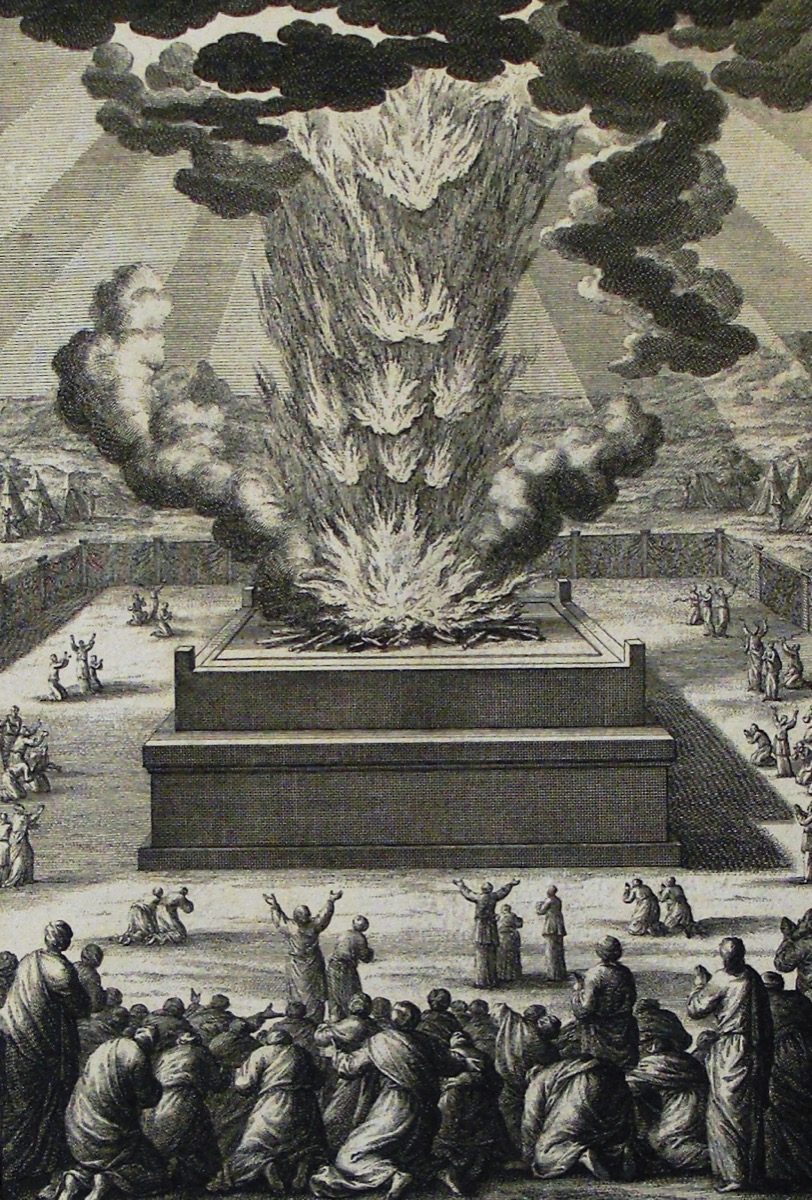
Engraving by Catharina Sperling, from Scheuchzer's Physica Sacra, 1731 · Phillip Medhurst Collection, St. George's Court, Kidderminster
The exact moment of v24: fire coming out from before Jehovah and consuming the burnt offering on the altar, while the whole congregation watches, shouts for joy, and falls on its face — an engraving by Catharina Sperling, one of the named engravers behind Johann Jakob Scheuchzer's 1731 "Physica Sacra" (the "Kupfer-Bibel," or Copper Bible), now held in the Phillip Medhurst Collection. The rays of light behind the smoke and the crowd's raised arms are the engraver's own reading of the scene, not the plain text — but the towering, tiered flame and the mass of onlookers below it capture something the chapter's own spare prose only states, never shows: that this was witnessed by everyone at once.
and he said to Aaron: Take for yourself a bull-calf for a sin-offering, and a ram for a burnt-offering, without blemish, and offer them before Jehovah.note
y dijo a Aarón: Toma para ti un novillo para ofrenda por el pecado, y un carnero para holocausto, sin defecto, y ofrécelos delante de Jehová.
And to the children of Israel you shall speak, saying: Take a male goat for a sin-offering, and a calf and a lamb, both a year old, without blemish, for a burnt-offering;note
Y a los hijos de Israel hablarás, diciendo: Tomad un macho cabrío para ofrenda por el pecado, y un becerro y un cordero, ambos de un año, sin defecto, para holocausto;
and an ox and a ram for peace-offerings, to sacrifice before Jehovah, and a grain-offering mixed with oil; for today Jehovah will appear to you.note
y un buey y un carnero para ofrendas de paz, para sacrificar delante de Jehová, y una ofrenda de grano mezclada con aceite; porque hoy Jehová se aparecerá a vosotros.
And Moses said to Aaron: Draw near to the altar, and offer your sin-offering and your burnt-offering, and make atonement for yourself and for the people; and offer the offering of the people, and make atonement for them, as Jehovah commanded.note
Y Moisés dijo a Aarón: Acércate al altar, y haz tu ofrenda por el pecado y tu holocausto, y haz expiación por ti y por el pueblo; y haz la ofrenda del pueblo, y haz expiación por ellos, como Jehová ha mandado.
And the sons of Aaron presented the blood to him, and he dipped his finger in the blood, and put it on the horns of the altar; and he poured out the blood at the base of the altar.note
Y los hijos de Aarón le presentaron la sangre, y él mojó su dedo en la sangre, y la puso sobre los cuernos del altar; y derramó la sangre al pie del altar.
And he brought near the offering of the people; and he took the goat of the sin-offering that was for the people, and slaughtered it, and offered it for sin, as the first.note
Y presentó la ofrenda del pueblo; y tomó el macho cabrío de la ofrenda por el pecado, que era por el pueblo, y lo degolló, y lo ofreció por el pecado, como el primero.
And he brought near the grain-offering, and filled his hand from it, and turned it into smoke on the altar, besides the burnt-offering of the morning.note
Y presentó la ofrenda de grano, y llenó su mano de ella, y la hizo arder en el altar, además del holocausto de la mañana.
He slaughtered also the ox and the ram, the sacrifice of peace-offerings that was for the people; and Aaron’s sons delivered the blood to him, and he dashed it against the altar all around,note
Degolló también el buey y el carnero, sacrificio de ofrendas de paz que era por el pueblo; y los hijos de Aarón le entregaron la sangre, y él la roció sobre el altar, alrededor,
And Aaron lifted up his hands toward the people, and blessed them; and he came down from offering the sin-offering, and the burnt-offering, and the peace-offerings.note
Y Aarón alzó sus manos hacia el pueblo, y los bendijo; y descendió de hacer la ofrenda por el pecado, y el holocausto, y las ofrendas de paz.
And fire came out from before Jehovah, and consumed on the altar the burnt-offering and the fat; and all the people saw it, and shouted for joy, and fell on their faces.note
Y salió fuego de delante de Jehová, y consumió sobre el altar el holocausto y la grasa; y todo el pueblo lo vio, y gritaron de júbilo, y cayeron sobre sus rostros.
The eighth day arrives, and this chapter states, out loud, why
‘The eighth day’ (v1) is not a fresh countdown — it is the deadline Leviticus 8’s own seven-day confinement was built to reach: ‘you shall remain at the door of the tent of meeting day and night for seven days… for so I have been commanded’ (Leviticus 8:35, already on these pages). That command’s own expiration is this chapter’s opening word. Aaron and his sons walk out from the doorway they have not left in a week, straight into their first working day.
⚠ Twice in six verses, almost identically, the text states an outcome no ordinary Leviticus offering has ever promised: ‘for today Jehovah will appear to you’ (v4) and ‘that the glory of Jehovah may appear to you’ (v6). Leviticus 1–7 (already on these pages) never once ties a sacrifice to something the offerer will SEE happen — only here, on the priesthood’s first day of work, does the text say out loud what all of it is actually for.
The man who could only watch, now does it himself
Leviticus 8’s own note at v14 flagged something deliberate: ‘notice who performs the ritual actions: MOSES, not Aaron… Aaron cannot yet act as a priest, because he is not yet a priest’ (already on these pages). That gap closes here. Moses’ own instruction is blunt — ‘draw near to the altar’ (v7) — and for the first time in the whole book, AARON slaughters, AARON’s own sons hand him the blood, AARON dips his own finger and touches the altar’s horns himself (v8–9). The hands filled eight days ago are now doing the filling.
⚠ Aaron’s first act as a working priest is on his OWN behalf — his own sin-offering, explicitly ‘for himself’ (v8) — before he is ever allowed to act for anyone else, exactly in the order Moses names it: ‘for yourself, and for the people’ (v7). It is the same sequence Leviticus 4 already set for an anointed priest’s own error (already on these pages): atonement begins at home.
Then he does it again, for everyone else
Verse 15’s own phrase, ‘as the first,’ makes the pattern explicit: the people’s sin-offering goat is handled by the SAME procedure just performed on Aaron’s own bull-calf, almost verse for verse. What took eight verses to narrate for the priesthood (v7–14) takes seven for the whole nation (v15–21) — not because the people mattered less, but because the ritual, once established, no longer needs re-explaining.
⚠ Verse 17’s grain-offering is explicitly ‘besides the burnt-offering of the morning’ — a reminder that this whole elaborate first day is layered ON TOP of an ordinary day’s routine, not a replacement for it. The twice-daily offering this assumes was already commanded, lamb by lamb, hin by hin, at Exodus 29:38–42 (already on these pages); it simply runs in the background here, unremarked, while the day’s real news happens beside it.
The blessing, the fire, and a crowd falling on its face
Aaron blesses the people once alone (v22), then Moses and Aaron go into the tent together, come out, and bless the people a second time (v23) — and it is only after THAT second blessing that ‘the glory of Jehovah appeared to all the people.’ One blessing from the new priest; a second, joint one from priest and lawgiver together, before the promise of v6 is finally kept.
Verse 22’s ‘his hands’ is a recorded ketiv/qere — a place where the Masorah preserves two forms of the same word at once. The text as WRITTEN, yado, spells a bare singular ‘his hand’; the text as READ, yadav, is the plural. KJV alone follows the written form — ‘Aaron lifted up HIS HAND toward the people’ — while ASV and this translation both follow the traditional reading, ‘his hands.’ Whichever it was, one or two, it is lifted over the whole nation at once.
⚠ The fire that ‘came out from before Jehovah, and consumed… the burnt-offering and the fat’ (v24) is not the ordinary altar fire that has been burning since Leviticus 6:6 (already on these pages) — it is a SEPARATE, sudden fire, and the text marks it as something the whole nation watched happen at once. The response is immediate and physical: they shouted for joy, and fell on their faces. Eight chapters of instruction and a week of confinement end in one moment nobody in the crowd could have manufactured for themselves.
Notes on this translation
Decisions. Hebrew and English Leviticus 9 both run 1–24 — no versification split. This chapter carries NO Masoretic paragraph marker anywhere within it — not one petuchah or setumah, checked against every verse — the only chapter shipped so far with zero internal breaks; it reads as one unbroken unit from the eighth day’s dawn to the fire that closes it, flowing straight into Leviticus 10 (already on these pages) with no pause in the scroll at all. ‘Presented’ and ‘delivered’ render two genuinely different Hebrew verbs for ‘brought the blood to him’ — hiqriv (v9) against himtzi (v12, v18) — kept distinct rather than flattened into one English phrase, though the difference reads as stylistic variation more than a deliberate contrast. ‘Male goat’ is kept for se’ir izzim (v3, v15), matching this translation’s own choice already established at Leviticus 4 (already on these pages), over KJV’s more literal but stranger-sounding ‘kid of the goats.’
⚠ A note on order: Leviticus stands complete on these pages, chapters 1–27.