Joshua 3 — The Mister Translation
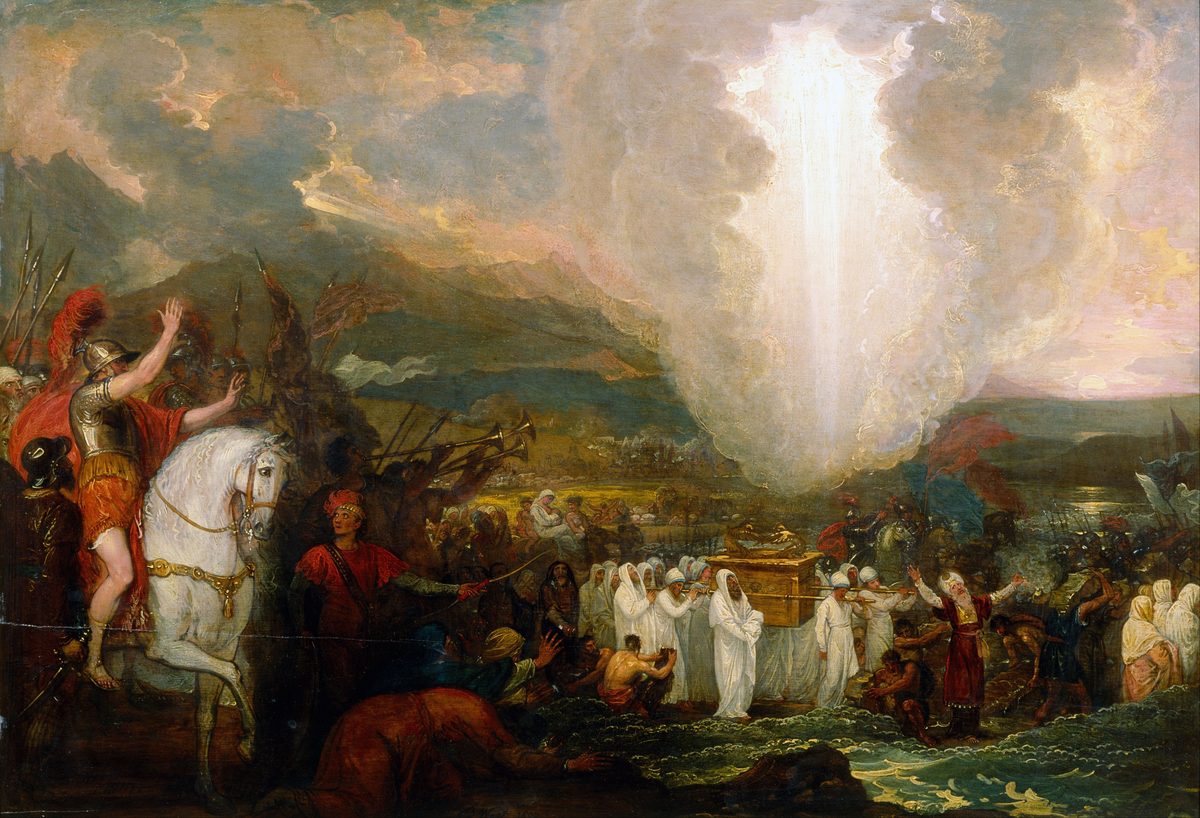
West, the Pennsylvania-born painter who became president of the Royal Academy, painted this small panel in 1800, in the years of his projected chapel of revealed religion at Windsor that was never completed. The pillar of light is his own device — the chapter has no cloud and no fire, only a river that stops — and the trumpets the priests carry belong to Joshua 6, not to the crossing; the Roman armour is the convention of his age. What he has kept from the text is the order of march: the ark in front, borne by priests on poles, and everyone else held back behind it.

★★ Joshua rises early, and the book will make a habit of it. Vayashkem Yehoshua, ‘and Joshua rose early,’ stands in four verses of the Hebrew Bible — here, on the morning of the crossing; at Joshua 6:12 (already on these pages), on the second morning round Jericho; and at 7:16 and 8:10 (neither yet on these pages), the morning Achan is found out and the morning Ai is taken. It is Abraham’s verb on the way to Moriah (Genesis 22:3, already on these pages) and Moses’s under the mountain (Exodus 24:4, already on these pages): the narrator’s way of saying a man did not put a thing off. The camp moves from Shittim, the acacia grove where Numbers 25 happened and Joshua 2:1 sent the spies from, to the river’s edge, and then stops — vayalinu sham, ‘they lodged there,’ the ordinary verb for spending a night, not the shakhav the spies used in Rahab’s house. KJV and ASV read ‘lodged there before they passed over’; NWT 1984 ‘spending the night there before they would cross’; NIV ‘camped before crossing over.’ The Douay-Rheims reads ‘abode there for three days’ and the Living Bible ‘camped for a few days’ — both have pulled v2’s three days up into v1, and the Douay-Rheims’ Latin also has Joshua rise ‘before daylight’ and gives him ‘heralds’ for the Hebrew’s officers.
★★ ‘At the end of three days’ is the deadline Joshua 1:11 set, and the officers who set it are the ones who now walk the camp. The phrase mi-qtseh sheloshet yamim stands in two verses of the Hebrew Bible, this one and Joshua 9:16 (not yet on these pages), where three days is exactly how long the Gibeonites’ trick lasts. The shoterim are the same officers Joshua commanded at 1:10, and the same verb, avar, that they ‘passed through’ the camp with there is the verb the chapter is about — it is used nine times in seventeen verses, of passing through a camp and passing over a river. Whether these three days are the three the spies hid (2:22) is the question the Joshua 2 page already reported Rashi harmonising; the text does not say. KJV has the officers go ‘through the host’ and the Geneva 1599 ‘throughout the host’; ASV and NWT 1984 read ‘through the midst of the camp’, NIV ‘throughout the camp.’ The Living Bible reads ‘on the third day’, which is not what at the end of three days says.
★★★ ‘The priests, the Levites, carrying it’ — and in the wilderness the ark was carried by Levites who were forbidden to be priests. Numbers 4:15 (already on these pages) gives the ark to the sons of Kohath, who may carry the holy things only after Aaron’s sons have covered them and who may not touch them on pain of death; 7:9 gives the Kohathites no wagons, because their load goes on the shoulder. Here, and at every stage of this crossing (vv6, 8, 13, 14, 15, 17), the carriers are the priests — Rashi remarks on it at v6 (‘until now it was carried by the Levites, but today it was to be carried by the Kohanim’), and Deuteronomy 31:9 (already on these pages) had already spoken of ‘the priests, the sons of Levi, who carry the ark of Jehovah’s covenant.’ The Hebrew here, ha-kohanim ha-leviyim, is Deuteronomy’s own double title (17:9, 18:1, both already on these pages), and this translation keeps it as the Deuteronomy pages do, ‘the priests, the Levites.’ KJV and ASV read ‘the priests the Levites’, the NWT 1984 ‘the priests, the Levites’; NIV ‘the Levitical priests’; the Geneva 1599 ‘the Priests of the Levites’; the Douay-Rheims ‘the priests of the race of Levi.’ In Spanish the RV 1909 reads «los sacerdotes y Levitas», two groups with an and the Hebrew does not have; the RV60 revised it to «los levitas sacerdotes». The order of march has changed too: in Numbers the cloud led and the ark travelled inside the column (Numbers 10:21, already on these pages); at 10:33 it once went ‘three days’ journey’ ahead to find a resting-place. Now it is in front, and nothing is in front of it.
★★ Two thousand cubits is a distance the Torah has measured once already, and the rabbis turned it into a law. Numbers 35:5 (already on these pages) lays out two thousand cubits on each side of a Levitical city as its pasture; from that figure and this verse the rabbis derived the techum shabbat, the two thousand cubits a person may walk outside a town on the sabbath — roughly a kilometre — and Rashi reads the gap here as built for it: Joshua foresaw a siege on the sabbath and set the ark exactly as far away as the people would still be allowed to go to pray before it. The plain sense is the one the verse gives itself: keep back so that you can see the way, because there is no road. Mi-tmol shilshom, literally ‘from yesterday and the day before,’ is Hebrew’s idiom for before now — the exact phrase stands in three verses of the Hebrew Bible, here and twice in the law of the manslayer who ‘did not hate him from yesterday and the day before’ (Deuteronomy 19:6, already on these pages; Joshua 20:5, not yet). Those two pages keep the idiom whole because a legal formula turns on it; here it is a plain adverb of time and this translation prints ‘before.’ KJV, ASV and Geneva 1599 read ‘a space between you and it’; NWT 1984 ‘a distance between YOU and it’; NIV ‘a distance of about two thousand cubits.’ The Living Bible converts it: ‘stay about a half mile behind.’ ⚠ Three of the thirteen versions put the purpose clause before the distance: the NIV (‘Then you will know which way to go … But keep a distance’), the RV60 in Spanish («a fin de que sepáis el camino por donde habéis de ir» before the cubits), and the Living Bible, whose ‘so they will guide you’ comes before its half mile; the RV 1909 that the RV60 revised keeps the Hebrew order. The Masoretic text closes the officers’ speech on an open break, {פ}.
★★★ Hitqaddeshu is the command given before Sinai and before the quail, and it will be given again before Achan. The form stands in ten verses of the Hebrew Bible, and the three in the Torah and Joshua are a set: Numbers 11:18 (already on these pages), ‘consecrate yourselves for tomorrow, and you shall eat meat’; this verse, for tomorrow Jehovah will do wonders; and Joshua 7:13 (not yet on these pages), ‘sanctify yourselves for tomorrow … there is a devoted thing in your midst.’ The other seven are 1 Samuel 16:5 and six verses of Chronicles, people readying themselves for a sacrifice or a temple service. The Greek Bible makes the set tighter still by adding the Numbers wording here, hagnisasthe eis aurion, ‘sanctify yourselves for tomorrow.’ What the sanctifying consisted of is not said; at Exodus 19:10–15 (already on these pages), where Moses is told to sanctify the people for the third day, it meant washed clothes and no going near a woman, and the Targum here simply reads izdammenu, ‘prepare yourselves,’ which Rashi adopts (‘here it means prepare yourselves’). This translation keeps the root visible — the qadash of Exodus 19 — where the Numbers page chose ‘consecrate’ for the same form. KJV, ASV, Geneva 1599 and NWT 1984 read ‘Sanctify yourselves’; the Douay-Rheims ‘Be ye sanctified’; NIV ‘Consecrate yourselves’; the Living Bible ‘purify themselves.’ In Spanish RV 1909 and RV60 read «Santificaos», the TNM 1987 «Santifíquense», the NVI «Conságrense».
★★ ‘Wonders in your midst’ is the promise of the burning bush, with Israel in Egypt’s place. Exodus 3:20 (already on these pages): ‘I will strike Egypt with all my wonders that I will do in its midst’ — nifle’otai asher e’eseh be-qirbo. Here it is ya’aseh … be-qirbekhem nifla’ot, the same verb, the same noun, the same in the midst of, and the people the wonder is done among are no longer the Egyptians. The root is pala, what only God does; Exodus 34:10 (already on these pages) had promised ‘marvels such as have not been done in all the earth’ before all the people, and this is the first of them on the far side of the wilderness. The shelf spreads: KJV, ASV and Geneva 1599 read ‘wonders’; NWT 1984 ‘wonderful things’; NIV ‘amazing things’; the Living Bible ‘a great miracle’, singular, which the Hebrew plural is not.
★★ ‘Cross over before the people’ — the last book said twice who would do that. Deuteronomy 31:3 (already on these pages) says it of both: ‘Jehovah your God — he is the one crossing over before you … Joshua — he is the one crossing over before you’; 9:3 says it of Jehovah, ‘a devouring fire.’ What actually crosses over before the people, in the event, is the ark — ivru lifnei ha-am here, over lifneikhem at v11 — carried by priests, with Joshua nowhere in the procession. The Masoretic text sets a closed break, {ס}, after the priests move. The Living Bible gives the priests a speech the Hebrew does not contain, ‘Take up the Ark and lead us across the river!’, and the Douay-Rheims adds an obedience clause, ‘they obeyed his commands’, that the Latin has and the Hebrew does not.
★★★ Ha-yom ha-zeh achel, ‘this day I will begin,’ has been spoken by God once before, and the Deuteronomy page has it. The phrase stands in two verses of the Hebrew Bible: Deuteronomy 2:25 (already on these pages), ‘This day I will begin to put the dread of you and the fear of you on the peoples,’ said as Israel turned toward Sihon; and this verse, ‘This day I will begin to make you great in the eyes of all Israel.’ The first begin was aimed outward, at the nations; the second inward, at the people’s regard for the man leading them — and a chapter that opened by sending the ark ahead of Joshua is now told that its purpose was Joshua’s standing. Gaddelkha is the causative of gadol, great: KJV, ASV and Geneva 1599 read ‘magnify thee’; NWT 1984 ‘make you great’; NIV and the Douay-Rheims ‘exalt’; the Living Bible ‘give you great honor.’ In Spanish the RV 1909 and TNM 1987 read «hacerte grande», the RV60 and NVI «engrandecerte».
★★ ‘As I was with Moses, I will be with you’ is Joshua 1:5, word for word, and the two verses are the only two. Ka’asher hayiti im-Mosheh stands in two verses of the Hebrew Bible, both in this book: the promise made on the morning after Moses died, and its restatement on the morning it is first tested. The chapter is built so that the people should draw the conclusion themselves — asher yede’un, ‘so that they may know’ — and v8 gives Joshua the first order he will relay to the priests: ba-Yarden ta’amodu, ‘in the Jordan you shall stand,’ with the river named before the verb. Standing still in a river in flood is the whole instruction; Calvin’s comment on the priests’ part is that ‘the valor of the priests in proceeding boldly beyond the bed into the water itself, was deserving of no mean praise.’ KJV and ASV read ‘ye shall stand still’; NWT 1984 ‘YOU should stand still in the Jordan’; NIV ‘go and stand in the river’; the Douay-Rheims ‘stand in it.’ A second open break, {פ}, closes the divine speech.
★★ ‘Come near here’ is Joseph’s word to his brothers, and Elijah’s to Israel on Carmel. Goshu hennah — the plural imperative of nagash, to draw near. Joseph says geshu-na elai, ‘come near to me, please,’ before he says his name (Genesis 45:4, already on these pages); Elijah says geshu elai to all the people before he rebuilds the altar (1 Kings 18:30, not yet on these pages). In each case the drawing-near comes before the thing that is to be believed. Rashi, following the rabbis, has the whole nation compressed between the two poles of the ark to hear this — ‘one of the places where a small space was able to hold a large amount’ — and reads v10’s by this you shall know as pointing at that crowding, not at the river. The plain sense is the river.
★★★ The Hebrew says El chai, ‘a living God,’ and has no article — and one version on each shelf prints it that way. Read as a name of God, the two words stand in four verses of the Hebrew Bible: this one, Hosea 2:1 (English 1:10; not yet on these pages), where the once-disowned people are called ‘sons of a living God’; and Psalms 42:3 and 84:3 (neither yet on these pages), the soul thirsting and the heart crying out ‘for a living God.’ The consonants match more verses than that (el-cheq, ‘into the bosom,’ and a ‘from strength to strength’ at Psalm 84:8 among them), which is why the count here is by reading. The plural form, Elohim chayyim, is Deuteronomy 5:22’s (already on these pages; 5:26 in English) — ‘who has heard the voice of the living God speaking out of the midst of the fire, as we have, and lived?’ — and the sense is the same in both: not a God who exists, but one who acts, as against the gods that do not. Nine of the thirteen versions on the two shelves supply a definite article: KJV, ASV, Geneva 1599, NIV and the Living Bible read ‘the living God’; the Douay-Rheims ‘the Lord the living God’; in Spanish RV 1909, RV60 and the NVI «el Dios viviente». Only the NWT 1984, ‘a living God is in YOUR midst’, and its Spanish twin the TNM 1987, «un Dios vivo» — and the 2013 and 2019 revisions of each — print the Hebrew’s indefinite — and the standing rule of this project is to follow the most exact witness where no doctrine rides on it. Nothing does here; this translation reads ‘a living God,’ and the dictionary entry carries the four verses. The Targum expands the phrase into ‘the living God has been pleased to make his Shekinah dwell among you’ — the Aramaic’s standing way of not saying that God himself is in a place. Calvin reads the sign as the threat: when God restores the river ‘it would just be as if he were stretching forth his hand to rout all the inhabitants of the land.’
★★ Horesh yorish — ‘he will surely dispossess’ — and the seven nations are Deuteronomy 7:1’s seven, shuffled. The infinitive absolute doubles the verb; this exact doubling stands in one verse of the Hebrew Bible, and KJV, ASV and NWT 1984 render the emphasis ‘without fail’, the Geneva 1599 and NIV ‘certainly’; the Douay-Rheims drops it and reads ‘he shall destroy before your sight.’ Deuteronomy 7:1 (already on these pages) is the one verse that counts the peoples — ‘seven nations’ — and lists them Hittite, Girgashite, Amorite, Canaanite, Perizzite, Hivite, Jebusite; Joshua names the same seven and begins with the Canaanite, ends with the Jebusite, and puts the Girgashite fifth. The Girgashite stands in seven verses of the Hebrew Bible, every one of them a list, and this is the second of the three in the Torah and Joshua that have all seven names (the third is Joshua 24:11, not yet on these pages). ⚠ The Douay-Rheims lists them in a different order again, ending ‘the Gergesite also and the Jebusite, and the Amorrhite’, and the Living Bible adds ‘all the people who now live in the land you will soon occupy,’ which is gloss.
★★★ ‘The Lord of the whole earth’ is a title that the Bible uses for the first time in this verse, and it is not the divine name. Adon kol-ha’arets — adon, the ordinary noun for a master or owner, not the tetragrammaton, and not the Adonai of address either. The phrase stands in six verses of the Hebrew Bible: twice here (vv11, 13), Zechariah 4:14 (already on these pages), where the two ‘sons of oil’ stand beside the Lord of the whole earth, Zechariah 6:5, Micah 4:13 and Psalm 97:5 (none yet on these pages). This page keeps the Zechariah page’s wording. The point of the title, in this verse, is that the God whose box is about to enter a river in Canaan is not a river-god and not Israel’s god only — the reason a Canaanite’s confession at Joshua 2:11 had put him ‘in the heavens above and on the earth below.’ ⚠ The grammar is odd, and Rashi notices it. Aron ha-brit, Adon kol-ha’arets reads, word for word, ‘the ark of THE covenant, Lord of the whole earth’ — a noun with the article standing where a construct chain would have it bare — and the same anomaly recurs at v14 (ha-aron ha-brit, ‘the ark the covenant’) and v17 (ha-aron brit-Yehovah). Rashi’s answer is that Scripture does this (‘do not wonder about the letter he … there are many Scriptural words that are so constructed’); the Greek Bible simply reads kibōtos diathēkēs Kyriou pasēs tēs gēs, a clean chain, and every version on the two shelves does the same, as does this one. KJV, ASV and the Douay-Rheims read ‘the Lord of all the earth’; NWT 1984 ‘the Lord of the whole earth’; NIV ‘the Lord of all the earth’; the Geneva 1599 ‘the Lord of all the world’; the Living Bible turns the title into a relative clause, ‘The Ark of God, who is Lord of the whole earth.’ The Spanish shelf shows the word being weighed: the RV 1909 coined «Señoreador de toda la tierra», an agent-noun, the one who lords it; the RV60 and TNM 1987 read «Señor de toda la tierra»; the NVI «Soberano de toda la tierra».
★★ Twelve men are chosen and given nothing to do — yet. Ish-echad ish-echad la-shavet, ‘one man, one man, for the tribe,’ is the doubled distributive this project has kept doubled since Numbers 34:18’s ‘one chieftain, one chieftain’ (already on these pages), and it is kept here. What the twelve are for the chapter does not say; Rashi’s gloss is ‘prepare them to be available to fulfil that which I will command them when you finally cross,’ and Joshua 4 (not yet on these pages) will send them back into the riverbed for twelve stones. The shelf smooths the doubling: KJV and Geneva 1599 read ‘out of every tribe a man’, ASV ‘for every tribe a man’, NWT 1984 ‘one man for each tribe’, NIV ‘one from each tribe’; the Living Bible adds ‘for a special task’, which is a fair guess but not a translation.
★★★ ‘When the soles of the feet of the priests … rest’ — the verb is nuach, the rest the book was promised, and the feet are the ones Joshua 1:3 was given the land by. Ke-noach kappot raglei ha-kohanim. The verb is the root of Noah’s name and of the menuchah Joshua promised the tribes at 1:13 (already on these pages) — the point of the whole crossing is somewhere to stop — and its first use in the land is of feet coming to rest in a river. The phrase kappot raglei, ‘the soles of the feet of,’ stands in five verses of the Hebrew Bible: here, at Joshua 4:18 (not yet on these pages), where the same soles are ‘pulled out’ onto dry ground and the river returns, and three times in the prophets. The singular is the phrase of the grant: every place that the sole of your foot treads on (Deuteronomy 11:24, Joshua 1:3, both already on these pages). The first soles to tread the land are priests’, and they tread water. The NWT 1984 reads ‘the soles of the feet of the priests … rest in the waters’, as do KJV and ASV (‘shall rest in the waters’); the Geneva 1599 ‘shall stay in the waters’; NIV shortens to ‘set foot in the Jordan’, the Living Bible to ‘touch the water with their feet.’
★★★ ‘The waters of the Jordan will be cut off … and stand in one heap’ — karat is the covenant-cutting verb, and ned is the Song of the Sea’s word for standing water. Yikkaretun, with the old lengthened ending: the verb that cuts a covenant (Deuteronomy 5:2, already on these pages) is the verb that cuts the river, and the ark of the covenant is what does the cutting. Ned echad, ‘one heap,’ stands in two verses of the Hebrew Bible, v13 and v16 of this chapter, the prediction and the event; the noun ned itself stands in six verses of the Hebrew Bible — and the first is Exodus 15:8 (already on these pages), the floods stood upright like a heap, the Song of the Sea’s picture of the Red Sea, which Psalm 78:13 (not yet on these pages) repeats and Psalm 33:7 and Isaiah 17:11 (neither yet on these pages) use of the sea’s waters and of a harvest. Rashi cites the last two for the sense: ‘expressions of height.’ The two consonants match many other words (Cain’s nad, a wanderer, among them), which is why that count is by reading. Rahab had named the Red Sea on her roof (2:10); the narrator now gives the Jordan the Red Sea’s own noun, and the reader is meant to hear it. The shelf mostly keeps a heap: KJV ‘upon an heap’, ASV ‘in one heap’, Geneva 1599 ‘upon an heap’, NIV ‘stand up in a heap’, the Douay-Rheims ‘upon a heap’; the NWT 1984 reads ‘stand still as one dam’, the Living Bible ‘as though held back by a dam … as though against an invisible wall’, and the NVI «formando un muro»; the RV60 keeps «en un montón». ⚠ The KJV alone reads the cutting-off as happening ‘from the waters that come down from above’, a separation rather than a stoppage; the Hebrew’s ha-mayim ha-yordim is in apposition, naming which waters are cut off, and this translation sets it off with dashes.
★★ The priests’ feet are dipped, and the only other feet the Bible dips in the Jordan are Naaman’s. Nitbelu, from taval, the verb for dipping a finger in blood or a morsel in vinegar — as a verb it stands in sixteen verses of the Hebrew Bible (the consonants also spell a name, Tebaliah, at 1 Chronicles 26:11), and in only two of them is the thing dipped into the Jordan: this verse and 2 Kings 5:14 (not yet on these pages), where the Syrian general goes down ‘and dipped in the Jordan seven times’ and is healed. Elisha, who sends him, will himself have crossed this river on dry ground beside Elijah (2 Kings 2:8). Bi-qtseh ha-mayim, ‘in the edge of the water’: the priests are at the brink, not in the stream, when the river stops. KJV reads ‘dipped in the brim of the water’, ASV and Geneva 1599 ‘dipped in the brink of the water’, NWT 1984 ‘dipped in the edge of the waters’, NIV ‘their feet touched the water’s edge’; the Douay-Rheims ‘dipped in part of the water’ follows the Greek’s eis meros tou hydatos. In Spanish RV 1909 and RV60 read «fueron mojados», the TNM 1987 «se mojaron», the NVI «tocaron las aguas».
★★★ ‘The Jordan is full over all its banks all the days of harvest’ — a parenthesis that dates the crossing and sets the size of the miracle. ‘Over all its banks’ stands in three verses of the Hebrew Bible: here, at Joshua 4:18 (not yet on these pages), where the river goes back to running ‘over all its banks as before,’ and Isaiah 8:7 (not yet on these pages), of the Euphrates as the king of Assyria in flood. The harvest is the barley harvest — the book will put the crossing four days before Passover (Joshua 4:19; 5:10, neither yet on these pages), the season Ruth 1:22 (already on these pages) calls ‘the beginning of the barley harvest,’ and the flax on Rahab’s roof had already said so (2:6). Rashi: ‘the days of Nisan coincide with the harvest.’ The Jordan runs highest in spring, when the snow on Hermon comes down; the narrator says the river was at its widest so that the reader will not think the priests found a ford. ⚠ The Greek Bible specifies the crop, hōsei hēmerai therismou pyrōn, ‘about the days of WHEAT harvest’ — some weeks later than barley — and the Douay-Rheims’ Latin turns the tense, ‘it being harvest time, had filled the banks of its channel.’ KJV reads ‘overfloweth all his banks all the time of harvest’, with the old possessive his for its; ASV ‘overfloweth all its banks’; NWT 1984 ‘overflows all its banks all the days of harvest’; NIV ‘at flood stage all during harvest’; the Geneva 1599 ‘useth to fill all his banks.’ Three versions move the sentence ahead of the priests’ feet, where the Hebrew holds it back until they are in the water: the NIV opens v15 ‘Now the Jordan is at flood stage all during harvest’, the NVI «Ahora bien, las aguas del Jordán se desbordan», and the Living Bible puts ‘Now it was the harvest season’ before anyone sets out.
★★★ ‘Very far away, from Adam’ — or ‘at Adam’: the Masorah writes one and reads the other, and the two shelves split down the middle. The consonants written in the scroll are b’adam, ‘AT Adam’; the form the Masoretes mark to be read is me’adam, ‘FROM Adam.’ This translation follows the read form, as it has at every ketiv/qere so far, and records the written one here. They do not mean quite the same thing: at Adam puts the heap of water there; from Adam measures the distance from there — and either way the point is harcheq me’od, very far: the water did not stand up in front of the priests but a long way upstream, out of sight. The written form is what ASV reads, ‘a great way off, at Adam’; NIV ‘a great distance away, at a town called Adam’; NWT 1984 ‘very far away at Adam’; the Living Bible ‘far up the river at the city of Adam.’ The read form is KJV’s, ‘very far from the city Adam’; the Geneva 1599’s, ‘departed far from the city of Adam’; and the Douay-Rheims’, ‘afar off from the city that is called Adom.’ In Spanish the RV60 and RV 1909 read «bien lejos de la ciudad de Adam», the read form, and the TNM 1987 «en Adán» and the NVI «a la altura del pueblo de Adán», the written one. ⚠ The Greek Bible has neither: heōs merous Kariathiarim, ‘as far as the region of Kiriath-jearim’ — no Adam at all, and a town in the hills of Judah in Zarethan’s place. The Latin’s ‘Adom’ and ‘Sarthan’ are the Hebrew names in Jerome’s spelling.
★★★ Adam is a real town, and its riverbank has collapsed into the Jordan at least twice in recorded history. The city is named only here in the Bible; it is generally identified with Tell ed-Damiyeh, on the east bank about thirty kilometres upstream of Jericho, where the Jabbok comes in and the Damiya bridge now crosses — the name has kept its consonants. Zarethan, its neighbour, stands in two verses of the Hebrew Bible with this spelling, here and 1 Kings 7:46 (not yet on these pages), where Solomon casts the temple’s bronze ‘in the clay ground between Succoth and Zarethan’ — the same stretch of valley, and its exact site is not known. The banks there are marl and soft clay, undercut by the river, and commentators since John Garstang, the excavator of Jericho in the 1930s, have reported that on 11 July 1927 an earthquake brought the west bank down at Damiya and stopped the Jordan for some twenty-one hours, people crossing the bed on foot — and that the Arab historian al-Nuwayri records the same thing in December 1267, for about sixteen hours. This page reports those as reported; it has not seen either primary account. What they establish is that a heap of standing water ‘very far away, at Adam’ describes a thing the river actually does; what they do not establish is when, and the text’s own claim is the timing — the feet went in, and the water stopped. Josephus, telling the story eighteen centuries earlier (Antiquities 5.1.3), had already made it smaller: the river ‘appeared fordable, the depth of the water being restrained and the sand appearing at the bottom,’ God having taken away ‘the main part of its waters’ — no heap, no Adam. Calvin, from the other side: ‘It was certainly neither a natural nor fortuitous event, when the waters stood gathered up into a heap.’ The two shelves name the lower sea five ways: KJV ‘the sea of the plain, even the salt sea’; ASV ‘the sea of the Arabah, even the Salt Sea’ and NWT 1984 ‘the Salt Sea’ after its own spelling of the Arabah; Geneva 1599 ‘the Sea of the wilderness, even the salt Sea’; the Douay-Rheims ‘the sea of the wilderness (which now is called the Dead Sea)’, the parenthesis being Jerome’s; NIV ‘the Sea of the Arabah (that is, the Dead Sea)’; the RV 1909 «la mar de los llanos» and the NVI «el mar Muerto». This translation keeps the sea of the Arabah, the Salt Sea, as the Deuteronomy 3:17 page already does; the phrase yam ha-Aravah stands in five verses of the Hebrew Bible, three of them boundary descriptions in Deuteronomy and Joshua. Tammu nikhratu, two verbs with no conjunction — ‘were finished, cut off’ — is kept as two; KJV reads ‘failed, and were cut off’, ASV ‘were wholly cut off’, NWT 1984 ‘were exhausted. They were cut off’, NIV ‘was completely cut off.’ ⚠ The Living Bible has the water below ‘flowed on to the Dead Sea until the riverbed was empty’ — a paraphrase of the mechanism the Hebrew leaves to the reader — and the Douay-Rheims reads ‘swelling up like a mountain, were seen afar off’, a mountain and a spectator the Hebrew does not have. And where the Hebrew ends the verse with the people crossing, the Greek has them standing opposite Jericho, heistēkei; the Douay-Rheims moves the crossing into v17.
⚠ Hosea may name this town again, and the verb he uses is avar. Hosea 6:7 (not yet on these pages) reads ke-Adam averu berit — ‘like Adam they transgressed a covenant’ in most versions, but avar is this chapter’s verb, to cross over, and a number of readers, ancient and modern, take the preposition as a place: ‘AT Adam they crossed the covenant; there they dealt treacherously with me.’ If so, the town where the water stood for the ark of the covenant is the town where the covenant was later broken. It is a reading, not a text; the note records it as one.
★★★ Be-charavah stands in three verses of the Hebrew Bible, and each is a body of water with people alive in it. The form stands in three verses of the Hebrew Bible: Genesis 7:22 (already on these pages), everything ‘on dry land’ that died in the flood; this verse, twice, the priests standing and Israel crossing; and 2 Kings 2:8 (not yet on these pages), Elijah and Elisha crossing this same river ‘on dry land’ after the mantle strikes it. The noun with a different preposition is Exodus 14:21’s (already on these pages), ‘made the sea into dry land,’ and the Exodus pages keep it distinct from yabbashah, the ‘dry ground’ the people walked on at 14:22; this page keeps the same distinction, charavah as ‘dry land’, and Joshua 4:22 (not yet on these pages) will use the other word. Be-tokh ha-Yarden, ‘in the midst of the Jordan,’ answers be-tokh ha-yam, ‘in the midst of the sea,’ at Exodus 14:22 and 14:29: the chapter has been quoting the Red Sea since v13, and here it says so in the plainest way it can. KJV and ASV read ‘stood firm on dry ground’; NWT 1984 ‘kept standing immovable on dry ground’; NIV ‘stood on dry ground’; the Geneva 1599 ‘stood dry within Jordan ready prepared’; the Douay-Rheims ‘stood girded upon the dry ground.’ In Spanish RV 1909 and RV60 read «estuvieron en seco, firmes», the TNM 1987 «permanecieron inmóviles en el suelo seco», the NVI «permanecieron de pie en tierra seca».
★★ Hakhen is a word that everywhere else is a command, and here alone is an adverb. The consonants stand in ten verses of the Hebrew Bible; in eight of them the word is the causative imperative prepare — Joseph’s steward told to prepare a meal (Genesis 43:16, already on these pages), Balak told to prepare seven bulls (Numbers 23:1, 29) — in one, Nahum 2:6 (not yet on these pages), a passive, is set up — and here it stands after ‘in the midst of the Jordan’ as a description: firmly, in readiness, set. Rashi: ‘they were placed firmly, exactly opposite each other.’ The Geneva 1599’s ‘ready prepared’ keeps the command-word’s sense; the Douay-Rheims’ ‘girded’ is the Latin’s guess (accincti); ‘firm’ and ‘immovable’ are the rest of the shelf. This translation reads ‘stood firm.’
★★ The waters ‘were finished’ (v16) and the nation ‘had finished’ (v17): one verb, tamam, for the river running out and the people running out. Tammu nikhratu is what the lower waters do; ad asher-tammu kol-ha-goy la’avor is how long the priests stand. The narrator has matched them. And the people are called ha-goy, ‘the nation’ — the word for a people as a body with a land, which Israel is about to be for the first time (see goy). The Greek reads pas ho laos, ‘all the people,’ and KJV has the same, ‘until all the people were passed clean over’; ASV ‘until all the nation were passed clean over’; NWT 1984 ‘until the whole nation had completed passing over’; NIV ‘until the whole nation had completed the crossing.’ The chapter ends in the riverbed, with the priests still standing in it; the water does not come back until the next chapter.
Echoes paid. Joshua 1:5’s ‘as I was with Moses, I will be with you,’ restated at v7 on the first morning it could be tested; 1:11’s three days, come due at v2; 1:3’s sole of the foot, resting in the river at v13. Deuteronomy 2:25’s ‘this day I will begin,’ at v7. Deuteronomy 31:3 and 9:3’s ‘crossing over before you,’ done by the ark at vv6 and 11. Deuteronomy 7:1’s seven nations at v10. Deuteronomy 5:22’s living God at v10. Numbers 11:18 and Exodus 19:10’s sanctifying, at v5; Exodus 3:20’s wonders in the midst, at v5. Exodus 15:8’s heap, at vv13 and 16; Exodus 14:21–22’s dry land in the midst of the water, at v17; Genesis 7:22’s be-charavah, at v17. Numbers 4:15’s Kohathite carriers, replaced by priests at v3; Numbers 35:5’s two thousand cubits at v4. Joshua 2:6’s flax season and 2:10’s Red Sea, at vv15–16; 2:11’s God of heaven and earth, become the Lord of the whole earth at v11.
Echoes planted. The twelve men of v12, sent for twelve stones in Joshua 4; the priests’ soles, pulled out of the river at 4:18, and the water back over all its banks; yabbashah for the crossing at 4:22 where this chapter said charavah; the barley harvest and Passover at 5:10; hitqaddeshu again at 7:13, before Achan (none yet on these pages). ‘The Lord of the whole earth’ at Micah 4:13, Zechariah 6:5 and Psalm 97:5, and El chai at Hosea 2:1 and Psalms 42 and 84 (none yet on these pages). Zarethan, at 1 Kings 7:46; Elijah and Elisha on dry land in this river at 2 Kings 2:8, and Naaman dipped in it at 5:14 (none yet on these pages). And Adam itself, perhaps, at Hosea 6:7.
Decisions. Hebrew and English verse numbers align through this whole chapter; the Masoretic text carries three breaks, an open {פ} after v4, a closed {ס} after v6, and an open {פ} after v8, and the chapter ends without one. The ketiv/qere at v16 is printed as the read form, from Adam, with the written at Adam in the note, as this project has done at every such reading. Ha-kohanim ha-leviyim is ‘the priests, the Levites,’ as the Deuteronomy pages have it; hitqaddeshu is ‘sanctify yourselves’ (the Numbers 11 page reads ‘consecrate yourselves’ for the same form, and both pages say so); nifla’ot is ‘wonders’; gaddelkha ‘make you great’; El chai ‘a living God,’ without the article the Hebrew does not have; Adon kol-ha’arets ‘the Lord of the whole earth,’ matching the Zechariah 4:14 page; ish-echad ish-echad kept doubled; ned ‘heap,’ as at Exodus 15:8; charavah ‘dry land,’ kept distinct from yabbashah’s ‘dry ground,’ as at Exodus 14; yam ha-Aravah yam ha-melach ‘the sea of the Arabah, the Salt Sea,’ as at Deuteronomy 3:17; mi-tmol shilshom at v4 is ‘before,’ where the two manslaughter pages keep the idiom whole because a law turns on it; tammu nikhratu is two verbs, ‘were finished, cut off’; hakhen is ‘firm.’ The three anomalous articles on ark of the covenant (vv11, 14, 17) are translated as the ordinary phrase and recorded in the note. ‘Jehovah’ for the tetragrammaton continues this project’s own convention; in this chapter God speaks once (vv7–8), and the name is otherwise in Joshua’s mouth and the narrator’s.
Library. Six new dictionary entries in both languages: ned, the Song of the Sea’s heap; charavah, dry land, beside the yabbashah it is not; adon, the ordinary master-word that becomes a title of God in this verse; El chai, a living God, in four verses; taval, to dip, from Joseph’s coat to Naaman; and shoter, the officer who walks the camp. Six existing entries extended in both languages: qadash, gaining hitqaddeshu and its three tomorrows; pala, gaining the wonders of v5 as Exodus 3:20 turned round; karat, gaining a river cut by the ark of the covenant; nuach, gaining the priests’ soles at rest in the water; regel, gaining the soles of the feet; and aron, gaining the chest that crosses before the people. Two encyclopedia entries new in both languages, Adam and Zarethan, both on the atlas; six updated: the Jordan, the ark of the covenant, Joshua, Shittim, Jericho and the Salt Sea, each now pointing at this chapter.
⚠ A note on order: Joshua stands on these pages at chapters 1, 2, 3 and 6. Joshua 4–5 and 7–24 remain the open sequence; next in this book is Joshua 4, the twelve stones and the water’s return.