Numbers 25 — The Mister Translation
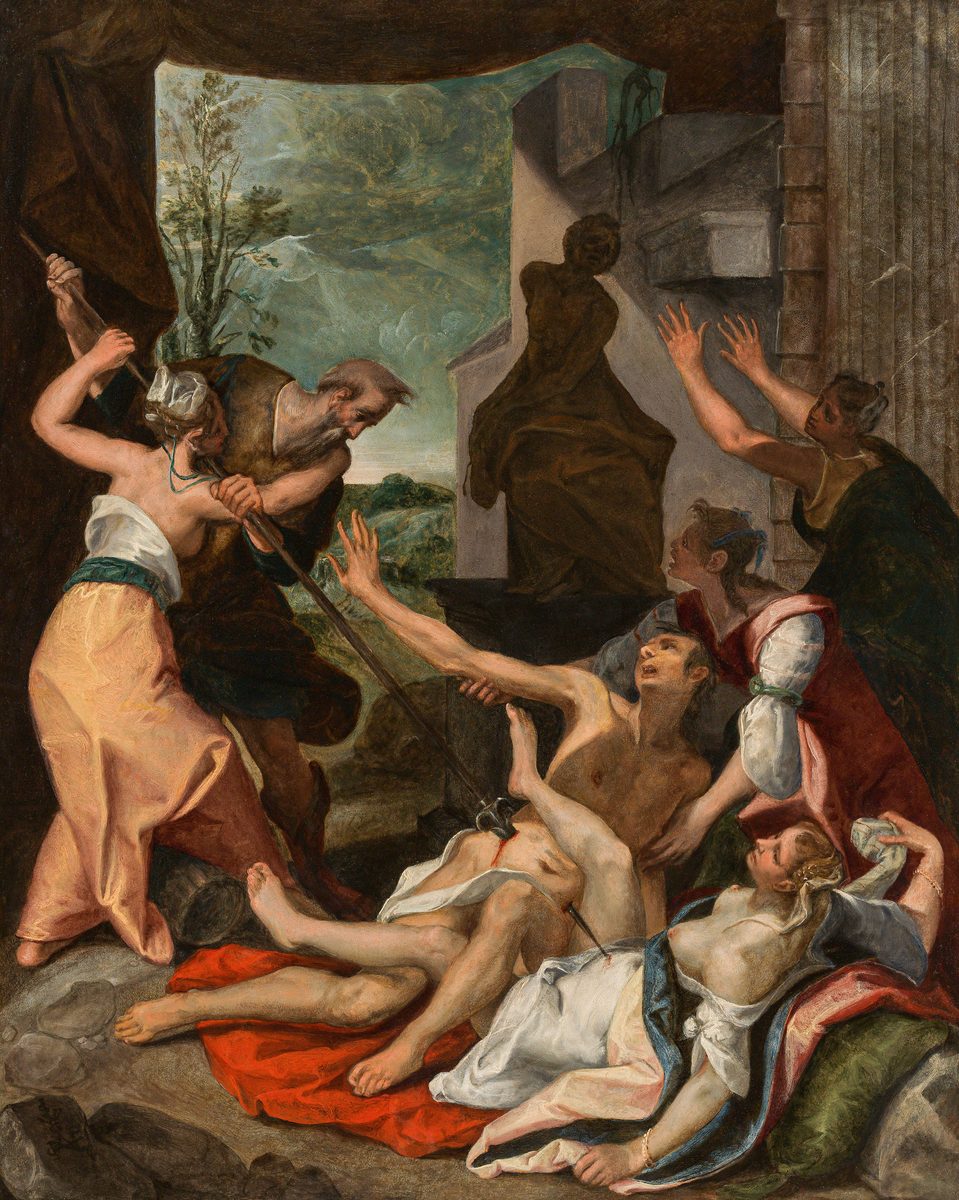
⚠ Look at what the painter has decided. Verse 8 says Phinehas followed the man into the qubbah — a word nobody can define — and van Winghe has answered the question by putting the killing at the SHRINE: the dark seated statue on its plinth, at the centre right, is the idol, and the column beside it makes the setting architecture rather than canvas. ⭐ That is one of the four guesses the shelf makes about the room, and it is not the one the Douay-Rheims made, which read it as a brothel. Neither is in the Hebrew. The painting is an interpretation of an untranslatable noun, and it is worth seeing it as that. ⚠ Two details are faithful to the text: both bodies are pierced together, which is what v8 specifies, and the spear is a long two-handed shaft rather than a priestly implement. One is not: the chapter has the congregation WEEPING at the entrance of the tent of meeting, and the onlookers here are alarmed, not mourning.

Numbers 25:1-5 — Israel YOKES itself to Baal-peor, and a rare verb for what is done to the bodies
⭐ Two chapters planted this place and here it detonates. Numbers 23:28 put Balak and Balaam on the top of Peor as a lookout with a view, and this translation said at the time that the mountain was a fuse. This is the explosion: not a curse delivered from outside, but Israel walking into the shrine on its own feet. ⚠ Balaam is not in this chapter — his name appears nowhere in it — and the book waits until Numbers 31:16 to say the advice was his. Read on its own terms, chapter 25 is what happened; the attribution is a later verse’s claim about why.
⭐ ‘Israel YOKED itself’ (v3) — the verb is built on the word for a pair of plough oxen. Tsamad is cognate with tsemed, the yoke or team — the noun behind Elisha ploughing with twelve tsemed of oxen and Job’s five hundred. Searched across the archived text, the VERB in this sense stands in this chapter (vv3, 5) and in Psalm 106:28, which is a retelling of this very episode. ⚠ The shelf is not unanimous here, and the outliers are the interesting part. Most of it reads a joining — KJV and ASV ‘joined himself’, NWT 1984 ‘attached itself’, TNM 1987 «se apegó», RV 1909 «allegóse». But Geneva prints ‘coupled himself’, which is the closest anyone gets to the harness; the RV60 revised its own ancestor’s word away to «acudió», went over to; the NVI supplies a noun the Hebrew does not have («unirse al CULTO»); and the Douay, from the Vulgate, reads something else entirely — Israel ‘was INITIATED’ to Beelphegor, which makes it a rite of admission rather than a coupling. Mister prints ‘yoked itself’, because the image is not affection but harness: a nation put its neck in a collar behind a local god, the way you hitch an animal to a plough it cannot leave.
⚠ What God orders in v4 is done in a verb that stands in exactly two verses of the Bible. Hoqa is rare enough that its precise sense is unrecoverable — hang, impale, expose, dismember are all defended — and the shelf shows the spread: KJV, ASV and Geneva ‘hang them up’, the Douay ‘on gibbets’, NWT 1984 ‘expose them’, NIV ‘kill them and expose them’, TLB ‘execute… hang them up’, the Spanish shelf «ahórcalos» (RV 1909, RV60, NVI). ⭐ The other verse settles the sense better than any lexicon: 2 Samuel 21:6 has the Gibeonites ask for seven of Saul’s sons to be hoqa’d ‘to Jehovah’, and v9 shows what it looked like — bodies left in public on a hill until the rain came and the famine broke. Same rare verb, same phrase ‘to Jehovah’, same logic of a national disaster ended by an exposed corpse.
⚠ And then Moses does not do what he was told. God says take all the HEADS of the people and hang them up; Moses tells the judges each to kill his own men who yoked themselves to Baal-peor. Those are different orders — the first executes the leadership, the second executes the guilty — and the text never reconciles them or reports either being carried out. What actually stops the plague is neither: it is one man with a spear, four verses later.
Numbers 25:6-9 — The chamber and the belly: two rare words, one of them found nowhere else
⭐⭐ Verse 8 contains two rare nouns that sound alike, and the likeness is almost certainly the point. Phinehas follows the man into the qubbah and runs the woman through her qevah. Qevatah, ‘her belly’, occurs in exactly one verse of the Hebrew Bible — this one. And a consonantal search for qubbah returns just one other verse, Deuteronomy 18:3, where the identical letters spell the MAW — the animal’s stomach, listed as a priest’s portion. ⚠ So the chamber and the belly are near-homonyms, and the verse runs one straight into the other. ⭐ No version can carry it, and the attempts are worth reading side by side: KJV and Geneva ‘into the tent’, ASV ‘into the pavilion’, NWT 1984 ‘the vaulted tent’ and TNM 1987 «la tienda abovedada», NIV and TLB simply ‘the tent’, the Spanish shelf «la tienda» (RV 1909, RV60). ⚠ And the Douay, following the Vulgate, reads it as a BROTHEL — which is an interpretation of the room rather than a translation of the word, and tells you what the Latin tradition assumed was happening inside it.
The weapon is a soldier’s. A romach is the thrusting spear of infantry — it turns up in armouries and musters through Chronicles and Nehemiah, never in a priestly inventory. The grandson of Aaron rises from the middle of a weeping congregation and picks up a piece of military equipment.
⚠ The count does not match the New Testament’s. V9 says twenty-four thousand died; 1 Corinthians 10:8, retelling this episode as a warning, says twenty-three thousand. This translation prints the Hebrew’s number and does not reconcile the two. ⚠ One of the standard harmonisations is not a guess about what Paul wrote: his sentence really does say mia hēmera, in ONE DAY, which the Hebrew’s total does not. What remains a guess is whether that accounts for the gap — as is the other suggestion, that the extra thousand were the leaders of v4. The honest report is that the figures differ and that Paul’s adds a time-limit the Hebrew does not have.
⚠ A note on what this chapter does NOT say. The text gives no dialogue for Zimri or Cozbi, no account of what was happening in the chamber, and no legal process. It reports an act and its effect. ⭐ The Bible itself is not finished with the question: Psalm 106:30-31 praises Phinehas in the language of Genesis 15:6 — it was ‘reckoned to him as righteousness’, the phrase used of Abraham’s faith — while the same Psalm calls what he did an intervention, not a war. This translation reports the act plainly, and flags below what has been built on it.
Numbers 25:10-13 — ‘My covenant, peace’ — a strange construct, a broken letter, and a verse with a violent afterlife
⭐ One word does the work of the whole speech, and it is the same word for God and for the man. Qin’ah is zeal and jealousy at once — the burning refusal to share what is yours. V11 says Phinehas was zealous with MY zeal, a cognate accusative the ASV keeps exactly (‘jealous with my jealousy’) where KJV softens it to ‘zealous for my sake’ and the NWT 1984 and TNM 1987 reach for a different idea entirely (‘tolerating no rivalry’, «no toleró ninguna rivalidad»). ⚠ The verse says the killing STOPPED the killing: God did not finish off Israel in his own qin’ah because one man exercised it first. That is the chapter’s logic, stated by the text about itself.
⭐ The Hebrew of v12 is not ‘my covenant of peace’. It reads beriti shalom — ‘my covenant, peace’ — two nouns set side by side without the construct that would bind them. Most of the shelf smooths it (KJV, ASV, Geneva ‘my covenant of peace’; RV 1909 and RV60 «mi pacto de paz»; NIV, NVI, NWT 1984 likewise), and the Douay alone inverts it into ‘the peace of my covenant’. Mister prints the two nouns as they stand, because the sentence is abrupt in Hebrew and the abruptness is the last thing a reader should be protected from here.
⭐ And the scribes marked this word. In the Masoretic manuscript tradition the vav of shalom in v12 is written BROKEN — a deliberate scribal peculiarity, one of a small set of such marks in the Hebrew Bible, preserved by copyists for centuries. ⚠ It is a feature of the manuscripts rather than of the consonantal text, so it does not appear in the edition printed on this page, and no translation can show it. What the tradition made of it is not recorded with it; the rabbinic readings that a peace won by a spear is a broken peace are later interpretation, not part of the mark. The mark itself is simply the oldest surviving evidence that readers found this verse difficult.
⚠ This verse has a documented violent afterlife, and the honest thing is to name it. The Greek word for zeal, zēlōtēs, is where the ZEALOTS of the first century AD took their name, and Phinehas is the model the sources cite for them; 1 Maccabees 2:26 has Mattathias killing a Jew at an altar and explicitly compares himself to Phinehas. In later Jewish law the case was hedged so tightly as to be almost inoperable — the Talmud rules that a zealot who asks a court whether he may act is told no, and that had Zimri killed Phinehas first he would not have been guilty of murder. ⭐ That hedging is itself the tradition’s verdict: the text rewards the act and the law that grew out of the text made sure nobody could plan one. This translation neither softens the reward nor recommends it, and reports both halves.
Numbers 25:14-15 — The names arrive after the deaths, and one of them means a lie
⭐ The chapter kills two people anonymously and then, six verses later, tells you who they were. The order is deliberate and it changes the scene retroactively: not a nameless couple caught in a tent, but Zimri son of Salu, a chief of a father’s house among the Simeonites, and Cozbi daughter of Zur, whose father was head of a father’s house in Midian. Two people from the top of two peoples. ⚠ What looked like a private act was a public one between houses, which is why the last three verses of the chapter are about foreign policy.
⭐ And her name reads as a word. Kozbi shares its consonants with kazav, to LIE or deceive — the root behind ‘a false witness’ in Proverbs and behind Delilah’s accusation that Samson had lied to her (Judges 16:10, 13). ⚠ Whether the name is Midianite and the resemblance accidental, or whether the narrator is making a point, cannot be settled — but v18 sits four verses later and says the Midianites beguiled you with their wiles, and it is hard to read the two together without hearing it. No version can print the sound; the whole shelf transliterates the name (KJV, ASV, Geneva, NIV, NWT 1984, and the Spanish shelf’s «Cozbi» in RV 1909 and RV60), which is the right call and costs the joke.
⚠ The Masoretic paragraph breaks fall in two places — after v9 and after v15 — and the weekly synagogue portion Pinchas begins at v10, in the middle of the chapter. So the tradition cuts this text between the plague and the reward, which means the man’s name is read out at the start of a portion and the killing belongs to the one before.
Numbers 25:16-18 — The order that becomes Numbers 31, and the bill for a hilltop
The chapter ends by turning a religious disaster into a military order. Harass the Midianites and strike them — tsaror and hikkitem — and the reason given is not the idolatry of vv1-3 but the wiles of v18. ⚠ Note who is named as the enemy: the women of v1 were MOABITE, and the war is declared on MIDIAN. The chapter has slid from one people to the other without explaining it, and only the woman of v6 was ever called a Midianite.
⭐ This is the order that Numbers 31 carries out, and it is where Balaam’s bill comes due. That chapter kills the five kings of Midian and Balaam with them (31:8), and states at 31:16 that these women acted by the counsel of Balaam — the advice he volunteered at 24:14 and whose content that chapter pointedly did not record. ⚠ So the Balaam cycle ends here rather than at his exit. He blessed Israel four times and could not curse it; what finally worked was not a curse at all, and the book files it under his name three chapters after he went home.
⚠ ‘Their sister’ (v18) is doing something. Cozbi is called the Midianites’ SISTER, not their daughter or their woman — a kinship word that makes the whole nation her relative and therefore liable. It is the sentence that converts a personal killing into a casus belli, and it is the last thing the chapter says.
Notes on this translation
Decisions. Hebrew and English agree on 18 verses. ⚠ Three renderings are flagged where they occur. ‘Yoked itself’ for tsamad at vv3 and 5, against a shelf that unanimously reads a joining — the verb is built on the noun for a pair of plough oxen, and harness is the image. ‘My covenant, peace’ at v12, two nouns side by side without the construct that would bind them, where all but the Douay smooth it to ‘my covenant of peace’. And ‘the chamber’ at v8 for a word whose sense is unrecoverable, with the shelf’s four guesses in the note. Hoqa at v4 is printed as the majority’s ‘hang them up’ and said here to be uncertain; the parallel at 2 Samuel 21 does more to fix its sense than any lexicon. ⭐ The chapter carries two Masoretic paragraph breaks, after v9 and after v15 — and the weekly portion Pinchas begins at v10, cutting between the killing and the reward.
Library. Four new dictionary entries in both languages: qubbah, the chamber that is a near-homonym of a belly; tsamad, to be yoked; hoqa, the rare verb for what is done to the bodies, standing in two verses; and zanah. Qanna was extended with this chapter. ⚠ It nearly got the wrong entry: an existing qinah slug is the LAMENT-word (a different Hebrew word, qinah not qin’ah), and the first draft of this chapter linked v11’s zeal to a dirge. The correction turned out to be the better note — the adjective qanna is used in the Hebrew Bible only of God, and this chapter is where the noun and the verb are applied to a man acting on his behalf. Five new encyclopedia entries: Shittim, Phinehas, Baal-peor, Zimri and Cozbi, with Peor and Midian gaining this chapter’s references.
Echoes paid — four. Numbers 23:28 put Balaam on the top of Peor and this translation called the mountain a fuse; this is where it burns. Numbers 24:14’s unrecorded advice is what v18’s ‘wiles’ turn out to be, according to a verse six chapters later. Numbers 22:4 put Midian in the room at the very start of the Balaam story, before there was any reason for them to be there; vv16-18 are the reason. And the Peor entry, written two chapters ago as ‘simply a mountain with a view’, now carries what it became.
Patterns worth carrying forward. First: the letter-search noise was the finding again, for the third chapter running. Searching qubbah returns one other verse, and it is a butcher’s term for a stomach — which is what proves the near-homonym with the qevah pierced in the same sentence. Second, and a correction to how this project has been reading the Balaam cycle: the man is not in this chapter at all. His name does not appear; the connection is made by Numbers 31:16, six chapters later, and every retelling since has read it back into a text that does not contain it. Reporting the seam is more honest than closing it. Third: a verse can have a reception history violent enough to need naming, and the naming belongs in the note with its sources, not in an adjective attached to the translation.
Echoes planted. Numbers 26 (now on these pages), the second census, which counts a generation that has just lost twenty-four thousand and finds Simeon — Zimri’s tribe — the most reduced of the twelve; Numbers 31 (not yet), which carries out v17’s order and kills Balaam in the doing of it; and Psalm 106:28-31 (not yet), the retelling that uses this chapter’s own yoke-verb and then says the act was reckoned to Phinehas as righteousness, in the phrase Genesis 15:6 used of Abraham’s faith.
⚠ A note on order: Numbers stands on these pages at chapters 1, 2, 3, 4, 5, 6, 7, 8, 9, 10, 11, 12, 13, 14, 15, 16, 17, 18, 19, 20, 21, 22, 23, 24, 25, 26, 27, 28, 29, 30, 31, 32, 33, and now 34. Chapters 35–36 remain the open sequence.