Numbers 24 — The Mister Translation
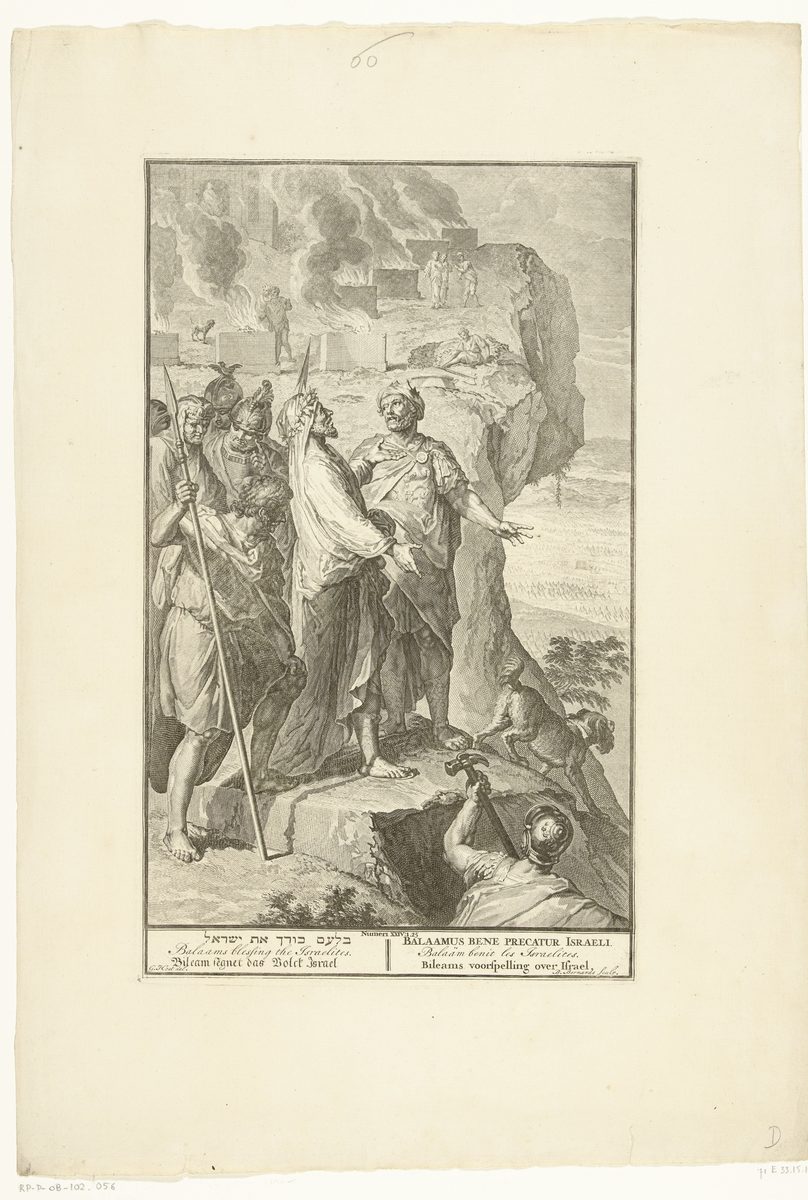
⭐ This engraving tells you which chapter it thinks it is illustrating, which is rarer than it sounds. The caption panel beneath the image carries a chapter citation — Numbers XXIV — alongside the same title in six languages: Hebrew, Latin, English, French, German and Dutch. ⚠ That mattered here: on the picture alone the natural guess is the previous chapter, because the smoking altars on the slope behind are Numbers 23’s apparatus, seven of them built three times over. The plate itself overrules the guess. What settles it is the plain below: the long regular rows of tents are what 24:2 describes, Israel ‘dwelling tribe by tribe’, and they are the thing the next verse calls good. ⭐ The two gestures are the chapter’s argument. Balak, armoured and crowned, points DOWN at the camp — a curse is a matter of aim, and he has moved his prophet three times to improve the angle. Balaam points UP. ⚠ One thing is the engraver’s invention: chapter 24 opens by saying Balaam stopped going off to meet omens, so the altars burning behind him belong to the method he has just abandoned.
,_RP-P-OB-102.056.jpg)
who sees the vision of the Almighty,
falling down, and with eyes uncovered:note
que ve la visión del Todopoderoso,
cayendo, y con los ojos descubiertos:
your dwellings, Israel!note
tus moradas, Israel!
like gardens beside a river,
like aloes Jehovah has planted,
like cedars beside waters.note
como huertos junto a un río,
como áloes que Jehová ha plantado,
como cedros junto a las aguas.
and his seed is in many waters.
His king shall be higher than Agag,
and his kingdom lifted up.note
y su simiente está en muchas aguas.
Su rey será más alto que Agag,
y su reino será enaltecido.
the soaring horns of a wild ox are his.
He shall devour the nations, his foes,
and gnaw their bones,
and shatter them with his arrows.note
suyos son los cuernos alzados del toro salvaje.
Devorará a las naciones, sus adversarios,
y roerá sus huesos,
y los destrozará con sus flechas.
The utterance of Balaam son of Beor,
and the utterance of the man whose eye is unsealed;note
Declaración de Balaam hijo de Beor,
y declaración del hombre de ojo desellado;
and knows the knowledge of the Most High,
who sees the vision of the Almighty,
falling down, and with eyes uncovered:note
y conoce el conocimiento del Altísimo,
que ve la visión del Todopoderoso,
cayendo, y con los ojos descubiertos:
and destroy the survivor from the city.note
y destruya al superviviente de la ciudad.
how long until Asshur takes you captive?note
¿hasta cuándo, hasta que Asur te lleve cautivo?
Alas — who shall live when God does this?note
¡Ay! ¿quién vivirá cuando Dios haga esto?
and they shall afflict Asshur, and afflict Eber,
and he too shall come to destruction.note
y afligirán a Asur, y afligirán a Éber,
y también él vendrá a destrucción.
Numbers 24:1-4 — The diviner stops divining, and a man whose eye is either wide open or sealed shut
⭐ The first line of this chapter is the last chapter’s note coming due. At Numbers 23:23 Balaam declared that there is no nachash in Jacob. Here the narrator says he stopped going, as time after time before, toward nechashim — the plural of that same noun. The man denied the practice in an oracle and then abandoned it in a narrative sentence, and the order matters: the denial came first. The shelf keeps the word: KJV and ASV ‘enchantments’, Geneva the same, Douay and NIV ‘divination’, RV 1909 and RV60 «agüeros», NVI «hechicería», and the NWT 1984 and TNM 1987 both press it toward luck (‘unlucky omens’, «agüeros de mala suerte»). ⚠ The TLB is the one version that drops the omens altogether and has him simply not going to meet God as before — which loses the whole point of the sentence, since what he gave up was a technique.
⭐⭐ ‘The man whose eye is unsealed’ (v3) is two Hebrew words, and the shelf reads them in OPPOSITE directions. Shetum ha-ayin stands in exactly two verses of the Hebrew Bible — v3 and v15 of this chapter, where Balaam introduces himself in words that are otherwise identical letter for letter. Nobody knows what shetum means. Three readings are on the shelf at once: OPEN — KJV ‘whose eyes are open’, RV 1909 and RV60 «de ojos abiertos», TLB ‘whose eyes are open’; SHUT — ASV ‘whose eye was closed’, Geneva ‘whose eyes were shut up’, Douay ‘whose eye is stopped up’; and a state that has CHANGED — the NWT 1984 ‘with the eye unsealed’ and TNM 1987 «con ojo ya no sellado», with the NIV (‘whose eye sees clearly’) and NVI («clarividente») nearby. ⚠ Mister prints ‘unsealed’, with the third group, for a reason inside the passage rather than outside it: v4 ends gelui einayim, with the eyes UNCOVERED, and Numbers 22:31 had Jehovah uncover those same eyes so he could see the angel his donkey had seen three times. A man whose eyes were opened for him two chapters ago is the likeliest referent of a word that means something happened to his eye.
And this is the first time the spirit of God is said to come upon him (v2). Twice before he was handed a word to carry; here ruach Elohim comes on him and there are no altars in the sentence at all. ⚠ The seven altars, the bulls and the rams do not appear again in the chapter. Whatever the machinery was for, it has been dispensed with.
Numbers 24:5-9 — ‘How good are your tents’ — and the word one verse later that is spelled the same
⭐ The best-known line a pagan diviner ever spoke opens the Jewish morning service. Mah tovu ohalekha Ya’aqov — how good are your tents, Jacob — is the first sentence recited on entering a synagogue, and it was said by a man on a hilltop who had been paid to curse the tents he is looking at. ⚠ It is tempting to say that on the most quoted verse in the chapter there is nothing to arbitrate. There is. The adjective splits three ways — ‘goodly’ (KJV, ASV, Geneva), ‘beautiful’ (Douay, NIV, and the whole Spanish shelf’s «hermosas»), and the NWT 1984’s ‘good-looking’. ⭐ More than that: the Douay SWAPS the two nouns, giving Jacob the tabernacles and Israel the tents, where the Hebrew gives Jacob the tents and Israel the dwellings — and the TLB abandons the image altogether, printing joys and homes and no tents at all. On the one line everybody knows by heart, three of the versions are doing something the others are not.
⭐⭐ Then v6 uses the same consonants again, and this time they mean something else — or do not. V5’s ohalekha is ‘your TENTS’. V6’s ka-ahalim is the identical consonantal stem, and everywhere else in the Bible that spelling means tents — except in a perfume list (Proverbs 7:17), where it is the aromatic ALOE. ⚠ Almost the whole shelf takes the second one as the plant: KJV ‘lign aloes’, ASV ‘lign-aloes’, Geneva ‘aloe trees’, NIV and NVI ‘aloes’, RV 1909 «lináloes», RV60 «áloes», NWT 1984 and TNM 1987 the same. ⭐ The Douay alone, following the Vulgate, reads TENTS — ‘as tabernacles which the Lord hath pitched’ — which keeps v5’s word running into v6 and gives up the botany. Each side pays for the other: ‘planted’ and ‘cedars beside waters’ want a tree, and the line before wants tents. Mister prints aloes and flags the pun here, because a Hebrew reader gets both and an English reader can only be given one.
⚠ ‘Higher than Agag’ (v7) points at the same chapter this translation was pointing at one chapter ago. Agag is the Amalekite king Saul spares in 1 Samuel 15 — and 1 Samuel 15 is where Numbers 23:19’s note had to go, because it is the chapter that argues God does not relent while saying twice that he did. Two of this cycle’s oracles reach forward into one chapter of Samuel, for two unrelated reasons.
The third oracle recycles the second on purpose. The wild ox of 23:22 returns in v8 in almost the same words, and the lion and lioness of 23:24 return in v9 — but reversed, lion first this time, and now Genesis 49:9’s pair is quoted with its own verb, couched. ⭐ And v9 ends by quoting Isaac. ‘Blessed are those who bless you, and cursed are those who curse you’ is the closing line of the blessing Jacob stole in Genesis 27:29 — where the order is the other way round, cursed first and blessed last. Balaam inverts it so the sentence ENDS on the curse. He is being paid for a curse, and it is the last word he gets to say before Balak stops him.
Numbers 24:10-14 — Balak claps his hands, and makes the donkey’s complaint
⭐ Balak’s outburst is the she-ass’s speech with a different noun in it. At Numbers 22:28 the donkey asked what she had done that he had struck her zeh shalosh regalim, these three times. Here the king says he called Balaam to hex his enemies and been blessed instead zeh shalosh pe’amim, these three times. Same accusation, same counting-frame, different word for a ‘time’ — and the donkey’s was the pilgrimage word. The only other narrative that counts to three this way is Delilah telling Samson he has mocked her three times (Judges 16:15). ⚠ Nothing in the Hebrew nudges the reader toward the parallel; it is there or it is not, and no version can print it either way.
The gesture is worth a beat. Va-yispoq et-kappav — he struck his palms together. The shelf hears it as fury (KJV ‘he smote his hands together’, ASV the same, NWT 1984 ‘he clapped his hands’), which in Hebrew is a gesture of rage or grief rather than applause — though a reader in English has to be told, because we clap for the opposite reason.
⚠ V13 is a quotation of himself, and the changes are the point. Balaam repeats the silver-and-gold speech he made to the first embassy at 22:18, and a word-by-word comparison shows three differences, none of them decorative. He drops ‘my God’ — to Balak’s servants he said he could not cross the mouth of Jehovah MY GOD; to Balak’s face he says only Jehovah. He swaps the pair: ‘anything small or great’ becomes ‘good or bad’, which moves the limit from SIZE to MORALITY. And he adds two clauses — out of my own heart, and what Jehovah speaks, that I will speak. ⭐ Put together they are a narrowing: the first version claimed he could do nothing at all on his own; this one concedes he has a heart with preferences in it, and pleads only that he cannot act on them. ⭐ And then he volunteers something nobody asked for — let me advise you — which is the hinge the rest of the Bible hangs on him: Numbers 31:16 says the advice he eventually gave is what ruined Israel at Peor. The chapter records the offer and not its content.
Numbers 24:15-19 — A star out of Jacob: the verse that named a revolt and a scepter the shelf cannot place
⭐⭐ ‘A star steps forth from Jacob, and a sceptre rises from Israel’ (v17) is the most consequential sentence Balaam speaks, and its consequences are documentable. In the second Jewish revolt against Rome (132–135 AD) the leader Simon ben Kosiba was called Bar Kokhba, ‘son of the star’, from this verse; Rabbi Akiva is reported as having applied it to him. The Dead Sea community cited the verse too. ⚠ The two nouns are ordinary: kokhav is a star, and shevet is the rod that is also the word for a TRIBE — the same noun Numbers 17 spent a chapter on, when twelve chieftains each held a rod with a tribe’s name on it. The Douay and Geneva both capitalise the Star, and the RV 1909 and RV60 print «ESTRELLA» in capitals — four versions marking a reading rather than translating a word.
⚠ The second half of v17 is broken and every version repairs it differently. Qarqar is a word of uncertain meaning, and benei Sheth can be a proper name or a common noun. So the shelf divides: KJV and Geneva read ‘the corners of Moab’ and ‘the children of Sheth’, taking both as names; ASV keeps ‘corners’ but turns the second into ‘the sons of tumult’; the NWT 1984 and TNM 1987 go furthest, reading ‘the temples of Moab’s head’ and ‘the sons of tumult of war’; NIV has ‘the foreheads of Moab’, and the Spanish shelf splits against itself — RV 1909 «los cantones» where RV60 and NVI read «las sienes», the temples of the head. Mister prints ‘the temples of Moab’ and ‘the sons of Sheth’ and says here that the first is a guess and the second may not be a name at all.
⚠ And notice who is being crushed. The oracle is delivered to the king of Moab, in Moab, and v17 says the star will crush the temples of MOAB. Balak asked for a prophecy about Israel and is given one about himself; v14’s promise was to say what Israel would do to your people, and this is Balaam keeping it.
Numbers 24:20-25 — Three short oracles, a pun no version can print, and a man who goes home
Amalek, ‘first of nations’ (v20), is not a claim about chronology. Reshit goyim most likely means first in rank or first to attack — and Amalek was the first nation to fight Israel after the exodus (Exodus 17). The TLB renders the sentence as a destiny rather than a history (‘its destiny is destruction’), which is the right instinct about a line that is a verdict, not a census.
⭐⭐ Verse 21 contains a pun that not one version on either shelf can print. Balaam looks at the Kenite — ha-Qeini — and says his nest is set in the crag: qinnekha. The people’s name and the word for the nest are the same two consonants. Every version keeps both and the joke evaporates in the gap between them (KJV ‘Kenites… thy nest’, ASV, Geneva, Douay ‘Cinite’, RV 1909 «Cineo… tu nido», RV60 «ceneo», NVI and TNM 1987 «quenita»). ⚠ And v22 doubles it: the nation is called Kain, which is the name of Cain. This translation prints all three plainly and puts the sound here, which is the only place it can go.
The last oracle is the strangest and the shortest (vv23-24). Ships from Kittim — Cyprus, and later a general word for a sea power from the west — afflicting Asshur and Eber. ⚠ The TLB simply prints ‘Cyprus’, deciding for its reader what every other version leaves as a name. It is a prophecy with no named agent and no date, delivered by a man on his way out the door.
⭐ And then he goes home, which is the problem. V25 has Balaam rise, go, and return to his place, and Balak go his way — two men parting with nothing settled and no violence. ⚠ Numbers 31:8 says he was killed with the sword among the kings of Midian, and 31:16 says the ruin of Israel at Peor happened by his advice. Both cannot be the last thing that happened to him in the order the book gives them; the seam is real, and this translation shows it rather than smoothing it. The petuchah after v25 is the only Masoretic paragraph break in the whole chapter — Numbers 23 had none at all in thirty verses — and it closes the Balaam cycle rather than dividing it.
Notes on this translation
Decisions. Hebrew and English agree on 25 verses. ⚠ The rendering to flag is ‘whose eye is unsealed’ at vv3 and 15, where the shelf holds three incompatible readings of the same two words and two of them are exact opposites — open (KJV, TLB, both Reina-Valeras) against shut (ASV, Geneva, Douay). This translation takes the third reading, a state that has changed, on the internal evidence of v4 and of Numbers 22:31. ⚠ Also flagged where they occur: ‘aloes’ at v6, which is the same consonantal word as ‘tents’ one line earlier and which the Douay alone reads as tents; ‘the temples of Moab’ and ‘the sons of Sheth’ at v17, both uncertain, the first a guess and the second possibly not a name; and ‘Kain’ at v22, kept as the name it is. Continuing renderings: qabab is ‘hex’ at v10 as in Numbers 22 and 23; mashal is ‘oracle’; the wild ox and the lioness keep the renderings the last chapter argued for. ⭐ The chapter carries exactly one Masoretic paragraph break, a petuchah after the last verse — so the scribes marked the end of the whole Balaam cycle and nothing inside it. Numbers 23 had none at all.
Library. Five new dictionary entries in both languages: shetum, the word nobody can construe, standing in two verses that are otherwise identical; ne’um, the prophetic utterance-formula, which this chapter uses six times before it is ever used of an Israelite prophet; ahalim, aloes-or-tents; kokhav, the star that named a revolt; and qen, the nest that puns on the Kenite’s name. Five existing entries were rewritten — nachash, mashal, reem, lavi and shevet — each given something this chapter supplies and the entry could not have had before. Three new encyclopedia entries: Agag, the Kenites and Kittim, with Amalek and Edom gaining this chapter’s references. ⚠ A fourth was drafted for SEIR and deleted before it shipped: the existing Edom entry is already titled ‘Edom (Seir)’ and carries Seir among its aliases, so a separate entry would have put two atlas pins twenty kilometres apart on one place. It was extended instead.
Echoes paid — six. Numbers 23 planted this chapter as the one where Balaam gives up omens, and v1 is that sentence, using the plural of the very noun he had denied of Israel at 23:23. The wild ox of 23:22 returns at v8 and the lion pair of 23:24 at v9, reversed. Numbers 22:31’s uncovering of his eyes is the best evidence for what shetum means. Numbers 22:28’s donkey counting ‘these three times’ is the frame Balak fills at v10 with a different noun. Numbers 22:18’s silver-and-gold speech is quoted back at v13 with one clause added. And Numbers 17’s rod-that-means-tribe is the shevet that rises out of Israel at v17.
Patterns worth carrying forward. First: this chapter is the third running in which the best finding was a pair of words a translation must split and Hebrew does not — efer/afar, then the serpent and the bronze, now tents and aloes one verse apart, and the Kenite and his nest. Second, and learned the hard way in this chapter’s own review: ‘every version agrees here’ is an absolute like any other and has to be checked like one. This chnote first claimed there was nothing to arbitrate at v5, the best-known line in the chapter — and a proper look found the adjective splitting three ways, the Douay-Rheims swapping the two nouns, and the Living Bible dropping the tents entirely. An apparent unanimity is the easiest claim in this project to make and the least likely to have been tested. Third, and specific to Balaam: he has now given up his technique, been given the spirit, and quoted Isaac; the book has spent three chapters making a foreign diviner sound like a patriarch, and two chapters later it will kill him.
Echoes planted. Numbers 25 (now on these pages), where Israel does at Peor what Balaam could not do to it from a hilltop, and the mountain named in Numbers 23:28 becomes the name of the disaster; Numbers 31:8 and 31:16 (not yet), which kill Balaam with the sword and lay Peor at his advice, against this chapter’s quiet last verse; and 1 Samuel 15 (not yet), the Agag chapter, which this cycle has now reached twice by two different roads.
⚠ A note on order: Numbers stands on these pages at chapters 1, 2, 3, 4, 5, 6, 7, 8, 9, 10, 11, 12, 13, 14, 15, 16, 17, 18, 19, 20, 21, 22, 23, 24, 25, 26, 27, 28, 29, 30, 31, 32, 33, and now 34. Chapters 35–36 remain the open sequence.