Numbers 36 — The Mister Translation
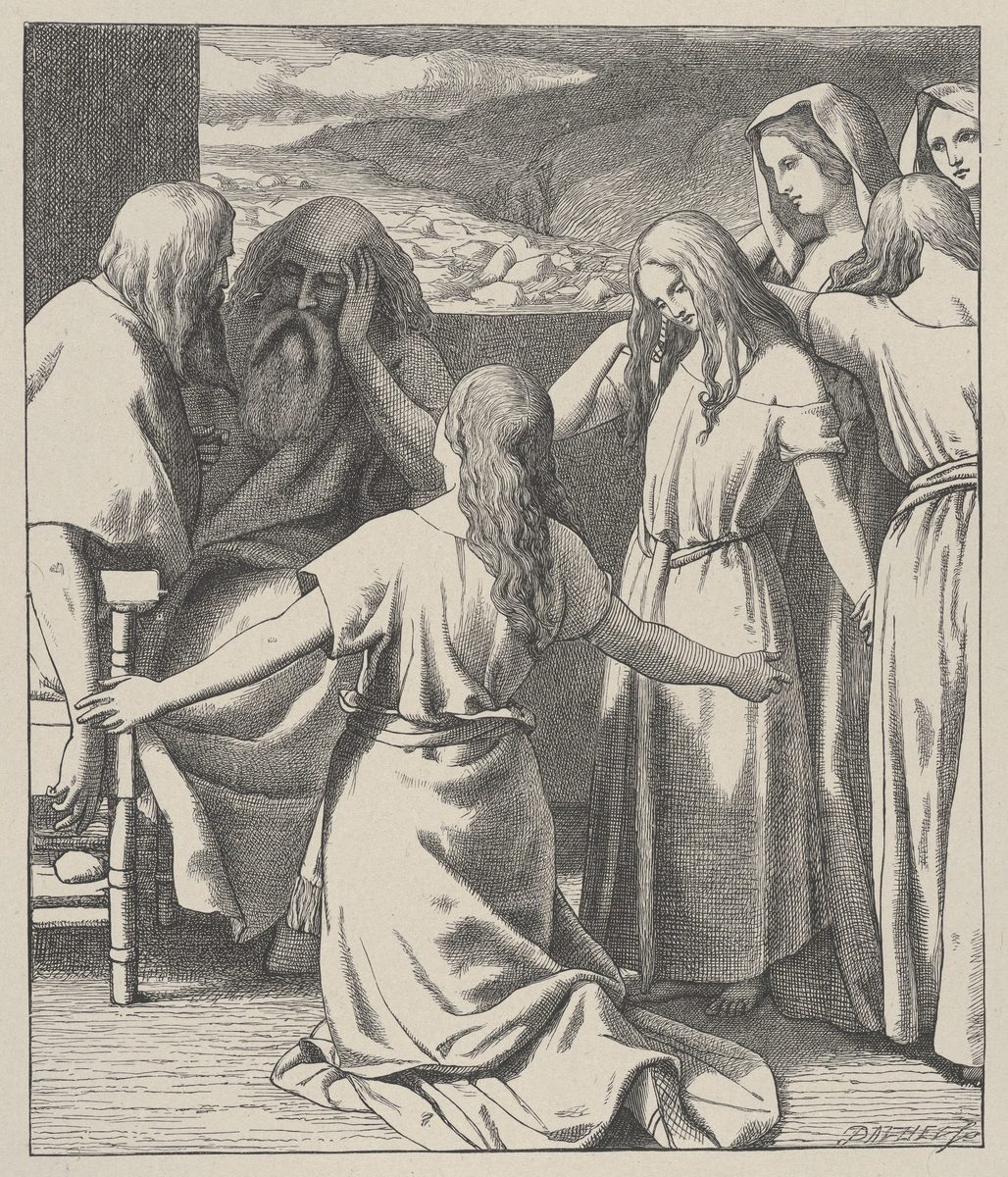
⭐ The engraver has caught the moment before the answer, and the answer is what this chapter is an appeal against. The scene is Numbers 27 — the five sisters drawing near to ask for their dead father’s share — and Moses is drawn with his hand at his brow, which is exactly right: the verse that follows says he brought their case before Jehovah, because he had no ruling to give them. Numbers 36 is the counter-petition and the marriages that settle it, so this is the picture the last chapter of the book is arguing about.
_MET_DP835633.jpg)
Numbers 36:1-4 — ‘Subtracted’: the third petition in the book of Numbers, and the one verb all three of them share
The winners of Numbers 27 are being appealed against, and the appellants open with the same word the chapter they are appealing opens with. Nine chapters ago the daughters of Zelophehad drew near — va-tiqravnah — and asked for their dead father’s share. Here the men of their own clan draw near, va-yiqrevu, the identical verb in the masculine, and ask what happens to that share when the women marry. The chapter is built as a mirror of the one it answers, and it starts mirroring in its first word. ⚠ The feminine form of that verb, va-tiqravnah, stands in exactly two verses of the whole Hebrew Bible, and both of them are these sisters: Numbers 27:1, where they come to ask, and Joshua 17:4 (not yet on these pages), where they come to collect. The men get the masculine of it once, here, in between.
⚠⚠ Three times in this book somebody petitions Moses, and all three petitions use the same verb for what is being done to them: gara, to be SUBTRACTED. At Numbers 9:7 men who had touched a corpse ask lammah niggara — why should we be subtracted, so as not to bring Jehovah’s offering with everyone else? At Numbers 27:4 the daughters ask lammah yiggara — why should our father’s NAME be subtracted from his clan? And here at v3 the clansmen say the word twice about land: their inheritance will be subtracted from our fathers’, and from the lot of our inheritance it will be subtracted. Three grievances, one verb — a corpse-contact, a dead man’s name, a parcel of ground — and every single time Moses takes it upstairs and the petitioner wins. Nobody in Numbers who says ‘we are being subtracted’ is told they are wrong.
⚠ Not one version on either shelf uses a single word in all three places, so the thread is invisible to every reader but a Hebrew one. A script classified all thirteen witnesses at all three verses and none of them repeats itself. The ASV is the closest, and it still breaks: it reads ‘kept back’ at 9:7 and then ‘taken away’ twice; the KJV spends three different words — ‘kept back’, ‘done away’, and here ‘taken from’. The NWT 1984 goes ‘restrained’, ‘taken away’, ‘withdrawn’; the NIV ‘kept from’, ‘disappear’, ‘taken from’. On the Spanish side the RV 1909 and RV60 come nearest of the thirteen, matching themselves at the last two with «quitada», and parting company at the first. ⚠ This translation does not manage it either, and says so rather than manufacturing an echo: it prints ‘kept back’ at 9:7 and ‘taken away’ at 27:4, because the Hebrew verb spans withholding a PERSON and subtracting a QUANTITY and English has no single word that carries both without strain. What the note can do is what no version does — point at the seam.
Why ‘subtracted’ here, against the whole shelf. V3 is a ledger entry, and it states both sides of it in one breath: ve-nigre’ah … ve-nosaf, subtracted here, added there. Eight of the thirteen versions print the second half as ‘added’ and then reach for something looser for the first — NWT 1984 ‘withdrawn’, TNM 1987 «retirada», The Living Bible ‘the total area of our tribe will be reduced’. Two go the other way and reach for the arithmetic: the Douay-Rheims, following the Vulgate, calls it ‘a diminishing of our inheritance’, and the RV 1909 uses the accountant’s «desfalcada», short-changed. Printing ‘subtracted’ against ‘added’ keeps the two halves of one sum in the same vocabulary, which is what the Hebrew does.
⚠ V3 also puts both of Hebrew’s tribe-words in one verse. Shevet stands exactly once in this chapter — here, in the petitioners’ own mouths, ‘the sons of the TRIBES of the children of Israel’ — while matteh carries the other fourteen occurrences. Numbers 18:2 is where this project set the pair out, and noted that the two nouns stand together inside a single phrase only there; they do not do that here, but they do share a verse — which happens in eleven verses of the Hebrew Bible, this one among them.
⚠ The jubilee at v4 is the only time the word appears in the whole book of Numbers. Searched consonantally across all thirty-six chapters it returns one verse, this one; its home is Leviticus 25, already on these pages, where it stands thirteen times and every field goes back to the family that started with it. The clansmen’s worry is precise and it is a lawyer’s: the fiftieth-year reset that returns all land to its original holders would, in this one case, work the wrong way — it would confirm the transfer instead of undoing it, because the women would by then be the original holders. ⚠ The Douay-Rheims does not leave the reader to work that out; following the Latin it writes the definition into the verse — ‘when the jubilee, that is, the fiftieth year of remission, is come, the distribution made by the lots shall be confounded’ — and the Hebrew has neither the fiftieth year nor the confounding.
Court manners, in the grammar. V2 says the same thing twice, once active and once passive: Jehovah commanded my lord, and my lord was commanded by Jehovah. Moses is standing in front of them and they call him adoni, my lord, in the third person, twice — the register of men who know they are about to disagree with a ruling he handed down. Nine of the thirteen keep the third person; four break the frame and address him directly, and they are the four freest translations on the shelf: the NIV (‘he ordered you to give the inheritance’), the NVI («Cuando el Señor le ordenó a usted repartir por sorteo la tierra»), the Living Bible (‘The Lord instructed you to divide the land’) and the Douay-Rheims, which does it in Jacobean second person, ‘hath commanded thee, my lord, that thou shouldst divide the land’ — and so keeps the honorific and loses the distance in the same sentence.
Numbers 36:5-9 — ‘They speak rightly’: the same verdict pronounced twice, and whose eyes get to decide
⚠⚠ Moses gives these men the identical ruling he gave the daughters, in the identical words. Numbers 27:7: ken benot Tzelophchad dovrot. Numbers 36:5: ken matteh venei-Yosef dovrim. The same particle, the same participle, feminine there and masculine here, and nothing else changed. Searched across the whole Hebrew Bible, that construction — ken plus this participle, as a verdict — stands in exactly two verses, and both of them are this one case. The nearest thing to a third is Exodus 10:29, where Moses tells Pharaoh ken dibbarta, ‘you have spoken rightly’ — but that is a finished-tense verb aimed at one man, not the standing formula used here to settle a claim. Both sides of this dispute are told, in the same breath of the same book, that they are right. Neither ruling is withdrawn; the second is fitted around the first.
⚠ Five of the thirteen versions let a reader see that, and eight do not. The ASV keeps it exactly — ‘speak right’ for the women, ‘speaketh right’ for the men; so do the NWT 1984 (‘are speaking right’ / ‘is speaking right’), the NWT’s 2013 revision (‘are correct’ / ‘is correct’), the NIV (‘is right’ both times) and the TNM 1987 («están hablando rectamente» / «está hablando rectamente»). The other eight change words between the two verses and the echo dies. The KJV gives the daughters ‘speak right’ and the men ‘hath said well’; Geneva 1599 does the same thing in the same direction, ‘speak right’ then ‘have said well’, which is the Geneva-to-King-James line showing itself. The Living Bible promotes the men and demotes the women in one move: the daughters ‘are correct’, the men ‘have a proper complaint’. On the Spanish shelf the RV 1909 and RV60 both give the daughters «Bien dicen» and the men «habla rectamente», two renderings of one formula; the NVI has «es algo justo» and then «tiene razón». This translation prints ‘speak rightly’ in both places on purpose.
⚠⚠ V6 grants the women a choice and does it with a MASCULINE pronoun. La-tov be-eineiHEM — ‘to whoever is good in their eyes’ — carries the masculine plural suffix, and so does avihem, ‘their father’, four words later. That would be unremarkable if the chapter were careless about gender, and it demonstrably is not. Every suffix in these thirteen verses that points at the DAUGHTERS is feminine — nachalatan at vv3, 4 and 12, dodeihen at v11, and at v12 the very same phrase, ‘their father’, spelled avihEN. And the chapter uses the masculine correctly too, in the only other two verses that carry it: lahem at vv3 and 4, ‘the tribe to which they shall belong’, where the referent really is the men they marry. So the masculine plural suffix stands in exactly three verses of the chapter, it is right in two of them, and the third is v6 — the verse about who gets to choose. The feminine form the writer declines to use here, be-eineihen, is not a form Hebrew lacks: it stands in the Bible exactly once, at Esther 1:17, already on these pages — where it is wives looking at husbands, in the chapter about a queen who would not come when she was called. ⚠ And the daughters get the feminine suffix on that same phrase in the end: at Joshua 17:4 (not yet on these pages) the land is given them among the brothers of avihen, THEIR father, spelled the way v6 declined to spell it.
⚠ Eleven of thirteen versions delete the eyes, and the twelfth quietly settles the pronoun. Only two witnesses print the idiom at all: the NWT 1984, ‘To whom it is good in their eyes they may become wives’, and the TNM 1987 — which goes further than any other version on either shelf and makes the pronoun explicitly FEMININE, «de quien, a los ojos de ellas, les parezca bien», resolving against the consonants without saying so. Everyone else replaces the eyes with a verb of preference: ASV and KJV and Geneva 1599 ‘to whom they think best’, NIV ‘anyone they please’, Living Bible ‘anyone they like’, Douay-Rheims ‘to whom they will’, RV60 «como a ellas les plazca». English ‘their’ is genderless and can hold the question open, which is why it is kept here. ⚠ Spanish cannot hold it open, and the Spanish edition of this chapter therefore has to pick; it follows the consonantal text into the masculine and flags it, rather than deciding a live question silently in the direction a modern reader would prefer.
⚠ The rule is fenced with two verbs, and the second one is the marriage verb. Inheritance must not sabab from tribe to tribe — go around, circle, change hands in a loop — and Israelites must davaq to their fathers’ land. Davaq is the verb of Genesis 2:24, already on these pages, where a man leaves his father and mother and CLINGS to his wife; it is the word Ruth 1:14 uses of Ruth refusing to let go of Naomi. In a chapter entirely about who marries whom, the clinging that is legislated is a man to a field. Only three of the thirteen let the reader see it, because a version has to use one word in both places: the ASV (‘cleave’ here, ‘cleave unto his wife’ there), the TNM 1987 («adherirse» in both) and the RV 1909 («se allegará á la heredad» against «allegarse ha á su mujer»). The KJV gave English ‘cleave unto his wife’ and then declined to reuse it here, printing ‘shall keep himself to the inheritance’; the NWT 1984 does the mirror image, ‘cleave’ here and ‘stick to his wife’ at Genesis. For sabab, Geneva 1599 is the most literal on the English side — ‘Neither shall the inheritance go about from tribe to tribe’ — and the RV 1909 and RV60 are the most vivid anywhere, «no ande la heredad rodando de una tribu a otra», let the inheritance not go rolling around.
⚠ The Douay turns a narrow rule into a general one, and it is the Vulgate doing it. The Hebrew binds one class of person: a daughter who has inherited. The Douay-Rheims at vv7-8 legislates for everybody — ‘For all men shall marry wives of their own tribe and kindred: And all women shall take husbands of the same tribe’ — and adds a reason the Hebrew does not give, that the tribes ‘be not mingled one with another’. That is a whole marriage law for the nation, grown out of a probate rule for heiresses, and it is the kind of divergence this shelf keeps producing wherever the Douay is reading Latin rather than Hebrew.
Numbers 36:10-12 — Mahlah, Tirzah, Hoglah, Milcah and Noah: four lists of five sisters, and only this one changes the order
The five names are listed four times in the Bible and three of the lists agree. Numbers 26:33 and Numbers 27:1, both already on these pages, and Joshua 17:3 (not yet on these pages) all read Mahlah, Noah, Hoglah, Milcah, Tirzah. Here at v11 the list reads Mahlah, TIRZAH, Hoglah, Milcah, NOAH — second and fifth have traded places, and nothing in the verse remarks on it. The other three lists sit in a genealogy or a naming formula; this is the one embedded in the sentence that records the marriage itself, and it is the one that reorders them. ⚠ All thirteen versions reproduce the new order faithfully, from the KJV’s ‘Mahlah, Tirzah, and Hoglah, and Milcah, and Noah’ to the NVI’s «Majlá, Tirsá, Joglá, Milca y Noa» and the Douay-Rheims’ ‘Maala, and Thersa, and Hegla, and Melcha, and Noa’; not one of them flags the change, so a reader who does not have the earlier lists in front of them will never know a change happened. Later Jewish commentary is reported to have noticed the reordering and offered explanations for it — that one list runs by age and another by something else — but that is reported here rather than verified, and the text itself gives no reason at all.
⚠ Noah here is not the Noah of the flood, and the Hebrew is not even the same word. The daughter is No’ah, spelled with an ayin; the man who built the ark is Noach, spelled with a chet. English spells both ‘Noah’ and hands the reader a collision Hebrew never had. The same is true of her sister: Tirzah is a woman here and a royal city in the hill country of Manasseh later — her own tribe’s territory taking her name.
They marry their cousins, and the chapter says so with a family word. Livnei dodeihen — to the sons of their uncles. The NIV compresses it to ‘their cousins on their father’s side’ and the NVI to «sus primos paternos»; the ASV keeps the Hebrew’s own construction, ‘their father’s brothers’ sons’. ⚠ It is worth saying plainly that the settlement costs the women something the earlier ruling had given them: Numbers 27 gave them a share with no condition attached, and this chapter attaches one. It is also worth saying that the text records them consenting — v10 is a compliance formula, ken asu, so did they — and that what they keep is the land. V12 closes the account in the vocabulary it opened with: their inheritance remained with their father’s tribe, which is the outcome the clansmen asked for at v3 and the outcome the daughters asked for at 27:4, in the same sentence.
Numbers 36:13 — ‘By the hand of Moses’: the colophon that closes the book of Numbers, and the one word it adds to the colophon that closed Leviticus
The book ends with a signature line, and it has a twin. Leviticus 27:34, already on these pages, closed that book: elleh ha-mitzvot asher tzivah YHWH et-Moshe … be-har Sinai. Numbers closes with the same opening words and three changes: it adds a second noun, it changes one preposition, and it moves the address. Searched across the whole Hebrew Bible the phrase elleh ha-mitzvot, ‘these are the commandments’, stands in exactly those two verses — the end of Leviticus and the end of Numbers, and nowhere else.
⚠⚠ Leviticus says God commanded Moses. Numbers says God commanded BY THE HAND OF Moses. Et-Moshe is a direct object; be-yad Moshe makes him the instrument. It is a small preposition and it describes what the book has spent thirty-six chapters becoming: at Sinai Moses received law, and on the plains of Moab he is the channel it comes through — which is exactly what happens in this chapter, where Moses relays the ruling at the mouth of Jehovah (v5) and no divine speech-formula appears anywhere in the thirteen verses at all. All thirteen versions keep the ‘by the hand’ here, from the KJV’s ‘by the hand of Moses’ to the ASV’s ‘by Moses’ and the NIV’s ‘through Moses’. And twelve of the thirteen keep the contrast, printing a plain ‘commanded Moses’ back at Leviticus 27:34 — Geneva 1599 is the single exception, reading ‘which the Lord commanded by Moses’ there too and so flattening the two colophons into one.
And Numbers adds ha-mishpatim, the judgements — the word for a ruling made on a case. Leviticus ends with commandments only. This book ends with commandments AND judgements, and the reason is sitting in the chapter above it: mishpat is the very word Numbers 27:5 used when Moses brought the daughters’ CASE before Jehovah, and 27:11 used for the statute that came out of it. Numbers is the book where the law gets asked questions it has no answer for — a second Passover, a father with no sons, and now his daughters’ marriages — and its last verse names that as a category of its own. ⚠ The thirteen reach for seven different nouns and the spread is worth having: KJV and Douay-Rheims read ‘judgments’, ASV and Living Bible ‘ordinances’, Geneva 1599 ‘laws’, NIV ‘regulations’, the RV 1909 and RV60 «estatutos» and the NVI «leyes» — all of which lose the case-law sense the Hebrew has and the chapter demonstrates. The one translation family that spells out what the word is doing is the New World Translation, and it does it on both shelves and in both of its editions: the NWT 1984 and its 2013 revision read ‘judicial decisions’, the TNM 1987 and its 2019 revision «decisiones judiciales».
⚠ The verse carries a mark that stands nowhere else in Numbers. Mechon-Mamre’s source printing closes this verse with a sign it does not use for an ordinary open or closed paragraph, and which it glosses as ‘an empty line at the end of some books’. Checked across all thirty-six chapters, it appears once — here — and the same is true at the last verse of Genesis, Exodus, Leviticus and Deuteronomy. It is a note about their page layout rather than a claim this project can verify as ancient practice, and Leviticus 27:34’s note said as much; but the placement holds, five books and five marks. ⚠ The chapter is otherwise one unbroken Masoretic unit — not a single paragraph break inside it, where Numbers 35 has one interior break, Numbers 33 two and Numbers 32 three (each of those chapters also closes with one, which this chapter does not: the mark at v13 is the end-of-book sign, not a paragraph). The scribes did not divide the last argument in the book.
Where Numbers stops. The camp is exactly where Numbers 22:1 put it and where every chapter since has left it: the plains of Moab, by the Jordan, opposite Jericho. Forty years of walking, two censuses, a generation buried in the wilderness, and the book ends with nobody having crossed anything — on a probate ruling about five women and a field, delivered by a man who has already been told he will not go over himself (Numbers 27:12-14). Deuteronomy 1, already on these pages, begins in the same place, on the same plains, and is a speech rather than a story.
Notes on this translation
Decisions. No Masoretic paragraph break divides this chapter; it is one unit, closed by the end-of-book mark. Three renderings are deliberate and two of them depart from most of the shelf. Gara at vv3-4 is printed ‘subtracted’, against ‘taken away’ / ‘withdrawn’ / «quitada» elsewhere, because v3 states a subtraction and an addition in one sentence and the two halves should share a vocabulary. Davaq at vv7 and 9 is ‘cling’, the word this project already uses at Genesis 2:24, so that the marriage verb is visible in a chapter about marriage — only three of thirteen versions manage the same. Sabab is ‘go around’, keeping the circling picture the Hebrew has. And v6’s ‘in their eyes’ is kept where eleven versions delete it; the pronoun there is masculine in the Hebrew and English is allowed to stay ambiguous, while the Spanish twin has to choose and chooses the consonants.
Library. Three new dictionary entries in both languages: gara, to be subtracted — the verb of all three petitions in this book; davaq, to cling; and sabab, to go around. One new encyclopedia entry in both languages: Gilead son of Machir, the MAN, split off from the region he shares a name with. Four existing entries extended, each in both languages: nachalah, which this chapter uses seventeen times in thirteen verses; yovel, now carrying the fact that the jubilee is named once in Numbers and named as an objection; Zelophehad, which gains the drawing-near verb and the four name-lists; and Manasseh and Ephraim, which gains the family line the whole case runs down. ⚠ A new Manasseh entry was written first and then deleted: this site already had one, and a second would have made the name ambiguous and quietly stripped the link off eight shipped pages that resolve it correctly today. Extending beats adding.
⚠ A correction the new chapter found in the old ones. Writing v1 turned up a live bug in this site’s own automatic linking: there was only one encyclopedia entry called Gilead, the region east of the Jordan, so the linker attached it to every ‘Gilead’ it met — including Numbers 26:29, ‘Machir fathered Gilead’, and Numbers 27:1, ‘son of Hepher, son of Gilead, son of Machir’. Both are men, and both were linked to a map of a territory. Splitting the entry in two, with each one’s verses listed separately, fixes those two shipped pages as well as this one.
Echoes paid — five. Numbers 35 promised this chapter would return to the daughters of Zelophehad, and it does. Numbers 27’s verdict formula comes back word for word, and its mishpat reappears in the book’s last verse as a category. Numbers 9’s second Passover joins this chapter and Numbers 27 as the third of the book’s three petitions, all sharing one verb. Numbers 18’s matteh/shevet pair gets a fourth sighting. Numbers 32, which this project already flagged for striking a covenant with no divine voice in it, is answered here by a chapter that also has none — and the silence is a pattern rather than a singularity: seven of the book’s thirty-six chapters carry no divine-speech formula at all (22, 23, 24, 29, 30, 32 and this one), which is the company the colophon’s ‘by the hand of Moses’ puts the last chapter in. And Genesis 2:24’s clinging is collected at v7.
Patterns worth carrying forward. First: a claim about how versions treat verse A against verse B is really two fetches, and the second one is the one that decides it. The davaq note was drafted saying the ASV and the NWT 1984 keep the marriage verb, on the strength of Numbers 36 alone; fetching Genesis 2:24 inverted half of it — the NWT 1984 says ‘stick to’ there, so it does NOT keep the link, while the RV 1909, which nobody would have guessed, does. Second: a grammatical oddity is only a finding once you have checked that the writer had the alternative available. The masculine suffix at v6 means something because the same chapter uses the feminine five times, including on the identical phrase six verses later; without that check it is just Hebrew being Hebrew. Third: composing a chapter is a good time to audit the machinery — the Gilead link bug had been live on two shipped pages and no build guard could see it, because a wrong link and a right link look identical to a validator.
Echoes planted. Joshua 17:3-6 (not yet on these pages) is where the daughters actually receive the land — they draw near a second time, in the same feminine verb this chapter’s men take the masculine of, standing before Eleazar and Joshua and quoting Moses’ ruling back at them; it carries the fourth of the four name-lists, and it gives them ‘their father’ in the feminine suffix v6 withheld. And 1 Chronicles 7:15 (not yet on these pages) names Zelophehad once more, in a genealogy that remembers only that he had daughters.
⚠ A note on order: Numbers stands on these pages at chapters 1, 2, 3, 4, 5, 6, 7, 8, 9, 10, 11, 12, 13, 14, 15, 16, 17, 18, 19, 20, 21, 22, 23, 24, 25, 26, 27, 28, 29, 30, 31, 32, 33, 34, 35, and now 36 — the whole book.