Deuteronomy 6 — The Mister Translation
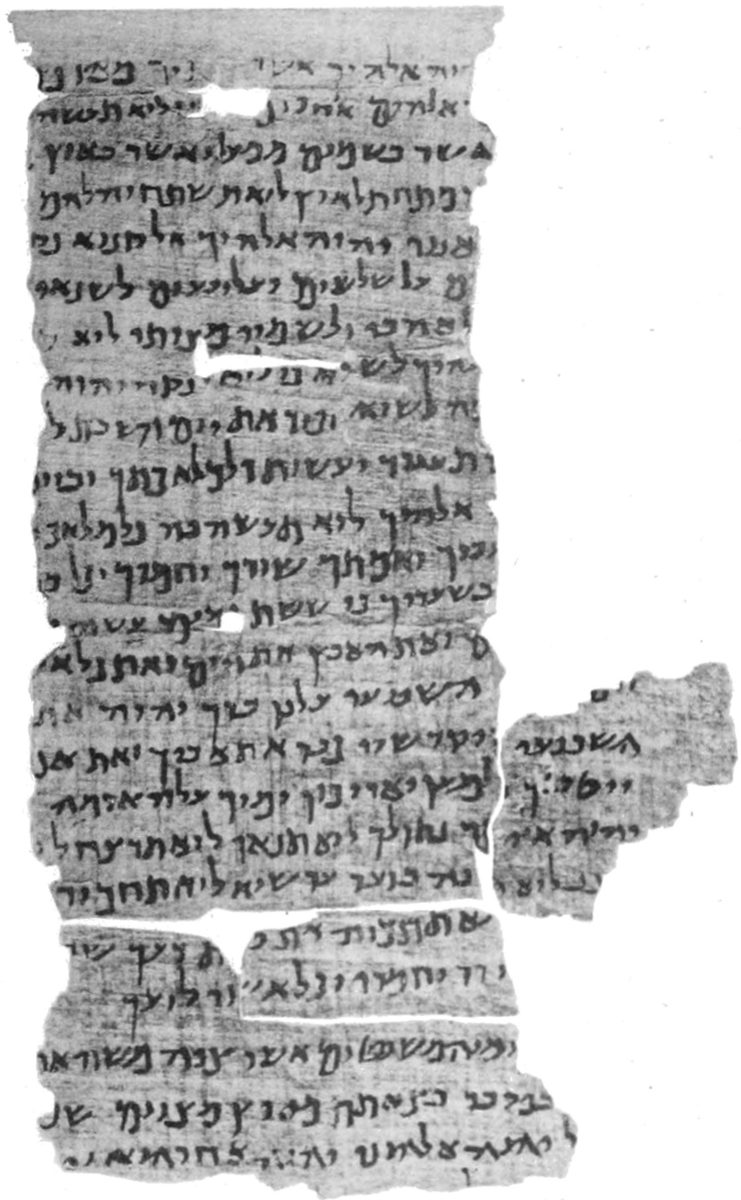
⭐ Not a picture of the chapter but a copy OF it. The four fragments carry the Ten Commandments and then the opening of the Shema — , this chapter's own words. When Stanley Cook first described them in 1903 they were the oldest Hebrew fragments then known of any part of the biblical text. ⭐ What is worth reading on it rather than around it, checked directly against this image at the resolution shown: the bottom-most line, the one that runs unbroken across the full width, is legibly shema‘ … YHVH eloheinu — and it runs flat, with no enlarged letters. The scribal tradition of writing the ayin and the dalet oversized so they spell ‘witness’, reported in , is not in this copy. ⚠ Reported rather than verified here: the file page notes, citing David Noel Freedman, that the ORDER of the commandments on this papyrus differs from the order in the Hebrew Bible and from the Septuagint alike, and that later reappraisals have moved Cook's second-century dating. A text that sets the Ten Words directly beside the Shema is in any case not shaped like a Torah scroll; it is shaped like something meant to be said, which is what v7 asks for.

Translator’s Notes
★ The chapter opens on a grammatical oddity every English reader walks straight past: ‘And this is the COMMANDMENT’ is singular in the Hebrew (ha-mitzvah, with a feminine singular demonstrative), and the two nouns beside it — the statutes and the ordinances — are plural. One commandment, many regulations. And the singular is not a slip: the chapter closes on it again at v25, ‘all this commandment’ (kol ha-mitzvah ha-zot), the same feminine singular twenty-four verses later. Whatever the plural rules are, the chapter frames them as ONE thing, named at both ends.
⚠ Counted across all thirteen witnesses at THIS verse, three keep the singular and ten do not. The ASV reads ‘Now this is the commandment’; the NWT’s 1984 edition keeps the singular noun more awkwardly, ‘these are the commandment, the regulations and the judicial decisions’; and on the Spanish shelf the TNM 1987 does the same, «estos son el mandamiento». The other ten pluralize — KJV ‘Now these are the commandments’, the Geneva Bible ‘These now are the commandments’, Douay-Rheims ‘These are the precepts’, the NIV ‘These are the commands’, RV60 and the RV 1909 «los mandamientos», the NVI the same, and the TLB ‘all these commandments’. ⭐ Both of the editions that DO keep it lose it in their own later revisions — the NWT’s 2013 revision reads ‘the commandments’ and the TNM 2019 «los mandamientos». The 1984/1987-versus-2013/2019 split this project keeps meeting, showing up on a point of number. See v25 for the other end of the frame, where the same three witnesses hold and the same two revisions let go.
Two smaller things worth flagging before they pay off. V2 names three generations at once — ‘you, and your son, and your son’s son’ — which is what the chapter is FOR; it is a teaching document, and it will end (vv20–25) with a script for what to say when the son actually asks. And v3 says ‘hear, O Israel’ one verse before the famous one does, in a different grammatical form: v3 is ve-shama‘ta, a perfect with waw (‘and you shall hear’), where v4 is the bare imperative shema‘. Two ‘hear, O Israel’s, back to back, and only the second one became a prayer.
★ ‘Hear, O Israel: Jehovah our God, Jehovah is one’ is four words in Hebrew — YHVH eloheinu YHVH echad — and not one of them is a verb. Hebrew does not need one; a sentence can be built out of a subject and a predicate sitting side by side. English cannot do that, so every English translation has to insert an ‘is’ that the Hebrew does not have, and the whole meaning of the most-recited sentence in Judaism depends on WHERE the translator puts it. Four readings are grammatically available: ‘Jehovah our God, Jehovah is one’; ‘Jehovah our God is one Jehovah’; ‘Jehovah is our God, Jehovah alone’; and ‘Jehovah is our God, Jehovah is one.’
This translation takes the first. The reason is visible in the source text itself rather than argued from outside it: the printed Masoretic edition this project works from punctuates the four words two-and-two, with a break after eloheinu — ‘Jehovah our God’ on one side, ‘Jehovah one’ on the other — so the copula goes between the last two words, not the first two.
⚠ The shelf splits three ways on the same four words, and the split does not follow the usual alliances. Seven of the thirteen witnesses make ‘one’ part of the predicate noun: the ASV reads ‘Jehovah our God is one Jehovah’, both editions of the NWT read ‘Listen, O Israel: Jehovah our God is one Jehovah’, both editions of the TNM «Jehová nuestro Dios es un solo Jehová», and the KJV and Douay-Rheims do the same with their own substitute for the name. Three punctuate it as this translation does — the NIV, and on the Spanish shelf RV60 and the RV 1909, both reading «Jehová nuestro Dios, Jehová uno es» word for word. ⭐ And three take the fourth reading, that the verse is about EXCLUSIVITY rather than arithmetic: the Geneva Bible of 1599 ends it ‘our God is Lord only’, the TLB ‘Jehovah is our God, Jehovah alone’, and the NVI «es el único Señor». A 1599 Calvinist Bible and a 1971 American paraphrase, three hundred and seventy years apart, landing on the same reading against the KJV that sits between them — which is a fair measure of how genuinely open the Hebrew is here. This translation prints one reading and does not pretend the others are errors.
⚠ Two things a reader may have been told about this verse that the printed text in front of us cannot show. The first is that the Greek New Testament settles it: it does not, but it is worth reading. Mark 12:29 (not yet on these pages) quotes the verse in Greek, and Greek DOES have to supply the verb — kyrios ho theos hēmōn kyrios heis estin, confirmed directly against the archived Greek, with the ‘is’ at the very end. That is one ancient reader’s choice among the four, not a ruling. The second is the scribal tradition that the ayin of shema‘ and the dalet of echad are written oversized in a Torah scroll, so that the two enlarged letters spell ‘ed, ‘witness’. That is a feature of the handwritten scroll, and it is NOT present in the printed edition this project translates from — reported here as a scribal tradition, not verified from our own source.
★ One correction, made by this chapter to a claim already on these pages. Deuteronomy 5:1’s note (already on these pages) established that the vocative ‘Hear, O Israel’ is spoken there FIRST, one chapter before the verse that made it famous — and that still holds. But its count of the search results was wrong, and the reason was a defect in this project’s own concordance tool: the printed Hebrew of THIS verse carries a comma between shema‘ and Yisrael, and the search treated the comma as a letter, so the most famous two-word phrase in the Hebrew Bible was invisible to a search for it. Fixed, and re-run: the phrase stands in six verses, of which five are genuine addresses to the nation — 5:1, this verse, and 9:1, 20:3 and 27:9 (all three later in this same book, none yet on these pages; 27:9 with a conjunction attached, ‘be silent and hear, O Israel’) — and the sixth, Genesis 35:22, is a letter-only false match where the same consonants mean ‘and Israel heard’. Every genuine one is in Deuteronomy. The phrase belongs to this book.
★ This translation reads ‘with all your UTMOST’, and not one of the thirteen witnesses does anything like it — four say ‘might’, three ‘strength’, three «fuerzas», one «poder» and two ‘vital force’ — so the departure is stated up front. The reason is that me’od is not a noun. In its ordinary use it is the adverb ‘very’ — the word behind ‘very good’ at the end of the sixth day, and behind ‘you may increase GREATLY’ two verses earlier in this same chapter. Here it takes a possessive suffix and is pressed into service as a thing you can have all of: your very-much-ness. English has one word shaped the same way — an intensifier that became a noun — and that is ‘utmost’. It is deliberately not another word for body or brawn, because the Hebrew’s third term is deliberately not a third body part.
⚠ Checked against the archived Hebrew, this exact phrase — ‘with all your heart and with all your soul and with all your me’od’ — occurs exactly TWICE in the whole Hebrew Bible. Here, and at 2 Kings 23:25 (not yet on these pages), which is the Bible’s verdict on King Josiah: there was no king before him who turned to Jehovah ‘with all his heart and with all his soul and with all his me’od, according to all the Torah of Moses’. The one other time the phrase is used, it is used to say that one man in the history of the monarchy actually did this.
★ And the strongest evidence that the word is untranslatable is that the Greek New Testament could not settle on a translation either — three quotations of this one verse, and no two of them agree. Confirmed directly against the archived Greek: Matthew 22:37 (already on these pages) gives THREE terms and renders me’od as dianoia, MIND — heart, soul, mind. Mark 12:30 (not yet on these pages) gives FOUR — heart, soul, mind, and ischys, strength — as though unwilling to drop either candidate. Luke 10:27 (not yet on these pages) also gives four, in a different order again. And Mark 12:33, where the scribe repeats the answer back, reaches for a fifth Greek word, synesis, understanding. Three verses of the Hebrew’s three terms become, in Greek, a shifting list of four or five. That is what a word with no equivalent looks like from the other side.
⚠ The shelf’s own spread says the same thing more quietly. KJV, the Geneva Bible and the ASV all read ‘with all thy might’; the NIV and Douay-Rheims read ‘strength’; RV60 and NVI «con todas tus fuerzas» while the RV 1909 reaches instead for «con todo tu poder», power rather than strength. ⭐ Two witnesses refuse the flattening, and they are the same translation on its two shelves: the NWT’s 1984 edition prints ‘all your vital force’ and the TNM 1987 «toda tu fuerza vital» — a periphrasis, and one carrying that translation’s own doctrinal vocabulary about life-force, but also the only rendering on either shelf that admits the word is not simply muscle. Both of their own later revisions drop it: the NWT 2013 to ‘strength’ and the TNM 2019 to «todas tus fuerzas».
Two more small things the Hebrew does here. The verb is ve-ahavta, ‘and you shall love’ — and checked across the whole archived Hebrew Bible, that exact form stands in only four verses: Leviticus 19:18 and 19:34 (already on these pages — love your neighbour, love the resident alien) and Deuteronomy 6:5 and 11:1 (love Jehovah). Two objects, four verses, one verb form. ⭐ It is not a coincidence that when Matthew 22:37–39 (already on these pages) reports Jesus naming the greatest commandment and the second like it, the two verses he names are one from each pair — this one and Leviticus 19:18. And the grammar differs between them: here the object is marked with et, the ordinary direct-object marker, while Leviticus 19:18 uses the preposition le, love TO your neighbour. Hebrew loves God transitively and the neighbour datively.
★ The famous rendering ‘and thou shalt teach them diligently unto thy children’ is covering a verb about edged weapons. Ve-shinnantam is from the root that means TO SHARPEN, TO WHET. Searching the archived Hebrew Bible for the root’s two written shapes turns up six verses in total, and the other five are unanimous about what gets sharpened: ARROWS three times (Isaiah 5:28, ‘whose arrows are sharpened’; Psalm 45:6; Psalm 120:4) and a TONGUE twice (Psalm 64:4, ‘who have sharpened their tongue like a sword’; Psalm 140:4, ‘they sharpened their tongue like a serpent’) — none of them yet on these pages. Every other use in the Bible sharpens a weapon. This verse alone points the verb at a child. ⚠ One hit in that search is noise and worth naming, because reading it is how the count stays honest: Psalm 12:5 matches on letters only (li-leshonenu, ‘as for our tongue’) and is not the verb at all.
So this translation reads ‘and you shall sharpen them into your sons’. It is a strange sentence on purpose. ⚠ Checked against the fetched shelf, no witness on either side keeps the metaphor: KJV and the ASV both read ‘teach them diligently’, the Geneva Bible ‘rehearse them continually’, the NIV ‘Impress them on your children’, Douay-Rheims flattest of all with ‘thou shalt tell them to thy children’, the NWT ‘inculcate them’ (both editions), RV60 and the RV 1909 «las repetirás a tus hijos», and the NVI «Incúlcaselas». Several of them are excellent guesses at the FORCE of the word — repetition until it bites — and every one of them chooses to spend the image to get there.
The four moments that follow — sitting in the house, walking on the road, lying down, rising up — are a merism: two pairs of opposites standing for the whole of a day, at home and abroad, asleep and awake. Read as a schedule rather than a figure, ‘when you lie down and when you rise up’ is the basis of the twice-daily recitation of this passage in Jewish practice, evening and morning.
⚠ Totafot is a word nobody can translate, and the honest thing is to say so rather than to pick a meaning. It occurs three times in the whole Hebrew Bible — Exodus 13:16 (already on these pages), this verse, and Deuteronomy 11:18 (not yet on these pages) — always in the same formula, and its etymology is unknown. Here it is even spelled short (totafot without its middle vowel letter) where the other two spell it full, a detail confirmed directly against the archived Hebrew. This translation keeps ‘frontlets’, which is not really an English word either: it was coined for this verse and has never had a life outside it. An opaque English word for an opaque Hebrew one is a deliberate choice, not a failure of nerve.
★ What is worth watching on the shelf is not the word but the PLACE. The Hebrew says between your eyes. The KJV, the Geneva Bible and the ASV all keep ‘frontlets between thine eyes’; but the NIV quietly moves it, ‘bind them on your foreheads’, and so do the NWT’s 2013 revision (‘like a headband on your forehead’), the TNM 2019 («como una cinta en tu frente») and the TLB (‘wear them on your forehead’) — four witnesses relocating an anatomical phrase to the place the practice actually puts the box. Their own earlier editions do not: the NWT 1984 reads ‘frontlet band between your eyes’, the TNM 1987 «de venda frontal entre los ojos», and RV60 and the RV 1909 both keep «entre tus ojos». The Douay-Rheims is stranger than any of them — ‘they shall be and shall MOVE between thy eyes’ — a Latin verb showing through, as it usually is when the Douay is alone.
★ V9’s doorposts are worth stopping on, because the fixture is not chosen at random. Mezuzot is the word that gives the mezuzah its name — the small case of scripture on a Jewish doorframe is this verse, obeyed literally. But the doorpost’s first appearance in the Bible is Exodus 12:7, 22–23 (already on these pages), where the blood of the Passover lamb is painted on it and the destroyer passes over the house. The one fixture Israel is now told to WRITE these words on is the same fixture the blood went on the night they left Egypt — and the very next paragraph of this chapter (v12) is about not forgetting that Egypt happened. ⚠ Here two of the thirteen lose the second half of the verse: Douay-Rheims reads ‘write them in the entry, and on the doors of thy house’ and the TLB ‘write them on the doorposts of your house’ — the city gate gone in both. The other eleven keep house AND gates, the NVI spelling out what the gates are («los portones de tus ciudades»).
The paragraph is built out of five relative clauses of the same shape, and the repetition IS the argument: cities you did not build, houses you did not fill, cisterns you did not hew, vineyards and olive trees you did not plant. Then ‘and you eat and are satisfied’ — and the warning lands not on hunger but on fullness. Everything in the list is a good thing arriving exactly as promised; the risk named is that receiving it will end the memory of who gave it.
⚠ A small translation point with a real fact under it: the Hebrew has borot chatzuvim, HEWN pits — cisterns cut down into limestone to catch the winter rain, which is what made settlement possible in the Judean hills. The KJV reads ‘wells digged’, the Geneva Bible ‘wells dug’ and the NIV ‘wells you did not dig’, all three turning a cut rock chamber into a dug shaft; RV60 and the RV 1909 keep the cistern but lose the hewing («cisternas cavadas», dug). Exactly three of the thirteen keep BOTH halves — the noun hewn and the verb repeated: the ASV ‘cisterns hewn out, which thou hewedst not’, the NWT 1984 ‘cisterns hewn out that you did not hew out’, and the TNM 1987 «cisternas labradas que no labraste». ⭐ And both of those two lose it in their own revisions, which is the third time in this chapter that the older edition of the same translation is the more literal one: the NWT 2013 keeps the adjective but drops the verb (‘hewn cisterns that you did not dig’) and the TNM 2019 drops both («cisternas que no excavaste»). The verb matters because the point of the sentence is the LABOUR someone else spent.
★ There is no word for ‘only’ in this verse. The Hebrew reads, flatly, ‘Jehovah your God you shall fear, and him you shall serve, and by his name you shall swear’ — three clauses with the object fronted for emphasis in the first two, which is as close to ‘only’ as the grammar gets, and it is not the same thing as saying it. ⚠ Checked directly against the fetched shelf, five of the thirteen witnesses put the word in anyway: the NIV (‘serve him only’), Douay-Rheims (‘shalt serve him only’), the TLB (‘use his name alone’), RV60 («a él sólo servirás») and the NVI («sírvele solamente a él»). The KJV, Geneva Bible, ASV, RV 1909, and both editions of the NWT and the TNM leave it out.
⭐ And there is a checkable reason the word is available to them. When Matthew 4:10 (already on these pages) has Jesus answer the devil with this verse, the Greek reads kyrion ton theon sou proskynēseis kai autō MONŌ latreuseis — ‘him ALONE shall you serve’ — confirmed directly against the archived Greek, and the same quotation also reads ‘you shall WORSHIP’ where the Hebrew of this verse reads ‘you shall FEAR’. Matthew 4’s own note on these pages already flags both seams. Whether or not any given translator reached for the Greek consciously, the effect is that a reader of those five versions meets the Hebrew verse already wearing the shape of its most famous quotation.
★ V15’s el qanna, ‘a jealous God’, is the FIFTH and last time that exact two-word phrase stands in the Hebrew Bible — and with this chapter, all five are on these pages. Verified by searching the whole archived Hebrew: Exodus 20:4, Exodus 34:14, Deuteronomy 4:24, Deuteronomy 5:8, and this verse. (A second spelling of the same adjective, el qanno, accounts for two more verses, Joshua 24:19 — not yet on these pages — and Nahum 1:2, which is.) ⚠ This corrects the count in Deuteronomy 5’s own note, which called that verse the phrase’s third appearance on these pages; Exodus 20:4 had shipped long before, so it was the fourth. Both pages now carry the full list. And this occurrence is the odd one structurally: it is the only one of the five that puts the ADJECTIVE first — ‘for a jealous God is Jehovah your God in your midst’ — where the other four name Jehovah first and add the epithet after. This translation keeps that order.
★ The verse says the same thing three times and an English reader can see it once. ‘You shall not TEST (tenassu) Jehovah your God, as you TESTED him (nissitem) at MASSAH (massah)’ — one root, n-s-h, in the verb, in the verb again, and in the place-name, which is simply the noun ‘testing’ used as a name. Exodus 17:7 (already on these pages) is where the place gets it: Moses names the spot Massah-and-Meribah, Testing-and-Strife, ‘because of their testing Jehovah, saying, is Jehovah in our midst or not?’
⚠ Checked directly against every fetched witness on both shelves, exactly one of the thirteen lets the pun through — and it does it by giving up the name. Douay-Rheims reads ‘as thou temptedst him in the place of temptation’, which is the Latin in loco tentationis showing through; the other twelve transliterate — KJV, the Geneva Bible and the ASV all ‘in Massah’, the NIV and TLB ‘at Massah’, RV60 «en Masah», the RV 1909 «en Massa», the NVI «en Masá». Both halves of the trade are real: transliterating keeps the geography and loses the joke; translating keeps the joke and loses the place. This translation transliterates and puts the pun here.
★ This verse and v13 are two of the three sentences Jesus answers the devil with, and the third comes from the next sermon over. Confirmed against the archived Greek: Matthew 4:7 (already on these pages) quotes this verse, Matthew 4:10 quotes v13, and Matthew 4:4 quotes Deuteronomy 8:3 — ‘not by bread alone shall the human live’ — two chapters further on and not yet on these pages. All three answers come out of one stretch of Moses’ second sermon, and two of them out of this chapter.
V17 opens with the Hebrew construction that doubles a verb for emphasis — shamor tishmerun, literally ‘keeping you shall keep’ — and every translation on both shelves reaches for an adverb instead: KJV and the Geneva Bible ‘diligently’, the NIV ‘Be sure to keep’, RV60 and the RV 1909 «cuidadosamente», the NWT 1984 ‘by all means’, the TNM 2019 «sin falta». The doubling is not available in English and an adverb is the honest substitute; this translation uses ‘surely’.
★ Something else is happening across vv13–18 that no translation can show, because English has one ‘you’ for both numbers: the Hebrew keeps switching between singular and plural, verse by verse. Confirmed against the archived text: v13 is singular, v14 plural, v15 singular, v16 plural, v17 plural, v18 singular again. Six verses, four switches. Some of it is doubtless the seam of an edited text and Deuteronomy is famous for it; but read forward it also does something, because the singular verses address a person and the plural ones address a nation, and the chapter is arguing that these are the same obligation. ⭐ Matthew 4’s own note on these pages had already noticed one half of this from the other end — that v16 is plural in Hebrew while the Greek Jesus speaks is singular, so he answers a personal invitation with a national commandment. The alternation this note measures is the pattern that observation sits inside.
‘What is right and good in the eyes of Jehovah’ (v18) is a standard this chapter states without defining — the closest thing the Torah gives to a general principle behind its particular laws. ⚠ Only the Douay-Rheims departs from the pair, reading ‘that which is PLEASING and good’; the Hebrew ha-yashar is straight, upright, the same image as the road that does not turn aside that closed Deuteronomy 5 (already on these pages).
★ The Hebrew says machar, TOMORROW, and this translation keeps it. It is an idiom for ‘in time to come’ and most of the shelf renders the idiom — KJV and the Geneva Bible ‘in time to come’, the NIV ‘In the future’, the TLB ‘In the years to come’. But three witnesses keep the word: Douay-Rheims ‘shall ask thee to morrow’, and on the Spanish shelf both RV60 and the RV 1909 «mañana». Keeping it is worth the small strangeness, because the sentence is about a household where the question is expected soon and often, not once a generation.
★ This is the fourth of the Bible’s four child-asks-a-question scripts, and the seder counts them. Exodus 13’s note on these pages already named the set — Exodus 12:26; 13:8; 13:14; and this verse — as the four sons of the Passover seder in Jewish tradition: the wise, the wicked, the simple, and the one who does not know how to ask. This is the son whose question is the most technical of the four, asking specifically about the testimonies, statutes and ordinances; and the answer he gets is not a definition. It is a story: we were slaves, and we were brought out. The chapter’s teaching method, set up back at v2 with its three generations, is finally shown working.
⚠ V22’s ‘signs and wonders, great and disastrous’ uses ra‘, the ordinary Hebrew word for BAD or EVIL — the same adjective as the tree of the knowledge of good and evil. It cannot mean morally wicked here, and the shelf spreads out accordingly: the Geneva Bible alone prints it flat as ‘great and evil’, the KJV reads ‘great and sore’, Douay-Rheims ‘great and very grievous’, the NIV ‘great and terrible’, the NWT 1984 ‘great and calamitous’ and the NWT 2013 ‘great and devastating’, the RV 1909 «grandes y nocivos», harmful. This translation reads ‘disastrous’: the signs were a disaster for Egypt, which is what the word is doing, and ‘evil’ in modern English would say something the Hebrew does not.
★ The chapter ends where it began, on the singular commandment of v1 — and then on tzedaqah, righteousness, promised here for DOING. The same three witnesses that kept the singular at v1 keep it here: the ASV ‘all this commandment’, the NWT 1984 ‘all this commandment’, the TNM 1987 «todo este mandamiento» — and the same two revisions let go of it, the NWT 2013 reading ‘all these commandments’ and the TNM 2019 «todos estos mandamientos». The NIV keeps a singular by changing the noun instead, ‘all this law’.
‘It will be righteousness for us if we keep to do all this commandment.’ The same noun’s most famous appearance is Genesis 15:6 (already on these pages), where Abram BELIEVES and it is reckoned to him as righteousness, with nothing done at all. Two verses, one noun, two ways of arriving at it — and the argument between them runs through the whole New Testament and out the far side into the Reformation. This project’s job here is to print both plainly and let a reader see that the tension is in the Hebrew Bible before anyone in the first century picks it up.
⚠ The shelf is unusually far apart on this one sentence. KJV (‘it shall be our righteousness’), the Geneva Bible, the ASV, RV60 and the RV 1909 («tendremos justicia») all keep the noun; the NVI turns it into a state of the person, «seremos justos», we will be righteous; the TLB drops the idea entirely and paraphrases ‘it always goes well with us when we obey’. ⭐ And the Douay-Rheims says something else again: ‘And he will be merciful to us, if we keep and do all his precepts’ — mercy where the Hebrew has righteousness, which is the Vulgate’s reading rather than a choice about the Hebrew, and the clearest single example in this chapter of why the Douay’s divergences usually need to be traced to Latin before they are treated as evidence about the Hebrew.
Notes on this translation
Decisions. Hebrew and English number this chapter identically at 25 verses — checked against the fetched shelf on both sides, no witness on either shelf numbers it differently, which is worth saying only because the previous chapter did not. Four rendering choices are departures worth naming, each argued in its own note: ‘Jehovah our God, Jehovah is one’ at v4, the reading the printed Masoretic edition’s own two-and-two punctuation supports, chosen out of four grammatically available readings that the shelf takes three different ways; ‘with all your utmost’ at v5 for me’od, where none of the thirteen does anything similar, because the Hebrew’s third term is an intensifier turned noun and not a third body part; ‘you shall sharpen them into your sons’ at v7, keeping a metaphor about edged weapons that no version on either shelf keeps; and ‘tomorrow’ at v20, which the Douay and both Reina-Valeras also keep. ‘Frontlets’ at v8 is retained deliberately as an opaque English word for an opaque Hebrew one. Established renderings hold throughout: Jehovah for the divine name, ‘statutes and ordinances’ for chuqqim u-mishpatim, and the verse and note anchors follow the canonical v6-N/n6-N form.
Library. Six new dictionary entries, each in both languages: mitzvah (the singular commandment framing vv1 and 25), shema, echad, me’od, shanan and mezuzah. Five existing English entries extended — totafot, tzedaqah, ahav, qanna and massah-meribah — of which qanna and massah-meribah were extended in Spanish too. And four pre-existing Spanish parity gaps closed: totafot, tzedaqah, ahav and yare had English entries with no Spanish twin at all, and now have one. No new encyclopedia entries — every person and place this chapter names (Abraham, Isaac, Jacob, Egypt, Pharaoh, Massah) already had one, and VIDEO_QUEUE was checked with nothing waiting for them.
Echoes paid. Deuteronomy 5:1’s promise of the Shema itself, paid off at v4 (n4) — and its count corrected there. The massah-meribah dictionary entry’s own forward promise about this verse, paid off at v16 (n16). Exodus 13’s four-sons-of-the-seder note, whose fourth son is v20 (n20). Exodus 12’s Passover doorposts, standing behind the doorposts of v9 (n8). Exodus 17:7’s naming of Massah, which v16 is quoting (n16). Matthew 4’s own notes on the two verses Jesus quotes from this chapter, and its observation about the singular-versus-plural seam, which n17 measures across six verses. And Genesis 15:6’s righteousness reckoned for believing, set against v25’s righteousness promised for doing (n25).
Patterns worth carrying forward. Deuteronomy 5’s closing note asked whether this book leans on near-synonym pairs more than Numbers did. This chapter answers differently: its best findings are not pairs but single words whose ordinary meaning is hiding under a famous translation — shanan, which sharpens arrows and tongues everywhere else in the Bible; me’od, an adverb pressed into use as a noun; totafot, which means nothing anyone can recover. Worth watching whether Deuteronomy keeps doing this, because it is a different failure mode from a flattened pair: a pair is lost when a translator uses one word twice, but a famous single word is lost when everyone agrees on the same substitute, and unanimity is much harder to notice than disagreement. Deuteronomy 5’s other open thread — the three-names-one-thing device — still has no subject to test against and stays untested. ⚠ One new thread this chapter opens: the shelf’s 1984/1987-versus-2013/2019 split appeared four separate times in one chapter (the singular commandment at vv1 and 25, ‘vital force’ at v5, the frontlets moving to the forehead at v8, and the hewn cistern losing its verb at v11), and every time the older edition was the more literal one. That is now frequent enough to be a property of those revisions rather than a coincidence; worth counting deliberately over the next few chapters rather than noting case by case.
Next installment in this book: Deuteronomy 7 — the seven nations, the command to devote them to destruction, and the reason Israel is chosen: not because it was numerous, but because it was the fewest of all peoples.