CreationBefore the FloodThe FloodAfter the FloodThe PatriarchsEgypt and the ExodusThe KingdomThe ExileThe ReturnBetween the TestamentsThe GospelsThe Apostolic Age
🕰
Immediately after the grain-offering law, Jehovah gives the law of the peace-offering — herd, flock, or goat, only the fat turned to smoke while the meat becomes a shared meal — closing on a permanent ban: never eat fat, never eat blood.
Same setting as ch. 1-2 — spoken at Sinai in the same roughly one-month window before Israel breaks camp (Numbers 10:11). The offering laws of Leviticus 1-7 are given as one continuous block; nothing in the text marks a separate date for this chapter.
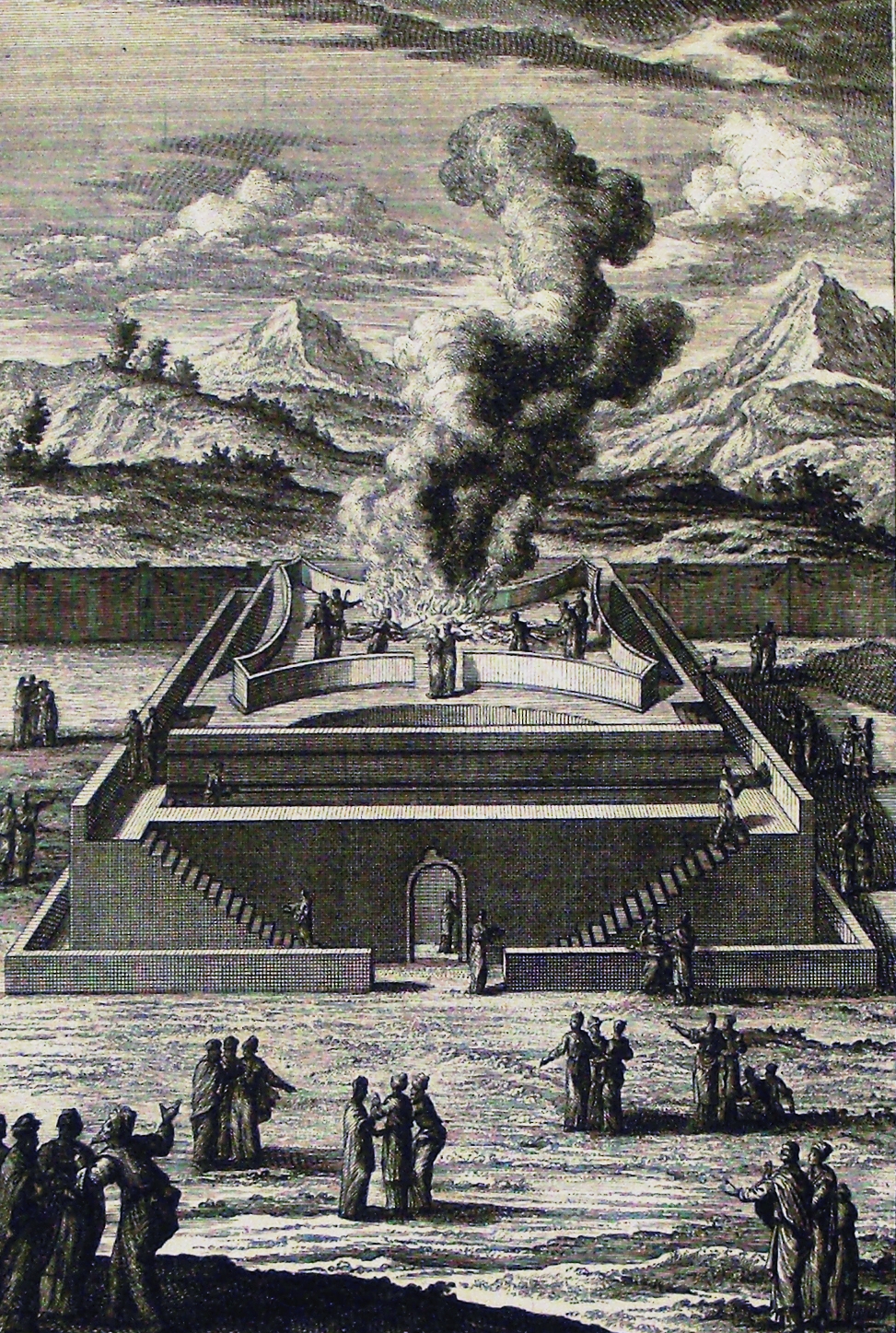
Tyroff, from Johann Jakob Scheuchzer's Physica Sacra (Kupfer-Bibel), 1731-1735, Augsburg · The Phillip Medhurst Collection, St. George's Court, Kidderminster, England
⚠ The engraving cannot show what actually makes this chapter's offering different from chapter 1's — a fire looks the same on the page whether the whole animal is burning or only its fat, and no static image can depict the meal the rest of it became. What the plate captures instead is the priestly action the text does share across every offering: Aaron's sons at the fire, the smoke rising 'a soothing aroma to Jehovah,' and, scattered below at ground level, the small clustered groups who stand in for the herd-owner, the shepherd, and the goatherd the chapter addresses in turn. The altar itself is the engraver's own invention — nothing in Exodus describes anything like this stepped, doored structure — the baroque architectural fantasy typical of the Physica Sacra series, more interested in monumental grandeur than in the actual small bronze altar the text specifies.
And if his offering is a sacrifice of peace-offerings — if he offers from the herd, whether male or female, he shall offer it without blemish before Jehovah.note
Y si su ofrenda es sacrificio de ofrendas de paz —si la ofrece del ganado, sea macho o hembra, sin defecto la ofrecerá delante de Jehová.
And he shall lay his hand on the head of his offering, and slaughter it at the door of the tent of meeting; and Aaron’s sons, the priests, shall dash the blood against the altar all around.note
Y pondrá su mano sobre la cabeza de su ofrenda, y la degollará a la puerta del tabernáculo de reunión; y los hijos de Aarón, los sacerdotes, rociarán la sangre sobre el altar en derredor.
And he shall present from the sacrifice of peace-offerings an offering by fire to Jehovah: the fat that covers the entrails, and all the fat that is on the entrails,note
Y del sacrificio de ofrendas de paz presentará como ofrenda encendida a Jehová: la grasa que cubre los intestinos, y toda la grasa que está sobre los intestinos,
And Aaron’s sons shall turn it into smoke on the altar, on the burnt-offering that is on the wood that is on the fire — an offering by fire, a soothing aroma to Jehovah. {פ}note
Y los hijos de Aarón lo harán arder en el altar, sobre el holocausto que está sobre la leña que está sobre el fuego —ofrenda encendida, aroma apacible a Jehová. {פ}
And he shall lay his hand on the head of his offering, and slaughter it before the tent of meeting; and Aaron’s sons shall dash its blood against the altar all around.note
Y pondrá su mano sobre la cabeza de su ofrenda, y la degollará delante del tabernáculo de reunión; y los hijos de Aarón rociarán su sangre sobre el altar en derredor.
And he shall present from the sacrifice of peace-offerings an offering by fire to Jehovah: its fat — the entire fat tail, which he shall remove close to the backbone — and the fat that covers the entrails, and all the fat that is on the entrails,note
Y del sacrificio de ofrendas de paz presentará como ofrenda encendida a Jehová: su grasa —la cola entera, que quitará junto al espinazo— y la grasa que cubre los intestinos, y toda la grasa que está sobre los intestinos,
And he shall lay his hand on its head, and slaughter it before the tent of meeting; and the sons of Aaron shall dash its blood against the altar all around.note
Y pondrá su mano sobre la cabeza de ella, y la degollará delante del tabernáculo de reunión; y los hijos de Aarón rociarán su sangre sobre el altar en derredor.
And he shall present from it his offering, an offering by fire to Jehovah: the fat that covers the entrails, and all the fat that is on the entrails,note
Y de ella presentará su ofrenda, ofrenda encendida a Jehová: la grasa que cubre los intestinos, y toda la grasa que está sobre los intestinos,
Every offering in Leviticus 1 went wholly to Jehovah, turned entirely into smoke; this one does not. Only the fat reaches the altar — the internal suet packed around the kidneys and liver (v3–4) — while the meat becomes food: a share for the priests (Leviticus 7, already on these pages), the rest for the offerer’s own family and guests at a shared meal. The name says as much: peace-offerings (shelamim) shares its root with shalom, ‘peace, wholeness, well-being’ — and the mechanics enact that meaning literally, dividing one animal three ways between God, priest, and worshiper, all eating from the same sacrifice.
⚠ A second, quieter difference from chapter 1: this offering may be male OR female. The burnt-offering from herd or flock required a MALE without blemish (Leviticus 1:3, 1:10, already on these pages); here, twice in five verses (v1, v6), the text allows either sex. A wholly-consumed gift to God apparently called for the more valuable animal; a shared meal did not need to.
The fat tail, and a shelf that mostly avoids the euphemism
The flock case repeats the herd case’s ritual almost word for word, with one addition: the fat TAIL (v9, alyah), named nowhere else in the burnt-offering law of chapter 1. The detail is real anatomy, not poetry — the broad-tailed sheep common across the ancient Near East (still bred today) carries a genuinely large fat deposit at the base of its tail, distinct enough from an ordinary sheep’s to warrant its own line in the law.
⚠ Here the shelf splits, and 1611 stands alone.KJV reaches for a euphemism, ‘the whole rump’; every other version checked renders it literally — ASV ‘the fat tail entire’, ESV ‘the whole fat tail’, NIV ‘the entire fat tail’, matching this translation’s own choice. The Spanish shelf never had KJV’s problem to begin with: both RV60 and NVI already read plainly, la grasa y la cola entera — ‘the fat and the whole tail’ — direct from a translation tradition four centuries younger than the King James, with no euphemism to inherit.
The rule this book will spend three more chapters defending
The goat case (v12–16) adds nothing new to the ritual — the third of three near-identical repetitions, herd, flock, goat — and the chapter closes on the reason all three existed: fat and blood belong to Jehovah alone, and neither may ever be eaten. ‘A perpetual statute throughout your generations, in all your dwellings’ (v17) is among the widest-reaching legal formulas in the book — not a sanctuary rule confined to the altar, but a kitchen rule that follows Israel everywhere it lives.
⚠ This is not the law’s only word on the subject — the book comes back to defend it twice more, with real teeth. Leviticus 7 restates the prohibition almost verbatim and adds the penalty: ‘whoever eats the fat… the soul that eats it shall be cut off from his people’ (7:23, 25, already on these pages), and repeats the blood ban with the same sentence attached (7:26–27, already on these pages). Centuries later, the one dietary instruction the Jerusalem apostles asked GENTILE believers to keep — who were bound by none of the rest of this book’s food law — was to abstain from blood (Acts 15:29, not yet on these pages); fat is never mentioned there. Of the two prohibitions issued together in this one verse, only one survived into the New Testament’s own instructions.
Notes on this translation
Decisions. ‘Peace-offerings’ is kept for shelamim, following the older shelf (KJV, ASV) over ‘fellowship offerings’ (NIV’s more relational reading) — both are defensible; this translation keeps the plainer term, and matches its own already-established choice at Exodus 24:5. ‘Fat tail’ is kept for alyah at v9, against KJV’s lone euphemism ‘rump’ — see the note above for the full shelf split, English and Spanish both. Every {פ} in this chapter is a petuchah, an OPEN paragraph space in the scroll — unlike Leviticus 2, which mixed both break-types, all three of this chapter’s breaks (v5, v11, v17) use the wider kind, marking the seam after each animal-case’s own law. Verse numbering follows the Hebrew exactly; Hebrew and English Leviticus 3 both run 1–17.
⚠ A note on order: Leviticus stands complete on these pages, chapters 1–27.