1
Ἰησοῦς δὲ ἐπορεύθη εἰς τὸ ὄρος τῶν Ἐλαιῶν.
Pero Jesús fue al monte de los Olivos.
2
Ὄρθρου δὲ πάλιν παρεγένετο εἰς τὸ ἱερόν, καὶ πᾶς ὁ λαὸς ἤρχετο· καὶ καθίσας ἐδίδασκεν αὐτούς.
At dawn he appeared again in the temple, and all the people came to him; he sat down and began to teach them.
noteAl amanecer se presentó otra vez en el templo, y todo el pueblo acudía a él; se sentó y comenzó a enseñarles.
3
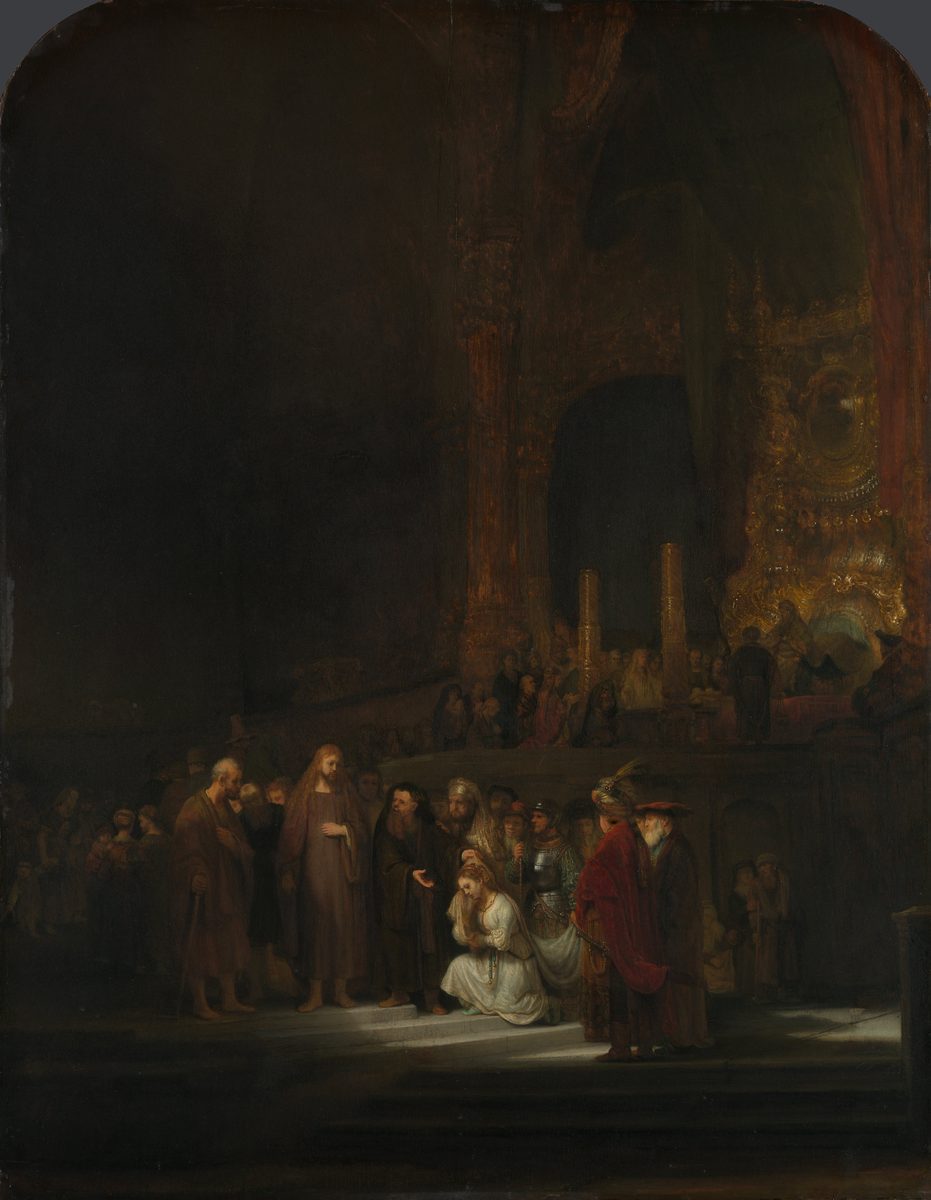
ἄγουσιν δὲ οἱ γραμματεῖς καὶ οἱ Φαρισαῖοι πρὸς αὐτὸν γυναῖκα ἐν μοιχείᾳ καταλήφθεισαν· καὶ στήσαντες αὐτὴν ἐν μέσῳ,
The scribes and Pharisees brought a woman caught in
adultery, made her stand in the middle of the crowd,
noteLos escribas y los fariseos le llevaron una mujer sorprendida en adulterio, la pusieron de pie en medio,
4
λέγουσιν αὐτῷ, πειράζοντες· Διδάσκαλε, αὕτη ἡ γυνὴ κατελήφθη ἐπʼ αὐτοφόρῳ μοιχευομένη.
and said to him, ‘Teacher, this woman was caught in the very act of committing adultery.
notey le dijeron: «Maestro, esta mujer fue sorprendida en el mismo acto de cometer adulterio.
5
ἐν δὲ τῷ νόμῳ Μωσῆς ἡμῖν ἐνετείλατο τὰς τοιαύτας λιθοβολεῖσθαι· σὺ οὖν τί λέγεις;
In the Law, Moses commanded us to stone such women. So what do you say?’
noteEn la Ley, Moisés nos ordenó apedrear a tales mujeres. ¿Tú qué dices?»
6
τοῦτο δὲ ἔλεγον πειράζοντες αὐτόν, ἵνα ἔχωσιν κατηγορεῖν αὐτοῦ. ὁ δὲ Ἰησοῦς κάτω κύψας, τῷ δακτύλῳ ἔγραφεν εἰς τὴν γῆν, μὴ προσποιούμενος.
They said this to test him, so that they would have a charge to bring against him. But Jesus bent down and started
writing on the ground with his finger.
noteDecían esto para ponerlo a prueba, a fin de tener de qué acusarlo. Pero Jesús se agachó y comenzó a escribir en el suelo con el dedo.
7
ὡς δὲ ἐπέμενον ἐρωτῶντες αὐτόν, ἀνακύψας εἶπεν πρὸς αὐτούς· Ὁ ἀναμάρτητος ὑμῶν, πρῶτον ἐπʼ αὐτὴν τὸν λίθον βαλέτω.
When they kept on questioning him, he straightened up and said to them,
‘Let the one among you who is without sin be the first to throw a stone at her.’noteComo insistían en preguntarle, se incorporó y les dijo: «El que de ustedes esté sin pecado, que sea el primero en arrojarle una piedra».
8
καὶ πάλιν κάτω κύψας ἔγραφεν εἰς τὴν γῆν.
And bending down again, he continued writing on the ground.
noteY agachándose de nuevo, siguió escribiendo en el suelo.
9
οἱ δέ, ἀκούσαντες, καὶ ὑπὸ τῆς συνειδήσεως ἐλεγχόμενοι, ἐξήρχοντο εἷς καθʼ εἷς, ἀρξάμενοι ἀπὸ τῶν πρεσβυτέρων· καὶ κατελείφθη μόνος ὁ Ἰησοῦς, καὶ ἡ γυνὴ ἐν μέσῳ οὖσα.
At this, they began to leave, one by one, starting with the oldest, until Jesus was left alone with the woman still standing there.
noteAl oír esto, comenzaron a irse uno por uno, empezando por los más viejos, hasta que Jesús quedó solo, con la mujer todavía de pie allí.
10
ἀνακύψας δὲ ὁ Ἰησοῦς, καὶ μηδένα θεασάμενος πλὴν τὴς γυναικός, εἶπεν αὐτῇ· Ποῦ εἰσιν ἐκεῖνοι οἱ κατήγοροί σου; Οὐδείς σε κατέκρινεν;
Jesus straightened up and said to her,
‘Woman, where are they? Has no one condemned you?’noteJesús se incorporó y le dijo: «Mujer, ¿dónde están? ¿Nadie te ha condenado?»
11
ἡ δὲ εἶπεν· Οὐδείς, κύριε. εἶπεν δὲ ὁ Ἰησοῦς· Οὐδὲ ἐγώ σε κρίνω· πορεύου καὶ μηκέτι ἁμάρτανε.
She said, ‘No one, sir.’ Jesus said,
‘Neither do I condemn you. Go, and from now on sin no more.’noteElla dijo: «Nadie, señor». Jesús dijo: «Tampoco yo te condeno. Vete, y desde ahora no peques más».
12
Πάλιν οὖν αὐτοῖς ἐλάλησεν ὁ Ἰησοῦς λέγων· Ἐγώ εἰμι τὸ φῶς τοῦ κόσμου· ὁ ἀκολουθῶν ἐμοὶ οὐ μὴ περιπατήσῃ ἐν τῇ σκοτίᾳ, ἀλλʼ ἕξει τὸ φῶς τῆς ζωῆς.
Again Jesus spoke to them, saying,
‘I am the light of the world. Whoever follows me will never walk in darkness, but will have the light of life.’noteJesús les habló de nuevo, diciendo: «Yo soy la luz del mundo. El que me sigue no andará jamás en tinieblas, sino que tendrá la luz de la vida».
13
εἶπον οὖν αὐτῷ οἱ Φαρισαῖοι· Σὺ περὶ σεαυτοῦ μαρτυρεῖς· ἡ μαρτυρία σου οὐκ ἔστιν ἀληθής.
So the Pharisees said to him, ‘You are testifying about yourself; your testimony is not valid.’
noteLos fariseos le dijeron: «Tú das testimonio de ti mismo; tu testimonio no es válido».
14
ἀπεκρίθη Ἰησοῦς καὶ εἶπεν αὐτοῖς· Κἂν ἐγὼ μαρτυρῶ περὶ ἐμαυτοῦ, ἀληθής ἐστιν ἡ μαρτυρία μου, ὅτι οἶδα πόθεν ἦλθον καὶ ποῦ ὑπάγω· ὑμεῖς δὲ οὐκ οἴδατε πόθεν ἔρχομαι ἢ ποῦ ὑπάγω.
Jesus answered them,
‘Even if I testify about myself, my testimony is valid, because I know where I came from and where I am going. But you do not know where I come from or where I am going.noteJesús les respondió: «Aunque yo dé testimonio de mí mismo, mi testimonio es válido, porque sé de dónde vine y adonde voy. Pero ustedes no saben de dónde vengo ni adonde voy.
15
ὑμεῖς κατὰ τὴν σάρκα κρίνετε, ἐγὼ οὐ κρίνω οὐδένα.
You judge by human standards. I judge no one.note
Ustedes juzgan según criterios humanos. Yo no juzgo a nadie.
16
καὶ ἐὰν κρίνω δὲ ἐγώ, ἡ κρίσις ἡ ἐμὴ ἀληθινή ἐστιν, ὅτι μόνος οὐκ εἰμί, ἀλλʼ ἐγὼ καὶ ὁ πέμψας με πατήρ.
And even if I do judge, my judgment is true, because I am not alone — I and the Father who sent me judge together.note
Y aunque yo juzgue, mi juicio es verdadero, porque no estoy solo —yo, y el Padre que me envió, juzgamos juntos.
17
καὶ ἐν τῷ νόμῳ δὲ τῷ ὑμετέρῳ γέγραπται ὅτι δύο ἀνθρώπων ἡ μαρτυρία ἀληθής ἐστιν.
In your own Law it is written that the testimony of two witnesses is valid.note
Y en la Ley de ustedes está escrito que el testimonio de dos testigos es válido.
18
ἐγώ εἰμι ὁ μαρτυρῶν περὶ ἐμαυτοῦ καὶ μαρτυρεῖ περὶ ἐμοῦ ὁ πέμψας με πατήρ.
I am one witness who testifies about myself, and the Father who sent me testifies about me.’note
Yo soy un testigo que doy testimonio de mí mismo, y el Padre que me envió también da testimonio de mí».
19
ἔλεγον οὖν αὐτῷ· Ποῦ ἐστιν ὁ πατήρ σου; ἀπεκρίθη Ἰησοῦς· Οὔτε ἐμὲ οἴδατε οὔτε τὸν πατέρα μου· εἰ ἐμὲ ᾔδειτε, καὶ τὸν πατέρα μου ἂν ᾔδειτε.
So they said to him, ‘Where is your father?’ Jesus answered,
‘You know neither me nor my Father. If you knew me, you would know my Father too.’noteLe dijeron: «¿Dónde está tu padre?». Jesús respondió: «Ustedes no me conocen a mí ni a mi Padre. Si me conocieran a mí, conocerían también a mi Padre».
20
ταῦτα τὰ ῥήματα ἐλάλησεν ἐν τῷ γαζοφυλακίῳ διδάσκων ἐν τῷ ἱερῷ· καὶ οὐδεὶς ἐπίασεν αὐτόν, ὅτι οὔπω ἐληλύθει ἡ ὥρα αὐτοῦ.
He spoke these words while teaching in the temple, near the treasury; and no one arrested him, because his hour had not yet come.
noteHabló estas palabras mientras enseñaba en el templo, junto al tesoro; y nadie lo arrestó, porque su hora todavía no había llegado.
21
Εἶπεν οὖν πάλιν αὐτοῖς· Ἐγὼ ὑπάγω καὶ ζητήσετέ με, καὶ ἐν τῇ ἁμαρτίᾳ ὑμῶν ἀποθανεῖσθε· ὅπου ἐγὼ ὑπάγω ὑμεῖς οὐ δύνασθε ἐλθεῖν.
So he said to them again,
‘I am going away, and you will look for me, and you will die in your sin. Where I am going, you cannot come.’noteLes dijo de nuevo: «Yo me voy, y me buscarán, y morirán en su pecado. Adonde yo voy, ustedes no pueden venir».
22
ἔλεγον οὖν οἱ Ἰουδαῖοι· Μήτι ἀποκτενεῖ ἑαυτὸν ὅτι λέγει· Ὅπου ἐγὼ ὑπάγω ὑμεῖς οὐ δύνασθε ἐλθεῖν;
So the Jewish leaders said, ‘Will he kill himself, since he says, “Where I am going, you cannot come”?’
noteLos líderes judíos decían: «¿Se matará a sí mismo, ya que dice: «Adonde yo voy, ustedes no pueden venir»?»
23
καὶ ἔλεγεν αὐτοῖς· Ὑμεῖς ἐκ τῶν κάτω ἐστέ, ἐγὼ ἐκ τῶν ἄνω εἰμί· ὑμεῖς ἐκ τούτου τοῦ κόσμου ἐστέ, ἐγὼ οὐκ εἰμὶ ἐκ τοῦ κόσμου τούτου.
He said to them,
‘You are from below; I am from above. You are of this world; I am not of this world.noteLes dijo: «Ustedes son de abajo; yo soy de arriba. Ustedes son de este mundo; yo no soy de este mundo.
24
εἶπον οὖν ὑμῖν ὅτι ἀποθανεῖσθε ἐν ταῖς ἁμαρτίαις ὑμῶν· ἐὰν γὰρ μὴ πιστεύσητε ὅτι ἐγώ εἰμι, ἀποθανεῖσθε ἐν ταῖς ἁμαρτίαις ὑμῶν.
That is why I told you that you will die in your sins. For unless you believe that I am he, you will die in your sins.’note
Por eso les dije que morirán en sus pecados. Porque si no creen que yo soy, morirán en sus pecados».
25
ἔλεγον οὖν αὐτῷ· Σὺ τίς εἶ; εἶπεν αὐτοῖς ὁ Ἰησοῦς· Τὴν ἀρχὴν ὅ τι καὶ λαλῶ ὑμῖν;
So they said to him, ‘Who are you?’ Jesus said to them,
‘Just what I have been telling you from the beginning.noteLe dijeron: «¿Quién eres tú?». Jesús les dijo: «Precisamente lo que les he estado diciendo desde el principio.
26
πολλὰ ἔχω περὶ ὑμῶν λαλεῖν καὶ κρίνειν· ἀλλʼ ὁ πέμψας με ἀληθής ἐστιν, κἀγὼ ἃ ἤκουσα παρʼ αὐτοῦ ταῦτα λαλῶ εἰς τὸν κόσμον.
I have much to say about you and much to judge. But he who sent me is true, and I say to the world what I heard from him.’
noteMucho tengo que decir y juzgar acerca de ustedes. Pero el que me envió es verdadero, y yo digo al mundo lo que oí de él».
27
οὐκ ἔγνωσαν ὅτι τὸν πατέρα αὐτοῖς ἔλεγεν.
They did not understand that he was speaking to them about the Father.
noteNo entendieron que les hablaba del Padre.
28
εἶπεν οὖν ὁ Ἰησοῦς· Ὅταν ὑψώσητε τὸν υἱὸν τοῦ ἀνθρώπου, τότε γνώσεσθε ὅτι ἐγώ εἰμι, καὶ ἀπʼ ἐμαυτοῦ ποιῶ οὐδέν, ἀλλὰ καθὼς ἐδίδαξέν με ὁ πατὴρ ταῦτα λαλῶ.
So Jesus said,
‘When you lift up the Son of Man, then you will know that I am he, and that I do nothing on my own, but I say these things as the Father taught me.noteEntonces Jesús dijo: «Cuando levanten al Hijo del Hombre, entonces sabrán que yo soy, y que nada hago por mi propia cuenta, sino que digo estas cosas tal como el Padre me enseñó.
29
καὶ ὁ πέμψας με μετʼ ἐμοῦ ἐστιν· οὐκ ἀφῆκέν με μόνον ὅτι ἐγὼ τὰ ἀρεστὰ αὐτῷ ποιῶ πάντοτε.
And he who sent me is with me. He has not left me alone, because I always do what pleases him.’note
Y el que me envió está conmigo. No me ha dejado solo, porque yo hago siempre lo que le agrada».
30
ταῦτα αὐτοῦ λαλοῦντος πολλοὶ ἐπίστευσαν εἰς αὐτόν.
As he was saying these things, many believed in him.
noteMientras decía estas cosas, muchos creyeron en él.
31
Ἔλεγεν οὖν ὁ Ἰησοῦς πρὸς τοὺς πεπιστευκότας αὐτῷ Ἰουδαίους· Ἐὰν ὑμεῖς μείνητε ἐν τῷ λόγῳ τῷ ἐμῷ, ἀληθῶς μαθηταί μού ἐστε,
So Jesus said to the
Jews who had believed him,
‘If you remain in my word, you are truly my disciples,noteJesús dijo entonces a los judíos que habían creído en él: «Si permanecen en mi palabra, serán verdaderamente mis discípulos,
32
καὶ γνώσεσθε τὴν ἀλήθειαν, καὶ ἡ ἀλήθεια ἐλευθερώσει ὑμᾶς.
and you will know the truth, and the truth will set you free.’note
y conocerán la verdad, y la verdad los hará libres».
33
ἀπεκρίθησαν πρὸς αὐτόν· Σπέρμα Ἀβραάμ ἐσμεν καὶ οὐδενὶ δεδουλεύκαμεν πώποτε· πῶς σὺ λέγεις ὅτι Ἐλεύθεροι γενήσεσθε;
They answered him, ‘We are descendants of Abraham and have never been enslaved to anyone. How can you say, “You will become free”?’
noteLe respondieron: «Somos descendientes de Abrahán y jamás hemos sido esclavos de nadie. ¿Cómo dices tú: «Serán libres»?»
34
Ἀπεκρίθη αὐτοῖς ὁ Ἰησοῦς· Ἀμὴν ἀμὴν λέγω ὑμῖν ὅτι πᾶς ὁ ποιῶν τὴν ἁμαρτίαν δοῦλός ἐστιν τῆς ἁμαρτίας·
Jesus answered them,
‘Truly, truly I tell you, everyone who commits sin is a slave of sin.noteJesús les respondió: «De cierto, de cierto les digo que todo el que comete pecado es esclavo del pecado.
35
ὁ δὲ δοῦλος οὐ μένει ἐν τῇ οἰκίᾳ εἰς τὸν αἰῶνα· ὁ υἱὸς μένει εἰς τὸν αἰῶνα.
Now the slave does not remain in the household forever; the son remains forever.note
El esclavo no permanece en la casa para siempre; el hijo permanece para siempre.
36
ἐὰν οὖν ὁ υἱὸς ὑμᾶς ἐλευθερώσῃ, ὄντως ἐλεύθεροι ἔσεσθε.
So if the Son sets you free, you will be free indeed.note
Así que si el Hijo los hace libres, serán verdaderamente libres.
37
οἶδα ὅτι σπέρμα Ἀβραάμ ἐστε· ἀλλὰ ζητεῖτέ με ἀποκτεῖναι, ὅτι ὁ λόγος ὁ ἐμὸς οὐ χωρεῖ ἐν ὑμῖν.
I know you are descendants of Abraham; yet you are seeking to kill me, because my word finds no place in you.note
Sé que son descendientes de Abrahán; pero procuran matarme, porque mi palabra no halla lugar en ustedes.
38
ἃ ἐγὼ ἑώρακα παρὰ τῷ πατρὶ λαλῶ· καὶ ὑμεῖς οὖν ἃ ἠκούσατε παρὰ τοῦ πατρὸς ποιεῖτε.
I speak of what I have seen with my Father, and you do what you have heard from your father.’note
Yo hablo de lo que he visto junto a mi Padre, y ustedes hacen lo que han oído de su padre».
39
Ἀπεκρίθησαν καὶ εἶπαν αὐτῷ· Ὁ πατὴρ ἡμῶν Ἀβραάμ ἐστιν. λέγει αὐτοῖς ὁ Ἰησοῦς· Εἰ τέκνα τοῦ Ἀβραάμ ἐστε τὰ ἔργα τοῦ Ἀβραὰμ ἐποιεῖτε
They answered him, ‘Our father is Abraham.’ Jesus said to them,
‘If you were Abraham's children, you would do what Abraham did.noteLe respondieron: «Nuestro padre es Abrahán». Jesús les dijo: «Si fueran hijos de Abrahán, harían las obras de Abrahán.
40
νῦν δὲ ζητεῖτέ με ἀποκτεῖναι, ἄνθρωπον ὃς τὴν ἀλήθειαν ὑμῖν λελάληκα ἣν ἤκουσα παρὰ τοῦ θεοῦ· τοῦτο Ἀβραὰμ οὐκ ἐποίησεν.
But now you are seeking to kill me, a man who has told you the truth that I heard from God. This is not what Abraham did.note
Pero ahora procuran matarme, a un hombre que les ha dicho la verdad que oí de Dios. Esto Abrahán no lo hizo.
41
ὑμεῖς ποιεῖτε τὰ ἔργα τοῦ πατρὸς ὑμῶν. εἶπαν αὐτῷ· Ἡμεῖς ἐκ πορνείας οὐ γεγεννήμεθα· ἕνα πατέρα ἔχομεν τὸν θεόν.
You are doing the works of your own father.’ They said to him, ‘We were not born of sexual immorality. We have one Father, God himself.’
note
Ustedes hacen las obras de su propio padre». Le dijeron: «Nosotros no nacimos de inmoralidad sexual; tenemos un solo Padre, Dios mismo».
42
εἶπεν αὐτοῖς ὁ Ἰησοῦς· Εἰ ὁ θεὸς πατὴρ ὑμῶν ἦν ἠγαπᾶτε ἂν ἐμέ, ἐγὼ γὰρ ἐκ τοῦ θεοῦ ἐξῆλθον καὶ ἥκω· οὐδὲ γὰρ ἀπʼ ἐμαυτοῦ ἐλήλυθα, ἀλλʼ ἐκεῖνός με ἀπέστειλεν.
Jesus said to them,
‘If God were your Father, you would love me, for I came from God and I am here; I did not come on my own accord, but he sent me.noteJesús les dijo: «Si Dios fuera su Padre, me amarían, porque yo salí de Dios y he venido; no he venido por mi propia cuenta, sino que él me envió.
43
διὰ τί τὴν λαλιὰν τὴν ἐμὴν οὐ γινώσκετε; ὅτι οὐ δύνασθε ἀκούειν τὸν λόγον τὸν ἐμόν.
Why do you not understand what I am saying? It is because you are unable to bear to hear my word.note
¿Por qué no entienden lo que digo? Porque no pueden soportar oír mi palabra.
44
ὑμεῖς ἐκ τοῦ πατρὸς τοῦ διαβόλου ἐστὲ καὶ τὰς ἐπιθυμίας τοῦ πατρὸς ὑμῶν θέλετε ποιεῖν. ἐκεῖνος ἀνθρωποκτόνος ἦν ἀπʼ ἀρχῆς, καὶ ἐν τῇ ἀληθείᾳ οὐκ ἔστηκεν, ὅτι οὐκ ἔστιν ἀλήθεια ἐν αὐτῷ. ὅταν λαλῇ τὸ ψεῦδος, ἐκ τῶν ἰδίων λαλεῖ, ὅτι ψεύστης ἐστὶν καὶ ὁ πατὴρ αὐτοῦ.
You are of your father the devil, and you want to carry out your father's desires. He was a murderer from the beginning, and does not stand in the truth, because there is no truth in him. When he lies, he speaks out of his own character, for he is a liar and the father of lies.note
Ustedes son de su padre el diablo, y quieren hacer los deseos de su padre. Él fue homicida desde el principio, y no se mantiene en la verdad, porque no hay verdad en él. Cuando dice la mentira, habla de lo que le es propio, porque es mentiroso y padre de la mentira.
45
ἐγὼ δὲ ὅτι τὴν ἀλήθειαν λέγω, οὐ πιστεύετέ μοι.
But because I tell the truth, you do not believe me.note
Pero a mí, porque digo la verdad, no me creen.
46
τίς ἐξ ὑμῶν ἐλέγχει με περὶ ἁμαρτίας; εἰ ἀλήθειαν λέγω, διὰ τί ὑμεῖς οὐ πιστεύετέ μοι;
Which of you convicts me of sin? If I tell the truth, why do you not believe me?note
¿Quién de ustedes me acusa de pecado? Si digo la verdad, ¿por qué no me creen?
47
ὁ ὢν ἐκ τοῦ θεοῦ τὰ ῥήματα τοῦ θεοῦ ἀκούει· διὰ τοῦτο ὑμεῖς οὐκ ἀκούετε ὅτι ἐκ τοῦ θεοῦ οὐκ ἐστέ.
Whoever belongs to God hears the words of God. The reason you do not hear them is that you do not belong to God.’note
El que es de Dios oye las palabras de Dios. Por eso ustedes no las oyen, porque no son de Dios».
48
Ἀπεκρίθησαν οἱ Ἰουδαῖοι καὶ εἶπαν αὐτῷ· Οὐ καλῶς λέγομεν ἡμεῖς ὅτι Σαμαρίτης εἶ σὺ καὶ δαιμόνιον ἔχεις;
The Jewish leaders answered him, ‘Aren't we right to say that you are a
Samaritan and have a demon?’
noteLos líderes judíos le respondieron: «¿No decimos bien nosotros que tú eres samaritano y que tienes un demonio?»
49
ἀπεκρίθη Ἰησοῦς· Ἐγὼ δαιμόνιον οὐκ ἔχω, ἀλλὰ τιμῶ τὸν πατέρα μου, καὶ ὑμεῖς ἀτιμάζετέ με.
Jesus answered,
‘I do not have a demon; but I honor my Father, and you dishonor me.noteJesús respondió: «Yo no tengo un demonio; sino que honro a mi Padre, y ustedes me deshonran a mí.
50
ἐγὼ δὲ οὐ ζητῶ τὴν δόξαν μου· ἔστιν ὁ ζητῶν καὶ κρίνων.
I am not seeking my own glory; there is one who seeks it, and he is the judge.note
Yo no busco mi propia gloria; hay quien la busca, y él es el juez.
51
ἀμὴν ἀμὴν λέγω ὑμῖν, ἐάν τις τὸν ἐμὸν λόγον τηρήσῃ, θάνατον οὐ μὴ θεωρήσῃ εἰς τὸν αἰῶνα.
Truly, truly I tell you, if anyone keeps my word, he will never see death.’note
De cierto, de cierto les digo, si alguien guarda mi palabra, jamás verá la muerte».
52
εἶπον αὐτῷ οἱ Ἰουδαῖοι· Νῦν ἐγνώκαμεν ὅτι δαιμόνιον ἔχεις. Ἀβραὰμ ἀπέθανεν καὶ οἱ προφῆται, καὶ σὺ λέγεις· Ἐάν τις τὸν λόγον μου τηρήσῃ, οὐ μὴ γεύσηται θανάτου εἰς τὸν αἰῶνα·
The Jewish leaders said to him, ‘Now we know that you have a demon! Abraham died, and so did the prophets, yet you say, “If anyone keeps my word, he will never taste death.”
noteLos líderes judíos le dijeron: «¡Ahora sabemos que tienes un demonio! Abrahán murió, y también los profetas, y tú dices: «Si alguien guarda mi palabra, jamás probará la muerte».
53
μὴ σὺ μείζων εἶ τοῦ πατρὸς ἡμῶν Ἀβραάμ, ὅστις ἀπέθανεν; καὶ οἱ προφῆται ἀπέθανον· τίνα σεαυτὸν ποιεῖς;
Are you greater than our father Abraham, who died? And the prophets died too. Who do you claim to be?’
note¿Eres tú acaso mayor que nuestro padre Abrahán, que murió? También los profetas murieron. ¿Quién te crees que eres?»
54
ἀπεκρίθη Ἰησοῦς· Ἐὰν ἐγὼ δοξάσω ἐμαυτόν, ἡ δόξα μου οὐδέν ἐστιν· ἔστιν ὁ πατήρ μου ὁ δοξάζων με, ὃν ὑμεῖς λέγετε ὅτι θεὸς ἡμῶν ἐστιν,
Jesus answered,
‘If I glorify myself, my glory is nothing. It is my Father who glorifies me, of whom you say, “He is our God.”noteJesús respondió: «Si yo me glorifico a mí mismo, mi gloria no es nada. Es mi Padre quien me glorifica, de quien ustedes dicen: «Es nuestro Dios».
55
καὶ οὐκ ἐγνώκατε αὐτόν, ἐγὼ δὲ οἶδα αὐτόν· κἂν εἴπω ὅτι οὐκ οἶδα αὐτόν, ἔσομαι ὅμοιος ὑμῖν ψεύστης· ἀλλὰ οἶδα αὐτὸν καὶ τὸν λόγον αὐτοῦ τηρῶ.
You have not known him, but I know him. If I said I did not know him, I would be a liar like you. But I do know him, and I keep his word.note
Ustedes no lo han conocido, pero yo lo conozco. Si dijera que no lo conozco, sería mentiroso como ustedes. Pero yo lo conozco, y guardo su palabra.
56
Ἀβραὰμ ὁ πατὴρ ὑμῶν ἠγαλλιάσατο ἵνα ἴδῃ τὴν ἡμέραν τὴν ἐμήν, καὶ εἶδεν καὶ ἐχάρη.
Your father Abraham rejoiced that he would see my day; he saw it and was glad.’note
Abrahán, su padre, se regocijó porque había de ver mi día; y lo vio, y se alegró».
57
εἶπον οὖν οἱ Ἰουδαῖοι πρὸς αὐτόν· Πεντήκοντα ἔτη οὔπω ἔχεις καὶ Ἀβραὰμ ἑώρακας;
So the Jewish leaders said to him, ‘You are not yet fifty years old, and you have seen Abraham?’
noteLos líderes judíos le dijeron: «Todavía no tienes cincuenta años, ¿y has visto a Abrahán?»
58
εἶπεν αὐτοῖς Ἰησοῦς· Ἀμὴν ἀμὴν λέγω ὑμῖν, πρὶν Ἀβραὰμ γενέσθαι ἐγὼ εἰμί.
Jesus said to them,
‘Truly, truly I tell you, before Abraham was, I am.’noteJesús les dijo: «De cierto, de cierto les digo, antes que Abrahán fuese, yo soy».
59
ἦραν οὖν λίθους ἵνα βάλωσιν ἐπʼ αὐτόν· Ἰησοῦς δὲ ἐκρύβη καὶ ἐξῆλθεν ἐκ τοῦ ἱεροῦ.
So they picked up stones to throw at him; but Jesus hid himself and went out of the temple.
noteEntonces tomaron piedras para arrojárselas; pero Jesús se escondió y salió del templo.
Notes on this translation
Verses 1–11 · ⚠ the passage that begins outside this Gospel's own earliest text
This chapter opens with the story this translation flagged at the end of chapter 7: the account of the woman caught in adultery, traditionally numbered John 7:53–8:11, is absent from the two oldest complete Greek New Testaments (Sinaiticus and Vaticanus) and from the earliest papyri that cover this stretch of text. It appears first in manuscripts of the Western textual tradition, then spreads into the Byzantine text underlying the King James Version; in some manuscript families it floats to other locations entirely, including after Luke 21 or at the very end of this Gospel — a pattern of movement that is itself strong evidence a passage was not original to any one fixed place. The Greek vocabulary and style also read as noticeably different from the rest of John, closer in places to Luke.
Nearly every modern translation still prints it, in this traditional location, because it is old — almost certainly older than its earliest surviving manuscript — and because nothing in the story itself is doctrinally alien to the rest of the Gospels; many serious scholars regard it as a genuine, free-floating tradition about Jesus that eventually settled here. This translation follows that near-universal practice and keeps the story in its familiar place, but states the textual situation plainly rather than passing over it in silence.
The story itself turns on a detail the text never explains: what Jesus wrote on the ground (vv6, 8), twice, and never says aloud. Readers have guessed everything from a list of the accusers' own sins to a citation of Jeremiah 17:13 (‘those who turn away from you shall be written in the earth’) to nothing more significant than a stalling gesture. The text does not gloss it, and this translation does not either. What the text DOES make plain is the trap itself: Roman law reserved capital sentencing to Rome, so a public demand that Jesus order a stoning was an attempt to catch him either defying Moses' law or defying Rome, with no safe answer available — until he supplies a third option neither side had offered. ‘Let the one without sin cast the first stone’ (v7) does not cancel the Law's penalty; it makes its EXECUTION conditional on a qualification none of her accusers can honestly claim, and one by one, beginning with the oldest, they cannot.
Verse 12 · the second ‘I am,’ and a claim staged in front of real lamps
‘I am the light of the world’ is the second of this Gospel's seven ‘I am’ sayings built with a stated predicate, following ‘I am the bread of life’ at John 6 (already on these pages). If this scene continues at the Feast of Tabernacles (the setting of the whole previous chapter, and this chapter gives no notice of a change), the claim has a literal backdrop: the festival's Court of the Women was lit by four enormous golden lampstands, tall enough to be seen across the city, kept burning through the festival nights while pilgrims danced and sang beneath them. Against that specific, blazing light, Jesus says the light that actually matters is himself — a claim this Gospel will spend its next chapter demonstrating on a man born blind (John 9, not yet on these pages).
Verses 13–20 · a legal technicality answered on its own terms
The Pharisees' objection is a real point of Jewish legal procedure: a witness cannot certify his own testimony (v13). Jesus does not deny the rule; he supplies the second witness the rule requires — his Father (v18) — while the questioners keep missing that this is what he means by ‘my Father’ at all (v19, v27). The scene closes on a small, easy-to-miss detail with real weight: this entire exchange happens ‘near the treasury’ (v20), in the most public, heavily trafficked part of the temple courts, and still ‘no one arrested him, because his hour had not yet come’ — the same phrase already used at John 7:30, marking a danger that is real but not yet permitted to close in.
Verses 21–30 · ⚠ ‘unless you believe that I am’ — the sentence with no predicate at all
Verse 24 is one of this Gospel's starkest absolute claims, and English has to add a word the Greek does not have. ‘Ean mē pisteusēte hoti egō eimi’ — literally ‘unless you believe that I am’ — supplies no predicate at all; every English version has to insert something (‘I am he,’ ‘I am the one,’ simply ‘I am’) to make it read as a sentence. The bare Greek leaves open exactly how far the claim reaches, and this chapter answers that question for good at v58. Verse 28's promise — ‘when you lift up the Son of Man, then you will know that I am’ — uses the same double-meaning verb (hypsoō, to lift up / to exalt) this Gospel already used of the bronze serpent at John 3:14 (already on these pages): the crucifixion itself will be the proof, read by this Gospel as an enthronement staged as an execution.
Verses 31–38 · freedom, and a household with two kinds of resident
⚠ The audience for everything through v47 is named precisely at v31, and it matters for reading what follows: ‘the Jews who had believed him.’ This is not a hostile crowd being confronted by an outsider — it is Jesus pressing his own new followers on whether their belief is the kind that lasts (‘if you REMAIN in my word’) or a shallower thing that will not survive being tested, which is exactly what happens across the next sixteen verses. The slave/son image (vv34–36) trades on a real distinction in ancient household law: a slave has no guaranteed place and can be sold or dismissed, but a son's place in the household is permanent by right of birth — freedom, in Jesus' image, is not the absence of belonging to a household but belonging to the right one, permanently.
Verses 39–47 · ⚠ the hardest verse in this chapter, and its afterlife
Verse 44 — ‘you are of your father the devil’ — has done more damage across history than almost any other single verse in the New Testament, used for centuries to justify violence against Jewish people as a people. This translation states plainly why that use is a misreading of what the text itself says. The addressees are not Jewish people in general, nor even Jesus' opponents in general — they are, by the chapter's own naming at v31, the specific believers-turned-doubters of THIS conversation, in an argument that started as encouragement (‘if you remain in my word’) and escalated only as they kept answering back. Jesus, his mother, his first disciples, the author of this Gospel, and the men he is arguing with here are all, without exception, Jewish; the entire scene is an internal argument within Second Temple Judaism about what it means to be a true child of Abraham, not a claim made from outside looking in. ⚠ This Gospel's own Greek term hoi Ioudaioi, rendered here and elsewhere as ‘the Jewish leaders’ rather than the flatter, more historically loaded ‘the Jews,’ is the same translation choice already explained at John 1:19 (already on these pages) — a choice made specifically because the blanket rendering has been read, wrongly and with real consequences, as a verdict on an entire people rather than a description of specific opponents in a specific first-century argument.
Whatever v44 means, it is spoken about individual behavior in a specific dispute — lying, and seeking to kill a man for telling the truth (v40) — not about ancestry or ethnicity; the same chapter has Jesus affirm, without irony, that these same people ARE Abraham's physical descendants (v37). The charge is moral and immediate, aimed at people actively trying to kill him in that room, and this translation reports it as such rather than either softening it or letting a reader import fifteen centuries of its worst later use back into the first century.
Verses 48–53 · a slur and an accusation, answered with neither denial nor anger
‘You are a Samaritan and have a demon’ (v48) combines an ethnic insult with the standard charge already made at John 7:20 (already on these pages). Jesus answers only the second half — he does not dignify or dispute the first — and moves straight past both to a fresh, even larger claim: whoever keeps his word will never see death (v51). The question that closes this section, ‘who do you claim to be?’ (v53), is the same question this whole chapter has been building toward, and the next eight verses answer it as directly as this Gospel ever will. ⚠ Whether the speakers here are the authorities rejoining or the same disillusioned believers of v31, the Greek says only hoi Ioudaioi — the scene runs continuously, and ‘the Jewish leaders’ is one reading of an audience the text itself leaves blurred.
Verses 54–59 · ⚠ ‘before Abraham was, I am’ — the sentence that ends the conversation with stones
Verse 58 completes what v24 left grammatically open, and does it with a verb tense that does not exist in ordinary Greek usage the way it is used here. ‘Before Abraham came to be (aorist, a past event with a beginning), I am (present tense, with no beginning stated at all)’ — a deliberate collision between a verb of becoming and a verb of simply being, placed on either side of the same sentence. It echoes, in Greek, the Septuagint's own rendering of God's self-naming to Moses at the burning bush (Exodus 3:14, already on these pages): egō eimi, ‘I am.’ ⚠ The shelf splits exactly along the theological fault line this verse creates: KJV, ASV, NIV and ESV all keep the plain, timeless ‘I am’; NWT alone renders it ‘I have been’ — a real, defensible grammatical possibility for a lone present-tense verb in isolation, but one that only NWT adopts here, consistent with that translation's wider theology that Jesus is not co-eternal with the Father. This translation follows the majority reading and reports the alternative rather than hiding it.
The response is immediate and unambiguous: they picked up stones (v59) — the standard first-century penalty for blasphemy, for a claim heard as nothing less than taking the divine name for himself. Jesus does not correct their hearing.
Patterns worth carrying forward.
⚠ Renderings chosen. Hoi Ioudaioi kept as ‘the Jewish leaders’ throughout this chapter, consistent with the choice already explained at John 1:19 and carried through John 7 — except at v31, where the text's own phrase, ‘the Jews who had believed him,’ is kept exactly, because the whole point of the verse is that these are fellow Jewish believers, not opponents. Egō eimi tracked without a supplied predicate wherever the Greek genuinely omits one (v24, v28, v58), so an English reader can see the same bare construction building toward the same climax three times.
Echoes paid. ‘I am the light of the world’ (v12) is the second of the seven predicated ‘I am’ sayings this Gospel opened at John 6's bread of life. The lifted-up Son of Man (v28) fulfills the bronze-serpent image planted at John 3:14. And ‘his hour had not yet come’ (v20) is the same clock already running at John 7:30.
Echoes planted. The light-of-the-world claim (v12) is staged for a direct demonstration one chapter ahead, on a man born blind (John 9, not yet on these pages). The stoning attempt that ends this chapter (v59) is the first of several; it will not be the one that succeeds. And the Father/witness argument opened here (vv13–18) is not this Gospel's last word on who testifies to whom.
Left open on purpose. What Jesus wrote on the ground (vv6, 8) — the text never says, and this translation does not guess on its behalf. Whether the Pericope Adulterae belongs at this exact location in the book at all, given how differently it moves across the manuscript tradition — reported, not resolved. And v44's full weight, stated plainly as a charge inside one argument rather than smoothed into something safer or amplified into something it was never about people as a people.
Next installment in this book, whenever it is translated: John 9, the man born blind — where ‘I am the light of the world’ gets its demonstration, and the healed man is thrown out of the synagogue for saying so.
.jpg)