Three Cents a Day, Sundays Included
SEPTEMBER 25, 2026
Thursday night, Strategy Inc — the company formerly known as MicroStrategy, now mostly a bitcoin pile with a software business attached — filed an 8-K saying its board wants to pay dividends on its four U.S.-listed preferred stocks every day. Not every trading day. Every calendar day, Saturdays and Sundays included, each one paid out the next business day.
My first reaction was that this could change everything. My second reaction was to do the arithmetic, which is where my first reactions usually go to be humbled. What I found: the amount of money doesn't change by a single cent. The shape of it changes a lot. And the one part that might genuinely matter is not the part most of the coverage is talking about.
What Was Actually Proposed
The four series are the ones Strategy calls its "digital credit": STRC ("Stretch," variable rate, currently 12%), STRF ("Strife," 10%), STRK ("Strike," 8%) and STRD ("Stride," 10%). Today STRC pays twice a month and the other three pay quarterly. Under the proposal, detailed in a preliminary proxy statement filed the same night:
- Every calendar day becomes a record date, with that day's dividend (if declared) payable the next business day.
- STRC goes first: its last semi-monthly dividend goes to holders of record on October 15, and the first daily one is paid Monday, November 2, to holders of record on Sunday, November 1. The first record date of the new schedule falls on a Sunday. It's a dividend that doesn't take weekends off, and it starts the way it means to go on.
- STRF, STRK and STRD follow in January, first paid January 4, 2027, for record dates January 1, 2 and 3.
- Nothing about the money moves. The filing is explicit that the change does not "increase or decrease the total amount of regular dividends payable," change any rate, or change "the Company's overall dividend payment obligations."
The Arithmetic: Same Dollar, Sliced Thinner
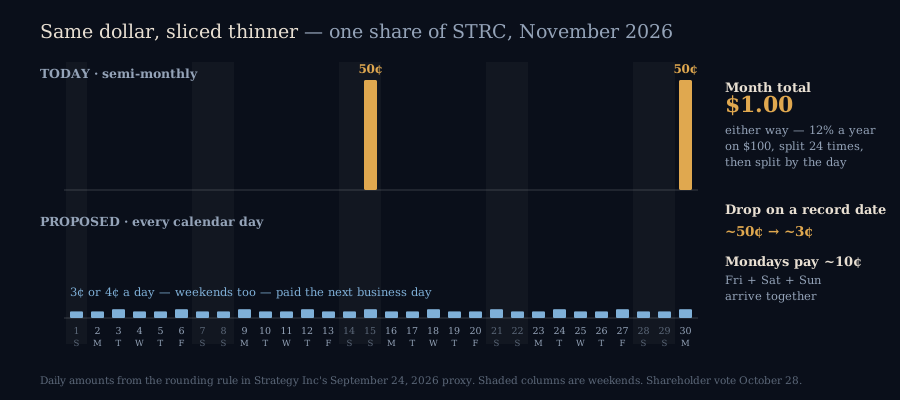
The proxy spells out the math, and it's more careful than I expected. Each month is still split into two halves (the 1st–15th and the 16th–end). Each half still earns one twenty-fourth of the annual rate — for STRC at 12% on its $100 stated amount, that's the same $0.50 it pays today. That fifty cents is then spread evenly across the calendar days in the half, rounded down to the cent each day, with the leftover fractions carried forward and the 15th and the last day of the month left unrounded, so every half-month still lands on exactly $0.50.
Worked through for November (the chart at the top): 3¢, 3¢, 4¢, 3¢, 3¢, 4¢, repeating, thirty times, totalling exactly one dollar. Because Friday's, Saturday's and Sunday's dividends all pay on Monday, Mondays carry about a dime. And because "business day" in the new terms means a day the Federal Reserve Bank of New York is open, not the stock exchange, Veterans Day on November 11 (market open, Fed closed) gets skipped, and Thursday the 12th pays six cents. For STRF, STRK and STRD the change is bigger: a quarterly check of $2.50 (STRF and STRD) or $2.00 (STRK) turns into two or three cents a day.
So if you own a hundred shares of STRC, you'll get somewhere around three or four dollars on a normal weekday and ten on a Monday, instead of fifty dollars twice a month. Same hundred dollars a month either way.
It Isn't the First
One headline I saw this morning announced that "No Company Does This." One company already does. Strive's SATA preferred has paid daily since mid-June; when Strive announced the plan in May, Michael Saylor's public reply was one word: "Impressive." Four months later, the sincerest form of flattery is in an SEC filing.
I can vouch for SATA's version firsthand: the rebalancer I run with real money, Arbitrageur, which I've written about before, holds a small SATA position, and its dividend record shows $0.052 a share landing on every trading day in September. The two designs differ in one telling detail. SATA's record dates fall only on trading days; there's nothing dated a Saturday. Strategy's accrues all 365 days and pays the weekend in a Monday lump. Same annual money either way, but Strategy's version is built for a calendar that doesn't close.
Why Bother, If the Money Doesn't Change?
The proxy lists five reasons. Translated:
- Less reinvestment lag. Your cash comes back sooner, so you can put it back to work sooner — including, the filing notes pointedly, "back into the Preferred Stock."
- Liquidity. No more timing a buy or sell around a record date.
- Price stability. This is the one to understand. Between payments, the dividend a share has earned but not yet paid builds up inside its price; on the record date it comes out all at once and the price steps down. Today STRC carries up to fifty cents of that and drops by it twice a month. Paid daily, the step shrinks to about three cents. For STRC specifically, the proxy ties this to "the Company's current intention to maintain STRC Stock's trading price at or close to its stated amount of $100 per share."
- Capital-markets access. Make the preferreds more attractive, sell more of them, and, in the filing's words, support "the Company's ability to acquire bitcoin."
- "Flexibility for Future Trading Models." More on this one below. It's the one that made me sit up.
On reason three, it's worth being honest about scale. The sawtooth is real but small next to ordinary noise: on September 15, STRC's last record date, it closed $1.77 lower than the day before, and only fifty cents of that was the dividend. For what it's worth, SATA has been the calmer security since July: its day-to-day price swings have been about half the size of STRC's, and it has closed at $100.01 four sessions running this week while STRC sat around $98.50. That's suggestive, but it isn't proof. Different company, different size, and STRC spent July climbing out of a June crash that took it as low as about $71. Daily dividends didn't cause that gap, and they won't close it by themselves.
The Part That Could Actually Change Something
Reason five, in full context: the change is "designed to provide the Company with greater flexibility to accommodate potential future developments in market infrastructure, including a potential transition towards expanded or continuous trading of Preferred Stock." The new terms also let Strategy designate additional days as business days.
That's the piece that looks forward. A dividend that only exists on trading days has an awkward question to answer the first weekend a security trades on a Saturday: who owns Saturday's dividend? A dividend with a record date on every calendar day has already answered it. On September 17 the SEC held a Roundtable on Preparations for 24-Hour Trading, the same day it gave tokenized stocks a five-year runway, and here is a company writing its securities' plumbing so they're ready for that before the exchanges are. It reads less like a dividend change and more like Strategy wiring the house before the power comes on.
Put reasons three, four and five together and you can see the product Strategy is aiming at: a security that sits at $100, accrues every day like a money-market fund, trades whenever you do, and pays 12%. If that works, it's a genuinely new kind of thing for a retail brokerage account. It would also be a very efficient machine for turning savers' cash into bitcoin purchases, which is, as the proxy says plainly, the point.
What It Doesn't Change
This is where the "could change everything" feeling needs its seatbelt.
- The credit is the same credit. Paying 12% in thirty slices doesn't make the 12% any safer. The reason STRC pays 12% while a money-market fund pays a fraction of that is that it is not a money-market fund. It's a perpetual preferred from a company whose operating business doesn't come close to covering its preferred dividends. On the CEBE board, which uses Strategy's June 30 balance sheet, that's roughly $15.5 billion of preferred at a blended ~11%, or about $1.7 billion a year. That works out to around $4.7 million every calendar day, against operating cash flow that covers about none of it. The money comes from raising more capital, which works as long as people keep buying.
- Every one of those daily dividends is still "if declared." The board still has to declare them. STRF, STRC and STRK are cumulative (a missed dividend is owed later, with compounding); STRD is not (a missed STRD dividend is simply gone).
- Transparency cuts both ways. Under a quarterly schedule, a company under strain has weeks of quiet before anyone finds out whether the check clears. Under a daily one, a skipped dividend shows up the next business morning. That's a genuine discipline, and I'd argue a point in the proposal's favor — but it also means there's no longer anywhere to hide a bad week.
The Vote Is Less Automatic Than It Looks
Two quirks worth knowing. First, the people who'd receive the daily dividends don't get a vote. Only common stockholders of record as of today, September 25, vote at the October 28 special meeting. The preferred holders just find out how it went.
Second, it needs a majority of all outstanding common voting power, not just of the votes cast. Michael Saylor's Class B shares carry ten votes each and give him 32.9% of the total, a lot but not a majority, so he can't pass this alone. The proxy is also explicit that an abstention counts as a vote against, and since brokers can't vote uninstructed shares on a matter like this, a retail shareholder who just ignores the ballot is effectively voting no. The same kind of vote passed in June, when shareholders approved moving STRC from monthly to semi-monthly, so I'd expect this one to pass too. But "expect" is doing some work in that sentence, and it's the only place in this story where anything is actually undecided.
So, Does It Change Everything?
Not the money. Not the risk. What it changes is the experience of holding the thing. Your brokerage account will tick up a few cents every morning, the price will sit stiller, and the security will look and feel a lot more like cash than it is. Whether that's a better product or a better disguise depends entirely on the credit underneath, and daily dividends don't touch the credit. The forward-looking bit, readiness for markets that never close, is the part I'd actually keep an eye on. It won't show up in November. If it matters, it'll be a few years from now.
What I'll Be Watching
- The October 28 result, and specifically the turnout, given that a no-show counts as a no.
- STRC's price behavior in November versus the last few months — whether the twice-monthly sawtooth actually disappears, and whether it trades any closer to $100.
- How brokerages display thirty tiny payments a month. Some of them are going to have very long dividend histories very quickly.
- Any movement toward weekend trading of these securities, which is the only thing that turns reason five from plumbing into news.
Where I Could Be Wrong
- The November schedule in the chart is my own calculation from the rounding rule quoted in the proxy, not a table Strategy published line by line (the proxy has an illustrative November graphic, but I worked the numbers myself). Treating Veterans Day as a non-payment day follows from the proxy's definition of a business day (a day the New York Fed is open); I haven't seen Strategy confirm that specific date.
- The ~$1.7 billion annual preferred obligation is computed from a June 30 balance sheet. Strategy has been issuing and buying back preferreds since, so today's figure is different in a direction I can't pin down precisely, and I haven't separately accounted for its euro-denominated preferred.
- The SATA-versus-STRC price comparison is a simple look at daily closes since July 1, with heavy confounding, as noted above. It's evidence that a daily-paying preferred can sit very close to par, not that daily payment is why.
- Prices are a Friday-afternoon snapshot (STRC about $98.50 on September 25) and will be stale by the time you read this.
- I own Strategy common stock, and small positions in both STRC and SATA, through Arbitrageur. None of this is investment advice; it's me reading the filings for securities I have a stake in.
- Strategy Inc. Form 8-K, filed 24 September 2026. sec.gov
- Strategy Inc. Preliminary Proxy Statement (Form PRE 14A) for the October 28, 2026 special meeting, filed 24 September 2026. sec.gov
- Strategy Inc. Form 8-K (STRC rate held at 12.00%; October 15 dividend declared), filed 31 August 2026. sec.gov
- Strategy Inc. Strategy Proposes to Pay Daily Dividends on its U.S. Listed Preferred Securities. strategy.com
- Strategy Inc. Strategy Announces Approval of STRC Semi-Monthly Dividends. Business Wire, 8 June 2026. businesswire.com
- Stocktwits. Michael Saylor Calls Strive's SATA Daily Dividend Plan 'Impressive'. 14 May 2026. stocktwits.com
- The Block. Strategy proposes daily dividends for STRC, STRD, STRF and STRK preferred stocks. 25 September 2026. theblock.co
- The Crypto Times. Michael Saylor's Strategy Proposes Daily Dividends on Preferred Stocks. No Company Does This. 25 September 2026. cryptotimes.io