Bought the Dip, After Selling It
SEPTEMBER 25, 2026
Somebody brought it up over coffee at Starbucks this morning: had I heard that Trump bought MicroStrategy? I'd half-heard it, which is the worst way to hear anything about a stock. So I went and read the filing. The short answer is yes, with three asterisks, and the asterisks are the interesting part.
What the Filing Actually Says
The document is an OGE Form 278-T, a periodic transaction report, which executive-branch officials have to file for securities trades over $1,000. This one was received by the Office of Government Ethics on September 14, certified September 18, and made the rounds in the crypto press over the last few days. It runs 37 pages and lists 1,156 transactions, every one of them in July 2026. Strategy Inc (the company still widely called MicroStrategy, ticker MSTR) shows up three times:
- July 8 — sale, $1,001–$15,000
- July 24 — purchase, $1,001–$15,000
- July 27 — purchase, $50,001–$100,000
The other crypto-adjacent lines: a Coinbase purchase on July 24 ($1,001–$15,000), and sales of two bitcoin miners on July 29, MARA Holdings and CleanSpark, $15,001–$50,000 each.
The form discloses dollar bands, not share counts or prices. So "Trump bought MicroStrategy" translates, precisely, to: somewhere between $51,002 and $115,000 of MSTR was bought in late July, in an account the President is the beneficial owner of.
Asterisk One: The Scale
That's real money for a person, but it's a small line in this particular filing. The same 37 pages include a single Amazon sale on July 20 in the $5,000,001–$25,000,000 band, plus nearly twenty lines in the $1,000,001–$5,000,000 band: municipal bonds, index and Treasury ETFs, and ordinary blue chips like Microsoft, McDonald's and Costco. At the top of its range, that one Amazon sale is about two hundred times the size of both MSTR purchases combined. If there's a crypto bet in this account, it's a garnish.
Asterisk Two: The "Yearly Low" Isn't Quite Right
Several headlines said the account bought MSTR "at yearly lows." I lined the dates up against the closing prices:
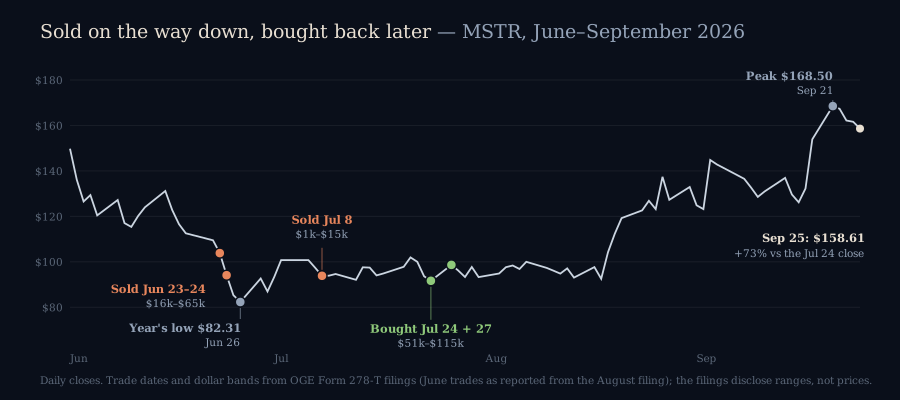
- June 23–24: the previous filing, covering June and published in August, reportedly shows two MSTR sales totalling $16,002–$65,000. MSTR closed those days at $103.84 and $94.13.
- June 26: MSTR hit its 2026 low, $82.31. That was two days after the sales.
- July 8: another small sale, with the stock around $94.
- July 24 and 27: the purchases, at closes of $91.67 and $98.65, which is 11 to 20 percent above the year's low.
So the more accurate story is less flattering and more human. The account sold on the way down, missed the actual bottom by a couple of days, and bought back a month later at roughly the prices it had sold at. The late-July buys weren't a bottom call. They were a round trip that ended just before a rally.
Asterisk Three: The Rally Came Later, and Not Everything Rallied
The widely quoted "up 83%" is measured from the July 24 close to MSTR's September 21 peak of $168.50, and it's correct for that pair of dates. At Friday afternoon's $158.61, it's about +73% from the smaller July 24 buy and +61% from the larger July 27 one. If the trades filled near those closing prices, that's a paper gain of very roughly $31,000 to $72,000, depending on where in the bands they really fell. Nice. Not historic.
The rest of the crypto lines tell a messier story, which is usually what a real portfolio looks like up close. The Coinbase purchase is up about 23% since July 24. But the two miners the account sold on July 29, at about $10.05 (MARA) and $12.01 (CleanSpark), are now around $12.55 and $13.95, up 25% and 16% since the sale. Same week, same sector, one call that aged well and two that didn't. That's what a busy manager's month looks like. It's not what a single well-timed bet looks like.
Who's Actually Pushing the Buttons
The White House position, as quoted in coverage of this filing, is that the accounts are run on a fully discretionary basis by independent third-party financial institutions, and that "neither President Trump, his family, nor The Trump Organization plays any role in selecting, directing, or approving specific investments." The filing itself doesn't name the managers.
Not everyone is satisfied with that. In an August 12 letter, Senator Elizabeth Warren and Representative Robert Garcia pointed to more than 21,000 trades in 2025 and roughly 50 a day in the first quarter of 2026, flagged fifteen specific trades they said deserved explanation, and asked the President to identify who manages the accounts. The June and July trades weren't public yet when the letter was written, so none of the MSTR trades are among the fifteen. Nothing in this filing's crypto lines settles that argument either way, and I'm not going to pretend it does.
What the volume does tell you is how to read one line out of 1,156. An account that trades about fifty times a day will, by pure arithmetic, have some trades that look brilliant in hindsight and some that look silly, and headlines tend to find the brilliant ones.
Can You Copy It?
This is where the coffee-shop version is most likely to cost someone money. These reports come out weeks after the trades by design. The July buys went public in mid-to-late September, after MSTR had already run up about 70%. The June sales went public in late August, after MSTR had already bounced roughly 45% off its low. By the time a trade in a disclosure reaches a Starbucks, it's old news: the move you'd want to copy has usually happened already.
So what I'd tell the person at coffee: yes, an account in the President's name bought somewhere between about fifty and a hundred and fifteen thousand dollars of MicroStrategy in late July, after selling some in June near the lows. It's a sliver of a very large, very busy account that he says outside managers run, and the news is two months old. If you want in on MSTR, want in for your own reasons, because the reasons in that filing are two months out of date.
Where I Could Be Wrong
- The June sales ($16,002–$65,000 on June 23–24) come from press reports of the August filing. I checked the July trades line by line in the September filing myself; I haven't traced the June lines personally.
- The paper-gain range assumes the trades filled near each day's closing price. The filing gives only dates and dollar bands, so the true figure could sit anywhere across a wide range.
- "Run by independent managers" is the White House's characterization, reported secondhand. I have no independent way to verify who made these specific trades.
- Prices are a Friday-afternoon snapshot (September 25) and will be stale by the time you read this.
- I own MSTR myself, through the rebalancer I've written about before, and bought it for reasons of my own long before this filing existed. None of this is investment advice.
- U.S. Office of Government Ethics. Donald J. Trump, OGE Form 278-T Periodic Transaction Report (July 2026 transactions), received 14 September 2026. oge.gov
- U.S. Office of Government Ethics. Donald J. Trump, OGE Form 278-T Periodic Transaction Report (June 2026 transactions), received 13 August 2026. oge.gov
- Yahoo Finance. Donald Trump Sold MicroStrategy and Bought Two Other Crypto Stocks. 23 August 2026. finance.yahoo.com
- TFTC. Trump Bought MSTR at 2026 Lows Per Federal Ethics Filing. tftc.io
- The Crypto Times. Trump Ethics Filing Shows July Buys of Strategy (MSTR) and Coinbase (COIN) Stocks. 24 September 2026. cryptotimes.io
- Senator Elizabeth Warren and Rep. Robert Garcia. Letter to President Trump re: Stock Trades. 12 August 2026. warren.senate.gov