Seventeen Billion Reasons They're Still Not In
SEPTEMBER 22, 2026
I keep half an eye on Strategy Inc's weekly filings the way some people check a sports score, partly because I write software that trades its own related preferred stock with real money, and partly because it's one of the stranger companies on the market right now — a forty-year-old business-intelligence firm that now reports its results one line at a time, in bitcoin. Last week gave me four separate numbers worth writing down, and they don't tell one story. They tell three, and the interesting part is that all three trace back to the same accounting rule.
The Week's Numbers
Between September 14 and 20, Strategy bought 950 bitcoin for $75.7 million, an average of $79,670 a coin including fees — its first purchase in two weeks. That brings the total to 846,000 BTC, bought over five years for a combined $63.80 billion, an average cost of $75,416 a coin. In the same week it spent $174.0 million buying back 1.77 million shares of its own STRC preferred stock, leaving $875.1 million of that buyback authorization unused, and paid $57.4 million of preferred dividends and debt interest out of a cash pool it calls the USD Reserve — which stood at $5.04 billion after the payment, alongside $1.05 billion of separate operating cash. Both the bitcoin purchase and the buyback came out of cash on hand; no new shares were sold that week.
The USD Reserve is worth a beat on its own, because it's new. Strategy set it up on December 1, 2025, as a dollar-denominated pool held apart from the bitcoin, specifically to fund preferred dividends and bond interest without ever having to sell BTC to make a payment. As of late June it held about $2.55 billion, covering roughly 17 months of obligations at the company's own stated run rate. Three months later it's nearly doubled to $5.04 billion. That's either genuine derisking or a company thinking hard about the next paragraph — probably both.
The Number the Index Cares About
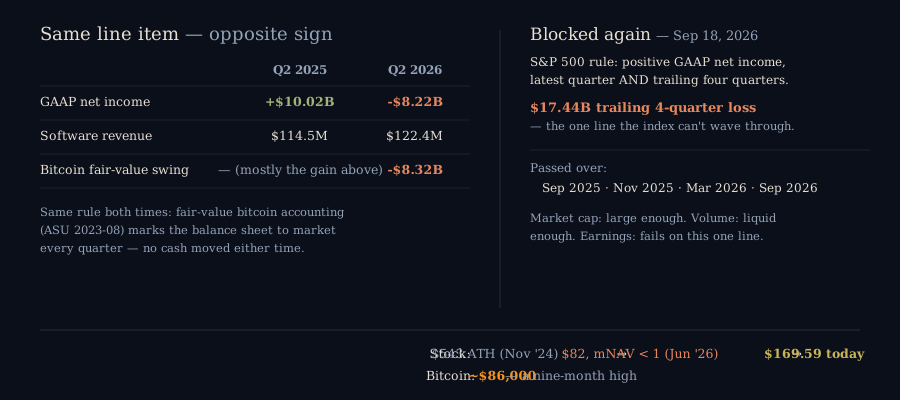
On September 18 — the same week — the S&P 500 did its quarterly rebalance and, for the fourth time running, left Strategy off the list. It's been passed over in the September 2025 rebalance, again in November 2025 (SanDisk got the spot instead), again in the March 2026 rebalance, and now again. The first few rejections came down to a soft judgment call: index committee members were on record describing the company less as an operating business than as a leveraged bitcoin fund wearing a software company's ticker. This time the reason was harder and more specific. Cryptobriefing reported that Strategy is disqualified by the index's own written profitability rule — positive GAAP net income required in both the most recent quarter and the trailing four quarters combined — because its trailing four quarters carry a cumulative $17.44 billion unrealized loss on its bitcoin holdings. Market cap: large enough. Trading volume: liquid enough. U.S. incorporation: check. One line on the income statement: fails outright, and the index has no discretion to look past it.
Here's the part that made me go check the prior year's number instead of just taking the current one at face value. Strategy's second quarter of 2026, reported at the end of July, was a net loss of $8.22 billion — $24.45 a share — driven by an $8.32 billion unrealized markdown on its bitcoin as the price slid to around $64,915 that quarter, against software revenue of a genuinely fine $122.4 million, up 6.9% year over year, at a 66.6% gross margin. The same quarter a year earlier, Strategy posted GAAP net income of $10.02 billion — a real number, not an adjusted one, driven by the identical mechanism running in the other direction. That's the whole joke and the whole problem in one sentence: the fair-value accounting rule that let bitcoin's paper gains flow straight into "profit" starting in 2025 — the rule change bitcoin-treasury advocates spent years lobbying for, on the theory that it would finally make companies like this look normal to an index committee — is the exact same rule now producing the paper loss that keeps this one out. It cuts both ways because it was always going to. Nobody built an asymmetric version.
A Number That Already Looks Stale
And because bitcoin doesn't sit still, the loss behind that $17.44 billion figure is already smaller than the headline suggests, and may not exist at all by the time you read this. Bitcoin traded near $64,915 when Strategy's books closed at the end of June. This morning it opened around $86,600 — a nine-month high, up roughly 10.6% in a week alone. Run 846,000 coins through that new price and Strategy's holdings are worth about $72.8 billion against a $63.8 billion cost basis: comfortably in unrealized-gain territory again, on paper, for the first time in months. An index rule gated on a trailing four quarters of GAAP earnings is, structurally, always going to be looking in the rearview mirror at an asset this volatile. That's not a defense of the rule or an attack on it — it's just worth knowing that "blocked again" and "underwater" are not the same fact, and by September 22 only one of them is still true.
The Swing That Explains the Stock
The stock itself had a rougher year than the bitcoin did. Strategy hit its all-time high of $543 a share on November 21, 2024. By June 27, 2026, it had fallen to around $82 — an 85% drawdown — and crossed a threshold that got real attention in the bitcoin-treasury world: its enterprise mNAV fell below 1, meaning the market was valuing the whole company — equity, debt, and preferred stock combined — at less than the bitcoin sitting on its balance sheet. mNAV is the ratio the entire strategy runs on: Strategy's playbook has always been to sell stock or convertible debt above the value of its bitcoin and use the premium to buy more bitcoin per share outstanding, the thing Saylor calls "BTC yield." Below 1, that machine runs backward — every new share sold buys less bitcoin per share than the shares already outstanding represent, which makes the whole flywheel dilutive instead of accretive. It's the one number that can quietly turn a growth strategy into a value-destroying one without a single trade going wrong.
As of today the stock sits at $169.59, up about 107% from that June low but still 69% below the November 2024 peak — a genuine recovery that still leaves a lot of ground uncovered. Market cap is roughly $65.2 billion against $72.8 billion of bitcoin at today's price, which by that simplest measure — stock alone versus the coins alone — is actually still a discount of about 10%. The "enterprise mNAV" trackers that quote numbers closer to 1.05–1.15 aren't wrong; they're answering a different question, one that adds back the face value of every dollar of preferred stock and debt outstanding (since a STRC or STRF holder is also, in its own way, long the balance sheet) and subtracts the now-larger cash reserve. Both numbers are honestly computed. Quote whichever one you're actually asking about.
A Junk Rating on a Trillion-Dollar Asset
Strategy also carries a credit rating now, which is new for this kind of company. S&P Global Ratings assigned it B- with a stable outlook on October 27, 2025 and affirmed it in December after the USD Reserve went live. Squarely junk-bond territory. The reasoning is straightforward and, honestly, hard to argue with: a balance sheet concentrated almost entirely in one volatile asset, thin dollar liquidity next to dollar-denominated obligations, and — the phrase that's stuck with me — a currency mismatch, since nearly everything the company owns is priced in bitcoin while every dividend and every interest payment it owes is priced in dollars. An analyst's line on it at the time: able to service debt for now, vulnerable to shocks. The company's own 10-Q as of June 30 lists the debt sitting ahead of the common stock in that mismatch — STRF preferred, $1.28 billion outstanding at a 10.00% fixed dividend; STRC, $10.49 billion at 11.50%, variable; STRE, €775 million at 10.00% — and that's before STRK and STRD, two more series with their own coupons. Five different classes of preferred stock, each one paid in full before a common shareholder sees a cent, none of them optional the way a dividend on the common stock is.
What I'll Be Watching
- Whether the trailing-four-quarter number flips. Bitcoin's already back above Strategy's average cost basis as of this morning. If the next few quarters post GAAP gains instead of losses, the earnings test that's blocking S&P 500 inclusion stops being an issue on its own — the "leveraged fund, not an operating company" objection from the earlier rejections wouldn't, though.
- The STRC buyback's pace. $875.1 million of authorization is still sitting there. A preferred-stock buyback funded by cash on hand, in the same week as a bitcoin purchase, is the company choosing to shrink one obligation while growing the asset that backs all the others — worth watching whether that trade-off holds if bitcoin turns again.
- A second rating agency. S&P is the only major agency that's rated Strategy so far. A Moody's or Fitch opinion, whenever one lands, will say a lot about whether B- is a consensus view or one agency's read.
- My own book. Arbitrageur, the rebalancer I've written about before, holds 45% MicroStrategy stock and 45% a bitcoin fund with real money, no forecasting, just a drift band. It doesn't know or care about any of the above — but I do, since it's my money doing the not-caring.
Where I Could Be Wrong
- The $17.44 billion trailing-four-quarter figure comes from Cryptobriefing's reporting on the S&P 500 eligibility decision, not from a Strategy filing that states that exact cumulative number itself; I've corroborated the mechanism (the profitability rule) and the single-quarter figures that would feed it (Q2 2026's $8.32 billion unrealized charge) independently, but I haven't traced the other three quarters that make up the full trailing total line by line.
- "mNAV below 1" and "enterprise mNAV around 1.05–1.15" are both real numbers I computed or sourced independently, on different dates and by different methods (raw market cap vs. bitcoin value, and enterprise value vs. bitcoin value) — they're not in conflict, but a reader skimming past that distinction could reasonably think I contradicted myself in the same piece.
- Bitcoin's price moves by the hour, and I'm quoting a morning snapshot. By the time this is read, the "back in unrealized-gain territory" line could be stale in either direction.
- STRK and STRD's current outstanding balances I don't have precise, dated figures for and didn't want to guess at — I've named them as existing obligations without a dollar amount attached, which is a real gap in the capital-stack picture, not a rounding error.
- I hold Strategy Inc. stock and bitcoin, through an ETF, myself — and Arbitrageur holds both directly with real money, as described above. None of this is investment advice; it's me checking numbers I have a personal stake in getting right.