The Family That Now Owns Your Childhood
SEPTEMBER 23, 2026
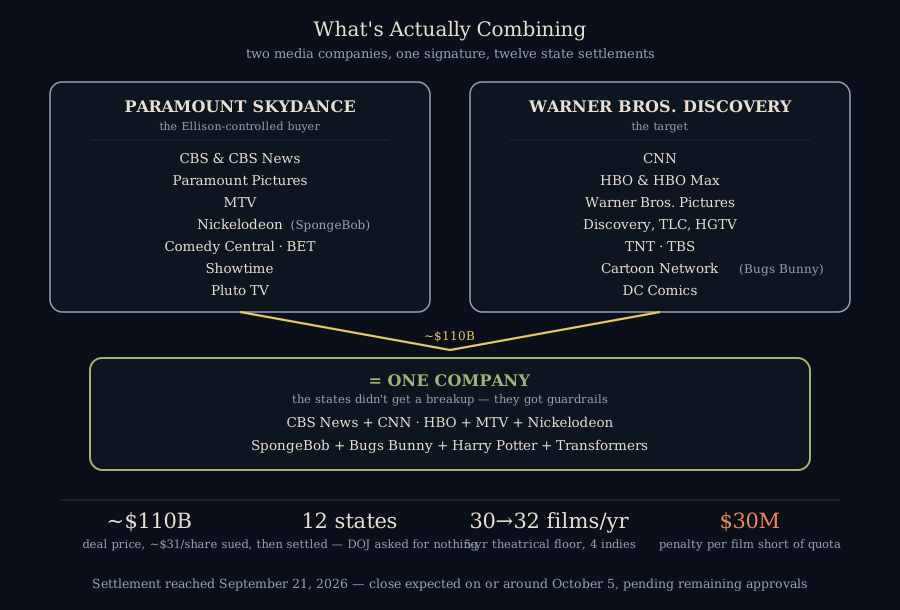
A friend texted me a single line this week: "so CNN's owner now also owns SpongeBob." I checked, and he's not wrong, though he undersold it. The same signature that puts CNN and SpongeBob under one roof also covers CBS, HBO, MTV, Bugs Bunny, Harry Potter and Transformers — a list that reads like someone raided both a newsroom and a toy aisle and filed the receipts together. Paramount Skydance's roughly $110 billion acquisition of Warner Bros. Discovery cleared its last real obstacle on September 21, when Paramount settled a lawsuit brought by twelve state attorneys general who'd sued to block it. I went and built the org chart, because I wanted to see the whole thing in one place before it disappears into a press release about "synergies."
What's Actually Combining
Paramount Skydance — the company David Ellison built by first buying Paramount Global in 2025, then turning around and bidding for its onetime corporate cousin — brings CBS and CBS News, Paramount Pictures, MTV, Nickelodeon (home of SpongeBob SquarePants), Comedy Central, BET, Showtime and the free ad-supported streamer Pluto TV. Warner Bros. Discovery brings CNN, HBO and HBO Max, Warner Bros. Pictures, the factual-cable stable of Discovery, TLC and HGTV, the Turner networks TNT and TBS, Cartoon Network — Bugs Bunny's actual employer — and DC Comics. Put the two rosters next to each other and the overlap isn't in the brands, it's in the audience: there is functionally no American household that watches television, streams anything, or has ever set foot in a movie theater that this deal doesn't touch. Transformers (Paramount, via a Hasbro license) and Harry Potter (Warner Bros., outright) have spent two decades as rival franchises fighting for the same July weekend. As of this month they're franchise-mates.
The Ellisons' Money
It's worth saying plainly who's actually buying this, because "Paramount Skydance" is a corporate name standing in for a family. David Ellison runs it. His father Larry Ellison — Oracle's co-founder and executive chairman, and by most rankings one of the two or three richest people alive — is the reason it can afford Warner Bros. Discovery at all. Back when this was still a hostile bid, Larry Ellison made what Paramount's own filing called an "irrevocable personal guarantee" of $40.4 billion toward the offer — one man's word, backing a bid for a company with CNN's newsroom in it. Reporting since has described the final capital stack as a wider mix: Ellison family equity, an investment from RedBird Capital, roughly $24 billion from Gulf sovereign wealth funds structured as non-voting shares, and a debt syndicate running to more than a dozen lenders. I can't fully verify how that stack looks the week the deal actually closes — see the caveat below — but the throughline doesn't change: one family's fortune, built in enterprise software, is now the single largest financial backstop behind CBS News, CNN, and the Batman movies. Warner Bros. Discovery shareholders approved the deal on April 23; the Department of Justice cleared it on June 12 — and, notably, asked for nothing in return.
Does Anyone Still Worry About Monopolies?
Here's the part I actually find interesting, and it isn't the size of the check. It's who cared enough to fight it. The federal government's antitrust review took about eight months and ended with zero conditions attached — no divestitures, no behavioral commitments, nothing. If that had been the whole story, this would be a deal that sailed through with the same institutional shrug that's waved through most of this decade's media consolidation. It wasn't the whole story. On July 13, a coalition of twelve states led by California's Rob Bonta sued to block the merger outright, arguing it would concentrate the film business enough to cut output, raise prices, and put Hollywood workers out of work — the fewer-movies, higher-prices, fewer-jobs case, made in state court by state officials, with no federal antitrust regulator anywhere in the room. A judge granted a temporary restraining order a week later. So: yes, people are still concerned about media monopolies — just not, this time, the people whose actual job it is at the federal level. It took a dozen state AGs doing DOJ's old job for DOJ to keep passing on.
Guardrails, Not a Breakup
What the states actually won is a five-year, court-enforceable consent decree — genuinely substantive, but a long way from what a breakup would have looked like, and Paramount keeps every network in the diagram above, including Warner Bros. Discovery's cable channels. The headline number: at least 30 theatrical films a year for the first two years, rising to 32 a year for years three through five, with at least 20 wide releases in the early years and 21 later, at least four independent films annually, and a rule that 20% of the slate must carry budgets of $50 million or more and open in 3,000-plus theaters — a floor under both quantity and scale, so the combined studio can't hit its film count with twenty straight-to-streaming programmers. Miss a film, and the penalty is $30 million per short film, paid into union health and retirement funds — and if the shortfall isn't fixed within 12 months, Paramount forfeits its stake in Miramax. On top of the film floor: a five-year, $1.5 billion commitment to domestic production above 2025 levels ($300 million a year), a 45-day exclusive theatrical window before anything moves to streaming, a $47.5 million workforce fund for retraining, a separate $17.5 million payment into the Writers Guild's health fund plus a five-year pause on layoffs at CBS News, five years of Paramount and Warner Bros. cable networks negotiating carriage separately rather than as one bargaining unit, and a five-member editorial-independence board — no more than two members from the same political party, three-year terms — overseeing CNN and CBS News. None of it un-merges the company. All of it is Paramount agreeing to be watched. NPR, TheWrap and CNBC each have their own writeups of the same terms if you want a second read on any of it.
What I'll Be Watching
- The actual close. Ellison said the deal would close roughly two weeks after the September 21 settlement — call it on or around October 5 — pending sign-off from remaining jurisdictions, the UK among them. Nothing above has happened to the org chart yet, only to the legal path toward it.
- Whether the editorial-independence board is real or ornamental. A five-person board reporting through a chief compliance officer to the very board it's overseeing is a structure that can go either way depending entirely on who gets appointed to it.
- The first missed film, if there is one. A $30 million penalty is a real number to a union health fund and a rounding error to a $110 billion company. Whether the quota bites depends on whether Paramount treats it as a floor or a fine worth paying.
- Whether any other state, or Congress, follows California's lead. DOJ clearing a deal used to be close to the last word. This time it wasn't even the deciding one.
Where I Could Be Wrong
- The total deal value is reported differently across outlets — $108 billion, $110 billion, $110.9 billion in enterprise value at $31 a share, $111 billion — depending on rounding and what's included. I've used "roughly $110 billion" throughout as the figure most outlets converge on; none of the differences I found look like a different underlying deal, just different rounding conventions.
- The final financing structure — the RedBird Capital investment and the roughly $24 billion from Gulf sovereign wealth funds — I sourced from secondary reporting rather than a primary SEC filing I read myself line by line, and financing structures on a deal this size are known to shift between an initial bid and an actual closing. The $40.4 billion Ellison personal guarantee is the one figure here I'm most confident in, since it comes from Paramount's own contemporaneous statement.
- Larry Ellison's net worth — I've seen it cited near $243 billion as of late February 2026 in Forbes' own coverage of this deal, but I wasn't able to load that article directly to confirm the exact figure and date myself; Oracle's stock has moved enough this year that any specific number is stale within weeks regardless.
- The Miramax divestiture penalty — I've seen this reported consistently across two independent sources as the 12-month backstop for an uncured film-quota miss, but I haven't read the underlying consent decree text myself, and Miramax's own ownership (split between beIN Media Group and a Paramount-linked minority stake, as I understand it) is a more tangled cap table than this piece has room to unpack.
- Whether "DOJ asked for nothing" is the full federal picture — I'm describing the Justice Department's own antitrust clearance, which came with no conditions; I haven't dug into whether the FCC, which separately touches broadcast-license transfers, attached anything of its own on the CBS side.