Nearly Two Million Barrels to Fix One Shortage
SEPTEMBER 23, 2026
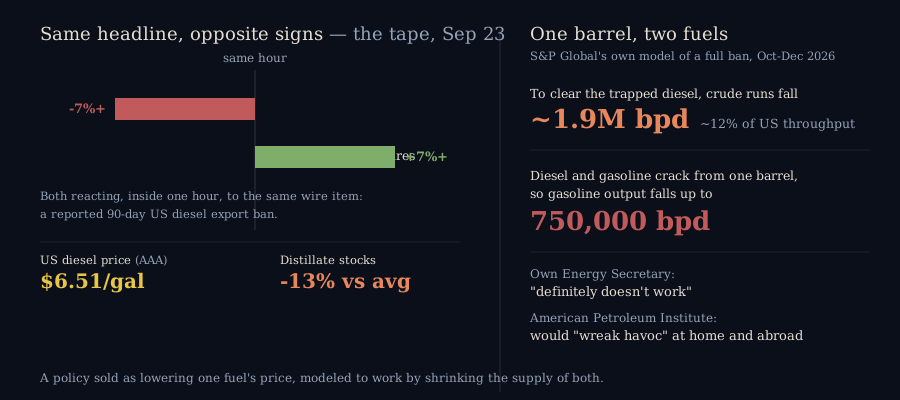
I don't usually stop scrolling for a ZeroHedge headline, but this one was two numbers with opposite signs in the same breath: "US diesel futures sink more than 7% to intraday low" stacked directly over "European diesel futures surge over 7% to session high," both reacting to the same wire item — Politico reporting that the White House is preparing a 90-day ban on US diesel exports. A market moving 7% in opposite directions on two sides of the Atlantic inside the same hour is itself informative — it's the market pricing "diesel gets trapped inside the US, Europe goes short" before a single barrel has actually moved. I went and read past the tape to find out what's actually being proposed, why, and what the people who'd have to implement it are saying about their own policy.
What's Actually on the Table
Nothing is signed. What's reported is a plan, not a policy: Louisiana Governor Jeff Landry — whose state hosts a large share of US Gulf Coast refining — has publicly pushed for a 90-day ban, and Trump endorsed the idea on September 22, telling reporters "I've said let's not send out the diesel" and that a decision would come "one way or another," with Politico's sourcing describing him as inclined to put something forward by the end of the week. Treasury Secretary Scott Bessent confirmed the administration is examining whether a ban is feasible, framed explicitly around whether US refining capacity could absorb it. Nobody in the reporting I found states the legal mechanism — an IEEPA emergency declaration is the one most commonly floated by outside commentary, but that's inference, not confirmation. Whether it lands as a full ban, a partial quota, or nothing at all is, as of this morning, still an open question the administration's own people are visibly arguing about.
Why Diesel, Why Now
The proximate reason is the price. US retail diesel hit a record $6.51 a gallon on September 22, according to AAA — roughly $3 above where it sat in January. On-road distillate inventories are running about 13% below their five-year seasonal average, and the EIA has flagged distillate stocks near their lowest level in roughly four decades. US refiners are already running close to full tilt, so there's essentially no idle capacity sitting around to simply switch on.
The deeper cause is mostly happening somewhere else. Ukrainian strikes on Russian refining infrastructure have knocked out enough capacity that Russia extended its own diesel export ban through October, and the EIA expects those Russian outages to keep weighing on the global distillate market through the first half of 2027. Separately, the disruption around Iran and the Strait of Hormuz has been cutting into crude flows and refinery runs elsewhere. On top of both, the US is heading into heating-oil season, and the EIA's own outlook projects retail diesel averaging $5.55 a gallon in the fourth quarter of 2026, with the Northeast — where diesel-based heating oil is still common — singled out for the steepest exposure. A Jones Act waiver, the policy lever the administration already tried to ease domestic supply, has had limited effect and is set to expire November 15.
And it's genuinely a lot of diesel leaving the country: US refiners produce something on the order of 5 million barrels a day of distillate against domestic demand closer to 3.6–3.9 million, with the difference — a record 1.6 million barrels a day in August — going out mostly to Brazil, Chile, Mexico, Peru, Morocco, France and the UK. Of roughly 8 million barrels of diesel that move by sea globally each day, the US alone supplies about 1.5 million of them — close to a fifth of the entire seaborne market.
His Own Officials Are Saying No
The most interesting thing about this story isn't the market reaction — it's that the administration is reportedly moving toward a policy its own Energy Secretary has publicly rejected. Chris Wright told reporters the ban "definitely doesn't work" and warned it risks creating a bigger supply squeeze later. The American Petroleum Institute — the refining industry's main lobby — went further in a statement the same week, saying a ban "would wreak havoc on fuel markets at home and abroad, destabilize refinery operations and deepen a global refining crisis." Politico's own framing was that the plan is proceeding "despite splits inside the administration and with the oil industry." That's an unusual place for a policy to be a few days before it might get signed.
The Number Behind the Backfire
Here's the mechanism the pushback keeps pointing at, and the one number I could actually trace to a named model. Diesel and gasoline are joint products — a refinery doesn't choose to make one without the other, it cracks a barrel of crude into both at once, in ratios it can shift only within limits. S&P Global modeled a complete diesel export ban running October through December 2026 and found that absorbing roughly 1.48 million barrels a day of now-forbidden exports would fill Gulf Coast storage fast enough that refiners would need to cut crude runs by about 1.9 million barrels a day — better than 10%, and by some framings closer to 12%, of total US throughput — just to stop the glut from crashing diesel prices below the cost of making it. Because gasoline comes off the same barrel, that same cut is modeled to pull gasoline output down by as much as 750,000 barrels a day.
That's the whole irony in one sentence: a policy built to fix a diesel shortage is modeled, by the industry's own analysts, to work by manufacturing a second shortage in gasoline. It doesn't even reliably fix the first one everywhere — Gulf Coast and Midwest diesel would get cheaper as it backs up with nowhere to go, but pipeline and shipping constraints mean a lot of that surplus can't easily reach the Northeast, the region actually most exposed to the heating-oil squeeze the ban is nominally aimed at. Europe, meanwhile, loses its largest single external diesel supplier at the exact moment it's already replacing lost Russian and Middle Eastern barrels — which is the other half of what the tape was pricing this morning.
What the Tape Actually Did
The reaction ZeroHedge caught was fast and clean: US ULSD futures down more than 7% to an intraday low, European gasoil futures up more than 7% to a session high, the market instantly splitting US and European diesel into two different assets on one headline. Refiner stocks fell in sympathy the same day — Marathon Petroleum, Valero and PBF Energy all traded lower — though by the next session the refiners had partly recovered. Bloomberg reported the policy talk was enough on its own to stall a rally the refining sector had been riding on record diesel margins — the same margins Goldman Sachs had been citing just weeks earlier as a reason to like refiner stocks in the first place. A sector getting rewarded for a shortage and then punished for the government's proposed fix to that same shortage, inside one news cycle, is a fairly clean illustration of why "good politics, bad economics" is the phrase showing up across nearly every independent analysis of this plan, from Columbia's Center on Global Energy Policy to the Atlantic Council to Bloomberg's own opinion desk.
What I'll Be Watching
- Whether anything actually gets signed, and in what form. A full 90-day ban, a partial quota, or nothing are all still live options per the reporting — Wright's own quoted framing ("do you do it across products? Do you do a ban or a quota?") suggests even the mechanism isn't settled internally yet.
- Gasoline, not diesel. If S&P Global's model is directionally right, the number that actually tells you whether this policy worked is the pump price of gasoline a month or two out — not the diesel spread the tape moved on this morning.
- The Jones Act waiver's November 15 expiration. It's the domestic-relief lever the administration already tried, with limited measured effect; whether it's extended alongside or instead of an export ban says a lot about how much the White House actually trusts the export-ban approach to work on its own.
- Whether the futures divergence holds. A same-hour, opposite-sign, 7%-both-ways move on a policy that isn't signed yet is a market pricing probability, not certainty — worth checking whether US and European diesel futures re-converge as the "will they, won't they" drags on.
Where I Could Be Wrong
- Nothing here is enacted policy. Every figure in this piece describes a plan reported as being drafted, with Trump described as "inclined" to act — not a signed order. It could still not happen, or land in a materially different (partial/quota) form than what's modeled above.
- The retail diesel price itself is a moving target. I'm using AAA's $6.51-a-gallon figure as reported September 22; other outlets have cited $6.29, $6.50 and $6.53 at slightly different moments in the same week, which is less a contradiction than a fast-moving number getting sampled at different times.
- I could not find a named, on-the-record estimate translating the roughly 750,000 barrel-a-day gasoline cut into a specific cents-per-gallon price impact. I've seen that framing floated in commentary, but every dollar figure I could actually trace to a source was either a barrels-per-day production number or a diesel (not gasoline) wholesale price move tied to a different mechanism — so I've left the gasoline number in barrels, not converted it to a price, rather than repeat a figure I couldn't pin to anyone.
- The ~97%-of-capacity refiner utilization figure and the Jefferies downgrade of Valero and Marathon both come from my research pass secondhand rather than a primary data release I pulled myself — worth treating as directionally right rather than exact.
Sources
- Bloomberg. US Prepares Plan for 90-Day Diesel Export Ban, Politico Reports. 23 September 2026. bloomberg.com
- Axios. Trump backs diesel export ban. 22 September 2026. axios.com
- CNBC. Trump administration is examining whether a diesel export ban is feasible, Treasury secretary says. 22 September 2026. cnbc.com
- CBS News. Diesel prices just hit a new record. Would a U.S. export ban bring relief? 22 September 2026. cbsnews.com
- U.S. Energy Information Administration. Today in Energy — distillate inventories. September 2026. eia.gov
- Yahoo Finance. Global diesel shortage tied to Iran, Ukraine conflicts seen persisting into 2027. September 2026. finance.yahoo.com
- GNG Research. How a US Diesel Export Ban Could Impact Global Fuel. September 2026. gngresearch.com
- ZeroHedge. "Definitely Doesn't Work": US Energy Sec Rejects Diesel Export Ban, Risks Creating Bigger Supply-Squeeze Later. September 2026. zerohedge.com
- American Petroleum Institute. A Diesel Export Ban Would Wreak Havoc at Home and Abroad. Here's Why. 22 September 2026. api.org
- American Action Forum. A Diesel Export Ban Won't Solve High Fuel Prices. September 2026 (citing S&P Global modeling). americanactionforum.org
- Investing.com. Trump admin said to mull 90-day diesel export ban; refiner stocks, futures fall. 22 September 2026. investing.com
- Bloomberg. Refining Stocks Rally Stalls as Talk of Diesel Export Ban Swirls. 22 September 2026. bloomberg.com
- ZeroHedge (@zerohedge). US prepares 90-day diesel export ban: Politico. US diesel futures sink more than 7% to intraday low. European diesel futures surge over 7% to session high. 23 September 2026. x.com