Binance Rebuilt My Bitkey, Minus the Metal
SEPTEMBER 23, 2026
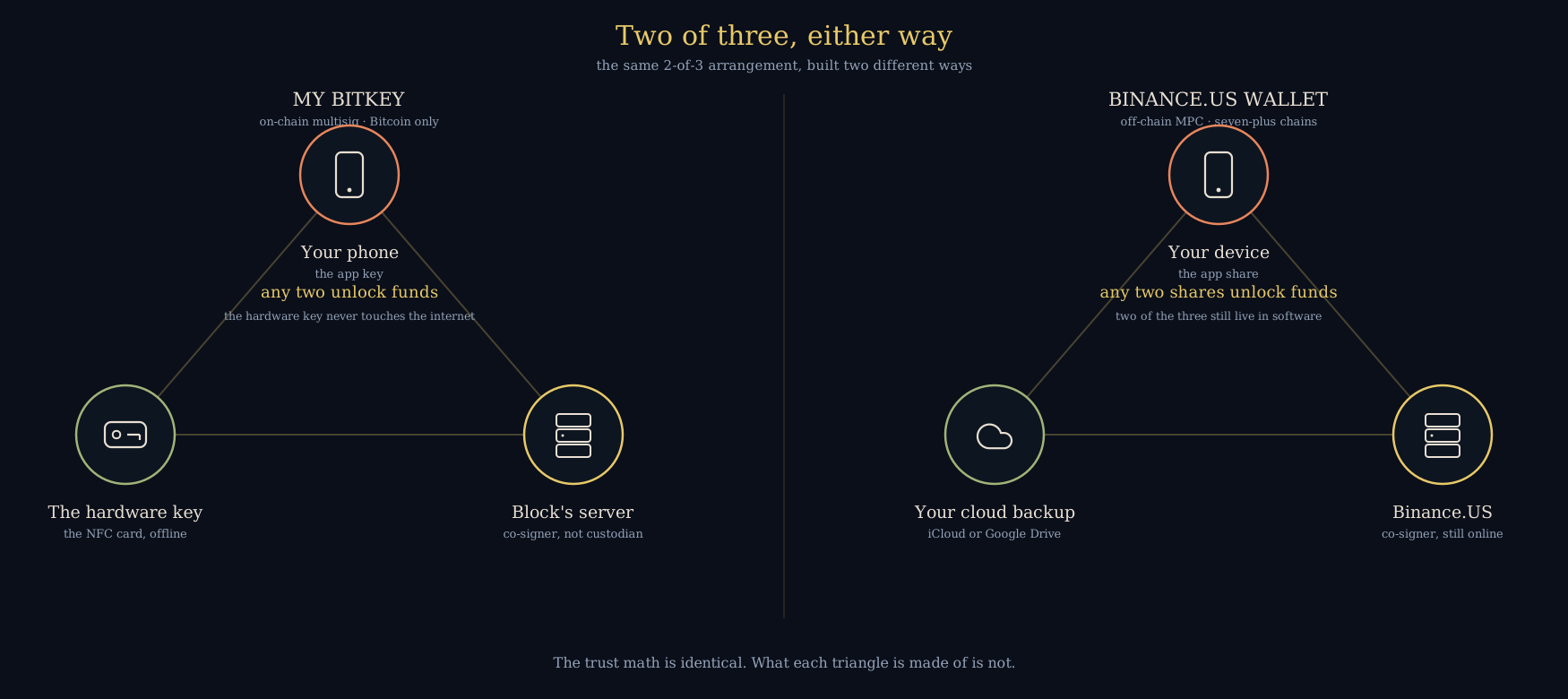
An email from Binance.US landed in my inbox this afternoon, subject line "A Different Way to Hold Your Crypto." The pitch: a new self-custody wallet built into their app, no seed phrase required, your keys "split three ways: across your device, your personal cloud storage, and Binance.US. No single point of failure." I read it twice, because I already own the thing this is describing. It's called a Bitkey, and I wrote about mine seven weeks ago, after a hardware wallet bug across town went and stole a hundred and thirty million dollars.
What Landed in My Inbox
Binance.US Wallet went live today, September 23, for eligible iOS and Android users — folded directly into the existing Binance.US app, so you can move between the exchange side and the wallet side without switching apps. The pitch, in the company's own words: "self-custody, simplified," keyless technology that splits your key three ways, and "no single point of failure" because a thief would need to compromise more than one location at once. It reaches Ethereum, BNB Chain, Base, Arbitrum, Polygon, Solana, and Robinhood's new Robinhood Chain — "tens of thousands of tokens and hundreds of DApps" in the company's phrasing. A built-in Security Center lets you check a token or a dApp before you trade it. And a footnote promises lower fees than "major self-custody wallets," measured, per the email's own fine print, against published fees as of September 22 and "not guaranteed for all users or transactions."
I Already Own the Idea This Is Selling as New
Here's the thing that actually surprised me: the marketing isn't lying, and it isn't even new. "No seed phrase, no single point of failure, need two of three to move anything" is precisely Bitkey's pitch — the one Jack Dorsey's company, Block, has been shipping since 2024. Binance's own explanation of the mechanics, published on its blog under the title "Embracing the Future of Web3," lays out the identical shape: three key-shares are generated, one lands on your device, one lands in your personal cloud storage (iCloud or Google Drive) behind a recovery password only you know, and one sits on Binance's own servers. "A minimum of two key-shares is required" to sign anything. Lose one, the other two still get you home. That's the exact sentence I wrote about my own hardware key in August, word for word in spirit if not in vendor.
Multisig and MPC Look Identical on a Slide, Not on the Chain
Where the two actually part ways is more interesting than "hardware versus software," and it's worth getting right before getting to that part, because the two techniques aren't quite the same thing wearing different clothes. Bitkey is on-chain multisig — three real Bitcoin keys, and the arrangement itself is visible in the transaction: anyone looking at the blockchain can see it's a two-of-three script, the same way you'd notice a signature line on a contract needs two names on it. Binance's mechanism is MPC, multi-party computation — three mathematical shares that jointly compute one ordinary signature without any single private key ever existing anywhere, even for an instant. Binance's own description is direct about this: "a single private key is never generated, split, or reconstructed in the process." That's a genuinely elegant piece of cryptography, and it produces a transaction that looks, on the blockchain, like any other single-signature wallet in the world — no visible fingerprint that three parties were involved at all. The trade is exactly the mirror image of the trade you'd guess: Bitkey's arrangement is auditable by a stranger from the outside, using nothing but a block explorer; Binance's is invisible from the outside and has to be trusted from the inside, on the strength of the company's own implementation.
The Difference That Actually Decides It: What's Doing the Signing
Set the cryptography aside, because it isn't the part that would keep me up at night. What matters more is where the two non-server keys physically live. My Bitkey's second key sits on a dedicated piece of hardware — a stainless-steel card, talking to my phone only over NFC, that has never once touched the internet and never will. Binance.US Wallet's two non-custodial shares are your device and your personal cloud storage — which is to say, your phone and your iCloud or Google account, both ordinary software, both reachable by anything that can already reach your phone. If malware gets onto that phone, an attacker doesn't need to break MPC math at all; they need your device share, which they may already have, and your cloud account, which is a password-and-2FA problem rather than a steal-something-out-of-my-pocket problem. Two of three starts to look a lot closer than the marketing implies once you notice both non-Binance shares share one attack surface.
I made this same point in my Bitkey piece about a different failure entirely — the billion and a half dollars Bybit lost out of a cold multisig in February of 2025, not because anyone broke the multisig math, but because the interface the signers were looking at showed them a different transaction than the one they actually approved. That risk applies here with extra force: Bitkey at least ships a hardware device whose whole second-generation redesign was adding a screen to verify what you're signing against. A phone-plus-cloud arrangement has no such independent surface to check against at all — the phone showing you the transaction is the same phone holding one of your two shares.
Scope Is the Real Trade, and It's Not a Small One
Bitkey does one thing: Bitcoin. That's Block's whole minimalist thesis, and it means the attack surface is whatever Bitcoin's base layer actually is — old, simple, thoroughly picked-over. Binance.US Wallet reaches seven-plus chains and, per its own pitch, tens of thousands of tokens. That's not a knock; multi-chain DeFi is a real use case with real demand. But it's also exactly why the wallet ships with a built-in "Security Center" to vet a token or a dApp before you touch it — a feature Bitkey has no need for, because there's nothing to vet. Every extra chain is an extra bridge, an extra token-approval dialog, an extra scam contract with a name one letter off from a real one. Bitcoin's narrowness isn't a missing feature. On a wallet built to hold savings rather than to explore, it's the feature.
Who's Actually Holding the Third Share
Worth naming plainly, since it's a fact about the arrangement and not a jab: Bitkey's co-signer is Block, a payments and hardware company sitting one step removed from anywhere your Bitcoin actually trades. Binance.US's third share sits inside the very same corporate entity that also runs the exchange side of the same app you're using. Neither of those facts should decide it by itself — but it's worth knowing the company holding your third share is also the company whose order book you might be trading against. And it's worth being fair about the specific company: the SEC's 2023 case against Binance.US and its BAM Trading Services entity — unregistered securities offerings, inflated volumes, the works — was paused in February 2025 and formally dismissed that May. That's genuinely resolved, not merely quiet. The much larger $4.3 billion settlement from November 2023 was the parent company Binance.com's, over Bank Secrecy Act and sanctions failures, and Binance.US was not a party to it. The overhang was real two years ago; the entity asking to hold a third of your key today is under materially less federal pressure than it was then, and I'd rather say that plainly than let a stale headline do the work of an argument.
Side by Side, in One Table
Everything above, compressed to the version you can actually scan:
| My Bitkey | Binance.US Wallet | |
|---|---|---|
| Architecture | On-chain multisig — two of three real Bitcoin keys | Off-chain MPC — two of three mathematical shares, no key ever assembled |
| Visible on-chain? | Yes, as a two-of-three script anyone can read | No, signs like an ordinary single-key wallet |
| Second key lives on | A dedicated NFC hardware card, never online | Your phone — ordinary software |
| Third key lives on | Block's own server — a co-signer, not a custodian | Your personal cloud backup (iCloud or Google Drive) |
| Co-signer | Block — a payments/hardware company, one step removed from the trade | Binance.US — the same company running the exchange side of the app |
| Transaction display | Second-gen device adds its own screen to verify against | Phone screen only — the device holding a share is also doing the showing |
| Assets covered | Bitcoin, only | Ethereum, BNB Chain, Base, Arbitrum, Polygon, Solana, Robinhood Chain |
| Regulatory overhang | N/A | SEC case vs. BAM Trading paused Feb. 2025, dismissed May 2025 |
What I'd Actually Do
Where I Could Be Wrong
- I don't have a Binance.US Wallet account. Everything above is drawn from the promotional email itself, Binance's own blog post describing its MPC architecture, and secondary reporting on the Binance.US-specific launch — not a hands-on test of the product against my own Bitkey. A published architecture and a shipped implementation can diverge.
- The MPC description I've quoted is Binance's own blog post about "Binance Wallet" generally, not a Binance.US-specific technical paper; secondary reporting describes the Binance.US Wallet as using the same underlying MPC technology, but I haven't seen a Binance.US-branded document that restates the three-share design in its own words.
- No independent, named third-party security audit of Binance's MPC wallet turned up in my own research, for what that's worth — I raised the identical gap about Bitkey in August, and I'd rather flag the same absence here than let one product's silence read as more suspicious than the other's.
- The fee comparison is Binance's own marketing claim — "pay less compared to major self-custody wallets," measured against published fees as of September 22 and stated as not guaranteed — not a benchmark I ran myself against Bitkey's real on-chain Bitcoin fees (which run higher per transaction than a single-signature spend, since a two-of-three spend needs more data on the blockchain than a plain one-key spend does).
- The SEC/Binance.US timeline — case paused February 2025, dismissed May 29, 2025 — is as I found it in contemporaneous reporting; I have not read the dismissal filing itself. The $4.3 billion November 2023 settlement figure is well-documented and specific to Binance Holdings/Changpeng Zhao, not BAM Trading Services (Binance.US), which is the distinction the paragraph above rests on.
- I own a Bitkey and no Binance.US products. I'm not a neutral party on whether a hardware leg beats a cloud leg, for the same reason I wasn't neutral comparing Bitkey to Coldcard in August. None of this is investment or security advice tailored to your own situation — it's one person's read of two published architectures.


