Psalm 23 — The Mister Translation
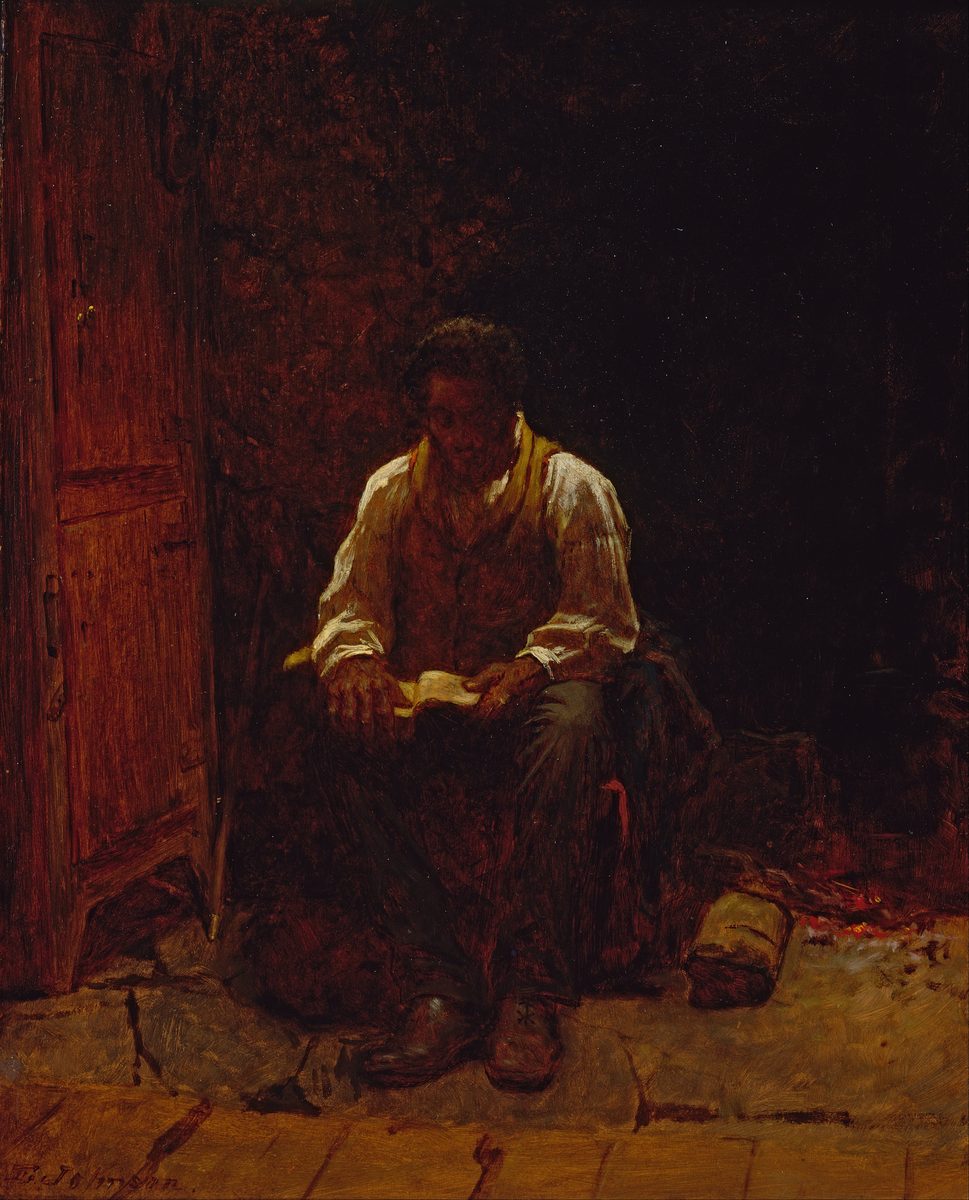
⚠ The painting is titled from this psalm and contains none of it — no shepherd, no pasture, no ravine, no table, no enemies. A man sits alone in a dark room with a book, and the only light in the picture is on the page he is reading. Johnson painted it in 1863, the year of the Emancipation Proclamation; the bundle he is sitting against is a blue jacket, usually read as Union army service, and the book is open near its front, which is why the museum suggests he may be in Exodus rather than the Psalms. Reading was precisely what had been withheld — teaching an enslaved person to read was a crime in much of the South — so literacy is the subject and the psalm is the title. ⚠ It is also far smaller than it photographs: oil on wood, 42 × 33 cm, about the size of a sheet of paper.

Jehová es mi pastor; nada me falta.
שִׁבְטְךָ וּמִשְׁעַנְתֶּךָ, הֵמָּה יְנַחֲמֻנִי.
דִּשַּׁנְתָּ בַשֶּׁמֶן רֹאשִׁי, כּוֹסִי רְוָיָה.
וְשַׁבְתִּי בְּבֵית-יְהוָה, לְאֹרֶךְ יָמִים.
Translator’s Notes
The superscription. Mizmor le-David — a mizmor is a song sung to a plucked instrument (root zamar, to pluck strings), which is why the traditional English is "psalm." The little prefix le- on David's name is doing more work than English can show: it means of, by, for, or belonging to, and seventy-three psalms carry it. It is a heading, not a signature, and this library reports it as the heading it is rather than settling a question the Hebrew leaves open.
⚠ "Shepherd" is a political word, not a pastoral one. Across the ancient Near East shepherd was the standard title of a king — Hammurabi calls himself the shepherd of his people, and the Hebrew prophets use it the same way. So the opening line is not a countryside sentiment; it is a claim about who rules the speaker. That is exactly how Jeremiah 23:1 uses it, already on these pages: "Woe to the shepherds who destroy and scatter the flock of my pasture" — addressed to the kings of Judah. Jeremiah 23 and Psalm 23 are the same metaphor argued from opposite ends: there, the shepherds who failed; here, the one who did not. Ezekiel 34 runs the same indictment at length (not yet on these pages).
And then the line everyone mishears. Lo echsar is the verb chaser, to lack — to be short of something. The KJV's "I shall not want" was exact in 1611, when want plainly meant lack; four centuries later a reader hears "I shall not desire," which turns a statement about supply into a statement about contentment — nearly the opposite. It belongs with the KJV archaisms this library keeps flagging (replenish = fill, meat = food). ASV keeps "want"; NIV has "I lack nothing" and NWT "I shall lack nothing," both of which say in modern English what the KJV said in its own. This translation follows them on the merits.
He does not let me lie down; he makes me. Yarbitzeni is the causative (hiphil) of ravats, and ravats is the specific verb for an animal folding its legs and settling on the ground. The line is not about permission or leisure — it is a shepherd putting a flock down. English versions that soften it to "he lets me rest" have changed the grammar as well as the picture.
⚠ The pastures are greener in English than in Hebrew, and the water is stiller. Ne'ot deshe is "pastures of deshe" — deshe being the first tender green growth after rain, not grass in general; and mei menuchot is literally "waters of resting-places" (menuchah, rest — the same noun used for the rest God promises Israel in the land). The KJV's beloved "green pastures… still waters" is a fair reading of the second phrase, since water you can stop beside is generally quiet water — but the Hebrew names the stopping, not the stillness. NWT's "grassy pastures… well-watered resting-places" is clumsier and closer. Yenahaleni (piel of nahal) is likewise not bare "leading": it is the verb for guiding to a watering place, and elsewhere for sustaining someone who cannot get there alone.
There is no soul in this sentence. Nefesh is the throat, the breath, the appetite, the life, the self — the whole living creature, not an immaterial part housed inside one. This library has said so since Genesis, where nefesh chayah is what fish and birds and animals and humans all equally are (see nefesh chayah). Put "soul" beside "restore" and English produces a Platonic sentence — an inner spirit repaired — that the Hebrew simply does not contain. Yeshovev is the polel of shuv, to turn back, bring back. What the line says is concrete: a person at the end of themselves is brought back. Hence "he brings my life back."
⚠ And here the two shelves split down the middle on the same word. The KJV and ASV read "restoreth my soul"; NIV softens to "refreshes my soul"; NWT 1984 keeps "My soul he refreshes." But the Spanish TNM — the same translation tradition, the other language — drops the noun altogether: "Renueva mis fuerzas," renews my strength, against RV 1909's "Confortará mi alma." One tradition, two languages, opposite calls on nefesh. That disagreement is the best evidence available that the word is genuinely hard, and it cost one fetch of each to find.
The paths are ruts. Ma'gal is a wheel-track — the root is agol, round — a rut worn into the ground by traffic that has gone that way before. "Paths of righteousness" sounds abstract and moral; ma'gelei tzedek are worn tracks, the route that is already there. NWT alone on the shelf prints "the tracks of righteousness," and this translation follows it for exactness, not familiarity. Lema'an shemo, "for the sake of his name," is the shem this library has been tracking since Babel grasped at one (11:4) and God gave one away (12:2).
⚠ Watch this root. Shuv is planted here and paid off in the psalm's last line — see verse 6.
⚠ The structural fact of this psalm, and no translation shows it because nothing is mistranslated. Verses 1–3 speak of God in the third person: he makes me lie down, he leads me, he brings my life back. At verse 4 the poem switches to the second person — "for you are with me… your rod and your staff" — and it never switches back. The turn happens at the exact centre of the psalm, and it happens in the dark: at the worst moment the speaker stops describing God and starts talking to him. Count the pronouns and the architecture is simply there.
A ravine, not a valley. Gei is a narrow cleft or wadi with walls, not an open vale — the danger of the place is that it is tight, shadowed, and you cannot see what is in it until you are in it too.
⚠ Tsalmavet — and why this translation prints the traditional words for an untraditional reason. The Masoretes pointed the word tsal·mávet, which reads as a compound of tsel (shadow) and mavet (death) — "death-shadow." Most modern lexicons (HALOT, DCH) instead propose re-pointing it tsalmut, an abstract noun from a root meaning to be dark (compare Akkadian ṣalāmu), giving "deep darkness" and treating "shadow of death" as an ancient folk etymology. Both readings are old and both are defensible; the difference is entirely in the vowels, which the consonantal text does not carry. This library's standing rule is that the Masoretic pointing is the text and emendations are noted, not adopted — so "shadow of death" stands here because that is what the vowels say, and for no other reason. It would be worth saying plainly: agreeing with the KJV is not itself an argument, and this library has departed from it whenever the Hebrew pointed elsewhere. The shelf splits cleanly: KJV, ASV and Douay keep "shadow of death"; NIV reads "the darkest valley"; NWT "the valley of deep shadow." So does the Spanish shelf, on the same fault line — RV 1909 "valle de sombra de muerte" against TNM "valle de profunda oscuridad." Counted in the Masoretic text itself, the word occurs 18 times — ten of them in Job, four in Psalms (here, 44:19 and twice in 107), two in Jeremiah, one each in Isaiah and Amos. Either way it lands in the same place: this is the darkest word Hebrew has.
Two pieces of wood, doing two different jobs. The shevet is a club — the shepherd's weapon against what is in the ravine, and, in other contexts, both a royal sceptre and the word for a tribe. The mish'enet is a leaning-stick (root sha'an, to lean), which does nothing to a predator and everything for the walker. One is pointed outward and one inward, which is why the verse needs both. And yenachamuni is nacham — the root that carried Noah's name-hope at 5:29 and God's regret at 6:6, here in its plainest mood: they comfort me.
The metaphor changes and most readers never notice. Sheep do not have tables set for them, or cups, or oil poured on their heads. At verse 5 the shepherd is simply gone and a host has taken his place; verse 6 will end in a house. The psalm is two pictures hinged at verse 4 — outdoors and indoors, the road and the table — and the hinge is the same place where the pronouns turned.
A table set, or a line drawn up. Ta'arokh is arakh, to arrange in order — used of laying out a meal and equally of drawing up a battle line. Followed by neged tzorerai, "in front of those pressing me" (tsarar, to press, hem in, besiege), the military sense is audible underneath the banquet: the meal is served in view of the enemy and the enemy can only watch.
⚠ The oil here is not the anointing oil, and the verb proves it. Dishanta is dashen — to make fat, rich, greasy. It is not mashach, the verb used for anointing kings, priests and prophets, and the verb from which mashiach — Messiah — is formed. So the line is a host oiling a guest's head at a feast, which is ordinary hospitality, and not a coronation or a consecration. The popular devotional reading in which a shepherd treats a sheep's wounds with oil belongs to a different scene and, in any case, to a different verb. NWT's "with oil you have greased my head" is literal to the point of ugliness and is right about the root; KJV's "anointest" imports precisely the sense dashen avoids. This translation says "made my head rich with oil."
And the last two words have no verb at all. Kosi revayah is a noun sentence: "my cup — revayah," saturation, drinking-your-fill. English has to supply a verb, and "my cup overflows" is the least intrusive one available; NWT's "well filled" is more cautious and slightly under-reads a word that means soaked.
Nothing "follows" anybody here. Radaph means to pursue, chase, hunt down. It is the verb for Egypt pursuing Israel to the sea and for Saul pursuing David through the wilderness — a hostile word, a word about being after someone. The psalm's last move is to take the verb that has been used all its life for enemies and hand it to tov va-chesed: what is chasing this man down is goodness and chesed. "Follow" — KJV, ASV, NIV, and both Spanish witnesses (RV "me seguirán," TNM "me acompañarán") — is far too polite for it. NWT 1984 alone on the English shelf prints "will pursue me," and the Septuagint agrees, rendering it katadiōxetai, "shall chase me down." Followed here on the merits.
⚠ And now the crux. The consonants of the next phrase are w-sh-b-t-y, and they can be read three different ways: as shuv, "and I shall return"; as yashav, "and I shall dwell" — though that root would normally be written with a yod, ve-yashavti; or as an infinitive with a suffix, shivti, "my dwelling." The Masoretes pointed it ve-shavti — shuv, return. The Septuagint took the third option and produced a noun ("my dwelling shall be in the house of the Lord"). Nearly every English version prints the second. This translation prints the Masoretic pointing, per the standing rule, and reports the alternatives here rather than quietly choosing among them.
⚠ Which pays off the root planted three verses earlier. If the pointing stands, then shuv frames the whole second half of the psalm: at verse 3 he brings my life back (yeshovev), and at verse 6 I shall come back to his house (ve-shavti) — the same root opening and closing, the return done to him and then by him. Every translation that reads "dwell" here erases that frame without leaving a mark on the page. It is worth being straight about the size of the claim: the frame is real if the Masoretic vowels are right, and this note is the place a reader can see that it rests on them.
Not "forever." Le-orekh yamim is "for length of days" — a long life. Hebrew has a word for forever, le-olam, and it is not the word here. KJV ("for ever") and NIV ("forever") print an eternity the phrase does not claim; NWT's "to the length of days" and ASV's "for ever" split, and the first is exact. A psalm that has just walked a man through a death-dark ravine ends by asking for a long life in God's house — which is a smaller and far more human request than the one tradition has put in its mouth.
Patterns worth carrying forward.
Renderings chosen. "I lack nothing" for lo echsar (v1), because the KJV's "want" meant exactly that in 1611 and means nearly the opposite now; "he makes me lie down" (v2), keeping the causative the softer versions drop; "he brings my life back" for nafshi yeshovev (v3) — no soul, no restoration, a person brought back; "tracks of righteousness" for ma'gelei tzedek (v3), a wheel-rut rather than an abstraction; "a ravine" for gei (v4), a narrow cleft rather than an open valley; "made my head rich with oil" for dishanta (v5), which is not the anointing verb; and "will pursue me" for yirdefuni (v6), the hunting word every familiar version turns into "follow."
⚠ Two places this translation followed the NWT and said why. "Tracks" at v3 and "pursue" and "to the length of days" at v6 are all cases where the least familiar version on the shelf is the tightest to the Hebrew and carries no doctrinal freight — which is the standing rule here, and worth restating because the pull in a psalm this famous is always toward the wording people already have by heart. Agreement with the KJV is never itself a reason.
Echoes paid. Shem (v3) — the name grasped at in Babel and given away to Abram — here the reason the shepherd acts at all. Nacham (v4), the root of Noah's name-hope and of God's regret, in its plainest sense: comfort. And ro'i, "my shepherd" (v1), read against Jeremiah 23:1's "woe to the shepherds" — the same royal metaphor argued from the opposite end, already on these pages.
Echoes planted. Shuv (vv3, 6), which frames the psalm's second half if the Masoretic pointing stands — brought back, then coming back. Tsalmavet (v4), whose other seventeen occurrences are mostly Job's, waiting for that book. Chesed (v6), the untranslatable this library has been building an entry for since Lot. And the shepherd itself, waiting for Ezekiel 34 and for John 10, where someone applies this psalm's opening noun to himself.
⚠ Three things left open on purpose. Tsalmavet at v4 — the Masoretic "death-shadow" against the lexicons' re-pointed "deep darkness"; ve-shavti at v6 — return, dwell, or my dwelling, one set of consonants and three real readings; and the superscription's le-David, which is a heading and not a signature. In all three the notes give the readings with their pedigrees, and where a wording had to be chosen the note says which rule chose it.
⚠ A note on order: Psalm 23 was translated out of sequence — the most-read chapter in the book and one of the most-read in the Bible, and it went early for exactly that reason. The sequential thread is still open and still correct: next in sequence is Psalm 2 — the other post of the Psalter's gateway, where the nations rage, the one enthroned laughs, and a king is told "you are my son; today I have begotten you."