Psalm 91 — The Mister Translation
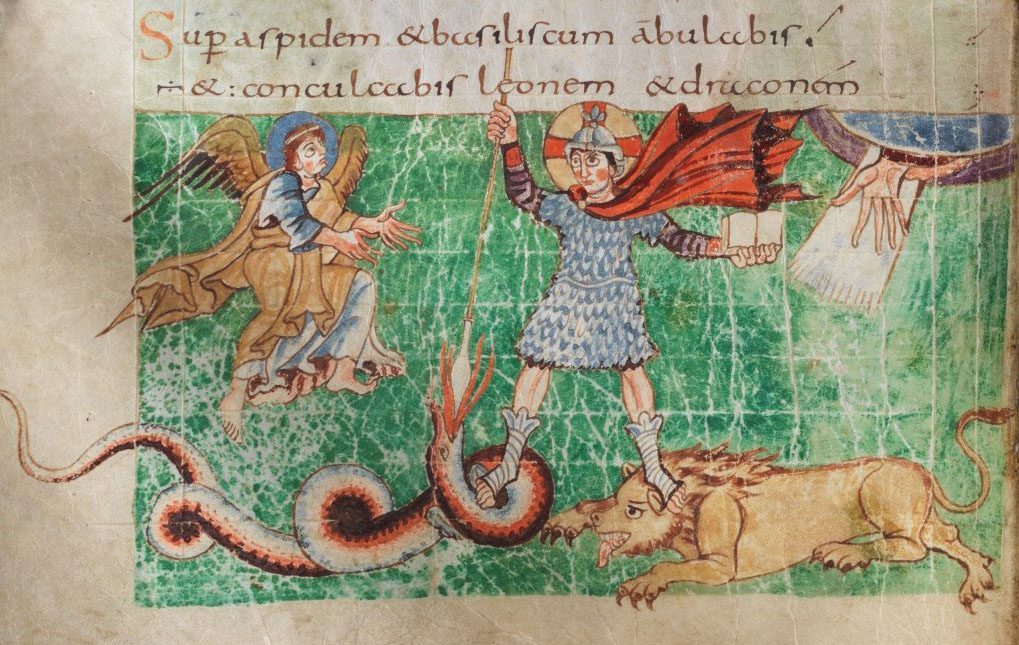
⚠ The verse is written across the top of its own picture, and it is the LATIN: super aspidem et basiliscum ambulabis et conculcabis leonem et draconem. So the word this chapter’s note is about — basiliscum, Jerome’s rendering of the Hebrew peten, a cobra — is legible on the image itself. The illuminator is illustrating the Vulgate, not the Hebrew, which is exactly how the basilisk got into Europe. ⚠ And notice the arithmetic: the Latin names four creatures (asp, basilisk, lion, dragon) and the picture shows two — one serpent, one lion. Even the artist working directly from the text collapsed the two snakes into one snake and the two lions into one lion, which is the same flattening every translation of this verse has to decide whether to make. ⚠ The protected man is painted as a ninth-century Frankish soldier — mail hauberk, helmet, spear, red cloak — and haloed, so the psalter is reading the psalm christologically, one of the three modes this manuscript works in. The angel at the left is not decoration either: it belongs to verses 11–12, the promise the devil quotes, so the picture puts the tempter’s proof-text and the trampling in a single frame.

Translator’s Notes
⚠ This psalm has no superscription at all. No mizmor, no le-David, no tune, no occasion — it simply begins. That is unusual enough in the Psalter to be worth naming: Book IV (Psalms 90–106) carries a cluster of these untitled psalms, and later tradition supplied what the text withholds (the Septuagint hands it to David; the Talmud attaches it to Moses, borrowing the heading of Psalm 90 next door). The Hebrew names nobody, and this library reports the silence rather than filling it.
⚠ Four different names for God inside two verses. Elyon — the Most High, the name Melchizedek used at Genesis 14:18; Shaddai — the Almighty, God’s self-introduction to Abram at Genesis 17:1; then YHVH, the covenant name; then Elohai, “my God.” The movement is from the highest and most distant title to the most personal possessive in the space of a breath, and it is the whole argument of the psalm in miniature.
The verbs are about staying the night. Yoshev is simply sitting; seter is a hiding-place, a covert; and yitlonan is from lun, to lodge, to pass the night — not permanent residence but the traveller’s overnight stop. So the opening image is somebody sheltering till morning, which is exactly the situation verses 5–6 will describe. And be-tzel Shaddai, “in the shadow of Shaddai,” is a small sound-play (tzel Shaddai) that also does something this library has met before from the other direction: in Psalm 23:4 the shadow belonged to death. Here it belongs to God.
The shelf on the shelter-words. Machseh is a refuge you run into and metzudah a mountain stronghold — the word for David’s desert fastnesses. KJV “my refuge and my fortress”; NWT “my refuge and my stronghold”; the Spanish RV 1909 goes its own way with “Esperanza mía y castillo mío” — my hope and my castle — which softens a fortification into a feeling.
The first danger is a trap set for birds. Pach yaqush is the snare of the fowler — the man who catches birds — which matters, because the very next line answers it with wings. The psalm sets a bird-trap and then hides the bird under God’s own feathers. That pairing is the argument, not decoration.
⚠ And the armour is made of an abstract noun. Verse 4 ends: tzinnah ve-socherah amitto — “a shield and a socherah is his faithfulness.” Tzinnah is the big body-shield, the one you stand behind; socherah occurs nowhere else in the Hebrew Bible, so its sense (buckler? encircling wall?) is inferred from the root idea of going round, and honest lexicons say so. What is not uncertain is the subject: the thing that functions as armour is God’s emet, his reliability. NWT renders it “his trueness will be a large shield and bulwark”; KJV “his truth shall be thy shield and buckler.” Both keep the abstraction where a looser translation would reach for “protection.”
Evrah is the pinion — the long flight-feather of the wing, not down — and the image is the parent bird mantling over the young. It is the same picture Deuteronomy 32:11 uses of the eagle and the one Jesus reaches for over Jerusalem at Matthew 23:37, where the bird is a hen and the offer is refused.
The four terrors are arranged by the hour. Night — day — darkness — noon: pachad laylah, the terror of the night; chetz ya’uf yomam, the arrow that flies by day; dever ba-ofel, the pestilence that walks in the gloom; qetev yashud tzohorayim, the destruction that lays waste at noon. Two of them are dark and two are bright, and they alternate rather than pair off, so the effect is a full turn of the clock with no safe hour in it. Only one of the four (the arrow) is human.
⚠ And this is where a famous creature enters Christianity by mistranslation. The Hebrew qetev is destruction, a scourge — a thing, not a person. The Septuagint (Psalm 90:6 in its numbering) rendered the phrase daimoniou mesēmbrinou, and Jerome carried it into the Vulgate as daemonium meridianum: the noonday demon. Personified, it had a long career — Evagrius Ponticus in the fourth century made the noonday demon the besetting spirit of monks, the one that arrives around the fourth hour with restlessness and disgust at one’s own life, and that is the ancestor of acedia and of every later “noonday devil.” None of it is in the Hebrew, which has a plague and not a personality. The library’s job here is not to sneer at the Greek but to say plainly which language the demon came from.
The shelf keeps the abstraction: KJV “the destruction that wasteth at noonday”; NWT “the destruction that despoils at midday”; Douay, translating the Vulgate, is the one English shelf-version that still carries the demon — which is exactly what a translation of a translation will do.
A thousand, ten thousand, and you. The numbers escalate by a factor of ten across the line and the verbs do nothing at all: the addressee is not fighting, fleeing, or hiding — he is simply not reached. Lo yiggash is “it will not come near/approach,” and the whole scene is one of a man standing still in a collapsing field.
⚠ Verse 8 is more uncomfortable than it usually sounds. Shillumat resha’im is the payment of the wicked — from shalem, the root of settling accounts (and of shalom) — and the promise is that the survivor will watch it. Being spared here includes seeing what happened to everyone else, which is a harder consolation than the psalm’s reputation suggests. KJV “the reward of the wicked” is a real 1611 sense of reward (recompense, payment) that has since drifted toward “prize”; NWT “the retribution itself of the wicked ones” and NIV “the punishment of the wicked” both keep the accounting sense the KJV has quietly lost.
Verse 9 does not parse cleanly, and that is the note. The Hebrew runs ki attah YHVH machsi — Elyon samta me’onekha: “for you, Jehovah, [are] MY refuge — the Most High you have made YOUR dwelling.” The possessive flips mid-verse. The first half is addressed to God about the speaker; the second is addressed to the man about God. Something has to give, and every translation gives somewhere.
⚠ Three witnesses, three different repairs — which is the best evidence the difficulty is real and not imagined. NWT 1984 supplies a verb and marks the addition with its own brackets: “Because you [said]: ‘Jehovah is my refuge.’” The Spanish TNM supplies the same verb without brackets (“Como tú dijiste…”). RV 1909 instead re-arranges the clause entirely — “Porque tú has puesto á Jehová, que es mi esperanza” — making the man the subject of both halves. KJV takes a fourth road, treating the first clause as the speaker’s own aside. This translation prints the seam instead of mending it, because a reader who can see the join can weigh the repairs; a reader handed a smooth sentence cannot.
Nega in verse 10 is a stroke or plague-mark — the same noun this library met as the plagues struck on Pharaoh’s house at Genesis 12:17, and the word Leviticus uses for the mark on a skin or a wall. Not misfortune in general: a blow that leaves a mark.
These are the two verses Satan quotes. At Matthew 4:6, on the pinnacle of the temple, the tempter argues from Scripture for the only time in the episode, and he argues from this psalm — which makes sense, since it is the Bible’s most unconditional-sounding promise of protection. That chapter’s note observed that he drops the middle clause. Standing on the Hebrew side of the quotation, the omission can now be shown exactly.
⚠ The Hebrew has three clauses; Matthew’s quotation has two. Verse 11: ki mal’akhav yetzavveh-lakh (“for he will command his angels concerning you”) / lishmorkha be-khol derakhekha (“to guard you in all your ways”); then verse 12, al kappayim yissa’unkha (“on their palms they will carry you”). Matthew’s Greek runs the first clause straight into the third and joins them with a bare kai — the middle clause, the one about ways, is simply not there. Checked against the text itself and not from memory: the Greek of Matthew 4:6 contains the words for angels, hands and stone, and contains neither diaphylaxai (“to guard”) nor hodois (“ways”), both of which stand in the Septuagint of this psalm.
Why the missing clause is the whole argument. Derakhekha, “your ways,” are the roads a man is actually walking — the ordinary business of a life. The promise is protection on the way, and stepping off a roof is not a way. Remove four words and a promise about journeys becomes a warranty for a stunt. It is worth saying that the omission is not a textual variant or a copying accident: the psalm is not in doubt, and the shortened form is the shape the quotation takes in the mouth of the character quoting it.
One small thing every version smooths: the Hebrew says kappayim, the palms of the hands specifically, not hands in general — the open flat surface you carry something fragile on.
Two lions, a snake, and something bigger. Shachal and kefir are both lions (the second is specifically the young lion, old enough to hunt); peten is a venomous snake, usually taken as the cobra; and tannin is the odd one out. NWT distinguishes the pair carefully — “the young lion… the maned young lion… the big snake” — where KJV flattens all four into “the lion and adder… the young lion and the dragon.”
⚠ Tannin is a word this library has already fixed a rendering for. It is the great sea-beast of Genesis 1:21, where God creates the taninim on the fifth day — and it is elsewhere the chaos-monster of the sea, the creature Isaiah and Ezekiel use for Egypt and for Pharaoh. Putting it at the end of a list of animals a man treads on quietly escalates the verse: the last thing underfoot is not a hazard of the road but the monster of the deep. Rendered “serpent” here to keep it on the ground with its three companions, with the larger sense flagged rather than smuggled in.
And the Spanish shelf preserves a creature the English one lost. RV 1909 reads “sobre el león y el basilisco pisarás” — the basilisk, straight out of Jerome’s basiliscum for peten. The medieval basilisk, the serpent that kills by looking at you, walks into European imagination partly through this verse; the modern TNM has quietly put it back to “cobra.” Two verses after the noonday demon, the same psalm has furnished a second monster to Christendom, and both arrived by way of a translation rather than the Hebrew.
⚠ The structural fact of this psalm: it has three speakers and never says so. Verses 1–2 are somebody talking about himself (“I say of Jehovah”). Verses 3–13 are somebody talking to a second person (“you will not fear”) — and it is not obvious that it is the same somebody. Then at verse 14 the voice changes again, to God, in the first person: “because he has bound himself to me, I will bring him out.” No heading marks the change; the Hebrew just switches. It is the same manoeuvre Psalm 23 makes once, in the middle, in the dark — here it happens twice and the second time it hands the microphone to God. ⚠ The Spanish TNM finds the silence intolerable and inserts a stage direction the Hebrew does not have — “Dios dijo:”, God said. That is a defensible reading of the structure printed as if it were text, and worth pointing at precisely because it is the same instinct that put “[said]” into verse 9.
The verb for how the man got here is a surprising one. Chashaq means to be attached to, to cling, to be bound by desire — it is used of Shechem’s longing for Dinah and of God’s own inexplicable attachment to Israel in Deuteronomy 7:7. Not obedience, not faith: fastening on. NWT “on me he has set his affection” and KJV “because he hath set his love upon me” both catch it; the word is warmer and more physical than either.
⚠ And the psalm ends on a phrase this library translated two days ago. Orekh yamim asbi’ehu — “with length of days I will satisfy him.” That is the identical phrase that closes Psalm 23:6, where the note argued it means a long life and not “forever,” since Hebrew has le-olam for that. Psalm 91 settles the argument from outside: you cannot satisfy somebody with eternity, and both Spanish witnesses read it exactly this way — RV 1909 “saciarélo de larga vida” and TNM “una larga vida.” Two psalms, the same closing phrase, and the second one supplies the verb that proves the first one’s reading.
The final word is yeshu’ati, “my salvation” — the noun that stands behind the name Joshua and, through Greek, the name Jesus. The psalm that the devil quoted ends on it.
Patterns worth carrying forward.
Renderings chosen. “Will pass the night” for yitlonan (v1) — lodging till morning, not permanent residence; “pinion” for evrah (v4), the flight-feather; “his faithfulness is shield and wall” (v4), letting the abstract noun be the armour rather than softening it to “protection”; “the wicked paid out” for shillumat (v8), keeping the accounting sense the KJV’s “reward” has drifted away from; the palms of the hands at v12; and “bound himself to me” for chashaq (v14), a verb of attachment rather than of obedience. Verse 9’s broken grammar is printed as it stands.
⚠ Two monsters that came from translations, not from the Hebrew. The noonday demon of v6 (qetev, a scourge, personified by the Septuagint into daimonion mesēmbrinon and by Jerome into daemonium meridianum, then made the patron demon of monastic acedia by Evagrius Ponticus) and the basilisk of v13 (peten, a cobra, turned into basiliscum by the Vulgate and still standing in the Spanish RV 1909). Naming where a creature entered is not a complaint about the Greek or the Latin; it is the difference between a translation and its afterlife.
Echoes paid. Tzel, the shadow — death’s at Psalm 23:4, God’s here. Tannin (v13), the great sea-beast created on the fifth day at Genesis 1:21, put underfoot. Elyon and Shaddai (v1), both first met in Genesis. And — the one that matters most — the debt owed to Matthew 4: that chapter’s note said the devil dropped a clause, and this chapter is the other half of the receipt, with the Hebrew’s three clauses against the quotation’s two.
⚠ And an echo paid from two days ago, which settles an argument. Orekh yamim closes this psalm (v16) exactly as it closes Psalm 23:6. There the note argued it means a long life rather than “forever,” since Hebrew has le-olam for eternity. Psalm 91 supplies the verb that settles it: you cannot satisfy a man with eternity, and both Spanish witnesses read “a long life” outright. A claim made in one chapter, confirmed from another — which is the only kind of confirmation this library counts.
Echoes planted. The three voices of this psalm (a speaker, an addressee, then God himself), a structure worth watching for wherever the Psalter stops describing and starts answering. Yeshuah (v16), the noun behind Joshua and Jesus. And the angels of vv11–12, whose next appearance on these pages is in the mouth of somebody quoting them selectively.
⚠ Left open on purpose. The psalm’s missing superscription — the Septuagint assigns it to David and the Talmud to Moses; the Hebrew names nobody, and neither does this translation. Socherah at v4, which occurs nowhere else in the Hebrew Bible and is therefore glossed from its root and flagged as uncertain rather than confidently rendered. And the grammar of v9, where three versions make three different repairs and this one prints the seam.
⚠ A note on order: Psalm 91 was translated out of sequence, as the Psalter’s most-read chapters go first. The sequential thread is unchanged and still correct: next in sequence is Psalm 2, the other post of the Psalter’s gateway, where the nations rage and the one enthroned laughs.