Psalm 121 — The Mister Translation
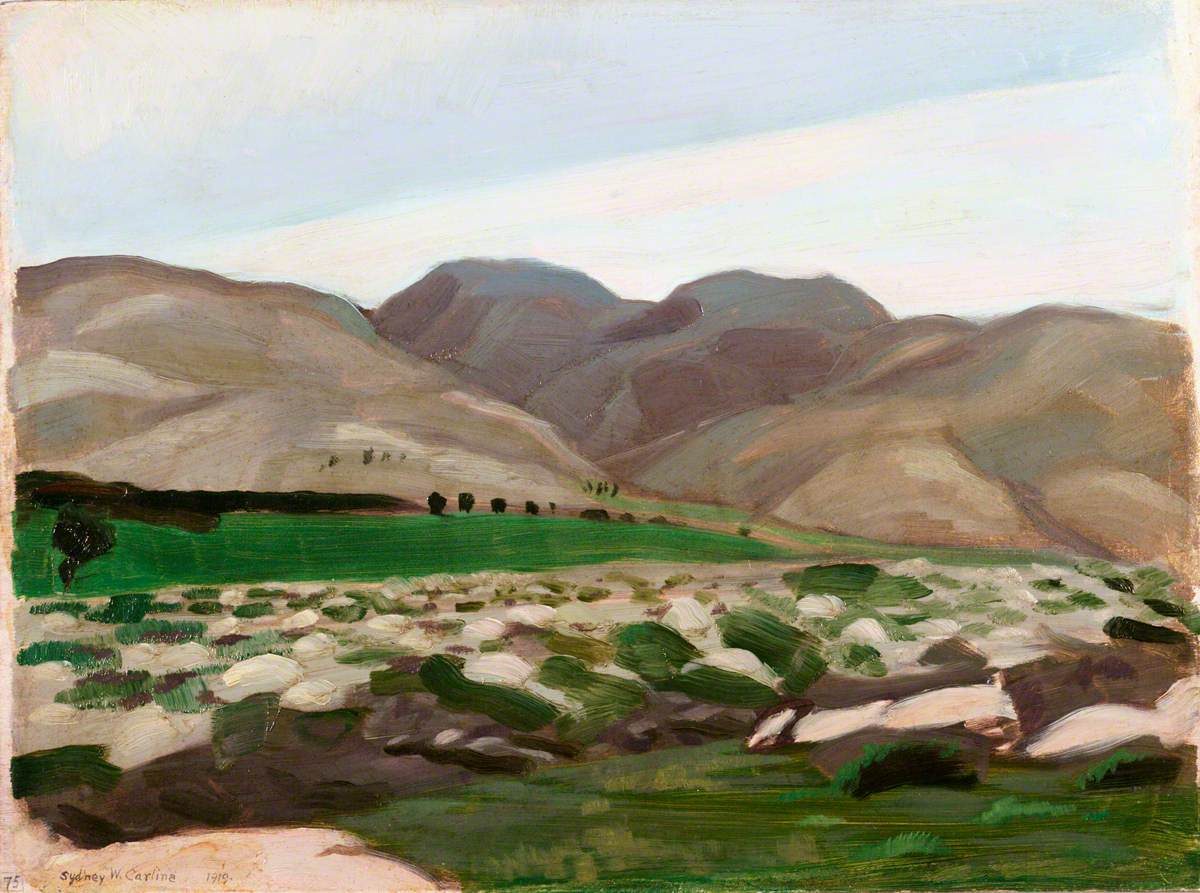
⚠ Painted on the spot, not composed to illustrate this psalm. Carline was a British official war artist attached to the Palestine campaign; his own title notes, dated 28 January 1919, record the afternoon it was made: ‘we got our oil boxes out of the car & both set to paint a study of the hilly landscape. The Hill of Judea are rolling hills, almost like glorified Downs, with cultivated terraces covering all those that are not too rocky.’ ‘Downs’ are the chalk hills of southern England — a painter far from home, reaching for the nearest comparison he had. These are, plainly and without embellishment, the actual mountains v1 lifts its eyes to: no single peak, no landmark, just hill after hill on the way up to the city.
_-_The_Hills_of_Judea_-_IWM_ART_4560_-_Imperial_War_Museums.jpg)
Translator’s Notes
A song for the walk uphill
“A Song of Ascents” (shir la-ma'alot, from alah, to go UP) heads fifteen psalms in a row, 120–134 — the only run of consecutive psalms in the Psalter that all share one label. Two explanations sit side by side in Jewish tradition, and neither cancels the other: the older is that these were sung by pilgrims literally going UP to Jerusalem, which sits on a ridge, for the three pilgrim feasts (Deuteronomy 16:16); the Mishnah instead ties the number to the TEMPLE itself, fifteen steps rising from the Court of the Women to the Court of Israel, one psalm sung on each (Middot 2:5). A song for a physical climb, or a song for a specific staircase — either way, going up is built into the title before the first word of content arrives.
A question, or a correction?
V1 ends on a real Hebrew question — me-ayin yavo ezri, “from-where will-come my-help” — and v2 answers it: help is me-im Jehovah, “from WITH Jehovah,” a different preposition than v1's plain “from.” Read together, that shift can sound like a quiet correction: the mountains the psalmist is looking at were also where Canaanite hill-shrines stood, so lifting one's eyes to them was not automatically a religious act. KJV alone on this shelf reads v1 as a plain STATEMENT rather than a question — “I will lift up mine eyes unto the hills, from whence cometh my help” — making the hills themselves (read as Zion, where the Temple stood) the source. ASV, NIV, ESV, RV60 and NVI all print a question mark instead, leaving v1 open until v2 closes it. This translation follows the question reading — the majority position, and the one that gives v2's answer something to answer.
The word this whole psalm turns on
Shamar, TO KEEP or GUARD, falls six times in six verses (3, 4, 5, 7 twice, 8) — the highest concentration of one root anywhere in the Psalter this short. This translation keeps “keep”/“keeper” on all six so the repetition stays visible in English, the way it already is in the Hebrew; most of the shelf varies the word instead — KJV mixes “keepeth” and “preserve,” NIV moves between “watches over” and “keep.” RV60 does the same thing this translation does, holding to guarda/guardador/guardará throughout. The same root is the human vocation in the garden (Genesis 2:15, “to work it and keep it”) and what Cain disowns (“my brother's keeper?”, Genesis 4:9) — here it is returned whole, six times, to God.
The god who has to be woken up
Two different verbs for sleep, stacked: yanum (to doze, nod off) in v3 alone, then yanum AND yishan (to sleep outright) together in v4. The doubling reads as polemic against a real ancient assumption — that a god's attention could lapse, that a shrine's power could nap. Elijah makes the taunt explicit at Mount Carmel, mocking Baal's prophets: “cry louder — perhaps he is asleep and must be awakened” (1 Kings 18:27). This psalm answers the question before it is asked: not dozing, not sleeping, not even once.
Shade, sun, and a moon that could still hurt you
Tzel, shade, is the same word for what a tree or a wing gives (Psalm 91:1's “shadow of the Almighty” is the identical noun) — concrete, physical relief from a sun that could genuinely kill in an unshaded Judean summer. V6 pairs it with something odder to modern ears: the moon, striking by night. The ancient Near East had a real, widespread folk belief that too much exposure to moonlight could sicken or blind a sleeper — English still keeps the fossil of it in “lunatic.” Whether or not the psalmist shared that specific belief, the verse's shape is a merism: EVERY hour, day or night, sun or moon, is covered.
Coming and going
“Your going out and your coming in” is a merism — two opposite actions standing for the whole of ordinary life between them, every departure and every return. Jehovah's promise to Jacob at Bethel uses the same verb of the same totality: “I am with you, and I will keep you wherever you go” (Genesis 28:15) — a promise made to one frightened man fleeing alone, generalized here into a psalm any pilgrim could sing on the road up.
Notes on this translation
Decisions. Shamar is rendered keep / keeper on all six of its occurrences (vv3, 4, 5, 7 twice, 8) rather than varied for style, so the repetition that structures the Hebrew stays visible in English. V1 is read as a question rather than KJV's declarative statement, following the rest of this shelf.
⚠ A note on order: this is the sixth psalm on these pages (after 1, 23, 27, 51 and 91) and the first Song of Ascents — Psalms 120 and 122–134, the other fourteen psalms carrying the same title, remain untranslated here.