Psalm 139 — The Mister Translation
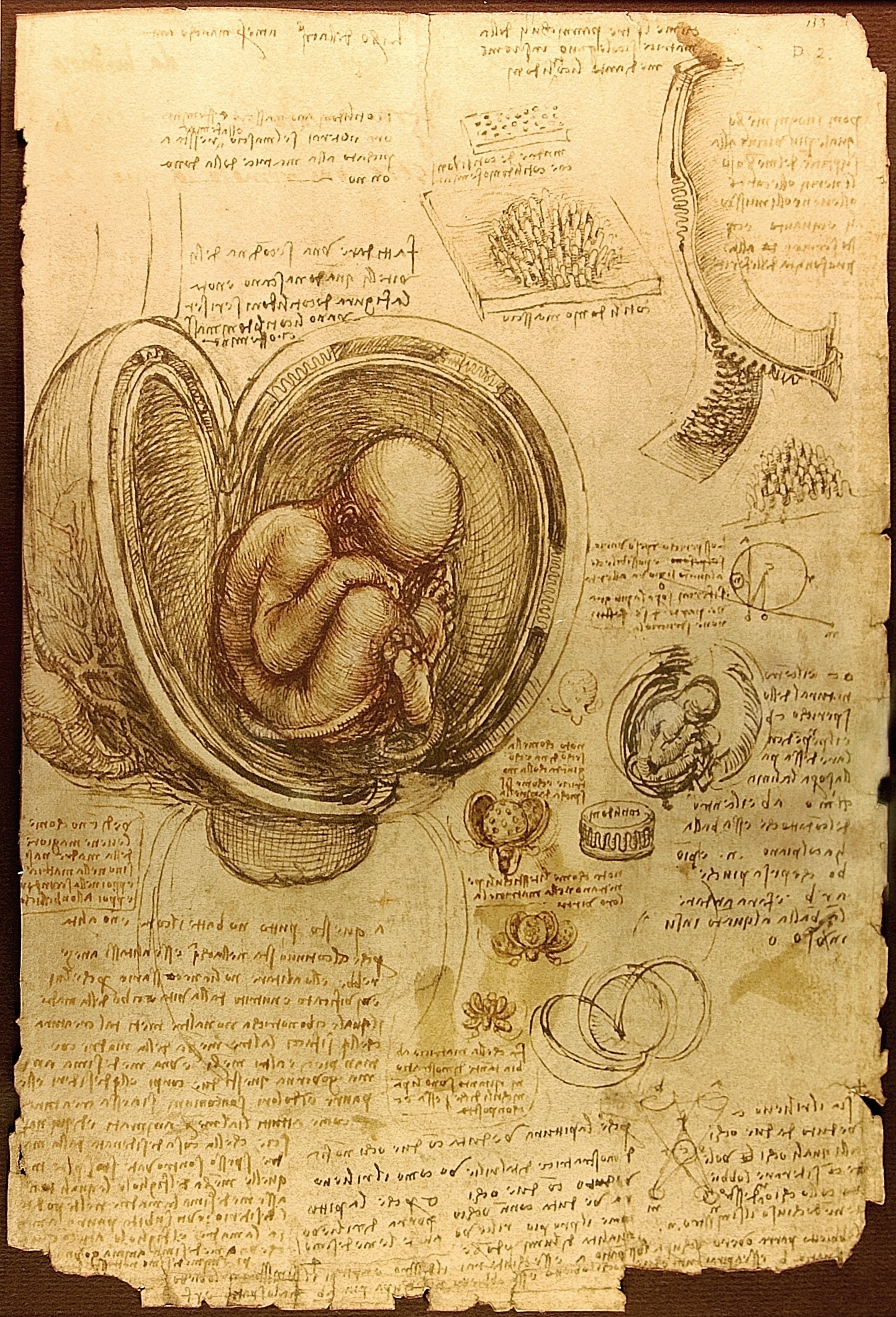
Verses 13–16 in a drawing. The psalm says the speaker was screened in the womb — sakak, woven over — and embroidered in the depths of the earth, and Leonardo has drawn the uterus peeled open in exactly those layers.
But the better fit is what the page is. It is a study: a man cutting things open to find out how a body is made. The psalm’s own verb is chaqar, to search out, prospect, examine — and it opens by saying that this has already been done to the speaker, and closes by asking for it again. Leonardo is doing from the outside what verse 1 says was done from the inside before he started.
The page is covered in his mirror-writing, running right to left and legible only when reflected — which is a quiet joke to hang beside a Hebrew column that also runs right to left, in a psalm about being read by someone who needs no mirror.
⚠ And an honest one. Leonardo was the most careful looker of his age and this anatomy is partly wrong: the small round structures are cotyledons, the button-like attachments of a cow’s placenta, not a human one. He dissected animals and extrapolated. A page of superb, patient, mistaken observation is a fair thing to set beside a poem about being known completely.

Translator’s Notes
1–6 — The verb that will come back at the end
The psalm opens with chaqar — to search out, the word for prospecting, for reconnoitring a country, for examining a legal case. Jehovah has searched the speaker, past tense, already done. Hold on to it: the psalm closes by asking for exactly the same verb (v23), and what sits between the two occurrences changes what the request means.
Verse 3’s zarita is a winnowing word — to scatter grain into the air so the chaff blows off. Applied to a person’s path and lying-down it is not gentle: the speaker has been sifted. And verse 5’s tsartani, “you have hemmed me in,” is a siege verb. This opening is more ambivalent than its devotional reputation: being wholly known is being wholly surrounded.
⚠ A scribal note at verse 6. The Hebrew column carries a ketiv/qere — the Masoretes’ “written / read” apparatus, which this library has met before at Jeremiah 21:9. The consonants as written are פלאיה; the form the tradition reads is פְּלִיאָה. Both are printed above, unpointed then pointed, exactly as the manuscripts do it. The sense is not affected here — but the same apparatus is about to decide the hardest verse in the psalm.
7–12 — Sheol, and a strange verb for darkness
Verse 8 puts heaven and Sheol as the two limits, and says God is in both. That is a stronger claim than it looks: elsewhere in the Psalms, Sheol is precisely where God is not remembered and does not act (6:5, 88:10–12, 115:17). This verse sits against those, and the psalm does not reconcile them.
Verse 11’s yeshupheni is odd: the root means to bruise or crush — it is the word used of the serpent and the heel at Genesis 3:15. “Darkness will bruise me” is what the Hebrew says, and most versions read it instead as “cover” on the assumption of a different root. KJV has “shall cover me,” and so do the rest. The text above keeps the bruise.
13–15 — Kidneys, weaving, and what “fearfully made” may not say
⚠ Two decisions in verse 13, and the first is a real crux. The verb is qanah, and this translation says acquired. Across some 130 occurrences its ordinary sense is commercial — to buy, to take possession — and that meaning is uncontested. A second sense, to create or produce, is proposed on the strength of a handful of disputed verses plus the Ugaritic cognate qny, “create.” The shelf splits precisely there: KJV “thou hast possessed my reins” and RV «tú poseiste mis riñones» take the plain sense; ASV “thou didst form” and NWT “you produced my kidneys” take the contested one.
The reason to prefer the plain sense here is not this verse. It is Proverbs 8:22 — Yhwh qanani reshit darko, where Wisdom says God qanah-ed her “at the beginning of his way.” Whether that word means possessed or created is the hinge of one of the oldest doctrinal arguments in Christianity, and the KJV, ASV and RV all print “possessed” there. Rendering the same verb “produced” in Psalm 139 quietly settles, in a verse about embryology, a question that belongs to Proverbs 8. This translation keeps the ordinary sense in both places and leaves the argument where it is.
The second decision is the noun: kidneys — kilyotai, and the versions say “reins” (KJV) or “inward parts.” In Hebrew physiology the kidneys are the seat of conscience and the deepest self, the organ God tests (Jeremiah 17:10). And the verb is sakak, to screen or weave over — the same root as the covering of the ark and the sukkah. The womb is a shelter woven around someone.
⚠ And now the famous line, which may not be about the speaker at all. Verse 14 in Hebrew is nora’ot niphleti — two words, and translators have to supply a verb to make an English sentence of them.
It is worth seeing what the Hebrew does here, because it is precise and almost every translation loses it. The verse contains two similar words built on two different roots, one letter apart. Niphleti — spelled with a yod — is from palah, to be separated or set apart. Niphla’im, in the next clause, is spelled with an aleph, from pala, to be wonderful. So the speaker is set apart and God’s works are wonderful, and the two words chime without being the same word.
This translation therefore reads “awesomely I am set apart” rather than “fearfully and wonderfully made.” A note on the English: “wonderfully distinguished” is lexically defensible and bad English — in current usage “distinguished” means eminent, and a reader would land confidently on the wrong sense. Where this translation is strange it should be strange enough to send you to the note. KJV supplies made: “I am fearfully and wonderfully made.” NWT does the same. But RV 1909 reads the wonder as belonging to God’s works rather than to the speaker: «porque formidables, maravillosas son tus obras». On that reading the verse never says “I am wonderfully made” at all — it says the works are wonderful, which is what the second half of the verse says in any case. The most-quoted sentence in the psalm rests on a supplied word.
Verse 15’s ruqqamti is embroidery — needlework in coloured thread, the word used of the tabernacle hangings. And “the depths of the earth” is not the womb literally; it is a poetic equivalence that quietly puts being formed in the womb and being formed in the underworld in the same line.
16 — ⚠ A hapax, and a crux the scribes marked in the margin
Golmi occurs once in the Hebrew Bible, here: an unformed, unshaped mass — the thing before it has been given a form. The word had a long afterlife, because it is the root behind the golem of later Jewish legend, the figure made of matter without shape. Three versions on the shelf now say embryo — RV «mi embrión», NWT “the embryo of me,” TNM «cuando yo era un embrión» — while KJV attempts “my substance, yet being unperfect” and ASV “mine unformed substance.”
⚠ And then the second half of the verse, which is the hardest sentence in the psalm. The reason translations diverge wildly here is not obscurity of vocabulary. It is a ketiv/qere, and it is printed in the Hebrew above: the consonants as written are ולא, “and not”; the form the tradition reads is וְלוֹ, “and for him.” One letter — aleph or vav — and the clause turns over:
— With the ketiv: “days were formed, and not one among them” —
i.e. they were written down before any of them existed.
— With the qere: “days were formed, and for him one of them” — a
quite different and much less clear statement.
What is genuinely interesting is that the shelf mostly follows the written form and not the read one: KJV “when as yet there was none of them,” NWT “and there was not yet one among them,” TNM «antes de que existiera cualquiera de ellas». The reading tradition is on one side and nearly every translation is on the other. ⚠ No vote is taken here either; the text above follows the ketiv and prints both.
17–18 — A sum, and a waking
Rasheihem (v17) is “their heads” and, in accounting usage, their sums or totals — the head of a column of figures. The psalm is counting God’s thoughts and finding the total unreachable, which is the same move verse 6 made with knowledge.
“I awake, and I am still with you” (v18) is one of the quietest lines in the Psalter and it is not clear what it means: waking from literal sleep, or waking from death. Nothing in the Hebrew settles it, and the ambiguity is very old.
19–22 — ⚠ The part that is never quoted
Here is the passage that almost nothing citing verse 14 mentions. The speaker asks God to kill people (v19), and then states his own position: tachlit sinah sneitim — with a complete hatred I hate them. Tachlit is completion, the end or limit of a thing: hatred carried all the way to its finish. KJV and RV both render it “perfect hatred” / «perfecto odio», and NWT “a complete hatred.” Only TNM softens the noun out of the sentence altogether («odio es todo lo que siento por ellos»).
Verse 20 is textually rough in a way that is worth admitting: nasu la-shav areicha is literally “they take up your cities for emptiness,” which does not obviously mean anything here, and many read areicha as “your adversaries” instead. The versions vary widely and none is confident. The text above keeps cities and says so here.
23–24 — ⚠ Why the ending is not a change of subject
This is the point of the whole page. Verse 23 asks God to chaqar — the same verb as verse 1, and the only other place it appears. The psalm is bracketed: you have searched me (v1) … search me (v23).
And the request comes immediately after the perfect hatred. Read as a bracket, verse 23 is not a pious add-on to a comfortable poem about being known; it is the speaker submitting the thing he has just said to examination. He has declared complete hatred and then asks to be searched and tested, and to be shown whether there is a way of pain in him. That reading takes verses 19–22 as the reason the psalm ends the way it does rather than as an embarrassment to be skipped.
⚠ Two words in verse 24, both of which the shelf handles inconsistently. Derekh otzev is literally a way of pain — and KJV prints “any wicked way” in the text while telling the truth in its margin: “Heb. way of pain, or, grief.” NWT alone puts the literal in the line, “any painful way.” Whether it means a way that causes pain, or one that leads to it, or an idolatrous way (a homonym means “idol”) is undecided.
And the last words are derekh olam. KJV “the way everlasting”; NWT “the way of time indefinite”; TNM «el camino de la eternidad». But olam looks backwards as readily as forwards, and “the ancient way” is equally defensible — the road that was always there. This library met the same word three chapters ago at Ecclesiastes 3:11, where the shelf split three ways over it.
Patterns worth carrying forward.
⚠ The one thing to carry out of this psalm. Chaqar, to search out, occurs exactly twice: “you have searched me” (v1) and “search me” (v23). The psalm is bracketed by it — and what sits between the two is verses 19–22, the part nobody quotes, where the speaker asks God to kill people and says he hates them with a complete hatred. Read as a bracket, the closing request is not a pious add-on to a comfortable poem about being known: it is the speaker submitting what he has just said to examination. That makes verses 19–22 the reason the psalm ends as it does, rather than an embarrassment to be skipped over.
⚠ The hardest verse is decided by a scribal note. At verse 16 the Hebrew column carries a ketiv/qere — written form ולא, “and not”; read form וְלוֹ, “and for him.” One letter, and the clause turns over. That, and not obscure vocabulary, is why translations diverge so widely there. Worth noting which side they take: the shelf mostly follows the written form and not the read one.
⚠ And a hapax with an afterlife. Golmi (v16) occurs once in the Hebrew Bible — an unformed mass, matter before it has a shape. It is the root behind the golem of later Jewish legend. RV, NWT and TNM all now say embryo; the KJV attempted “my substance, yet being unperfect.”
⚠ The most-quoted line rests on a supplied word. Verse 14 is two Hebrew words, nora’ot niphleti, and the KJV’s “I am fearfully and wonderfully made” supplies the verb. RV 1909 reads the wonder as belonging to God’s works rather than to the speaker — on which reading the verse never says “I am wonderfully made” at all.
The opening is less comfortable than its reputation. Verse 3’s zarah is a winnowing word — grain thrown into the air so the chaff blows off — and verse 5’s “you have hemmed me in” is a siege verb. Being wholly known is being wholly surrounded. Verse 11’s darkness bruises (the Genesis 3:15 word); the versions read “cover” on a different root.
Renderings chosen. Kidneys at v13, which in Hebrew physiology is the seat of conscience, not a squeamish “inward parts.” Screened for sakak, the weaving-over word behind the sukkah. Embroidered for ruqqam at v15. And at v24, way of pain for derekh otzev — which the KJV puts in its margin (“Heb. way of pain, or, grief”) while printing “wicked way” in the line, and which the NWT alone puts in the line itself.
Echoes paid. The psalm ends on derekh olam — “the way everlasting,” or equally “the ancient way,” since olam looks backwards as readily as forwards. This library met the same word at Ecclesiastes 3:11, where the shelf split three ways over it. And the ketiv/qere apparatus is the one first met at Jeremiah 21:9.
⚠ Left rough. Verse 20 is textually difficult: nasu la-shav areicha is literally “they take up your cities for emptiness,” which does not obviously mean anything; many read “your adversaries” instead. Kept as cities, and named as a problem.
⚠ A note on order: the Psalms stand on these pages at 1, 23, 91 and now 139 — chosen by search demand rather than in sequence. The sequential thread is unchanged: next in sequence is Psalm 2, which is where the navigation above points.