Ten Conditions and a Footnote
SEPTEMBER 17, 2026
Fifth text since Tuesday, and this one came with no caption at all — just a link to a CFTC press release, which after this week I've learned to read as "your turn." The release is three sentences long and says the Commission's Market Participants Division has issued a "no-action position to providers of passive software." That is the kind of headline that gets written when somebody would prefer you didn't read the attachment. I read the attachment.
Here's the plain-English version. If you build an app — a crypto wallet, a sports app, a social network, anything with users — that lets those users trade futures, perpetuals or event contracts on a CFTC-registered exchange; and your app never holds their money, never tells them to buy or sell, and never decides where an order goes; then as of today you may market that app, promote specific contracts on it, steer your users to a specific exchange, and take a cut of every trade they make — and the CFTC's staff will not recommend enforcement against you for failing to register as an introducing broker. Ten conditions apply. You file a notice. That's it.
The SEC did its big thing this morning with a Commission order and a five-year clock. The CFTC did its thing the same day with a staff letter, a division director's signature, and no clock. Of the two, I think the second one will end up in more phones.
What the Letter Actually Does
Staff Letter 26-25 is seven pages, and the first thing it does is explain that it isn't new. On March 17 the same division gave a one-company version of this relief to Phantom Technologies — the Solana wallet with, by its own count, twenty million users, which had bolted Kalshi's prediction markets into the app last December and had been offering perpetuals through Hyperliquid, an offshore venue, since the summer before. Phantom asked the CFTC whether it could do the same thing with U.S.-regulated exchanges without becoming a broker. Letter 26-09 said yes, with conditions. Under the CFTC's own rules, a no-action letter protects only the company it's addressed to — so, the new letter says, "MPD has received inquiries from other similarly situated providers of passive software and their counsel seeking a similar no-action position." Today's letter is the answer to all of them at once: same terms, anyone who qualifies. Footnote 14, for the avoidance of doubt: "PSPs are not limited to providers of crypto asset related software."
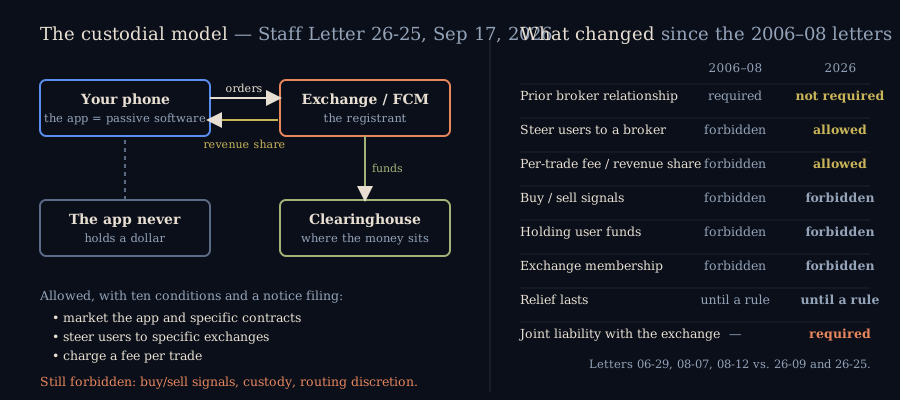
The model it blesses is what the letter calls, in quotation marks, a "custodial" one, and the word is doing a lot of work. The app sits on your phone. Your orders go from the app directly to a registered exchange, or to a registered futures commission merchant that's a member of one. Your money sits at the exchange's clearinghouse, or at that FCM — never at the app. The app "would serve only to passively enable Users to transact." It can't generate "express 'buy' or 'sell' signals," can't hold or control your assets, can't "exercise discretion with respect to the routing or execution" of an order. In exchange for staying that passive, it gets to do three things a passive thing has never been allowed to do.
The Line From 1983
To see why those three things matter, you have to read the letter's own footnote 11, which quotes the Commission's 1983 rule on who counts as an introducing broker. The Commission said then that "soliciting or accepting orders" — the statutory test — covers more than literally taking orders; it covers steering a customer to a broker for "the institution of a trading relationship," and it covers anyone "compensated on a per-trade basis or by a referral fee." Such a person, the 1983 Commission wrote, "would be within the definition of, and generally required to register as, an introducing broker."
That was the line for forty-three years: if you get paid per trade for sending people to a broker, you are a broker. Software vendors got a narrow exception starting in 2006 — three staff letters to firms that made order-entry screens — and the exception had six conditions, which the new letter helpfully lists. The customer had to already have a broker before they met the software. The software couldn't recommend a broker "even upon request." No buy or sell signals. No soliciting orders. The vendor's fees couldn't be tied to the broker's execution fees. No exchange membership.
Line them up against today's letter and three of the six are gone. The pre-existing relationship: not required — the exchange can onboard you through the app. Recommending a broker: not just allowed but the point — the app "will introduce Users to—and solicit Users to engage with—specific Registrants." Trade-linked fees: allowed twice over — the exchange "may also agree to share a specified portion of their relevant revenues" with the app, and the app "may charge a transaction-based fee directly to Users." The three that survive: no buy or sell signals, no exchange seat, and no touching individual orders — the app may solicit users, the letter says, but never an order, a distinction that is the CFTC's, not mine. Plus one the old letters took for granted and the new one spells out: no custody. In other words, the 1983 test is still on the books, and a division of the agency has written a letter saying it won't apply it to the exact fact pattern the 1983 Commission used as its example — as long as the software is "passive."
What Replaces the Line
It isn't nothing. This is where I'd push back on anyone calling it a free pass. The ten conditions are, read together, most of what an introducing broker actually has to do — minus the exam and the membership card.
- Disclosures. The app must tell users about its relationship with the exchange, including the fees, and give them the same risk-disclosure statement a registered broker gives — and keep a record that each user acknowledged it.
- Marketing rules as if registered. Policies "reasonably designed to ensure compliance" with the CFTC's and the National Futures Association's rules on communications with the public, "as if the PSP were registered as an IB" — and no promotions that would need NFA pre-approval if it were. The Solana meme-coin wallet is now bound by NFA Compliance Rule 2-29. Somewhere a compliance officer just got a new job.
- Joint and several liability. This is the teeth. Condition seven requires the app and each exchange or FCM it works with to sign a written undertaking that they are "jointly and severally liable for any violations of the Act or Commission regulations by the PSP or any of its personnel." The exchange is on the hook for the app. That's a stronger incentive for Kalshi or Coinbase Derivatives to police their front ends than any registration would be — a registered IB's sins are its own; a passive app's sins are now its exchange's too.
- Consent to jurisdiction. The app files a notice agreeing to all of this and consenting to be investigated and prosecuted by the Commission. Nobody statutorily disqualified may be involved. Records kept to CFTC standards. Notice if you go bankrupt.
Read it that way and it's less a loophole than a new category built by contract: registration-lite, with the liability moved one rung up the ladder to the party the CFTC already regulates. Whether that's clever or just an admission that the agency can't examine ten thousand apps is a matter of taste. It's clearly the former from where the agency sits.
The Footnote
Condition ten is the consent-to-jurisdiction clause, and it carries footnote 22, which I've read four times: "Some PSPs may be affiliated with a state or tribal government and as such potentially protected by sovereign immunity. Thus, a PSP shall include a waiver of sovereign immunity, limited or otherwise, if necessary to make enforceable the PSP's consent to the Commission's jurisdiction."
Nobody writes that footnote on spec. A state or tribal government does not build a crypto wallet. What a state government builds is a lottery, and what a tribal government builds is a casino, and what both of them have spent 2026 doing is fighting the CFTC over sports event contracts — the prediction-market bets on games that Kalshi and its competitors offer under federal commodities law in states, and on reservations, where sports betting is otherwise licensed, taxed, or banned. The Indian Gaming Association announced a legal defense fund this spring; more than sixty tribes have filed amicus briefs in the federal cases; tribal leaders told a congressional hearing that prediction markets are the biggest threat to a $40-billion-a-year industry that funds their schools and clinics. And here, in a letter about crypto wallets, is the CFTC anticipating that a state or tribal entity might want to be a front end to those same contracts — to put the "trade it on Kalshi" button inside its own app, take the revenue share, and waive its immunity to do it.
I don't know who asked. The letter says "may be," not "is," and no state or tribe has announced anything. But the CFTC's staff doesn't draft immunity-waiver language for a hypothetical. If you can't beat them, apparently, you can be their user interface.
Two Agencies, One Morning, Two Instruments
Compare the instruments, because the difference is the whole story of this week.
The SEC's tokenized-stock exemption is a Commission order — voted, published, and expiring in five years, which I argued this morning was the design: a genie with a lease. The CFTC's letter is signed by one division director. Its last page says it "represent[s] the views of the Division only," does "not necessarily represent the position or view of the Commission," and is "not binding on the Commission." It lasts "until the effective date of a Commission rulemaking or guidance addressing the application of the IB registration requirement to software developers." The Phantom letter said the same thing in March. Six months later there is no such rule — there is a second letter, for everybody, saying the rule is still coming. The 2006 vendor letters said it too, twenty years ago. "Until a rule" is the longest-running tenancy in Washington.
And it lands two days after the Senate declined to write the rule itself. The CLARITY Act that fell eleven votes short on Monday carried, in Section 604, a developer safe harbor — the Blockchain Regulatory Certainty Act, which Senator Wyden had spent the summer fighting to keep in — saying that whoever writes non-custodial software that never controls user funds isn't a money transmitter. That died with the bill. Forty-eight hours later the CFTC's staff wrote a narrower version of the same instinct for the one corner it controls: non-custodial software isn't a broker, either. Narrower is the operative word. This letter says nothing about money-transmitter law, which is the Justice Department's statute, not the CFTC's, and the Justice Department has prosecuted wallet developers under it as recently as last year. An app can now be a blessed passive front end for perpetual futures on Wednesday and a criminal money transmitter on Thursday, depending on which building you're standing in.
That is what regulating without Congress looks like up close: not one framework, but a set of letters, each from a different room, each covering the ground that room can see.
What I'll Be Watching
- The notices. Every app relying on this files a notice and an undertaking with the division. Whether the CFTC publishes the list is the difference between knowing who's a front end and guessing.
- The first non-crypto app. Footnote 14 invites it. The first time a sports app or a social network — Truth Social already has a prediction-market deal with Crypto.com — files under this letter rather than registering, the "crypto wallet" framing is over.
- The first state or tribe. Footnote 22.
- The rule. Chairman Selig said in March the agency was working on broader guidance for when non-custodial software triggers registration. Every month that passes with a letter instead of a rule is a month this can be withdrawn "in its discretion" by whoever holds the pen.
- Whether the SEC copies it. The securities-side equivalent — an app that routes stock orders to a broker-dealer for a cut without registering — would be the bigger story. Same morning, same building across town; I'd be surprised if nobody has asked.
Where I Could Be Wrong
- I'm not a lawyer, and this is a reading of the letter's text against the letters it cites, not legal advice. The distinction between "engaging in activities that would require IB registration" and "not being an IB" is one the letter itself draws carefully — it grants no-action relief for conduct it concedes is IB activity — and a lawyer might weigh that framing differently than I have.
- "Three of six conditions dropped" is my comparison of the 2006–08 requirements as summarized in the letter against the 2026 covered activities. The old letters had additional representations (one required no compensation from the broker at all; one didn't), and the new letter's conditions aren't a one-to-one replacement.
- The footnote-22 inference — that a state or tribal entity has inquired — is exactly that, an inference from why a drafter would include immunity-waiver language. The letter doesn't say, and nobody has announced a deal. It could be boilerplate carried over from somewhere else; I couldn't find it in the Phantom letter.
- Phantom's existing Kalshi integration was described at launch as tokenized positions referencing Kalshi's markets, bought with Solana tokens — which may not be the same structure the March letter covers (orders to a registered exchange, funds at the clearinghouse). I'm using it as the reason Phantom asked, not as an example of the model.
- "Prosecuted wallet developers as recently as last year" refers to the Justice Department's money-transmitting cases against the Tornado Cash and Samourai Wallet developers, which concluded in 2025. Those involved mixing software, not trading front ends; the point is that the statute exists and is used, not that a Kalshi button is a mixer.
- I hold no crypto tokens, use no Phantom wallet, and have no position on Kalshi or any prediction market. My book is Bitcoin through an ETF and Strategy Inc. None of this is investment advice, and a friend who sends links without captions is not a source, just a prompt.