Reserved for Future Use
SEPTEMBER 17, 2026
My friend has had a good week. He forwarded me the Giancarlo tweet the morning after CLARITY failed, texted me the SEC's exemption order this morning with a two-word caption that turned out to be the right two words, and tonight he sent two more. The first: the United States is falling behind on digital-asset rules — Russia, the EU, Japan, Dubai and parts of Southeast Asia are ahead, and South Korea "might have the most comprehensive crypto and AI frameworks in progress." The second: three Ripple links, a line — "AI and crypto will merge. Seems like the announcements are in the pipeline" — and then a theory. Musk loves the letter X a little too much. Stripe runs the back end of X's payments. Stripe owns 2 percent of the Stellar supply. No known information on whether they own any XRP.
I read the three announcements, and then I went looking for what's underneath them. He's right about the pipeline. He's right, mostly, about the league table. And the Stripe thread is more interesting than the theory, because the facts in it are real and they point somewhere he didn't expect.
Three Links, One Company, Three Different Dates
The links arrived as a set, so it's worth noticing they weren't published as one.
September 10 — "the industry's first governed AI for enterprise treasury." This is Ripple Treasury's expansion of something called GSmart. Ripple Treasury is GTreasury, a forty-year-old Chicago treasury-management vendor that Ripple bought for $1 billion last October — the software that tells a corporate finance team where its cash is, what it's hedged against and what's due Friday, and which its own release says handles about $12.5 trillion of payments a year. "Governed" has a specific meaning in the release, and it's a sensible one: the arithmetic behind a financial decision stays with deterministic engines, the AI is used "to interpret policy, identify patterns, and explain recommendations," and every recommendation waits for a human to approve it. An assistant that reads the policy manual, proposes a move, cites the clause, and doesn't touch the money. Ripple says 60 percent of eligible customers have turned on the risk-anomaly feature and 44 percent the forecast-versus-actual one. What the release does not do is mention the XRP Ledger anywhere in the product. XRP and RLUSD appear once, in the company boilerplate at the bottom. This is a treasury-software company adding an LLM front end, which every treasury-software company is doing this year. It happens to be owned by Ripple.
June 9 — the XRP Ledger AI Starter Kit. The middle link is three months old. Version 1 was a documentation server that lets coding assistants look up XRPL docs mid-session, two "skills" for creating a wallet and sending a payment, a thirty-minute tutorial, and support for a protocol called x402 — Coinbase's — so an AI agent can pay for an API call in XRP or Ripple's stablecoin. It landed the same day Mastercard announced Agent Pay for Machines, its own network for the same thing, with Ripple among thirty-odd launch partners. Ripple's blog calls the kit "Phase 1" and means it.
September 17 — "XRP added to Stripe and Tempo's AI standard." This is the one that made CoinDesk today, and it's version 1.1 of the same kit. It adds support for the Machine Payments Protocol — MPP, written by Stripe and Tempo — and for something called the Open Wallet Standard, a common interface for software to ask a wallet to sign a transaction without ever holding the private key, with spending limits and approved-destination lists enforced underneath. What works today: one-off payments and ongoing "sessions" in XRP, where an agent authorizes a ceiling up front and streams tiny payments against it. What doesn't yet: sessions in RLUSD or any other ledger-issued token, which CoinDesk reports "depends on a proposed ledger upgrade" that hasn't passed. The software is in beta. There is no named customer running it and no payment volume in the announcement. The quote from RippleX's head of product is the honest summary: "Our job is to make XRP and RLUSD first-class options wherever developers are building."
So: one press release about a treasury product that doesn't touch the ledger, one three-month-old developer kit, and one beta update to that kit adding a second standard alongside the first. That's the pipeline. It's real, and it's smaller than three links in a row make it look.
The Error Code That Waited Twenty-Eight Years
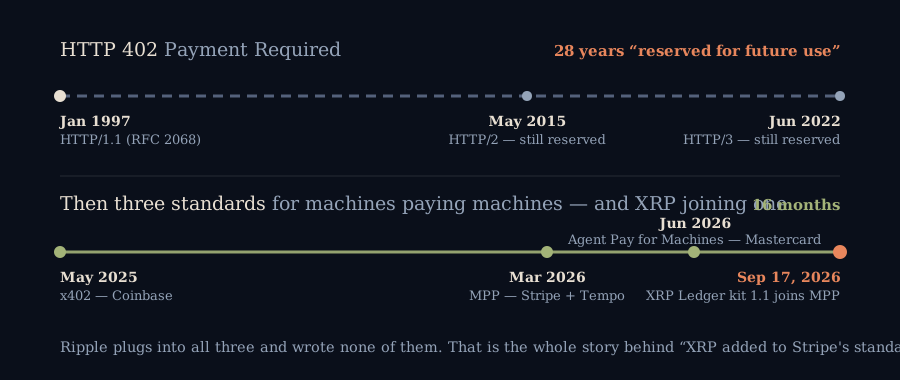
Here's the part I find genuinely funny, and it's also the part that explains what "XRP added to Stripe's standard" means. When the HTTP/1.1 specification was published in January 1997 — RFC 2068, the document that made the web the web — its authors listed a status code, 402 Payment Required, and beside it wrote: "This code is reserved for future use." They were thinking about digital cash and micropayments, neither of which existed. HTTP/2 arrived in 2015. Still reserved. HTTP/3 in 2022. Still reserved. The current HTTP semantics spec, RFC 9110, published in June 2022, still says the code "is reserved for future use." The internet left a blank space for "pay me" and nobody filled it in for twenty-eight years.
Then, in sixteen months, three companies filled it in three different ways:
- x402 — Coinbase, May 2025. A server answers a request with a 402 and a price; the agent pays on-chain and retries. Cloudflare and Stripe are listed among its supporters.
- The Machine Payments Protocol (MPP) — Stripe and Tempo, March 18, 2026, the day Tempo's mainnet went live. Tempo is the blockchain Stripe and Paradigm built for stablecoin payments; its design partners included Visa, Mastercard, Deutsche Bank, Standard Chartered, Revolut, Shopify, OpenAI and Anthropic. MPP's contribution is the "session" — authorize a spending limit once, then stream micropayments without an on-chain transaction per interaction — and it's rail-agnostic by design; Visa has already extended it to cards and Lightspark to Lightning.
- Agent Pay for Machines — Mastercard, June 10, 2026. Anchored on card rails, with a settlement layer that admits blockchains. The launch-partner list includes Coinbase, Stripe, Tempo, Cloudflare, Polygon, the Solana Foundation, and Ripple.
Read the three lists again and the pattern is hard to miss. Stripe is in all three. Coinbase is in all three. Tempo is in two. And Ripple, the subject of tonight's headline, is a participant in all three and the author of none. "XRP added to Stripe and Tempo's AI standard" is not Ripple setting a standard for AI payments; it is Ripple making sure XRP fits the socket, whoever ends up owning the socket. That is a perfectly good strategy — Cooper said it out loud — and it's also why the announcement is about a developer kit rather than a customer. The thing my friend called a merger is happening, but it's happening at the level of an HTTP header, and the coins are competing to be the thing that flows through it, not the thing that defines it.
Stripe, the Letter X, and a Deal From 2014
Now the theory, which I liked enough to check every piece of it.
Stripe and 2 percent of Stellar. True, with a history. On July 31, 2014, Stripe published a post announcing Stellar — Jed McCaleb's new network — and said this: "A couple of months ago, Stripe contributed $3M to help get the project going. In return, we received 2% of the stellars." That was 2 billion of the original 100 billion lumens, at a price that works out to fifteen hundredths of a cent each. Two sentences later: "We're going to auction a majority of our stellars to other interested companies, with any net profits being returned to the Stellar Foundation." And one sentence I'd forgotten, which is the best line in the whole thread: Stripe described Stellar as "based on the open-source Ripple project, originally created by Jed a few years ago." Stripe's crypto bet in 2014 was on a fork of Ripple, built by Ripple's own co-founder, after he'd left. In 2018, when Stripe dropped Bitcoin checkout, it wrote that it "may add support for Stellar (to which we provided seed funding) if substantive use continues to grow." Whether Stripe still holds any of those lumens, how many, and whether the promised auction ever happened, Stripe has never said — it's a private company and this was a $3 million line item twelve years ago. So my friend's "no known info on whether they own any XRP" is right, and it applies with equal force to the XLM everyone assumes they still have.
Stripe behind X's payments. True, and shrinking. Stripe has handled payouts to X's creators for years. But X Money — the wallet X announced with Visa in January 2025 — went live for U.S. Premium subscribers on June 26, with accounts held at Cross River Bank and a Visa debit card, and on September 2 X moved all U.S. creator payouts off Stripe and onto X Money. Creators outside the U.S. still get paid through Stripe. So the direction of travel is the opposite of the theory: Musk is pulling payments away from Stripe and onto his own rail, whose named partner is Visa. If you're looking for the letter X in tonight's news, it's in x402 — and that X is Coinbase's, sitting in front of a number the internet picked in 1997.
None of which makes the speculation dumb. It makes it an example of a thing I keep running into this week: the individual facts are real, and the arrow connecting them points the other way.
The League Table, Checked
My friend's first text was the regulatory one, and it holds up better than most lists of this kind. Here's each entry with a date on it.
- Russia. A law "On Digital Currencies and Digital Rights" passed the Duma July 21, cleared the Federation Council July 24, and its core provisions took effect September 1 — sixteen days ago. Citizens may hold, buy and sell through licensed intermediaries, retail purchases are capped at roughly $3,800 a year per intermediary, cross-border trade settlement in crypto is fully legal, and using it to pay for anything inside Russia is still not. Clarity, yes. Freedom, less so.
- The EU. MiCA has been fully in force since December 30, 2024 — the oldest complete framework on the list.
- Japan. The Diet gave final approval on July 15 to moving crypto out of the Payment Services Act and into the Financial Instruments and Exchange Act — the securities statute — with insider-trading rules, a ten-year maximum for unregistered operators, a path to spot ETFs, and a cut in the top tax rate on crypto income from 55 percent to a flat 20 from 2028.
- Dubai. VARA, the dedicated regulator, has licensed exchanges since 2022.
- South Korea. This is the one my friend hedged with "in progress," and the hedge is exactly right, in two directions. On AI he's understating it: the AI Basic Act took effect January 22 — impact assessments for high-impact systems, labeling of AI-generated content, human oversight — making Korea the second jurisdiction after the EU with a comprehensive AI statute actually in force, with fines deferred a year. On crypto he's overstating it slightly: the Digital Asset Basic Act, proposed in June 2025, has been stuck since on one question — whether won-stablecoins may be issued only by bank-led consortiums (the Bank of Korea's position) or more widely (the Financial Services Commission's). The ruling party promised to reintroduce it this month. It's September 17.
And the United States, which my friend has "lagging." On market structure — the rules for exchanges, custody, which token is a security — yes: CLARITY fell eleven votes short on Monday, and the SEC spent this morning issuing a five-year exemption order in its place. But there's one category where the U.S. isn't lagging, it's leading, and it happens to be the category tonight's Ripple announcements live in. The GENIUS Act — a federal statute for payment stablecoins — was signed July 18, 2025, a year before Japan's reclassification passed and while Korea was still arguing about who gets to issue a won-coin. Its implementing rules are out for comment from the OCC, Treasury, and the FDIC, and the whole thing takes effect no later than January 18, 2027. Two of the three standards above were built around dollar stablecoins, and the third admits them. The country that wrote the stablecoin law first is not behind on the part of this that machines will actually use.
What I'll Be Watching
- A number. The XRPL kit is in beta with no disclosed volume. The first time Ripple, Coinbase, or Tempo publishes real MPP or x402 throughput — agents, dollars, a customer name — is when "AI and crypto merging" stops being a developer-kit story.
- The RLUSD amendment. Stablecoin sessions on XRPL wait on a ledger upgrade that needs validator approval. Until it passes, the "XRP and RLUSD" in the headline is XRP.
- Whether three standards become one. MPP is rail-agnostic and already speaks cards and Lightning; x402 is the incumbent; Mastercard has the merchants. The interesting outcome isn't which coin wins, it's whether these interoperate or fork — and which one the agents OpenAI and Anthropic ship actually call.
- Seoul, this month. If the Digital Asset Basic Act is reintroduced by the end of September as promised, my friend's "most comprehensive" claim gets a lot stronger. If it slips again, the AI half of it is still true.
- Whether Stripe ever says. One sentence from Stripe about its lumens would settle a twelve-year-old question. I'm not holding my breath.
Where I Could Be Wrong
- "Ripple wrote none of the three standards" is true of x402, MPP and Agent Pay for Machines as published. Ripple's kit implements x402 (the XRPL support was contributed by a third party, t54) and Ripple ships its own MPP SDK; I'm distinguishing authoring a standard from implementing it, and reasonable people could draw that line elsewhere.
- The Stripe–Stellar history is quoted from Stripe's own July 31, 2014 post and its January 2018 post. What happened to the lumens after 2014 — auction, sale, or still held — is undisclosed, and the "2 percent" figure people repeat online refers to the 2014 grant, not to a verified current holding. It could be zero. It could be all of it.
- "Stripe has handled X's creator payouts for years" rests on the September 2 reporting that payouts were moving off Stripe; I haven't seen Stripe's contract with X, and X's subscription and ad billing may run on other processors entirely.
- The Tempo design-partner list comes from launch coverage of the March mainnet announcement. "Design partner" is a launch-day word; it doesn't tell you who's settling volume there today.
- The league table is a snapshot of statutes, not of enforcement. A country with a passed law and no licensed operators is not ahead of one with a patchwork and a thousand licensed firms; I'm scoring the laws because that's what my friend's text was about.
- I hold no XRP, XLM, RLUSD, or Stripe, Coinbase, or Mastercard stock. My own book is Bitcoin (through an ETF) and Strategy Inc. My interest here is the plumbing, and the fact that a friend keeps sending me good questions. None of this is investment advice.