Eight Million Accounts and a Basketball Court
SEPTEMBER 17, 2026
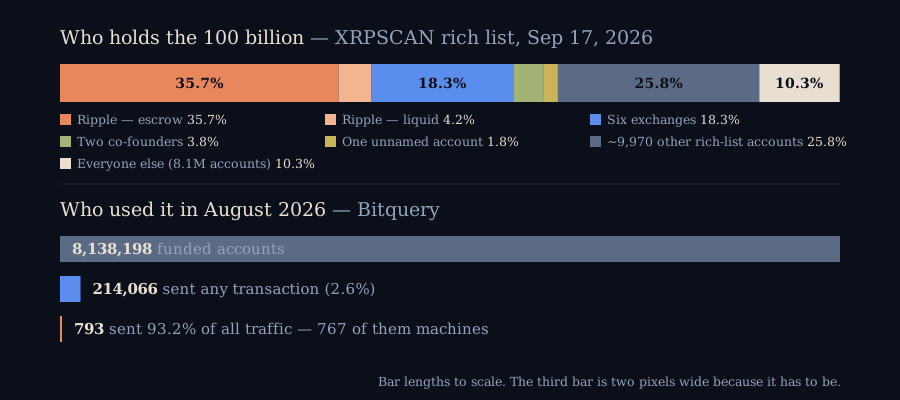
Four texts since Tuesday is a pace. My friend — the one who has been feeding this publication all week — sent a screenshot tonight of the XRPSCAN rich list, a donut chart of who owns XRP, with a caption: "What's amazing is that only 8,130,000 XRP accounts exist. Many users hold multiple accounts. Less than 1% of 1% of people mathematically own any XRP.. yet XRP always gets tons of attention." And a postscript: the University of Louisville is now the third university to put XRP on its uniforms or its field.
I like this text more than the others, because it isn't a forwarded headline. It's a number he found, a calculation he did, and a puzzle he noticed. All three deserve a straight answer, and the answer to the third one is sitting in the chart he sent.
The Arithmetic First, Because It's the Least Interesting Error
The number is real. XRPSCAN counts 8,138,198 funded accounts on the ledger as of this week; my friend rounded it. The world has about 8.2 billion people in it. Divide, and you get 0.099 percent — roughly one person in a thousand. "One percent of one percent" is one in ten thousand. He's off by a factor of ten, in the direction that makes his point sound better than it is.
But I'd let that go, because the numerator is wrong in two directions at once, and the ways it's wrong are more interesting than the division.
An Account Is Not a Person, in Either Direction
Direction one: the count is far too low to be "people who own XRP." Look at the screenshot again. Coinbase appears as 347 accounts. UPbit, the Korean exchange, as 13. Binance as 147, Bithumb as 3, Uphold as 4, bitbank as 2. Six companies, 516 ledger accounts, 18.3 percent of every XRP in existence — held on behalf of customers who, as far as the ledger knows, do not exist. When you buy XRP on Coinbase you don't get an account on the XRP Ledger; you get a row in Coinbase's database, and Coinbase's 347 accounts hold 5.8 billion XRP for all of you at once. The spot XRP ETFs have taken in about $1.5 billion; every one of those holders has zero XRPL accounts. So do the people holding it on Robinhood, Kraken, eToro and every other custodian. The ledger's account count is a count of doors, and most of the people are behind six of them.
Here's a way to size the gap. Security.org's 2026 consumer survey put U.S. crypto ownership at about 30 percent of adults — 70 million people — and found 11 percent of those owners hold XRP. Do the multiplication and you get something like 7.7 million Americans. That's a survey of 992 people, so hold it loosely, but the order of magnitude is the point: the United States alone may have about as many XRP holders as the entire ledger has accounts, and the U.S. isn't even where XRP's big retail base is. Korea is — which is why an exchange you've never used, UPbit, holds more XRP than Coinbase.
Direction two: the count is far too high to be "people who use XRP." Opening an XRPL account costs one XRP — about a dollar-thirty at tonight's price — since validators cut the base reserve from 10 XRP in December 2024. Cheap accounts get made. Of the 8.14 million, 6.72 million hold less than 1,000 XRP, and the median balance across the whole ledger is 12 XRP, about sixteen dollars. That's not a portfolio; that's the change in a car door. Then there's spam. Bitquery's audit of the ledger, published this month, counted a single dust-spam campaign that touched 2.4 million wallets this year, and a phishing run between August 23 and September 8 that reached 1,280,036 distinct wallets in seventeen days for a total cost of 69.6 XRP — ninety-six dollars. Every wallet that received one of those is a "funded account."
So the 8.13 million undercounts holders by a lot and overcounts users by a lot, and there is no arithmetic you can do on it that lands on "how many people own XRP." My friend's instinct — that accounts and people aren't the same thing — was right. He just applied it in one direction.
What the Ledger Actually Does All Day
The Bitquery audit is the most useful document I've read on XRP this year, and it's worth quoting its numbers straight, because they are the ones that answer "how many people use this."
- In August 2026, 214,066 accounts sent at least one transaction. That's 2.6 percent of the funded accounts.
- Of those, 793 accounts — 0.37 percent of senders — sent 93.2 percent of all August traffic. Bitquery classifies 767 of the 793 as machines: exchanges, bots, spam senders. The top thousand accounts have produced 70 to 90 percent of monthly transactions every month since 2013.
- Over the twelve months to August, 1,568,580 accounts sent at least one payment. Two-thirds of the accounts that arrived last year never came back after their first month.
- Filter out the spam, and the number of genuinely active accounts in August 2026 — about 191,000 — is roughly what it was in January 2018.
That last line is the one to sit with. The XRP Ledger went live in 2012. It is fourteen years old, older than Ethereum, older than every chain that's eaten its lunch. And after a full cycle of lawsuits, settlements, ETF approvals, a stablecoin, university sponsorships and this week's AI developer kits, the count of real people doing real things on it is back where it was the month after the 2017 bubble popped. My friend's puzzle was "so few owners, so much attention." The audit's answer is "so few users, and it's been that way for nearly nine years."
For scale: Bitcoin's count of addresses with a non-zero balance crossed 40 million back in early 2022, and nobody uses that to argue Bitcoin is secretly under-owned, because everybody understands that an address is not a person. The same courtesy applies here.
Now Read the Chart He Sent
The donut is the interesting part, and not for the reason it was sent. Here's what it says, in order.
Ripple, 31 accounts, 39.88 percent. Four-tenths of every XRP that exists is held by the company, and by XRPSCAN's tally 35.7 billion of Ripple's 39.9 billion is in escrow — time-locked contracts that release one billion XRP on the first of every month, of which Ripple has historically re-locked 600 to 800 million and kept the rest. At tonight's price the part that isn't re-locked is somewhere between $260 million and $520 million a month of potential supply from a single seller. Other trackers put the escrow at 31 to 32 billion rather than 35.7; the difference is how you count the re-locks, and it doesn't change the shape.
Six exchanges, 516 accounts, 18.3 percent. Customer money, as above.
Two co-founders, 14 accounts, 3.8 percent. The labels say chrislarsen and ahbritto — Chris Larsen, Ripple's co-founder and executive chairman, and Arthur Britto, the co-creator of the ledger, who has kept an almost total public silence since. 3.8 billion XRP between two people.
One unlabeled account, 1.8 percent. Nobody knows. 1.8 billion XRP.
The other roughly 9,970 accounts on the rich list, 25.8 percent. Everyone who holds more than about 240,000 XRP — roughly $310,000 — and isn't one of the above.
Everyone outside the top ten thousand — the other 8.13 million accounts — 10.31 percent.
Read it once more. The 8.13 million accounts my friend was counting own, put together, a tenth of the coin. The top ten thousand accounts own the other nine-tenths, and one company owns four-tenths by itself. That is the actually amazing statistic in the screenshot, and it was there the whole time.
The Attention, and Who's Buying It
Which brings us to the puzzle. Why does a coin with this few real users get "tons of attention"?
Because the largest holder is a company, and the company buys the attention. The University of Kansas announced on July 8 that an XRP patch would go on every uniform in its athletic department, multi-year, terms undisclosed — Ripple called it "the first-ever crypto sponsorship of a major college athletics program." The University of Florida followed on September 4 with the XRP logo painted on the field at Ben Hill Griffin Stadium, a deal reported at about $5 million a year. And on September 15 Louisville announced that two XRP logos would become a permanent fixture on Denny Crum Court — in the two spots at midcourt where the late Hall of Fame coach's signature used to be. The signature isn't gone; it's been moved inside the three-point lines, closer to the baselines, to make room. So my friend is right: Louisville is the third. Uniforms, field, court — Ripple has now bought each of the three surfaces a camera points at.
None of this is sinister, and I want to be careful not to write it as if it were. If you owned 40 percent of a thing, you'd put its logo at midcourt too; that's just what a marketing budget is for, and Ripple has funded university blockchain research since 2018 on top of the sports deals. But it flips the inference in the text. The attention isn't evidence of an adoption wave the account count hasn't caught up with. The attention is a line item, paid for by the holder of the 40 percent, out of a treasury that unlocks a billion of its own coins every month. Bitcoin's marketing budget is zero, which is why its logo isn't on anybody's court — and also why nobody has to wonder who's paying for it.
Put the two halves together and the text reads differently. Few people own XRP directly: true, but the same is true of every coin, and the ledger count can't tell you how few. Few people use it: true, and stable since 2018. Lots of attention: true, and purchased. The mystery isn't a mystery. It's a business model.
What I'll Be Watching
- The monthly senders number. 214,066 in August, per Bitquery. If Ripple's developer kits and stablecoin ever bring real users, this is the line that moves — not the funded count, which a $96 phishing campaign can move by a million.
- Ripple's slice of the bar. 39.88 percent tonight. Every month's unlock that isn't re-locked shrinks it a little; a company that still holds 40 percent after nearly nine years of selling has a long runway.
- Louisville's terms. Kansas and Louisville are undisclosed; Florida leaked at $5 million a year. If the other two surface, I'll have a number for what a season of attention costs.
- The fourth school. There will be one. Three in ten weeks is a program, not a coincidence.
Where I Could Be Wrong
- The account count itself depends on who's counting. XRPSCAN's 8,138,198 is funded accounts this week. Bitquery counts 8,972,159 accounts ever created — the gap is accounts that were deleted and their reserves reclaimed, which the ledger allows. A July report put the total at 8.4 million using yet another method. My friend's figure matches XRPSCAN's, so that's the one I used.
- The 7.7 million Americans comes from a 992-person survey multiplied out; the confidence interval on an 11 percent subgroup of that is wide. I'm using it for order of magnitude, not as a count.
- "767 of 793 are machines" is Bitquery's classification, and classifying an account as a bot is a judgment call made from its behavior. The broad shape — a few hundred accounts sending nearly everything — doesn't depend on where the line is drawn.
- The escrow figure. XRPSCAN's per-account escrow sums to 35.7 billion; trackers that read the escrow objects directly report 31 to 32 billion after the September 1 release. I've given both. The "$260 to $520 million a month" is what the historically un-relocked portion is worth at $1.30, not a claim about what Ripple actually sells — its sales are disclosed quarterly and vary.
- "Paid for out of a treasury that receives a billion coins a month" is my inference about where a sponsorship budget comes from, not a disclosed fact. Ripple has other revenue — it bought a $1 billion treasury-software company last year — and none of the three schools has said what it was paid in.
- Some of the attention is organic. The XRP community is real, loud, and older than most; the $1.5 billion that went into the ETFs came from actual people. I'm arguing the sponsorships explain the attention my friend was puzzled by, not that nobody would care without them.
- I hold no XRP and no Ripple stock, which isn't public anyway. My own book is Bitcoin through an ETF and Strategy Inc. I have no opinion on the price; this is a note about what a chart says, and none of it is investment advice.