Same Price, Same Coin Count
SEPTEMBER 17, 2026
A friend sent me a post this week from an account I don't follow, with the question every forwarded chart eventually comes with: what is this actually saying, and is any of it true? The post, from Sun Liao on X on September 16, puts two charts side by side — Zcash from 2018 to now, Bitcoin from 2014 to 2017 — cropped so both show the same shape, a long flat floor and then a wall. The caption: "$ZEC at $1200 = $BTC at $1200. Study what happened in 2017." Zcash had just printed a new eight-year high above $1,380 that afternoon, and the chart he screenshotted shows it closing around $1,289. He'd made the same call two weeks earlier at $856, so the second post is partly a victory lap. Seventy-five thousand people looked at it.
The honest answer to my friend's question has two halves, and they point in opposite directions. The arithmetic in the post is correct — more correct than most people retweeting it probably realize. And the conclusion drawn from it has been wrong every single time it's been drawn before.
Why the Arithmetic Works
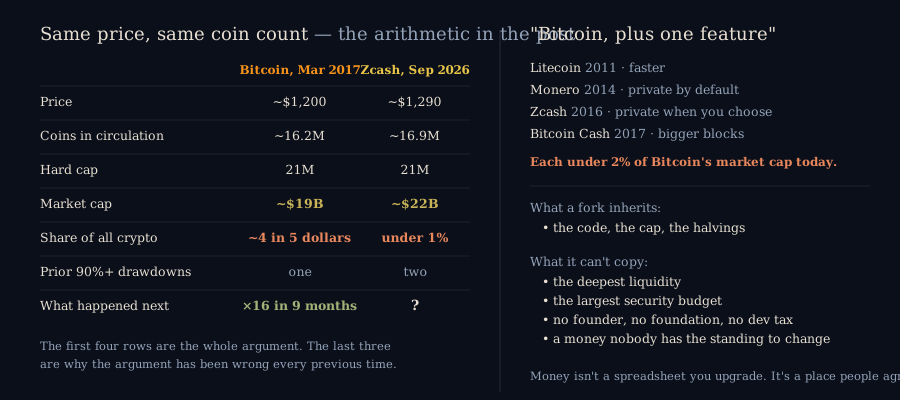
"Zcash at $1,200 equals Bitcoin at $1,200" sounds like a coincidence of price. It isn't. Zcash was forked from Bitcoin's code in October 2016 and kept the part that matters for this comparison: a hard cap of 21 million coins, issued on the same halving schedule. So the two coins have nearly identical supply curves, offset by about eight years. And by an accident of timing, Zcash today — about 16.9 million coins in circulation — is almost exactly where Bitcoin was in March 2017, when it had about 16.2 million and first crossed $1,200.
Same coin count, same price, same market cap. Bitcoin at $1,200 in March 2017 was worth roughly $19 billion in total. Zcash at $1,289 on Wednesday evening was worth roughly $22 billion. When the post says "study 2017," what it means is: Bitcoin, at this exact market cap, went to just under $20,000 by December. Sixteen times in nine months. That's the trade being pitched.
It's a better argument than the usual "this chart looks like that chart," and I want to give it its due before taking it apart. Most crypto analogies compare a $2 billion coin to a $2 trillion one and hand-wave the difference. This one compares two things that genuinely are the same size, with the same scarcity rule, and asks what a market did the last time it priced that exact object at that exact number. That's a real question.
Why the Conclusion Doesn't Follow
Here's the trouble. Same market cap is not the same starting line.
Bitcoin's $19 billion in March 2017 was about four out of every five dollars in the entire crypto market, which was roughly $24 billion in total. It was the first asset of its kind, with one prior cycle behind it, being discovered by a public that had mostly never heard the word. The 2017 run wasn't a coin re-rating; it was a category being discovered, and Bitcoin was most of the category.
Zcash's $22 billion is under one percent of a multi-trillion-dollar market, sitting next to a Bitcoin at about $76,000 and a few thousand alternatives. It isn't a category being discovered. It's one privacy coin being rotated into — a real rotation, with real catalysts, but a rotation.
And Zcash has done this before. His own chart shows it, if you look at the left edge instead of the right: a spike to nearly $900 in early 2018, followed by a 98% decline that took six years to bottom at about $16. What his chart doesn't show — it starts in 2018 — is the launch. On its first day of trading, October 2016, with almost no coins in existence, Zcash briefly printed $5,941. So the coin has already had two 90%-plus drawdowns to Bitcoin's one at the equivalent point, and its all-time high is still four times above where it closed Wednesday. The "study 2017" framing needs Zcash to be a thing that has never been here before. It's been here twice.
Then there's the shape itself. "Kinda looks like BTC in 2017" is chart-pattern matching on a linear scale with a chosen crop, and any parabola looks like any other parabola if you pick the window. I built one of these myself — a pattern engine that hunted for historical "analogs" of the current shape — and retired it; its out-of-sample edge never cleared zero. Irresistible to look at, worthless to trade.
Last, the flows. Grayscale's spot Zcash ETF, ticker ZCSH, listed on NYSE Arca on August 25 and crossed $500 million in assets two weeks later. That sounds like the wall of institutional money the post implies. Look closer: it launched with about $260 million, Grayscale's parent bought $100 million of it in-kind with its own coins, and the rest of the growth is mostly the price of the ZEC the fund already held going up. Genuine new inflows since launch are on the order of $35 million — against a $22 billion coin trading over a billion dollars a day. The ETF is a real milestone for what it permits. It is not what moved the price.
"All the Functionality of Bitcoin, Plus Privacy"
When I explained the arithmetic to my friend, he came back with the version of the thesis I think most people actually hold: if it has everything Bitcoin has and adds privacy, isn't it the better Bitcoin? Wouldn't that make it the apex property on the planet?
I don't think so, and the reasons are worth laying out because they're the reasons I own Bitcoin in the first place.
First, it doesn't have everything Bitcoin has. It has the code, the cap and the halvings. It also has things Bitcoin deliberately doesn't. About a fifth of every Zcash block's issuance has been diverted away from miners since launch — first to the founders, then to a development fund split between the Electric Coin Company, the Zcash Foundation and a grants program, and since the November 2024 upgrade to community grants plus a protocol-controlled "lockbox" whose disbursement the coinholders are still working out. That's a company, a foundation and a treasury with a funding lever, and they've changed the rules more than once. Bitcoin has no equivalent, and the absence is the feature. Zcash also launched on a "trusted setup" — a cryptographic ceremony that, had it been compromised, would have allowed silent counterfeiting nobody could detect. That was fixed in 2022 and this summer's upgrade made the shielded supply independently auditable, so I'd call it solved. But it was a live question for six years, in a way it has never been for Bitcoin's supply for one second.
Second, the privacy is optional, and most people don't opt in. Shielded transactions have always been a minority of the Zcash ledger; the bulk of it is as transparent as Bitcoin's. That's changing this year, which is part of why the coin is moving. But it means the privacy is only as strong as the crowd using it, and the crowd is thin. Monero, which has been private by default for a decade, is the actual privacy coin. Zcash's real niche is narrower and more interesting: it's the privacy coin an exchange can list, because the transparent side lets a compliance department look at it.
Third, and this is the one that answers "apex property": privacy cuts against it, not toward it. The biggest bid on earth — the ETFs, the corporate treasuries, the sovereign wealth funds, the pensions, the banks — can hold Bitcoin because it's auditable. Source-of-funds isn't a preference for those institutions; it's a legal requirement. Money the state can't see is money the state fights, and the pools of capital that would make something the apex property are precisely the pools that can't hold an opaque asset. Zcash's optional privacy is the compromise that got it an ETF at all — Grayscale holds the transparent kind. But that means the thing being pitched as the killer feature is the thing the buyers it needs most are forbidden to use. It's private enough to be a regulatory target and not private enough to be Monero.
Fourth, feature superiority has never beaten Bitcoin, and this is roughly the tenth attempt. Litecoin was faster. Bitcoin Cash had bigger blocks. Monero was private by default. Zcash was Bitcoin plus zero-knowledge proofs. Every one was pitched as "Bitcoin with the missing feature," every one had a moment, and every one is under 2% of Bitcoin's market cap today after a decade of trying. The entire 2017 thesis — the one the post wants you to study — was "better technology wins." The years 2018 through 2024 falsified it about as thoroughly as a market can falsify anything. Money isn't a spreadsheet you upgrade. It's a place people agree to meet, and Bitcoin's value sits in the things a fork can't copy: the deepest liquidity, the largest security budget by a mile, no founder, no foundation, no dev tax, and a monetary policy nobody has the standing to change.
Fifth, the moat can erode from Bitcoin's side. Coinjoins, Silent Payments, Lightning, Ark — Bitcoin's privacy improves incrementally at the layers above the base asset without anyone touching the base asset. It will never be Zcash-grade. But "good enough, plus Bitcoin's network" has beaten "best-in-class, alone" every time it has been tried.
Why My Broker Won't Sell It to Me — but Will Sell Me the ETF
A practical detail that says more than any thesis. The brokerage my trading systems run through lists thirty-six cryptocurrencies. Not one of them is a privacy coin — no Zcash, no Monero, no Dash. It has never published a reason, but the reason is the same across the U.S. industry: a privacy coin is an anti-money-laundering problem, because a platform can't screen where shielded funds came from, and the broker-dealer side of the business is the conservative side. Even the U.S. exchanges that do list ZEC — Coinbase, Kraken and Gemini all do — generally only accept transparent-address deposits and withdrawals. Robinhood has a Zcash page but no live pricing on it; I'd check the app before believing either the page or the guides that say it doesn't list privacy coins. (The Crypto Screener board on this site doesn't score Zcash for the same reason: the exchange feed it's built on doesn't carry it.)
And yet the same brokerage will sell me ZCSH — the ETF — in whole shares, on NYSE Arca, today. That's the whole compliance story in one contrast. Zcash the coin is a thing institutions can't touch; Zcash the ETF is a thing they can, because Grayscale's custodian is holding the auditable half. The coin's ceiling and the ETF's existence are the same fact from two sides.
What Kind of Future I Think It Has
A real one, and a bounded one. Most likely it stays what it's been: a cyclical satellite with a genuine narrative, violent moves in both directions, and a market cap that swings between roughly one and three percent of Bitcoin's through the cycle, with drawdowns between peaks that look like the last two. That's not nothing — a coin that runs sixty times off its lows in two years is a perfectly good trade if you size it like one.
There's a meaningful tail where I'm wrong on the upside, and it's worth naming honestly, because it's the bet Sun Liao is really making. If surveillance central-bank digital currencies and global travel-rule regimes get aggressive enough that financial privacy becomes a mainstream demand rather than a niche one, Zcash is the only privacy asset with an ETF wrapper, a U.S.-listed custodian, and a compliance story. Monero structurally can't get there. In that world, the compromise I called a ceiling above becomes the moat, and the coin re-rates several-fold. I put real probability on it. Not a majority of it.
And there's a smaller tail on the other side. The European Union's anti-money-laundering rules bar licensed crypto firms from handling anonymity-enhancing coins starting in mid-2027, and the United States has periodically leaned the same way. Exchanges have delisted privacy coins in whole jurisdictions before. If that spreads, or if Bitcoin-native privacy gets good enough that the differentiator stops mattering, the niche hollows out from both ends.
What none of those futures includes is "apex property." The apex property isn't the one with the most features. It's the one with the fewest things that can change.
What I'm Doing About It
Nothing, with a footnote. I don't own Zcash in either form. If I wanted the exposure, the honest expression of "I think privacy might matter" is the ETF, at a size where a 90% drawdown is a shrug and not a story — and it comes out of the speculative sliver of the book, never out of the Bitcoin and Strategy core. That's a standing rule of mine: don't cap the core thesis to fund a side bet, no matter how good the side bet's chart looks. This is a trade, not a thesis, and the thesis it borrows — better tech beats the incumbent money — is one that has failed every time it's been told about a different coin. That is precisely why the arithmetic in the post, correct as it is, doesn't move me: same price, same coin count, and a completely different question.
Where I Could Be Wrong
- The March 2017 figures are round. Bitcoin first crossed $1,200 in early March 2017 with about 16.2 million coins outstanding; different exchanges printed different highs that month, and "$19 billion" is that supply times that price, not a figure from any one data vendor. Zcash's ~16.9 million circulating and ~$22 billion cap are CoinMarketCap's numbers on the evening of September 16; its $1,383 high that day and $1,289 close are from the TradingView chart in the post. All of these are dated snapshots — the coin moves 10% on an ordinary day right now.
- "Four out of five dollars." Bitcoin's share of the total crypto market in early March 2017 was in the low-to-mid eighties by the common trackers, and fell below half by June. I've used the March figure because that's the moment the post picks.
- The dev-fund history is compressed. The original Founders' Reward ran through the first halving in November 2020; the direct dev fund through the second in November 2024; the current arrangement (8% to community grants, 12% to the lockbox, now feeding a coinholder-directed grants program) is governed by ZIP 1016 and runs through the third halving in 2028. The point — a fifth of issuance has never gone to miners — survives every version of the detail.
- "Under 2% of Bitcoin's market cap" for Litecoin, Bitcoin Cash, Monero and Zcash is a rounded reading of current caps against Bitcoin's roughly $1.5 trillion, not a precise ranking, and Zcash at about 1.4% is the closest of the four to the line.
- The EU date. The anti-money-laundering regulation's prohibition on anonymity-enhancing coins for licensed firms applies from July 2027 as I read it; the exact scope of "anonymity-enhancing" and whether an optionally-private coin's transparent side is caught is a question the industry is still arguing about, and a regulator could answer it either way.
- Robinhood may well list it — I found a live product page and a guide saying it doesn't, on the same day, and I've said so rather than pick one.
- The ETF-flow numbers are a snapshot: the $500 million milestone from the fund's own 8-K of September 8, the $100 million in-kind purchase from the same filing, the ~$35 million of net inflows from The Block's reporting through September 4. Flows since then could be larger, and they matter for the thesis in a way the price alone doesn't.
- I hold no Zcash and no ZCSH, long or short. My book is Bitcoin through an ETF and Strategy Inc., which is to say I am not a neutral party on the question of whether a Bitcoin-plus-a-feature can beat Bitcoin. None of this is investment advice, and a post with "NFA" at the end of it isn't either.