Ninety Percent of Nothing
SEPTEMBER 25, 2026
Some version of this pitch shows up at dinner tables and in comment threads every tax season, and it has real emotional pull. Abolish federal and state income taxes for every US citizen, wherever they live. Replace the money with a 90% tax on the profits of publicly traded corporations above some market-cap line. Keep taxing non-citizens, on the theory that they might send their dollars home. Let the states make up their share with other taxes. As a bonus, a 90% rate should make giant mergers unattractive, and monopolies would stop forming.
It's aimed at two things that are genuinely worth being angry about. Wages are the most visible, most completely taxed income in the country. And a lot of American industries have been merging their way down to three or four players. So I took the proposal seriously and went through it the way I'd go through any business plan: first the arithmetic, then what the people on the other side of it would do the next morning. The arithmetic is disappointing. The next morning is worse.
The Arithmetic Before Anybody Moves
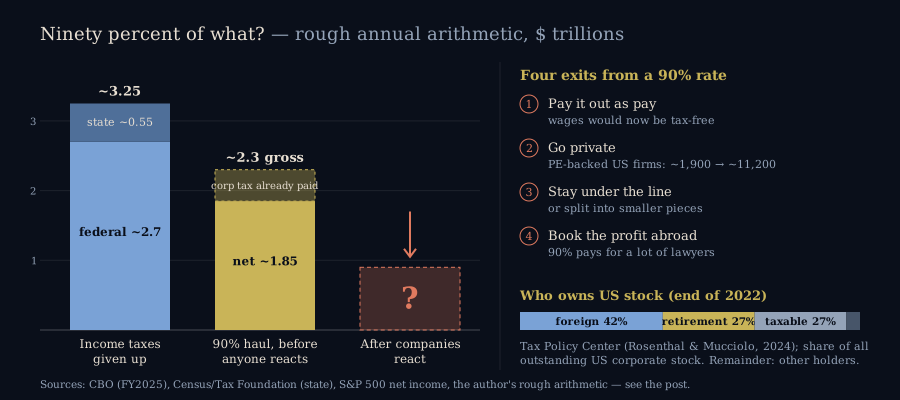
Start with what gets given up. In fiscal 2025, federal individual income tax receipts rose to about $2.7 trillion, more than half of all federal revenue, in a year that still ran a $1.8 trillion deficit. The states collected nearly $1.5 trillion in taxes in 2024, and individual income tax has been about 38% of that, or roughly another $0.55 trillion. Call it $3.25 trillion a year to replace.
Now the thing being taxed. The S&P 500, a reasonable stand-in for "big public company," earned about $2.1 trillion in net income over the twelve months to September 2025. Add back the tax those companies already pay and the pre-tax pool comes to roughly $2.5 trillion. Ninety percent of that is about $2.3 trillion. But the federal budget already collects about $452 billion a year in corporate income tax, so the new money is closer to $1.85 trillion. And about 28% of those companies' revenue comes from outside the US, where other countries get first claim on the profit.
So before a single executive has read the new law, the swap is short by more than a trillion dollars a year, on top of a deficit that is already $1.8 trillion. That $1.85 trillion is the ceiling, and it assumes the companies sit still. They won't.
The Loophole the Plan Builds for Itself
Here's the part that sinks it. Under this plan, a dollar a company keeps as profit is taxed at 90%, and a dollar it pays out as salary to a citizen is taxed at 0%. Wages are a deductible business expense. So the obvious move is to stop having profit and pay it out as compensation: bigger bonuses, fatter stock grants, raises for everyone with a W-2. The only thing that changes is the label on the money.
Current law does have a partial speed bump. Section 162(m) caps a public company's deduction for pay above $1 million to a small group of top executives. That covers a handful of people per company, though. It doesn't reach the thousands of engineers, salespeople and managers whose pay could quietly double, and it doesn't reach the other ways to spend profit before it becomes profit: research, marketing, new buildings, perks. A 90% rate turns every dollar of reported earnings into something a company would rather spend on almost anything else.
The irony is that the people who end up with those redirected dollars, tax-free, are mostly the well-paid employees and executives of the biggest companies. The plan ends up cutting taxes for the people it set out to reach.
Four Doors Out
Compensation is the easiest exit, but it isn't the only one. Every one of these already exists at today's 21% rate. A 90% rate just makes each of them far more worth the trouble:
- Go private. The tax only applies to publicly traded companies, and private money is already happy to oblige. The number of US public companies fell from about 7,300 in 1996 to about 4,300, while the number backed by private equity rose from about 1,900 to about 11,200. That trend would stop being a trend and become a stampede.
- Stay under the line, or split up. Any market-cap threshold creates a cliff. A company sitting just above it has every reason to spin off divisions until each piece sits just below. There's also a circular problem: a 90% tax on profit would crush share prices, so a lot of companies would fall under the line without doing anything at all.
- Book the profit somewhere else. Multinationals already spend a lot of effort deciding which country their profit shows up in. At 90%, that decision becomes the most important thing their tax department does. A 90% rate pays for a lot of lawyers.
- Move the company. The US has anti-inversion rules, but they were written for a world where the gap between the US rate and everyone else's was a few points, not 70.
Who Actually Owns the Target
"Tax the big corporations" sounds like it lands on someone else. It's worth checking who that someone is. At the end of 2022, according to the Tax Policy Center's count, foreign investors held about 42% of all outstanding US corporate stock, domestic retirement accounts about 27%, and ordinary taxable accounts about 27%. That 27% in retirement accounts is 401(k)s, IRAs and pensions: the savings of the same average Americans the plan means to help. Their first experience of the new system would be a sharp drop in their retirement balance.
The cost also doesn't stop with shareholders. The government's own tax scorekeepers assume that roughly 20% to 25% of the corporate income tax is ultimately borne by workers, through lower wages and less investment. At 21%, that's a modest drag. At 90%, it isn't.
It Has Been Tried, Sort Of
The US has actually used rates in this range on corporate profit once, and the details are revealing. During World War II, Congress passed an excess profits tax that hit 90% in 1942 and 95% in 1943. But it only taxed profits above a pre-war baseline (roughly what the company earned in 1936 to 1939), it came with a promised post-war refund, a ceiling capped the combined bill at around 70% of income, and Congress repealed it effective January 1, 1946. Even in the middle of a world war, with wartime price controls and patriotic pressure behind it, Congress wouldn't take 90% of all corporate profit. It took most of the extra, for a few years, with a ceiling and a refund.
Why It Misses the Monopolies
The anti-monopoly goal is the most sympathetic part of the idea, and it's also where the mechanism fits worst. A tax on profit doesn't ask whether a company got big by buying its rivals or by building something people wanted. A market-cap threshold hits a company that grew by acquisition and one that grew by being better with exactly the same force. In practice it would discourage anyone from growing past the line at all, including the scrappy challenger that was about to take on the incumbent. Meanwhile an incumbent that's already private, or that splits itself into three friendly pieces, escapes entirely.
The US already has tools built for this job. Merger review exists to block the acquisitions that reduce competition, and the 2023 Merger Guidelines from the FTC and Justice Department lay out when a deal crosses that line. Those tools have real limits, which I'll get to below, but they aim at the actual behavior rather than at size itself.
The Citizenship Line
The last piece, taxing non-citizens while exempting citizens, runs into three separate walls.
The first is treaties. The US has income tax treaties with dozens of countries, and their nondiscrimination articles generally prohibit taxing another country's nationals more heavily than US nationals in the same circumstances. A tax that falls only on non-citizens is close to the textbook case those clauses were written to stop.
The second is the courts. The Supreme Court held in Graham v. Richardson (1971) that state laws treating lawful resident aliens differently from citizens get strict scrutiny, the same standard courts apply to classifications by race. Federal rules touching immigration get much more deference, so the federal half is a genuinely open question. The state half looks much harder to defend.
The third is the incentive it creates. The US is already one of only two countries, with Eritrea, that taxes its citizens wherever they live. Exempting citizens worldwide would flip that overnight and turn a US passport into one of the best tax shelters on earth, with predictable effects on who wants one. The remittance rationale doesn't hold up well either: a legal immigrant who sends money home is sending wages that were already taxed, and plenty of citizens spend and invest abroad too.
What Could Actually Work, and What Each Costs
None of that makes the underlying goals wrong. Wage earners do carry a heavy, visible load, and concentration is a real problem. Here are six approaches that aim at the same targets. Each one has an honest downside, and people disagree about them for good reasons.
1. Cut taxes on wages directly
A much larger standard deduction, or a cut to the payroll tax that every paycheck carries, would put money straight into the pockets of wage earners.
- The good: it's precise. It reaches the people the swap was trying to help, with no new agency and no new tax base to police.
- The bad: it costs real money, and that money has to come from somewhere. A payroll-tax cut also touches the funding for Social Security and Medicare, which is its own fight.
2. A consumption tax (a VAT) with a rebate
A value-added tax is used by about 175 of the 193 UN member countries, and the US is the only OECD country without one. The Congressional Budget Office estimates a 5% VAT on a broad base would raise about $3.4 trillion over ten years.
- The good: it's hard to dodge, since it's collected at every stage of production. It doesn't penalize saving or investment the way an income tax does, and a per-person rebate can make it progressive for low earners.
- The bad: on its own it's regressive, because lower-income families spend a larger share of what they earn. Replacing the income tax entirely takes a much higher rate than its fans usually quote. The Tax Policy Center found the "FairTax" plan's advertised 23% rate would add close to $10 trillion to deficits over a decade, and that it needs about 28%, or 39% at the register, to break even, and only if nobody evades it.
3. A minimum tax on the very largest companies
This one already exists. The 2022 Inflation Reduction Act created a 15% corporate alternative minimum tax on companies with more than $1 billion a year in book profit. It reaches roughly 100 to 150 companies, and the Joint Committee on Taxation projected about $222 billion over nine years.
- The good: it's the size-based corporate tax this idea is reaching for, with a rate low enough that it isn't worth reorganizing a company to avoid.
- The bad: it's complicated, it taxes accounting profit rather than taxable income, and it raises a small fraction of what the swap would need. That's the trade-off: the lower the rate, the less anyone bothers to avoid it, and the less it raises.
4. Close the step-up in basis
When someone dies holding stock that has gone up in value, their heirs inherit it with the gain wiped clean for tax purposes. The Joint Committee on Taxation puts the cost at about $72.5 billion in lost revenue in 2026. It's one of the main reasons the very wealthy can hold appreciated assets for life and never pay tax on the gain.
- The good: it goes straight at untaxed gains on inherited stock, the income that fortunes are mostly made of, without inventing a new tax.
- The bad: heirs of family farms and small businesses can owe tax on assets they can't easily sell, and tracking decades-old purchase prices is a real record-keeping headache. Congress has tried this once. The Tax Reform Act of 1976 replaced the step-up with "carryover basis," and the Crude Oil Windfall Profit Tax Act of 1980 repealed it before it ever really took effect. A windfall-profits bill repealing a tax on inherited windfalls is either irony or a very clear message about who shows up to lobby.
5. A wealth tax
An annual tax on net worth above a high threshold goes after wealth directly rather than waiting for anyone to sell.
- The good: it reaches fortunes that generate little taxable income, which is exactly the gap the income tax leaves open.
- The bad: the track record abroad is poor. The number of OECD countries with a net wealth tax fell from 12 in 1990 to 4 in 2017, mostly because of valuation fights, capital flight and disappointing revenue. In the US there's also an unsettled constitutional question about whether such a tax would have to be apportioned by state population, which would make it nearly impossible to design.
6. Just enforce antitrust
If the goal is to stop monopolies, the most direct tool is the one built for it: blocking anticompetitive mergers and, when warranted, breaking companies up.
- The good: it targets the actual harm (reduced competition) rather than size, and it doesn't punish a company for growing by being better.
- The bad: it's slow, case by case, and decided in court over years. How hard it gets pushed also swings with each administration. Merger guidelines are guidance, not law.
No single one of these replaces $3.25 trillion. That's the honest lesson from the whole exercise: there's no single tax you can dial to 90% that quietly pays for everything else. What exists is a menu of real trade-offs, each hitting a different part of the problem, and the fight is always over which trade-offs to accept.
Where I Could Be Wrong
- The revenue arithmetic is deliberately rough. I used the S&P 500's trailing net income as a proxy for "big public companies." A lower market-cap threshold would pull in more companies and more profit. I also netted out the whole $452 billion of corporate tax as if these companies paid all of it; they don't quite, so the static gain could be a few hundred billion dollars higher. Neither adjustment closes a trillion-dollar gap, and both are swamped by what happens once companies react.
- The state figure comes from two sources. I combined Census's roughly $1.5 trillion in 2024 state tax collections with the Tax Foundation's 38% income-tax share, which is from fiscal 2022. Treat the $0.55 trillion as an estimate, not an official total.
- The World War II ceiling depends on which account you read. Descriptions of the excess profits tax's combined ceiling range from about 70% to around 80% of income, depending on the year and the source. The point stands either way: it never took 90% of all profit.
- The citizenship question hasn't been tested. No court has ruled on a federal income tax that applies only to non-citizens, because nobody has passed one. My read of the treaty and equal-protection problems is an informed guess, not settled law.
- Economists genuinely disagree about who bears the corporate tax. The 20% to 25% labor share is the assumption government scorekeepers use. Some studies find more, some less.
Sources
- Congressional Budget Office. Monthly Budget Review: Summary for Fiscal Year 2025. November 2025. cbo.gov
- U.S. Census Bureau. Annual Survey of State Government Tax Collections Data Available. April 2025. census.gov
- Tax Foundation. 2024 State Income Tax Rates and Brackets. taxfoundation.org
- GuruFocus. S&P 500 Net Income (TTM). gurufocus.com
- RBC Wealth Management. U.S. equity returns in 2025: Record-breaking resilience. rbcwealthmanagement.com
- BDO. Publicly Traded Companies' Deduction Limit for Compensation Over $1 Million Expanded; Section 162(m) Regulations Finalized. bdo.com
- EQT. Why is the stock market shrinking? February 2025. eqtgroup.com
- Rosenthal, Steven M. and Livia Mucciolo. Who's Left to Tax? Grappling With a Dwindling Shareholder Tax Base. Tax Policy Center / Tax Notes Federal, April 2024. taxpolicycenter.org
- Tax Policy Center. Who bears the burden of the corporate income tax? Briefing Book. taxpolicycenter.org
- Wikipedia. Excess profits tax. wikipedia.org
- Tax Foundation. The History of Excess Profits Taxes Not as Effective or Harmless as Today's Advocates Portray. taxfoundation.org
- Federal Trade Commission and U.S. Department of Justice. Merger Guidelines. 18 December 2023. ftc.gov
- Internal Revenue Service. Notice 2015-35: Qualified Income Tax Treaty Countries. irs.gov
- Graham v. Richardson, 403 U.S. 365 (1971). justia.com
- Greenback Tax Services. Citizenship-Based Taxation vs. Residency-Based Taxation. greenbacktaxservices.com
- Wikipedia. Value-added tax. wikipedia.org
- Congressional Budget Office. Impose a 5 Percent Value-Added Tax (Options for Reducing the Deficit: 2025 to 2034). December 2024. cbo.gov
- Tax Policy Center. Proposed FairTax Rate Would Add Trillions to Deficits Over Ten Years. taxpolicycenter.org
- Congressional Research Service. The 15% Corporate Alternative Minimum Tax (R47328). congress.gov
- Peter G. Peterson Foundation. What Is Stepped-Up Basis on Capital Gains and How Does It Affect the Federal Budget? pgpf.org
- U.S. Congress. H.R. 3919 — Crude Oil Windfall Profit Tax Act of 1980. congress.gov
- OECD. The Role and Design of Net Wealth Taxes in the OECD. April 2018. oecd.org