The Cheapest Fuel in the Solar System Is a Planet
SCIENCE & TECHNOLOGY · SEPTEMBER 23, 2026
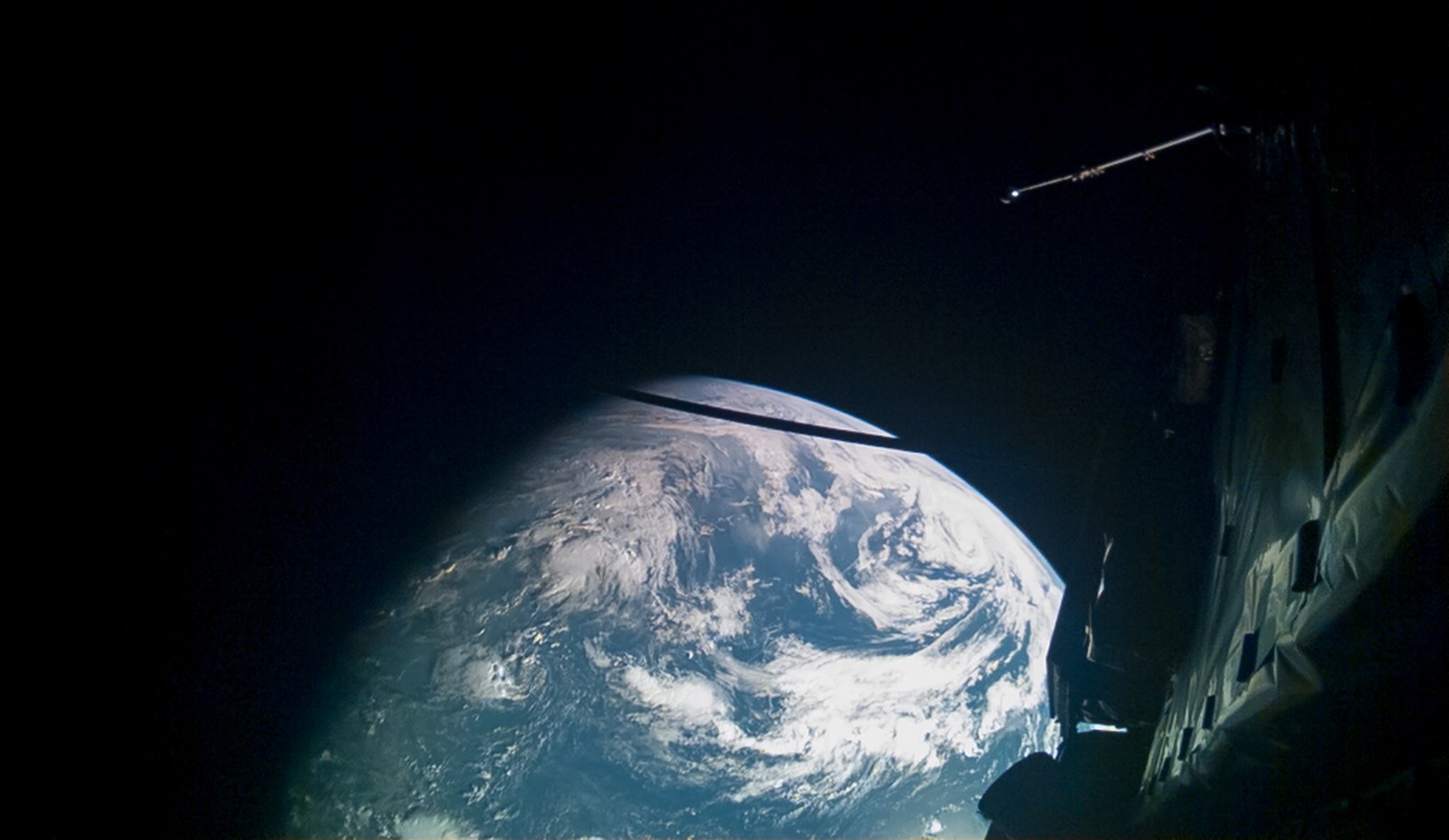
On September 28, the European Space Agency's Jupiter Icy Moons Explorer — JUICE for short — passes within 8,640 kilometres of Earth, close enough that fifteen to thirty minutes beforehand it will visibly cross the sky over Australia. Closest approach is 13:45 CEST (11:45 UTC), over the Indian Ocean. The point of coming back to the planet it left three and a half years ago isn't sightseeing: the flyby bends JUICE's path by about 20 degrees and adds roughly 3.5 kilometres a second to its speed — 12,600 km/h, for nothing. No fuel burned. It's the third time JUICE has done this trick, and it needs one more before it's done.
Why Does a Spacecraft Need to Steal Speed From a Planet?
JUICE launched on 14 April 2023 aboard an Ariane 5 rocket, carrying about 3,000 kilograms of propellant for a spacecraft that weighed just over 6,000 kg fully fuelled. That sounds like a lot until you do the arithmetic a direct flight to Jupiter demands: getting there on rocket power alone, and then slowing down enough to be useful once you arrive, costs far more delta-v — the technical measure of a manoeuvre's difficulty — than any propellant tank of that size can supply. So instead of trying to out-muscle the problem, mission designers route the spacecraft past other planets and let gravity do the work for free. Fly close enough to a moving planet on the right side, and you leave the encounter faster than you arrived, at the planet's expense — its own orbital momentum is so much larger than the spacecraft's that the planet doesn't notice the loan. It's the cheapest fuel in the solar system, and the only cost is time.
JUICE's route, in order: an unprecedented double flyby of the Moon and Earth back-to-back in August 2024, then Venus in August 2025, this Earth flyby on September 28, 2026, and one final Earth flyby in January 2029. Four gravity assists to do what a much bigger, much more expensive rocket might have done in one straight shot — arriving at Jupiter in July 2031, eight years and three months after launch.
How close is 8,640 km, really? The International Space Station orbits at about 400 km — JUICE stays well clear of it and everything else in low orbit. GPS satellites sit around 20,200 km, geostationary communications satellites at 35,786 km. So Monday's pass threads the needle between those: low enough to be a genuine close encounter with real gravity to borrow, high enough to clear every satellite constellation in between.
What Actually Happens on the Day?
The trickiest part isn't the flyby itself — it's the several hours before it. From 21:24 CEST on September 27 to 06:03 CEST on September 28, JUICE passes through Earth's shadow, cut off from sunlight and running on battery alone, the same stretch of darkness any satellite crosses on every orbit, except JUICE isn't built to live in Earth orbit and this is the only time it will. Getting lined up for it took less correcting than the team expected. "Until now, only one manoeuvre at minus four weeks was needed," said Angela Dietz, JUICE's spacecraft operations manager, in ESA's own release. "It was of relatively small size, but extremely effective." Flight controllers had blocked out six correction windows — at four weeks, two weeks, one week and three days before closest approach — and as of ESA's statement, only that first one had actually been needed.
The close pass is also a rehearsal. All ten of JUICE's science instruments are switched on from September 23 to October 3 to gather real data on Earth and the Moon, and the navigation camera will practise finding its bearings off the Moon's horizon — the exact optical-navigation trick it will need to fly precisely past Europa, Ganymede and Callisto five years from now, with no other chance to test it against a body this familiar. "This is great news for science," said Claire Vallat, JUICE's project scientist, "because it means we will be able to turn Juice in all different directions to point its science instruments at different parts of Earth and the Moon." A mission built to study alien ice gets one last look at home ice first.
Where Is All This Actually Headed?
Jupiter, eventually, and specifically its three largest icy moons: Ganymede, Callisto and Europa, each thought to hide a liquid water ocean under a shell of ice — the closest thing this solar system has to a second chance at the ingredients for life, just very cold and very far from the Sun. After orbit insertion in July 2031, JUICE spends roughly three years making 35 flybys of the three moons before settling into orbit around Ganymede at the end of 2034 — the first spacecraft ever to orbit a moon that isn't our own. The mission is expected to end in late 2035, when its remaining propellant runs out.
What I'd Watch For
The next milestone on the route is the final Earth flyby in January 2029 — after that, JUICE is done borrowing and starts the long coast to Jupiter proper. It's a strange kind of countdown: four gravity assists, three of them behind it after Monday, each one a free tank of gas from a planet that never even feels the withdrawal.
Where I Could Be Wrong
ESA counts this as the "third gravity assist," treating the August 2024 lunar-Earth double flyby as one event — some secondary write-ups describe it as a "second Earth flyby" instead, which is really a difference in how you count the Moon, not a disagreement about what happened. The six-correction-maneuver count and "only one used so far" figure is accurate as of ESA's own statement ahead of the flyby, which may be a few days stale by the time you're reading this — more of the scheduled windows may have fired, or been skipped, by September 28 itself. And I've taken JUICE's dry mass and propellant load from public mission summaries rather than an ESA technical document; treat those two numbers as approximate rather than exact.
Sources
- European Space Agency. Juice to fly past Earth for third gravity assist. September 2026. esa.int
- European Space Agency. Juice factsheet. esa.int
- ESA / Cosmos. Juice trajectory profile. cosmos.esa.int
- Wikipedia. Jupiter Icy Moons Explorer. en.wikipedia.org
- eoPortal. JUICE (Jupiter Icy Moons Explorer). eoportal.org