A Comet Carrying Someone Else's Recipe for Water
SCIENCE & TECHNOLOGY · SEPTEMBER 23, 2026
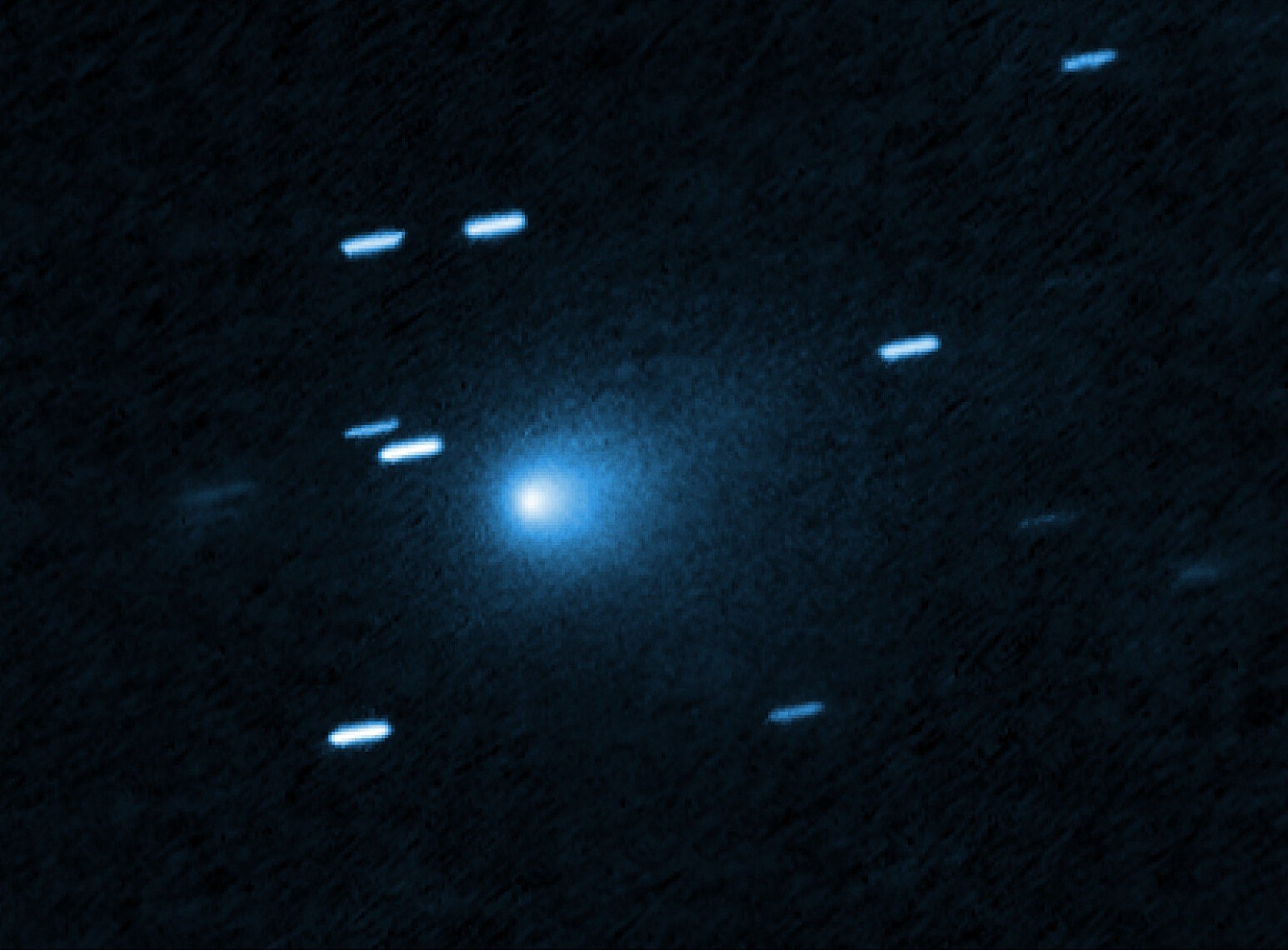
3I/ATLAS — the third interstellar object ever confirmed passing through our solar system, spotted on July 1, 2025 by the ATLAS survey telescope in Río Hurtado, Chile — has been leaking a chemical secret about where it was born. A paper led by Kenji Furuya of Japan's RIKEN Pioneering Research Institute, submitted this month to The Astrophysical Journal Letters, works through what that secret means: the water boiling off the comet as it nears the Sun carries a deuterium-to-hydrogen ratio of about 1%, somewhere between roughly 30 and 65 times higher than anything measured in a comet that actually formed in our own solar system. That's not a small discrepancy to explain away. It's the kind of number that makes you ask what recipe this water was made from, and where.
What a Deuterium-to-Hydrogen Ratio Actually Measures
Deuterium is hydrogen with an extra neutron bolted on — twice the mass, chemically almost identical. Water built with deuterium instead of ordinary hydrogen is, literally, "heavy water," and every water molecule in the universe carries some mix of the two. The ratio between them (D/H) isn't fixed; it's set by the temperature and density of the cloud a water molecule froze out of, which makes it a kind of chemical birth certificate. Solar-system comets, having formed from the same cloud of gas and dust that built the Sun, cluster in a fairly narrow D/H range — roughly 0.015% to 0.03%, depending on which comet you measure. The number for 3I/ATLAS, (0.98 ± 0.06)%, was pinned down using infrared spectroscopy from the James Webb Space Telescope by a team led by Martin Cordiner of NASA's Goddard Space Flight Center, and it's the measurement Furuya's paper sets out to explain. That's not a variant reading on the family recipe. That's a different kitchen.
Why a Poorer Nursery Makes Heavier Water
The paper's job is explaining that gap, and the mechanism runs through a single ion-molecule reaction: H₃⁺ + HD ⇌ H₂D⁺ + H₂, which at very cold temperatures runs preferentially in the deuterium-loading direction. That reaction gets short-circuited wherever carbon monoxide and other heavy elements are abundant, because they destroy the H₃⁺ ion before it has time to react. In astronomers' shorthand, "metals" means every element heavier than helium — nearly all of it forged in earlier generations of stars and seeded back into the galaxy when those stars died. A cloud that formed early, before many stellar generations had enriched the galaxy, has less of that material lying around to interrupt the reaction — so the deuterium-loading keeps running, and more of it ends up locked into the water ice that eventually becomes a comet's nucleus. Furuya's team ran gas-ice astrochemical models across a range of cloud conditions and found the observed ratio is "most readily reproduced" at subsolar metallicity — half the Sun's or less — combined with a fairly dense cloud (~10,000 molecules per cubic centimetre) and an unusually low cosmic-ray ionization rate. Put plainly: 3I/ATLAS's ice most likely formed somewhere colder and chemically leaner than the cloud that built the Sun.
A second molecule says the same thing. The team didn't stop at water. They checked the same ratio in methane and found it running about 3% in 3I/ATLAS, versus roughly 0.2% in comet 67P/Churyumov–Gerasimenko — the comet the European Space Agency's Rosetta mission landed a probe on in 2014. Two independent molecules, measured by different chemistry, both point the same direction: whatever built this object's ices ran colder and more deuterium-loaded than anything in our own solar system's family tree.
An Explanation for a Signal Astronomers Already Had
Cordiner's team didn't just measure the ratio back in June — they used it, together with a matching depletion of carbon-13 and a formation temperature estimated around −243°C, to argue in that same Nature paper that 3I/ATLAS could be up to 12 billion years old, tentatively the oldest object ever observed passing through our solar system. Cordiner himself flagged "edge-case scenarios" that could change that reading. Furuya's contribution three months later isn't a new age estimate — it's the mechanism: a working model for exactly how a cloud has to be built, chemically, to produce water this deuterium-rich in the first place, which turns "the water looks strange" into "the water looks strange in a way that specifically requires an old, metal-poor nursery."
There's a genuinely independent line pointing the same way, too, and it started even earlier. Matthew Hopkins, an Oxford doctoral student, had defended his own PhD thesis on predicting what future interstellar objects should look like just one week before 3I/ATLAS was discovered — he described waking up to a flood of messages reading "3I!!!!!!!!!!" and spending the day comparing his model to the incoming data in real time. Run against 3I/ATLAS's actual trajectory and speed, that model put the comet's age at more than 7.5 billion years and its likely birthplace in the galaxy's thick disk, a population of old, metal-poor stars — using none of the same data Cordiner or Furuya did: no spectroscopy, no isotopes, just orbital mechanics. Three groups, three different techniques, and they keep landing in the same neighborhood — this thing is old, and it was built from a leaner chemical pantry than the one that made us.
Where I Could Be Wrong
This is a model fit to one object, not a settled measurement of "the" interstellar D/H ratio — 3I/ATLAS is only the third confirmed interstellar visitor, after 'Oumuamua in 2017 and 2I/Borisov in 2019, and neither of those offers a comparable water measurement to check this one against. The low-metallicity, low-cosmic-ray-rate combination that best fits the data isn't the only physically plausible one; deuterium fractionation chemistry has more than one free parameter, and a different combination of temperature, density and ionization rate could in principle land near the same number. I'm working from the preprint and the secondary science writeups rather than a completed peer review, and the JWST measurement itself — published separately by Cordiner and collaborators — carries its own instrumental uncertainties that this piece hasn't independently verified. If either the observed ratio or the astrochemical model gets revised, the "low-metallicity nursery" read could soften.
Sources
- Furuya, K., Cordiner, M., Bockelée-Morvan, D., Bodewits, D., Chandler, C. O., Drozdovskaya, M. N., Roth, N. X., Villanueva, G. High water D/H ratio of the interstellar object 3I/ATLAS is consistent with a low-metallicity origin. Submitted to The Astrophysical Journal Letters, September 2026. arxiv.org
- Cordiner, M. et al. Isotopic evidence for a cold and distant origin of 3I/ATLAS. Nature, June 2026. nature.com
- Water D/H in 3I/ATLAS as a probe of formation conditions in another planetary system. Nature Astronomy, 2026. nature.com
- Hopkins, M. J. et al. From a Different Star: 3I/ATLAS in the Context of the Ōtautahi–Oxford Interstellar Object Population Model. The Astrophysical Journal Letters, July 2026. arxiv.org
- University of Oxford, Department of Physics. Third ever detection of interstellar object. 2026. physics.ox.ac.uk
- Phys.org. Third known interstellar visitor 3I/ATLAS may be billions of years older than the solar system, study finds. June 2026. phys.org
- Phys.org. 3I/ATLAS has an extreme taste for heavy water. September 2026. phys.org
- Universe Today. 3I/ATLAS Has An Extreme Taste For Heavy Water. September 2026. universetoday.com
- ESA/Hubble. 3I/ATLAS. esahubble.org