A Drug for Hair Loss That Clears Aging Cells Instead of Blocking a Hormone
SEPTEMBER 22, 2026
On September 16, a clinical-stage biotech company called Rubedo Life Sciences announced it is starting a human trial, in October 2026, of a drug for androgenetic alopecia — ordinary male and female pattern hair loss — that works nothing like the two drugs that have owned this market since the 1990s. Minoxidil and finasteride both work around the edges of the problem: one dilates blood vessels near the follicle, the other blocks the hormone that shrinks it. The new drug, RLS-1496, is built on a different premise entirely — that the follicle stops growing hair because some of its own cells have gotten old and are actively holding it back, and that clearing those cells out restarts the follicle rather than just protecting it. The company's ex vivo data, on real human follicles pulled from men with the condition, found RLS-1496 matched or beat finasteride at regrowing hair in six days [1]. That is a genuinely interesting result. It is also six days, in a dish, and worth being precise about before getting excited.
What actually causes male pattern hair loss
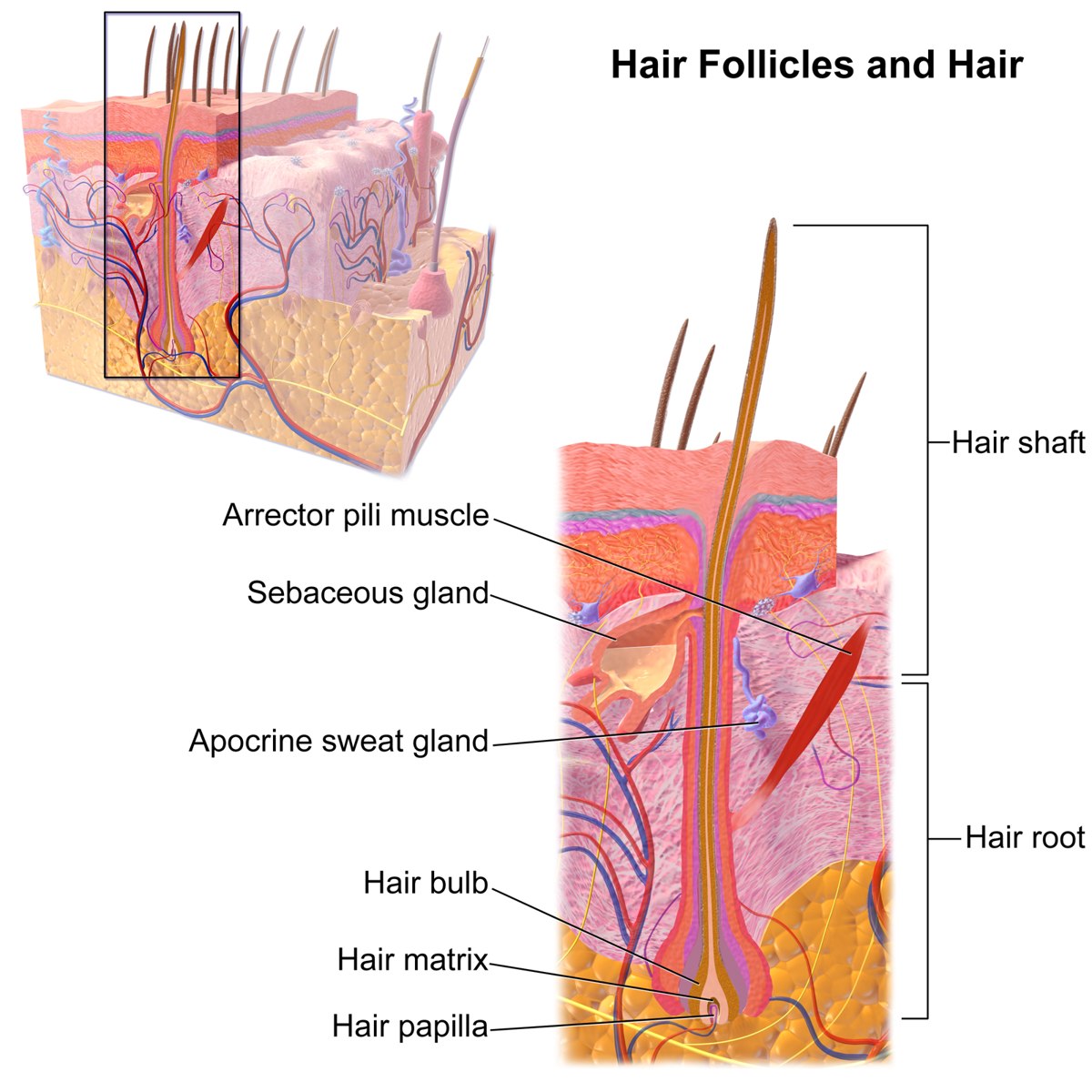
The textbook explanation starts with dihydrotestosterone, or DHT, a hormone made from testosterone by an enzyme called 5-alpha reductase. In scalp that's genetically sensitive to it, DHT binds receptors in the hair follicle and, over repeated growth cycles, shrinks it — miniaturization — until what was a thick terminal hair is a barely-visible vellus hair, and eventually nothing grows at all. Finasteride works upstream of that: it blocks the enzyme that makes DHT, so less of the hormone ever reaches the follicle. In the pivotal trials behind its approval — three placebo-controlled studies in 1,879 men, run in the 1990s — a year of finasteride produced a net hair-count improvement of about 8.3% over placebo, and five years of continuous use cut the odds of a man's hair loss visibly progressing further by 93% relative to placebo [2]. Those are real, durable, and also modest numbers: finasteride mostly slows or holds the line, and works only on scalp that still has miniaturizing follicles left to rescue, not follicles that have already gone dormant.
What DHT doesn't explain is why blocking it only gets you partway there, or why some follicles stop responding to it at all. The newer idea, and the one Rubedo is building a drug around, is that DHT sensitivity is the trigger but cellular senescence is a big part of what actually executes the damage. Senescent cells are cells that have stopped dividing but refuse to die — they sit there instead, secreting a cocktail of inflammatory signals (researchers call it the SASP, senescence-associated secretory phenotype) that degrades the tissue around them and, the theory goes, actively suppresses the stem cells a follicle needs to start a new growth cycle. This isn't a new idea in aging biology generally — it's the same mechanism behind a wave of drugs called senolytics, aimed at everything from osteoarthritis to lung fibrosis — but RLS-1496 is the first attempt to point it specifically at a bald scalp.
How RLS-1496 is supposed to work
RLS-1496 modulates an enzyme called GPX4 (glutathione peroxidase 4), whose normal job is protecting cell membranes from a specific kind of oxidative damage called lipid peroxidation. Senescent cells, it turns out, are unusually dependent on GPX4 to keep that damage in check — pull the plug on it, and they're pushed into ferroptosis, an iron-dependent, membrane-rupturing form of cell death that's mechanistically distinct from normal apoptosis. The pitch is selectivity: senescent cells are sensitized to this failure mode in a way healthy, actively-dividing cells generally aren't, so the drug can clear the aged cells without taking out the follicle's working stem cells alongside them [1].
Rubedo's co-founder and chief scientific officer, Marco Quarta — who did his postdoctoral work in Thomas Rando's lab at Stanford studying why aged muscle stem cells lose the ability to regenerate tissue [3] — describes the drug as acting at several points in the hair-loss cascade at once: clearing senescent cells outright, damping down the SASP's inflammatory signaling, and modulating two separate cellular pathways (NRF2 and Wnt/β-catenin) that are involved in pushing a dormant follicle back into its active growth phase [1]. The company calls this combination — selectively killing the cells that are unsalvageable while chemically nudging the stressed-but-viable ones back toward normal function — "Adaptive SenoTherapeutics," a name for the same "SenoAdaptive" idea it's applied to its other skin programs [1] [4]. Whether "kill some, rescue others" is a real, cleanly separable mechanism or a marketing gloss on ordinary senolytic biology is not something an outside reader can verify from a press release — it is the kind of claim that gets tested (or quietly dropped) as the actual trial data accumulates.
What the ex vivo data actually shows
The company's evidence so far comes from an ex vivo human hair follicle organ culture model — meaning intact follicles were physically removed from the scalps of men with androgenetic alopecia and kept alive in a dish, then dosed with dihydrotestosterone to reproduce the miniaturization process, a standard technique for studying hair biology outside a living person [1]. Against that DHT challenge, RLS-1496 produced a statistically significant increase in follicle elongation compared to untreated (vehicle) controls at two different doses over six days, with the effect strongest at the highest concentration tested — and at that top dose, the follicles grew numerically more than a finasteride-treated comparison arm [1]. The company also reported spatial-transcriptomics data from patient biopsies (its proprietary "ALEMBIC" platform) showing gene-expression signals consistent with senescent cells being cleared and the follicle's regenerative program switching back on, and cited roughly 32% greater hair regrowth versus vehicle in animal studies [1]. The press release did not disclose the number of follicles or patients in the ex vivo cohort, nor the exact elongation measurements in millimeters or percentages — those specifics would normally show up in a peer- reviewed paper or a conference poster, and the company says Marco Quarta will present this data at the Annual Aging Research & Drug Discovery meeting at Harvard in early October [1], which is the point at which independent scientists get to actually look at the numbers rather than the company's characterization of them.
The human trial that's actually starting
Separately from the hair-loss news, RLS-1496 is not a brand-new molecule being rushed into people for the first time. It cleared FDA review for a Phase 1b/2a trial in actinic keratosis (precancerous sun-damaged skin lesions) in September 2025, and a European trial covering plaque psoriasis, atopic dermatitis, and photoaged skin began in May 2025, with results expected by the end of 2026 [5]. The hair-loss study is what's new here: a clinical trial in patients with androgenetic alopecia, enrolling starting October 2026, led by David Pariser, a dermatologist and former president of the American Academy of Dermatology who has run more than 450 dermatology trials [1]. Rubedo says initial data is expected in the first half of 2027. The company did not disclose the trial's phase, size, or its primary endpoint (whether that's a hair-count measurement, a physician global assessment, or something else) in the announcement — those details typically surface on ClinicalTrials.gov once the study is formally registered, which is worth checking before treating "data in H1 2027" as a specific promise.
Why "senolytic" should make you a little more careful, not less
The idea that clearing senescent cells can reverse an age-related problem is not hypothetical — it has already had a very public, very expensive test. Unity Biotechnology, the first company to get a senolytic into a Phase 2 human trial, ran UBX0101 — a p53/MDM2 inhibitor injected directly into the knee — against painful osteoarthritis in 183 patients. It missed its primary endpoint completely at every dose tested; the company blamed an unusually strong placebo response, dropped the program, and its stock collapsed [6]. That failure doesn't mean senescent-cell biology is wrong — the follow-up analysis that's been done since largely blames trial design and dosing rather than the underlying hypothesis [6] — but it's the reason a senolytic drug earns real skepticism rather than automatic credit for a plausible-sounding mechanism. A 2026 trade-press review of Rubedo's own program noted that earlier senolytic efforts broadly produced "limited and mixed signals, with dose-limiting toxicities," and flagged the general challenge of hitting only the harmful senescent cells without also catching healthy "innocent bystander" cells nearby [7] — precisely the selectivity question RLS-1496's ferroptosis-sensitization mechanism is a bet on solving.
Where the evidence is weak
Every piece of efficacy data released so far is preclinical: follicles in a dish for six days, and an unspecified animal model. None of it is a measurement of a living human scalp growing more hair over months, which is the only outcome that actually matters to someone with hair loss, and which ex vivo organ culture cannot fully predict — a follicle sitting in a dish has none of a living scalp's blood supply, immune system, or hormonal environment. The comparison to finasteride is "numerically greater" at one dose in one experiment, not a head-to-head clinical trial with a p-value attached, and finasteride itself is a modest drug (single-digit percentage hair-count gains) that this ex vivo model may simply be more sensitive to than a real scalp would show over a year. The company hasn't disclosed sample sizes, exact effect sizes, or submitted this data for peer review — everything here comes from a press release, which is a genre built to lead with the best number available. And the hair-loss trial itself hasn't started yet: no registered protocol, no stated phase or endpoint, and a company that is privately held — it has raised about $52 million across two rounds since 2018, most recently the $40 million Series A — and cannot be bought as a stock (a detail worth knowing, since press coverage of biotech news often gets asked "how do I invest in this"; Rubedo has not filed for an IPO as of this writing) [8].
What the evidence says. RLS-1496 is a real, well-funded drug candidate — not a supplement or a claim with nothing behind it — built on a genuinely different mechanism than the two drugs that have dominated hair-loss treatment for thirty years, backed by an actual FDA IND clearance and two other trials already running in related skin conditions. The specific hair-follicle evidence, though, is six days of growth in isolated follicles in a lab, compared against a real but modest drug (finasteride) and reported without the underlying numbers, sample size, or peer review. Senolytics as a drug class have exactly one Phase 2 readout in the medical literature so far, and it failed its primary endpoint. The honest read is: a promising, testable hypothesis that's about to get its first real human test — not yet evidence that this treats hair loss.
What I'd do. Nothing here is a recommendation and I am nobody's dermatologist. But if this genre of drug interests you, the thing worth actually tracking is whether Rubedo posts a registered protocol on ClinicalTrials.gov once the AGA study opens in October, and whether the ex vivo numbers hold up once Marco Quarta's Harvard presentation and any resulting paper are public — a real sample size and effect size, not a press release's characterization of one. That's a several-month wait, and finasteride and minoxidil remain the only treatments in this space with years of randomized-trial evidence behind them today.
Sources
- Rubedo Life Sciences. Rubedo Life Sciences Announces Clinical Study to Treat Hair Loss with GPX4 Modulator RLS-1496, First Human Ex Vivo Evidence Demonstrates Robust Hair Follicle Growth. Press release, 16 September 2026. biospace.com
- Kaufman KD, Olsen EA, Whiting D, et al. Finasteride in the treatment of men with androgenetic alopecia (Finasteride Male Pattern Hair Loss Study Group); and long-term 5-year multinational follow-up. Journal of the American Academy of Dermatology, 1998 / 2002. pubmed.ncbi.nlm.nih.gov
- Stanford Medicine. Researchers rejuvenate stem cell population from elderly mice, enabling muscle recovery — background on the Rando lab's aged-stem-cell research Marco Quarta trained in. 2014. med.stanford.edu
- Rubedo Life Sciences. Rubedo Life Sciences Closes $40M Series A Financing Led by Khosla Ventures and Ahren Innovation Capital — company background, founding, and pipeline. Press release, 22 April 2024. businesswire.com
- Rubedo Life Sciences. Rubedo Life Sciences Announces U.S. FDA Clearance of IND for Selective GPX4 Modulating Lead Drug Candidate RLS-1496 for Actinic Keratosis, Expands Clinical Advisory Board. Press release, 17 September 2025. biospace.com
- Clinical Trials Arena / Fierce Biotech. Unity's Phase II osteoarthritis study of UBX0101 misses primary goal; and Buzzy anti-aging biotech Unity drops leading program after flop, shares in freefall. August 2020. clinicaltrialsarena.com
- Drug Discovery Trends. Rubedo bets senescent cell clearance can make skin act younger — context on senolytic drug-class track record and the selectivity challenge. 2026. drugdiscoverytrends.com
- Tracxn. Rubedo Life Sciences — Company Profile: Valuation, Funding & Investors — private-company status, founders, and total funding raised. 2026. tracxn.com
This is one reader's reading of the research, not medical advice. If something here touches on your own health, take it to a clinician who knows you — and read how these entries are put together.