The MisterLibrarian Bible Project
Catalogued & compared, one chapter at a time
☰ Menu
🌐 Español🗺️ Atlas
CreationBefore the FloodThe FloodAfter the FloodThe PatriarchsEgypt and the ExodusThe KingdomThe ExileThe ReturnBetween the TestamentsThe GospelsThe Apostolic Age
🕰
Nebuchadnezzar's golden image on the plain of Dura; Shadrach, Meshach, and Abednego refuse to bow and walk unburned from the furnace.
⚠ No date is given — unlike chs. 1, 2, 5, and 6, which all open on a numbered year or a named night. Most placements put it early in the reign, after ch. 2's dream (c. 603 BC) supplies a plausible occasion for the image, but that is inference from the book's order, not a date in the text.
Full chronology →

Daniel 3 — The Mister Translation
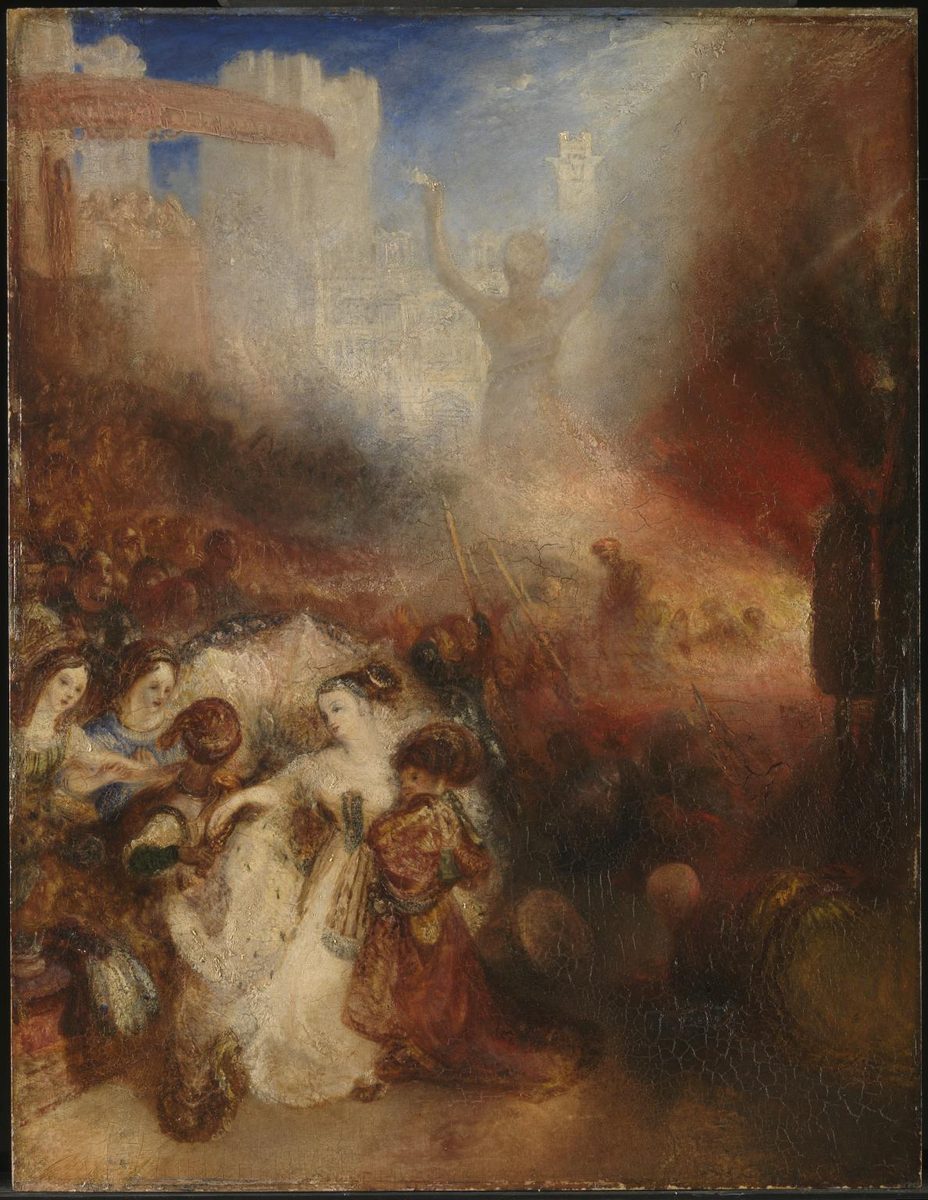
A hazy oil painting in warm ochre and red tones. In the sharply lit lower left, a cluster of elegantly dressed women and attendants stand together — one in a white and gold gown with an elaborate hairstyle, another kneeling in red. Behind them at upper left, a red canopy shelters indistinct seated figures. In the center background, pale and ghostlike against a blue sky and distant towers, a tall robed statue stands with both arms raised. To the right, spear-points and smoke rise into a diffuse orange-red glow where a fire burns, its details dissolved into haze.
Shadrach, Meshach and Abednego in the Burning Fiery Furnace
J. M. W. Turner, 1832 · Tate, London

⚠ Turner's canvas is easy to misread at first glance, because almost nothing in it is where the story would put it. Look for the three men, or the furnace itself, and what you find on the right is a wall of atmosphere — spear-points, smoke, a reddish glow — with no figures inside it clear enough to name. The pale, upright form with both arms raised in the center background, ghostly against the blue sky and the city's towers, is Nebuchadnezzar's golden image, not the king: Turner pushes Nebuchadnezzar himself back into the red canopy at upper left, a shadowy presence rather than the commanding tyrant most painters of this scene put center stage. And the sharpest, most fully realized passage in the whole picture — real faces, real fabric, real light — is a cluster of elegantly dressed onlookers in the lower left who have no clear role in Daniel's account at all. The painting has drawn little of the attention Turner's other fire scenes from the same decade still receive, and its figures specifically have been judged among his weakest. ⚠ It is oil on a mahogany panel — Turner worked on wood as often as canvas — and entered the national collection in 1856 as part of the Turner Bequest, the nearly 300 paintings and 30,000-plus works on paper he left to Britain at his death.

Public domain (artist d. 1851) — faithful photographic reproduction of a two-dimensional work · View the original
1
נְבוּכַדְנֶצַּר מַלְכָּא, עֲבַד צְלֵם דִּי-דְהַב, רוּמֵהּ אַמִּין שִׁתִּין, פְּתָיֵהּ אַמִּין שִׁת; אֲקִימֵהּ בְּבִקְעַת דּוּרָא, בִּמְדִינַת בָּבֶל.
Nebuchadnezzar the king made an image of gold, whose height was sixty cubits and its breadth six cubits; he set it up in the plain of Dura, in the province of Babylon.note
El rey Nabucodonosor hizo una imagen de oro, de sesenta codos de altura y seis codos de anchura; la erigió en el llano de Dura, en la provincia de Babilonia.
2
וּנְבוּכַדְנֶצַּר מַלְכָּא שְׁלַח לְמִכְנַשׁ לַאֲחַשְׁדַּרְפְּנַיָּא סִגְנַיָּא וּפַחֲוָתָא אֲדַרְגָּזְרַיָּא גְדָבְרַיָּא דְּתָבְרַיָּא, תִּפְתָּיֵא, וְכֹל, שִׁלְטֹנֵי מְדִינָתָא--לְמֵתֵא לַחֲנֻכַּת צַלְמָא, דִּי הֲקֵים נְבוּכַדְנֶצַּר מַלְכָּא.
And Nebuchadnezzar the king sent to gather the satraps, the prefects, and the governors, the counsellors, the treasurers, the judges, the magistrates, and all the rulers of the provinces, to come to the dedication of the image that Nebuchadnezzar the king had set up.note
Y el rey Nabucodonosor envió a reunir a los sátrapas, los prefectos y los gobernadores, los consejeros, los tesoreros, los jueces, los magistrados y a todos los gobernantes de las provincias, para que vinieran a la dedicación de la imagen que el rey Nabucodonosor había erigido.
3
בֵּאדַיִן מִתְכַּנְּשִׁין אֲחַשְׁדַּרְפְּנַיָּא סִגְנַיָּא וּפַחֲוָתָא אֲדַרְגָּזְרַיָּא גְדָבְרַיָּא דְּתָבְרַיָּא תִּפְתָּיֵא, וְכֹל שִׁלְטֹנֵי מְדִינָתָא, לַחֲנֻכַּת צַלְמָא, דִּי הֲקֵים נְבוּכַדְנֶצַּר מַלְכָּא; וְקָיְמִין לָקֳבֵל צַלְמָא, דִּי הֲקֵים נְבֻכַדְנֶצַּר.
Then the satraps, the prefects, and the governors, the counsellors, the treasurers, the judges, the magistrates, and all the rulers of the provinces gathered for the dedication of the image that Nebuchadnezzar the king had set up, and they stood before the image that Nebuchadnezzar had set up.note
Entonces se reunieron los sátrapas, los prefectos y los gobernadores, los consejeros, los tesoreros, los jueces, los magistrados y todos los gobernantes de las provincias para la dedicación de la imagen que el rey Nabucodonosor había erigido, y se pusieron de pie ante la imagen que Nabucodonosor había erigido.
4
וְכָרוֹזָא, קָרֵא בְחָיִל: לְכוֹן אָמְרִין עַמְמַיָּא, אֻמַּיָּא וְלִשָּׁנַיָּא.
And the herald cried aloud: “To you it is commanded, O peoples, nations, and languages:note
Y el heraldo proclamó en voz alta: «A vosotros se os manda, pueblos, naciones y lenguas:
5
בְּעִדָּנָא דִּי-תִשְׁמְעוּן קָל קַרְנָא מַשְׁרוֹקִיתָא קַתְרֹס שַׂבְּכָא פְסַנְתֵּרִין, סוּמְפֹּנְיָא, וְכֹל, זְנֵי זְמָרָא--תִּפְּלוּן וְתִסְגְּדוּן לְצֶלֶם דַּהֲבָא, דִּי הֲקֵים נְבוּכַדְנֶצַּר מַלְכָּא.
at the moment you hear the sound of the horn, pipe, lyre, trigon, harp, bagpipe, and every kind of music, you are to fall down and worship the golden image that Nebuchadnezzar the king has set up.note
en el momento en que oigáis el sonido del cuerno, la flauta, la cítara, el arpa, el salterio, la gaita y toda clase de música, os postraréis y adoraréis la imagen de oro que el rey Nabucodonosor ha erigido.
cross-refs⤷ 2:46
6
וּמַן-דִּי-לָא יִפֵּל, וְיִסְגֻּד--בַּהּ-שַׁעֲתָא יִתְרְמֵא, לְגוֹא-אַתּוּן נוּרָא יָקִדְתָּא.
And whoever does not fall down and worship shall at that very hour be thrown into the middle of a burning fiery furnace.”note
Y el que no se postre y adore será arrojado en aquel mismo instante en medio de un horno de fuego ardiente».
7
כָּל-קֳבֵל דְּנָה בֵּהּ-זִמְנָא כְּדִי שָׁמְעִין כָּל-עַמְמַיָּא קָל קַרְנָא מַשְׁרוֹקִיתָא קַתְרֹס שַׂבְּכָא, פְּסַנְטֵרִין, וְכֹל, זְנֵי זְמָרָא--נָפְלִין כָּל-עַמְמַיָּא אֻמַּיָּא וְלִשָּׁנַיָּא, סָגְדִין לְצֶלֶם דַּהֲבָא, דִּי הֲקֵים, נְבוּכַדְנֶצַּר מַלְכָּא.
Therefore, at that time, as soon as all the peoples heard the sound of the horn, pipe, lyre, trigon, harp, and every kind of music, all the peoples, nations, and languages fell down and worshipped the golden image that Nebuchadnezzar the king had set up.note
Por lo cual, en aquel tiempo, tan pronto como todos los pueblos oyeron el sonido del cuerno, la flauta, la cítara, el arpa y toda clase de música, todos los pueblos, naciones y lenguas se postraron y adoraron la imagen de oro que el rey Nabucodonosor había erigido.
8
כָּל-קֳבֵל דְּנָה בֵּהּ-זִמְנָא, קְרִבוּ גֻּבְרִין כַּשְׂדָּאִין; וַאֲכַלוּ קַרְצֵיהוֹן, דִּי יְהוּדָיֵא.
At that time certain Chaldeans came forward and denounced the Jews.note
En aquel tiempo se adelantaron ciertos caldeos y denunciaron a los judíos.
9
עֲנוֹ, וְאָמְרִין, לִנְבוּכַדְנֶצַּר, מַלְכָּא: מַלְכָּא, לְעָלְמִין חֱיִי.
They answered and said to Nebuchadnezzar the king, “O king, live forever!note
Respondieron y dijeron al rey Nabucodonosor: «Oh rey, vive para siempre.
10
אַנְתְּ מַלְכָּא, שָׂמְתָּ טְּעֵם, דִּי כָל-אֱנָשׁ דִּי-יִשְׁמַע קָל קַרְנָא מַשְׁרֹקִיתָא קַתְרֹס שַׂבְּכָא פְסַנְתֵּרִין וְסוּפֹּנְיָה, וְכֹל זְנֵי זְמָרָא--יִפֵּל וְיִסְגֻּד, לְצֶלֶם דַּהֲבָא.
You, O king, have made a decree that every man who hears the sound of the horn, pipe, lyre, trigon, harp, bagpipe, and every kind of music shall fall down and worship the golden image,note
Tú, oh rey, has dado un decreto de que todo hombre que oiga el sonido del cuerno, la flauta, la cítara, el arpa, el salterio, la gaita y toda clase de música se postre y adore la imagen de oro,
11
וּמַן-דִּי-לָא יִפֵּל, וְיִסְגֻּד--יִתְרְמֵא, לְגוֹא-אַתּוּן נוּרָא יָקִדְתָּא.
and whoever does not fall down and worship shall be thrown into the middle of a burning fiery furnace.note
y el que no se postre y adore sea arrojado en medio de un horno de fuego ardiente.
12
אִיתַי גֻּבְרִין יְהוּדָאיִן, דִּי-מַנִּיתָ יָתְהוֹן עַל-עֲבִידַת מְדִינַת בָּבֶל, שַׁדְרַךְ מֵישַׁךְ, וַעֲבֵד נְגוֹ--גֻּבְרַיָּא אִלֵּךְ, לָא-שָׂמוּ עֲלָךְ מַלְכָּא טְעֵם, לֵאלָהָךְ לָא פָלְחִין, וּלְצֶלֶם דַּהֲבָא דִּי הֲקֵימְתָּ לָא סָגְדִין. {ס}
There are certain Jews whom you have appointed over the affairs of the province of Babylon — Shadrach, Meshach, and Abed-nego. These men, O king, have paid no attention to you; they do not serve your gods, and they do not worship the golden image that you have set up.”note
Hay ciertos judíos a quienes has puesto sobre los asuntos de la provincia de Babilonia — Sadrac, Mesac y Abed-nego. Estos hombres, oh rey, no te han hecho caso; no sirven a tus dioses, ni adoran la imagen de oro que has erigido».
13
בֵּאדַיִן נְבוּכַדְנֶצַּר, בִּרְגַז וַחֲמָא, אֲמַר לְהַיְתָיָה, לְשַׁדְרַךְ מֵישַׁךְ וַעֲבֵד נְגוֹ; בֵּאדַיִן גֻּבְרַיָּא אִלֵּךְ, הֵיתָיוּ קֳדָם מַלְכָּא.
Then Nebuchadnezzar, in rage and fury, commanded that Shadrach, Meshach, and Abed-nego be brought. So they brought these men before the king.note
Entonces Nabucodonosor, con ira y furor, mandó traer a Sadrac, Mesac y Abed-nego. Y trajeron a estos hombres ante el rey.
14
עָנֵה נְבוּכַדְנֶצַּר, וְאָמַר לְהוֹן, הַצְדָּא, שַׁדְרַךְ מֵישַׁךְ וַעֲבֵד נְגוֹ: לֵאלָהַי, לָא אִיתֵיכוֹן פָּלְחִין, וּלְצֶלֶם דַּהֲבָא דִּי הֲקֵימֶת, לָא סָגְדִין.
Nebuchadnezzar answered and said to them, “Is it true, Shadrach, Meshach, and Abed-nego, that you do not serve my gods, and that you do not worship the golden image that I have set up?note
Nabucodonosor respondió y les dijo: «¿Es verdad, Sadrac, Mesac y Abed-nego, que no sirvéis a mis dioses, ni adoráis la imagen de oro que he erigido?
15
כְּעַן הֵן אִיתֵיכוֹן עֲתִידִין, דִּי בְעִדָּנָא דִּי-תִשְׁמְעוּן קָל קַרְנָא מַשְׁרוֹקִיתָא קַתְרֹס שַׂבְּכָא פְּסַנְתֵּרִין וְסוּמְפֹּנְיָה וְכֹל זְנֵי זְמָרָא תִּפְּלוּן וְתִסְגְּדוּן לְצַלְמָא דִי-עַבְדֵת, וְהֵן לָא תִסְגְּדוּן, בַּהּ-שַׁעֲתָא תִתְרְמוֹן לְגוֹא-אַתּוּן נוּרָא יָקִדְתָּא; וּמַן-הוּא אֱלָהּ, דִּי יְשֵׁיזְבִנְכוֹן מִן-יְדָי.
Now if you are ready, at the moment you hear the sound of the horn, pipe, lyre, trigon, harp, bagpipe, and every kind of music, to fall down and worship the image that I have made — good. But if you do not worship, you shall at that very hour be thrown into the middle of a burning fiery furnace. And who is the god that shall deliver you out of my hand?”note
Ahora bien, si estáis dispuestos, en el momento en que oigáis el sonido del cuerno, la flauta, la cítara, el arpa, el salterio, la gaita y toda clase de música, a postraros y adorar la imagen que he hecho — bien. Pero si no adoráis, seréis arrojados en aquel mismo instante en medio de un horno de fuego ardiente. Y ¿quién es el dios que os librará de mi mano?»
16
עֲנוֹ, שַׁדְרַךְ מֵישַׁךְ וַעֲבֵד נְגוֹ, וְאָמְרִין, לְמַלְכָּא: נְבוּכַדְנֶצַּר--לָא-חַשְׁחִין אֲנַחְנָא עַל-דְּנָה פִּתְגָם, לַהֲתָבוּתָךְ.
Shadrach, Meshach, and Abed-nego answered and said to the king, “Nebuchadnezzar, we have no need to give you an answer on this matter.note
Sadrac, Mesac y Abed-nego respondieron y dijeron al rey: «Nabucodonosor, no tenemos necesidad de responderte sobre este asunto.
17
הֵן אִיתַי, אֱלָהַנָא דִּי-אֲנַחְנָא פָלְחִין--יָכִל, לְשֵׁיזָבוּתַנָא: מִן-אַתּוּן נוּרָא יָקִדְתָּא וּמִן-יְדָךְ מַלְכָּא, יְשֵׁיזִב.
If it is so, our God whom we serve is able to deliver us from the burning fiery furnace, and he will deliver us from your hand, O king.note
Si es así, nuestro Dios a quien servimos puede librarnos del horno de fuego ardiente, y nos librará de tu mano, oh rey.
18
וְהֵן לָא, יְדִיעַ לֶהֱוֵא-לָךְ מַלְכָּא; דִּי לֵאלָהָךְ, אִיתַנָא פָלְחִין, וּלְצֶלֶם דַּהֲבָא דִּי הֲקֵימְתָּ, לָא נִסְגֻּד. {ס}
But if not, let it be known to you, O king, that we will not serve your gods, and we will not worship the golden image that you have set up.”note
Y si no, sepas, oh rey, que no serviremos a tus dioses, ni adoraremos la imagen de oro que has erigido».
19
בֵּאדַיִן נְבוּכַדְנֶצַּר הִתְמְלִי חֱמָא, וּצְלֵם אַנְפּוֹהִי אֶשְׁתַּנִּי, עַל-שַׁדְרַךְ מֵישַׁךְ, וַעֲבֵד נְגוֹ; עָנֵה וְאָמַר, לְמֵזֵא לְאַתּוּנָא, חַד-שִׁבְעָה, עַל דִּי חֲזֵה לְמֵזְיֵהּ.
Then Nebuchadnezzar was filled with fury, and the form of his face was changed against Shadrach, Meshach, and Abed-nego. He answered and commanded that the furnace be heated seven times more than it was usually heated.note
Entonces Nabucodonosor se llenó de furor, y la forma de su rostro se demudó contra Sadrac, Mesac y Abed-nego. Respondió y mandó que el horno se calentara siete veces más de lo acostumbrado.
cross-refs⤷ 3:1
20
וּלְגֻבְרִין גִּבָּרֵי-חַיִל, דִּי בְחַיְלֵהּ, אֲמַר לְכַפָּתָה, לְשַׁדְרַךְ מֵישַׁךְ וַעֲבֵד נְגוֹ--לְמִרְמֵא, לְאַתּוּן נוּרָא יָקִדְתָּא.
And he commanded certain mighty men of valour who were in his army to bind Shadrach, Meshach, and Abed-nego, to throw them into the burning fiery furnace.note
Y mandó a ciertos hombres fuertes y valientes de su ejército que ataran a Sadrac, Mesac y Abed-nego, para arrojarlos en el horno de fuego ardiente.
21
בֵּאדַיִן גֻּבְרַיָּא אִלֵּךְ, כְּפִתוּ בְּסַרְבָּלֵיהוֹן פַּטְּשֵׁיהוֹן, וְכַרְבְּלָתְהוֹן, וּלְבֻשֵׁיהוֹן; וּרְמִיו, לְגוֹא-אַתּוּן נוּרָא יָקִדְתָּא.
Then these men were bound in their cloaks, their tunics, their hats, and their other garments, and they were thrown into the middle of the burning fiery furnace.note
Entonces estos hombres fueron atados con sus mantos, sus túnicas, sus gorros y sus demás vestidos, y fueron arrojados en medio del horno de fuego ardiente.
22
כָּל-קֳבֵל דְּנָה, מִן-דִּי מִלַּת מַלְכָּא מַחְצְפָה, וְאַתּוּנָא, אֵזֵה יַתִּירָה; גֻּבְרַיָּא אִלֵּךְ, דִּי הַסִּקוּ לְשַׁדְרַךְ מֵישַׁךְ וַעֲבֵד נְגוֹ, קַטִּל הִמּוֹן, שְׁבִיבָא דִּי נוּרָא.
Because the king’s word was urgent and the furnace was exceedingly hot, the flame of the fire killed those men who took up Shadrach, Meshach, and Abed-nego.note
Como la orden del rey era apremiante y el horno estaba sumamente caliente, la llama del fuego mató a los hombres que llevaban a Sadrac, Mesac y Abed-nego.
23
וְגֻבְרַיָּא אִלֵּךְ תְּלָתֵּהוֹן, שַׁדְרַךְ מֵישַׁךְ וַעֲבֵד נְגוֹ--נְפַלוּ לְגוֹא-אַתּוּן-נוּרָא יָקִדְתָּא, מְכַפְּתִין. {פ}
And these three men, Shadrach, Meshach, and Abed-nego, fell down bound into the middle of the burning fiery furnace.note
Y estos tres hombres, Sadrac, Mesac y Abed-nego, cayeron atados en medio del horno de fuego ardiente.
24
אֱדַיִן נְבוּכַדְנֶצַּר מַלְכָּא, תְּוַהּ וְקָם בְּהִתְבְּהָלָה; עָנֵה וְאָמַר לְהַדָּבְרוֹהִי, הֲלָא גֻבְרִין תְּלָתָה רְמֵינָא לְגוֹא-נוּרָא מְכַפְּתִין, עָנַיִן וְאָמְרִין לְמַלְכָּא, יַצִּיבָא מַלְכָּא.
Then Nebuchadnezzar the king was astonished, and rose up in haste. He answered and said to his counsellors, “Did we not throw three men, bound, into the middle of the fire?” They answered and said to the king, “True, O king.”note
Entonces el rey Nabucodonosor se asombró, y se levantó apresuradamente. Respondió y dijo a sus consejeros: «¿No arrojamos a tres hombres atados en medio del fuego?». Respondieron y dijeron al rey: «Es verdad, oh rey».
25
עָנֵה וְאָמַר, הָא-אֲנָה חָזֵה גֻּבְרִין אַרְבְּעָה שְׁרַיִן מַהְלְכִין בְּגוֹ-נוּרָא, וַחֲבָל, לָא-אִיתַי בְּהוֹן; וְרֵוֵהּ דִּי רְבִיעָאָה, דָּמֵה לְבַר-אֱלָהִין. {ס}
He answered and said, “Look — I see four men, unbound, walking in the middle of the fire, and they are unharmed; and the appearance of the fourth is like a son of the gods.”note
Respondió y dijo: «Mirad — yo veo a cuatro hombres, sueltos, que se pasean en medio del fuego, y no sufren daño alguno; y el aspecto del cuarto es semejante a un hijo de los dioses».
26
בֵּאדַיִן קְרֵב נְבוּכַדְנֶצַּר, לִתְרַע אַתּוּן נוּרָא יָקִדְתָּא, עָנֵה וְאָמַר שַׁדְרַךְ מֵישַׁךְ וַעֲבֵד-נְגוֹ עַבְדוֹהִי דִּי-אֱלָהָא עִלָּאָה, פֻּקוּ וֶאֱתוֹ; בֵּאדַיִן נָפְקִין, שַׁדְרַךְ מֵישַׁךְ וַעֲבֵד נְגוֹ--מִן-גּוֹא נוּרָא.
Then Nebuchadnezzar came near to the door of the burning fiery furnace. He answered and said, “Shadrach, Meshach, and Abed-nego, servants of the Most High God, come out, and come here!” Then Shadrach, Meshach, and Abed-nego came out from the middle of the fire.note
Entonces Nabucodonosor se acercó a la puerta del horno de fuego ardiente. Respondió y dijo: «Sadrac, Mesac y Abed-nego, siervos del Dios Altísimo, ¡salid, venid acá!». Entonces Sadrac, Mesac y Abed-nego salieron de en medio del fuego.
27
וּמִתְכַּנְּשִׁין אֲחַשְׁדַּרְפְּנַיָּא סִגְנַיָּא וּפַחֲוָתָא, וְהַדָּבְרֵי מַלְכָּא--חָזַיִן לְגֻבְרַיָּא אִלֵּךְ דִּי לָא-שְׁלֵט נוּרָא בְּגֶשְׁמְהוֹן וּשְׂעַר רֵאשְׁהוֹן לָא הִתְחָרַךְ, וְסַרְבָּלֵיהוֹן לָא שְׁנוֹ; וְרֵיחַ נוּר, לָא עֲדָת בְּהוֹן.
And the satraps, the prefects, the governors, and the king’s counsellors gathered together and saw these men, over whose bodies the fire had had no power; the hair of their heads was not singed, their cloaks were not harmed, and the smell of fire had not even come upon them.note
Y se reunieron los sátrapas, los prefectos, los gobernadores y los consejeros del rey, y vieron a estos hombres, sobre cuyos cuerpos el fuego no había tenido poder alguno; el cabello de sus cabezas no se había chamuscado, sus mantos no habían sido dañados, y ni siquiera el olor del fuego había pasado sobre ellos.
28
עָנֵה נְבוּכַדְנֶצַּר וְאָמַר, בְּרִיךְ אֱלָהֲהוֹן דִּי-שַׁדְרַךְ מֵישַׁךְ וַעֲבֵד נְגוֹ, דִּי-שְׁלַח מַלְאֲכֵהּ וְשֵׁיזִב לְעַבְדוֹהִי, דִּי הִתְרְחִצוּ עֲלוֹהִי; וּמִלַּת מַלְכָּא, שַׁנִּיו, וִיהַבוּ גֶשְׁמְהוֹן דִּי לָא-יִפְלְחוּן וְלָא-יִסְגְּדוּן לְכָל-אֱלָהּ, לָהֵן לֵאלָהֲהוֹן.
Nebuchadnezzar answered and said, “Blessed be the God of Shadrach, Meshach, and Abed-nego, who sent his angel and delivered his servants who trusted in him, and set aside the king’s word, and gave up their bodies rather than serve or worship any god except their own God.note
Nabucodonosor respondió y dijo: «Bendito sea el Dios de Sadrac, Mesac y Abed-nego, que envió a su ángel y libró a sus siervos que confiaron en él, y dejaron de lado la orden del rey, y entregaron sus cuerpos antes que servir o adorar a ningún dios excepto a su propio Dios.
29
וּמִנִּי, שִׂים טְעֵם, דִּי כָל-עַם אֻמָּה וְלִשָּׁן דִּי-יֵאמַר שָׁלוּ עַל אֱלָהֲהוֹן דִּי-שַׁדְרַךְ מֵישַׁךְ וַעֲבֵד נְגוֹא, הַדָּמִין יִתְעֲבֵד וּבַיְתֵהּ נְוָלִי יִשְׁתַּוֵּה; כָּל-קֳבֵל, דִּי לָא אִיתַי אֱלָהּ אָחֳרָן, דִּי-יִכֻּל לְהַצָּלָה, כִּדְנָה.
Therefore I make a decree, that any people, nation, or language that speaks anything wrong against the God of Shadrach, Meshach, and Abed-nego shall be cut in pieces, and their houses laid in ruins — because there is no other god who can deliver in this way.”note
Por tanto, decreto que todo pueblo, nación o lengua que diga algo indebido contra el Dios de Sadrac, Mesac y Abed-nego sea descuartizado, y sus casas reducidas a escombros — porque no hay otro dios que pueda librar de esta manera».
30
בֵּאדַיִן מַלְכָּא, הַצְלַח לְשַׁדְרַךְ מֵישַׁךְ וַעֲבֵד נְגוֹ--בִּמְדִינַת בָּבֶל. {פ}
Then the king promoted Shadrach, Meshach, and Abed-nego in the province of Babylon.note
Entonces el rey ascendió a Sadrac, Mesac y Abed-nego en la provincia de Babilonia.
31
נְבוּכַדְנֶצַּר מַלְכָּא, לְכָל-עַמְמַיָּא אֻמַּיָּא וְלִשָּׁנַיָּא דָיְרִין בְּכָל-אַרְעָא--שְׁלָמְכוֹן יִשְׂגֵּא.
EN 4:1 Nebuchadnezzar the king, to all peoples, nations, and languages that live in all the earth: “May your peace be great.note
ES 4:1 El rey Nabucodonosor, a todos los pueblos, naciones y lenguas que habitan en toda la tierra: «Que vuestra paz sea grande.
32
אָתַיָּא, וְתִמְהַיָּא, דִּי עֲבַד עִמִּי, אֱלָהָא עִלָּאָה--שְׁפַר קָדָמַי, לְהַחֲוָיָה.
EN 4:2 It has seemed good to me to declare the signs and wonders that the Most High God has done for me.note
ES 4:2 Me ha parecido bien declarar las señales y maravillas que el Dios Altísimo ha hecho por mí.
33
אָתוֹהִי כְּמָה רַבְרְבִין, וְתִמְהוֹהִי כְּמָה תַקִּיפִין; מַלְכוּתֵהּ מַלְכוּת עָלַם, וְשָׁלְטָנֵהּ עִם-דָּר וְדָר.
EN 4:3 How great are his signs! And how mighty are his wonders! His kingdom is an everlasting kingdom, and his dominion is from generation to generation.”note
ES 4:3 ¡Cuán grandes son sus señales! ¡Y cuán poderosas son sus maravillas! Su reino es un reino eterno, y su dominio es de generación en generación».

Translator’s Notes

1–3 — ⚠ The image is entirely gold, and that is the whole argument with the previous chapter

This chapter is Aramaic, not Hebrew. Daniel 2:4b through 7:28 is written in the empire’s own language, not Israel’s — a court-tale block set in a foreign administration, framed on both sides by Hebrew. The translation below is made from that Aramaic text directly, not filtered through the Hebrew of the chapters around it.

⚠ And it opens on a word this book has just used, meaning something very different. The Aramaic is tzelem, image — the identical word Daniel used one chapter earlier for the statue in Nebuchadnezzar’s dream: a head of gold, chest and arms of silver, belly and thighs of bronze, legs of iron, feet of iron mixed with clay (2:31–33). Daniel interpreted that statue as a sequence of kingdoms, Nebuchadnezzar’s own being only the head — gold, but the first and not the last, certain to be succeeded (2:39–40).

⚠ Nebuchadnezzar responds by building a statue that is gold from head to foot. The chapter does not say this in so many words. It does not need to. A reader who has just read chapter 2 cannot miss that the king who was told his kingdom would end has commissioned a monument declaring that it will not — using the very image-word Daniel used to tell him so.

⚠ The shelf is unanimous on “image” hereKJV, ASV, NIV and ESV all print “image,” not “statue” — which matters once verse 19 needs the same word for a face; no version breaks the connection the way RV does in Spanish by switching to estatua partway through (see the Spanish note on this verse for the full comparison).

The proportions are wrong for a human figure. Sixty cubits tall (roughly ninety feet) by six cubits wide is a ten-to-one ratio; an actual human body runs closer to four-to-one. Whatever stood on the plain of Dura, it was not a naturalistic statue — more likely an obelisk or a stele with an image mounted on it, gold plate over a core, which is how such monuments were typically built in the ancient Near East. The text does not explain the shape and this page does not guess further than that.

4–7 — A list repeated four times, and a list of instruments repeated four times

The seven officials and the six instruments are named in full four separate times in this chapter (here at vv2–5, again at vv7 and 10, and once more at v15) — the herald’s proclamation, the crowd’s compliance, the Chaldeans’ accusation, and the king’s own restatement all recite the identical catalogue. Aramaic court narrative uses this kind of exact verbal repetition as a storytelling device, the way a folk tale repeats a formula three times; it is not padding, and older commentators who trimmed it in translation were removing part of how the story is told, not just words.

The furnace itself gets four different English adjectives. KJV and ASV both print “burning fiery furnace” — three words doing one job — while NIV trims it to “blazing furnace” and ESV to “burning fiery furnace” as well. The Aramaic is two words, attun nura yaqidta, furnace of fire, burning — the KJV/ASV triple adjective is closer to the Aramaic’s own piling-up than the trimmed modern versions are, for once the older shelf being fuller rather than the newer one.

⚠ The instrument list is genuinely hard to translate and always has been. Two of the six Aramaic words — qatros and pesanterin — are themselves loanwords from Greek (kitharis, psalterion), which is a real datum in the long argument over when the Aramaic of Daniel was written: Greek instrument names in a Babylonian court under Nebuchadnezzar is at minimum an anachronism worth noting, whatever a reader concludes from it. The specific identity of each instrument beyond a general sense (horn, pipe, stringed instruments, a bagpipe or bag-shaped drum) is not fully recoverable, and every version on the shelf guesses slightly differently.

8–12 — ⚠ “Certain Jews”: the accusation names them by what they are, not what they did

“Chaldeans” here is a profession, not an ethnicity. By this point in Daniel the word has narrowed to mean the class of court diviners, astrologers, and interpreters — the same guild that failed to tell Nebuchadnezzar his dream in chapter 2, and whom Daniel’s promotion in that chapter would have displaced or outranked. This accusation, five verses after the fact of chapter 2 has had time to sink in, reads as professional resentment finding its opening.

⚠ The charge itself is built to be racial before it is legal. Verse 12 identifies Shadrach, Meshach, and Abed-nego first as Jews and only then as men the king himself appointed — the accusation leads with what they are, not what they refused to do, and repeats the king’s own decree back to him nearly verbatim as if reciting it were itself proof of guilt. Nothing in the text says the accusers had any loyalty to the king’s religion; the chapter simply lets the shape of the accusation speak for itself.

13–15 — “Who is the god that shall deliver you” — a line this book has heard before, from someone else

Nebuchadnezzar gives them a second chance the accusers did not ask for. Verse 15 restates the whole ultimatum from scratch, offering the identical choice again — which is either a genuine opening or a king enjoying the theatre of his own power; the text supports both readings and does not choose.

⚠ “Who is the god that shall deliver you out of my hand?” is close enough in both wording and situation to a taunt that appears elsewhere in the Bible, spoken by a different Mesopotamian king’s spokesman at the walls of Jerusalem: “Who are they among all the gods of the countries that have delivered their country out of my hand, that Jehovah should deliver Jerusalem out of my hand?” (2 Kings 18:35 / Isaiah 36:20, not yet on these pages). Whether the resemblance is a deliberate echo or simply two Mesopotamian kings using the same stock boast, the challenge is the same one, aimed the same direction: your God cannot do what I can.

16–18 — ⚠ “If not” — and the whole shelf splits on what it means

This is the most-discussed sentence in the chapter, and the disagreement is not about the Aramaic words. It is about what the grammar is doing.

Reading one — a real conditional about ability: “If our God is able to deliver us, he will deliver us… but if not” (i.e. if he is not able), we still will not worship. KJV, ASV and ESV all read it this way, and it is the older, more literal parse of hen (“if”) at the head of verse 17.

Reading two — certainty of ability, doubt only about God’s will: “our God is able to deliver us, and he will… but even if he does not” choose to, we still will not worship. NIV reads it this way, and so, among the versions checked here, does NVI in Spanish (“pero incluso si no lo hace”).

The difference is not small. The first reading makes their courage rest on uncertainty about God’s power. The second makes it rest on certainty about his power and uncertainty only about whether he will choose, this time, to use it — which is a considerably harder thing to say a moment before being thrown into a furnace, and arguably the more remarkable claim of the two. This translation keeps if… but if not, the plainer reading of the Aramaic particle, and prints this note because the choice matters and a reader deserves to see it made.

19–23 — The king’s own face wears the word from verse 1

⚠ “The form of his face was changed” uses tzelem again — the same word rendered image in verse 1, now applied to Nebuchadnezzar’s own features, distorted with rage. Twelve verses earlier he commissioned an image of gold; here his own face becomes an altered image, and the Aramaic uses one word to say both. Nothing marks this as deliberate wordplay and nothing rules it out; the repetition is simply there to be noticed.

The furnace kills the men who load it and does not touch the men inside it. Verse 22 records this without comment and moves straight on — the detail is not lingered over, which is part of what makes it land.

They go in fully dressed and bound. Cloaks, tunics, hats, and “other garments” are listed once at verse 21 and referred to again at verse 27, when the same garments come out unmarked. The inventory going in matches the inventory coming out; the text is keeping its own receipts.

24–25 — ⚠ “A son of the gods” — a plural word, in a pagan king’s mouth

The Aramaic is bar-elahin, and elahin is plural. Grammatically this is “a son of the gods,” not “the Son of God” — the ordinary language of a polytheist describing something he cannot categorise, not a title. Nebuchadnezzar is not making a theological claim about the God of Israel; he is reaching for the nearest category his own religion supplies for an unaccountable divine figure.

⚠ And on this one, the King James is the outlier, not the modern shelf. KJV alone prints “the form of the fourth is like the Son of God” — capitalised, singular, with the definite article, which is the reading a King James reader would recognise as a title. ASV, NIV and ESV all correct it to “a son of the gods,” plural and indefinite, because elahin simply does not support the King James reading. A phrase many readers know only from the KJV turns out to be the one place on the whole shelf where the KJV stands alone against everyone else.

⚠ And three verses later the narrative quietly answers its own question. At verse 28 Nebuchadnezzar himself describes what he saw as his angelmalakh, the ordinary word for a messenger, the same root behind the Hebrew word used throughout the rest of the Bible. The king’s own polytheistic first guess (“a son of the gods”) is left standing in the text exactly as he said it; the correction, if it is one, comes from his own mouth a few verses later, not from Daniel and not from the narrator.

28–30 — The first word of Nebuchadnezzar’s doxology, and the case he makes for it

Blessed” — berikh — is the word that opens this speech, and it is the same root behind the Hebrew barukh that opens a thousand years of Jewish prayer. This is a pagan king using the vocabulary of blessing correctly, on the God of three men he has just tried to kill.

⚠ And the shelf splits on the very first word. KJV, ASV and ESV all open with “Blessed be the God…”, keeping berikh’s passive form; NIV opens “Praise be to the God…”, turning it active. Both are defensible; “blessed” is closer to the single Aramaic word.

⚠ And notice exactly what Nebuchadnezzar praises. Not that the men survived. That they gave up their bodies rather than serve any god but their own — verse 28 states their willingness to die before it states that they did not. The king’s doxology honours the thing that was true before the rescue and would have stayed true without it.

31–33 (English Daniel 4:1–3) — ⚠ The chapter the numbering itself argues about

These three verses are where this page and every English Bible in your house disagree about which chapter they belong to. The Aramaic text numbers them 3:31–33, closing this chapter with Nebuchadnezzar’s proclamation to “all peoples, nations, and languages.” Standard English chapter division moves the same three verses to open chapter 4, as 4:1–3 — and Daniel 4 proper, in the Aramaic, then starts at what English numbers 4:4 (“I, Nebuchadnezzar, was at rest in my house”).

Neither numbering is a translation choice; both are inherited. This page follows the Aramaic source text’s own division, which is what the chapter actually was written as, and marks each of these three lines with its familiar English reference so a reader checking another Bible is not left hunting for a verse that has, by their count, already turned the page.

Read as the ending of chapter 3 rather than the opening of chapter 4, the proclamation changes shape. It stops being Nebuchadnezzar’s introduction to a new story about his own humbling and becomes instead the direct, immediate sequel to the furnace: the same king, the same decree-making impulse from verse 29, now praising the “Most High God” in his own voice rather than legislating protection for other people’s. Whether that is the more natural reading or simply an accident of how the material was cut up centuries later is exactly the kind of question a chapter break should not be allowed to settle quietly.

Patterns worth carrying forward.

⚠ This chapter is Aramaic, and the word it opens on is not innocent. Tzelem, “image,” is the identical word Daniel used one chapter earlier for the composite statue of Nebuchadnezzar’s dream — a statue whose head alone was gold, interpreted as a kingdom certain to be succeeded. Building an image entirely of gold, one chapter later, reads as an answer to that interpretation without the text ever saying so. Tzelem occurs 17 times across these two chapters (5x in the dream of ch.2, 11x of the golden image here) and once more, at v19, of Nebuchadnezzar’s own furious face — one Aramaic word doing three different kinds of work.

⚠ Two things this chapter says are genuinely disputed, and this page marks both rather than picking quietly. Verses 17–18 turn on whether the particle hen, “if,” opening verse 17 and repeated with the negative at the head of verse 18 (“and if not”), doubts God’s ability (KJV, ASV, ESV, RV) or only his choice (NIV, NVI) — and the difference changes what kind of courage the three men are shown having. And verse 25’s “a son of the gods” (plural elahin) is a pagan king’s own polytheistic guess, answered three verses later in his own mouth as “his angel” — not corrected by Daniel, not corrected by the narrator, corrected by Nebuchadnezzar himself.

Counted, not assumed. Attun, furnace, 10 times, all in this chapter. Nur, fire, 14 times. Sgd, bow down/worship, 11 times here plus once in chapter 2 — of Nebuchadnezzar himself, falling down before Daniel (2:46), the same verb this chapter spends demanding for a statue. Shezav, deliver, 4 times here and 5 more in chapter 6’s lions’ den, the same verb doing the same work in the Bible’s two best-known Daniel rescue stories.

Renderings chosen. Image for tzelem throughout, including at v19 of the king’s own face, so the repetition stays visible. If…but if not at vv17–18, the plainer parse, with the alternative given in full in the note. A son of the gods at v25, plural, unresolved until the king resolves it himself at v28. And EN 4:1–3 markers on the closing verses, because the Aramaic and the English Bible on your shelf disagree about which chapter these words are in.

Worth not skipping. The list of officials and the list of instruments are each recited in full four times — not padding, but how this kind of story is told. Two of the six instrument-names are Greek loanwords in a Babylonian court, a genuine oddity worth knowing about even without a settled explanation. The three men go into the furnace bound and dressed and come out with the inventory unchanged, down to the smell of smoke. And Nebuchadnezzar’s doxology praises them for being willing to die, stated before the text says they lived.

⚠ A note on order: Daniel stands on these pages at chapters 1, 2, 11 and 12, and now 3 — the most-searched chapter in the book, and one that fills a real gap between two chapters already here. The arrow at the top of this page follows the nearer thread; Daniel 4–10 remain the open sequence.