4.7 Sigma, and a New Kind of Spooky
SCIENCE & TECHNOLOGY · SEPTEMBER 20, 2026
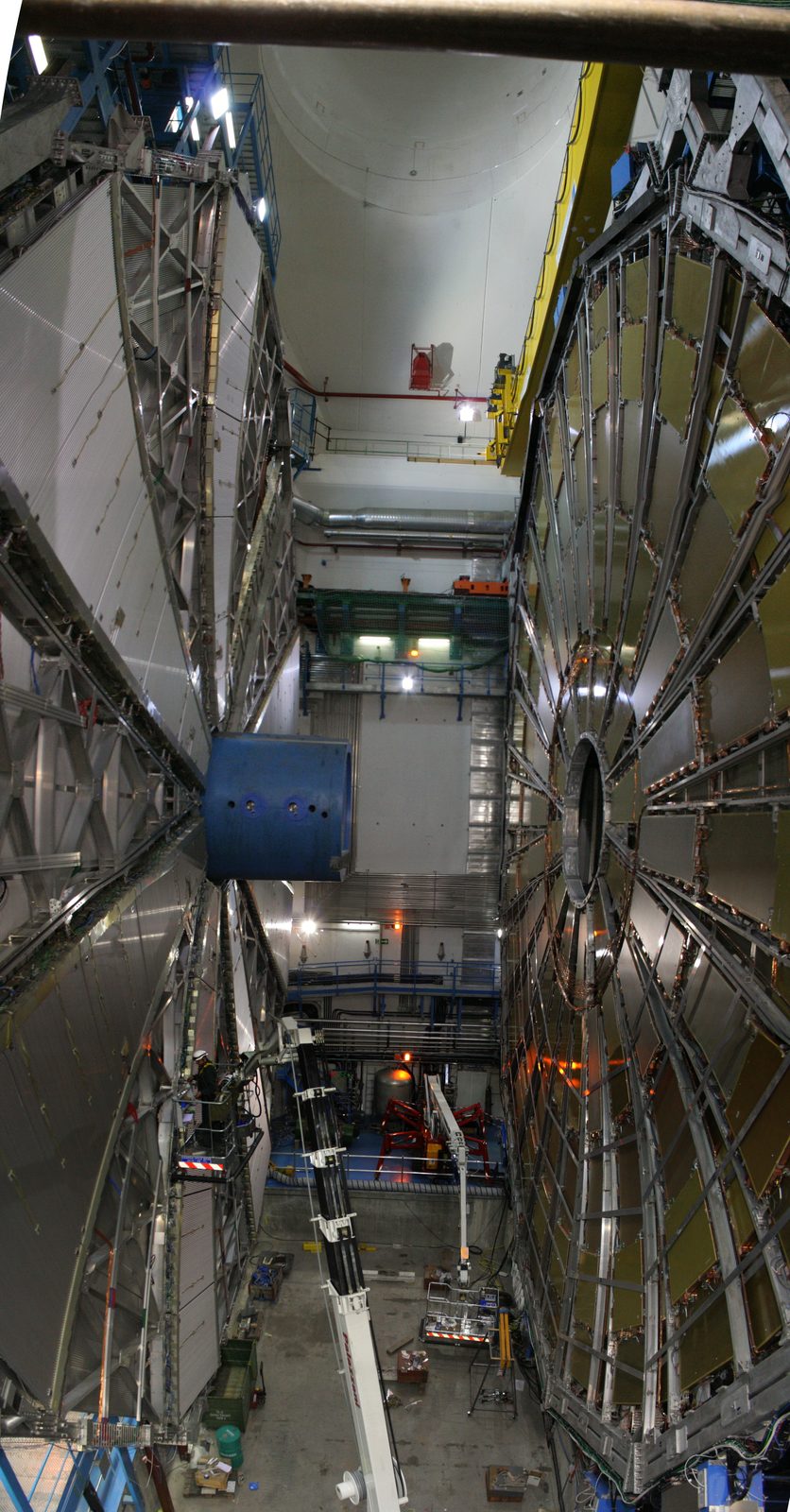
On September 17, CERN announced that physicists on the ATLAS and CMS experiments at the Large Hadron Collider have found strong evidence that pairs of Z bosons — the electrically neutral carrier of the weak nuclear force — come out of certain Higgs boson decays quantum entangled with each other. It's a genuinely new kind of measurement: every earlier collider test of entanglement, including the one this result is explicitly compared against, involved matter particles — quarks. This one is between two force carriers, and it's the first time entanglement has been measured between two massive bosons at all. The announcement reaches for Einstein's own line about the phenomenon, "spooky action at a distance," and for once the reach is earned — this really is the same strangeness he was uneasy about, just showing up somewhere it's never been directly tested before.
What Actually Got Measured
The process is called H → ZZ* → 4ℓ: a Higgs boson decays into two Z bosons — one of them, marked with the asterisk, forced slightly off its normal mass because a 125 GeV Higgs doesn't have quite enough energy to make two full-mass Z bosons (each about 91 GeV) — and those two Z bosons then almost instantly decay again, this time into four charged leptons: electrons or muons, in pairs. Physicists have nicknamed it "the golden channel" since before the Higgs boson was even confirmed to exist, because it's unusually clean: ATLAS and CMS can identify and measure electrons and muons with very high precision, almost nothing else mimics the signature of four of them appearing at once with the right combined mass, and it was one of the two decay signatures that let both experiments announce the Higgs boson's discovery in July 2012.
How rare is "golden"? The Standard Model gives a Higgs boson roughly a 2.6 percent chance of decaying to a Z boson pair at all. Each Z boson then decays to an electron pair or muon pair about 3.4 percent of the time apiece — call it 6.7 percent for either flavor — so both Z bosons landing on an electron or muon pair happens around 6.7% × 6.7%, or roughly 0.45 percent, of ZZ decays. Multiply the two steps together and a Higgs boson produces this exact four-lepton signature only about once in every 8,000 times it decays — somewhere around 0.01 percent. "Golden" describes how clean the channel is to detect, not how often it happens; it's rare enough that seeing it at all, let alone with the precision needed for this measurement, took every proton-proton collision the LHC could deliver across two full runs.
And that's what the two experiments used: ATLAS's headline result combines 140 inverse femtobarns of Run 2 data, collected at a collision energy of 13 TeV between 2015 and 2018, with 164 inverse femtobarns of Run 3 data at the LHC's current energy of 13.6 TeV, collected 2022 through 2024 — three more years of data than existed the last time anyone looked at this specific question. CMS ran its own, independently-built analysis over a comparable span of collisions, using a broader statistical framework that measures eight separate Higgs-boson couplings to electroweak bosons at once rather than isolating entanglement on its own; CMS describes its result as the first clear evidence of an entangled Z-boson pair in this channel, though the public materials I could find don't state a single sigma figure for it the way ATLAS's do below. The two experiments are independent detectors built and operated by separate collaborations sitting at different points around the same 27-kilometre ring — when both see the same thing, it's a genuine cross-check, not one experiment confirming itself.
Why a Zero-Spin Particle Forces Its Children to Be Correlated
The physics reason this works at all is angular momentum bookkeeping. The Higgs boson is unique among known fundamental particles in having zero spin — literally no intrinsic angular momentum in any direction. A Z boson, like the photon, is a spin-1 particle, which means it can point its spin in three possible ways relative to a chosen axis: +1, 0, or −1. When a spin-zero Higgs boson decays into two Z bosons, the two Z bosons' spins have to add back up to zero, the same way two people jumping off a stationary rowboat in opposite directions have to carry away equal and opposite momentum so the boat itself ends up where it started. That constraint doesn't just limit which combinations of spin states are allowed — under quantum mechanics, it links the two Z bosons into a single joint state that can't be described as "Z boson A is doing this, and independently, Z boson B is doing that." Describing one requires describing the other. That linkage is what entanglement means, precisely, and it's also exactly the discomfort Einstein voiced in a 1947 letter to Max Born, calling the idea of a measurement here instantaneously fixing a description of something over there spukhafte Fernwirkung — "spooky action at a distance."
ATLAS measured this directly two ways. First, two specific numbers describing how the Z-boson pair's spin states correlate — physicists call them C2,1,2,−1 and C2,2,2,−2 — which are exactly zero if the two Z bosons are not entangled and take on specific nonzero values, predicted precisely by the Standard Model, if they are. The measured values were C2,1,2,−1 = −0.71 ± 0.45 (the Standard Model predicts −0.97) and C2,2,2,−2 = 0.08 ± 0.44 (predicted: 0.64) — in the right direction, but with error bars wide enough on their own to leave real doubt. Rather than stop there, the team ran a second, more powerful test: a likelihood-ratio comparison of the full angular distribution of all four leptons against two competing hypotheses, one where the Z bosons are entangled exactly as the Standard Model predicts and one where they aren't. That test rejected the non-entangled hypothesis at 4.7 standard deviations of observed significance (4.9 were expected going in) — past the 5-sigma bar particle physics usually reserves for a formal "discovery," but comfortably inside the range physicists call strong evidence.
Is This the Same "Spooky" Einstein Meant, or Just Correlation?
Worth being honest about the difference, because it's easy to blur. Ordinary correlation — like mailing one glove of a pair to a friend and keeping the other, so that opening your box and finding a left glove tells you instantly the other box holds a right one — needs no quantum mechanics at all; the gloves were always definitely left and right, you just didn't know which was where. What makes this a test of genuine entanglement rather than a mailed-glove correlation is the separability criterion the analysis is built around, a mathematical test (named for the physicists Asher Peres and the Horodecki family) for whether a joint quantum state can be written as some probability-weighted mix of the two particles each having their own definite, independent state all along — the quantum equivalent of the gloves having been left- or right-handed in the box the whole time. The Standard Model's entangled prediction fails that test; a merely-correlated-but-separable state would pass it. Rejecting the separable hypothesis at 4.7 sigma is rejecting the "the gloves were secretly always sorted" explanation specifically, not just rejecting "the two Z bosons have nothing to do with each other."
One honest limitation, though: this is not what physicists call a loophole-free Bell test — the gold standard that rules out even a conspiracy of hidden, faster-than-light or pre-arranged information passing between the particles, which requires measuring each particle far enough apart, and fast enough, that no signal could travel between the measurements. Nothing about a Higgs boson decaying inside a detector gives you that kind of spatial separation. What ATLAS and CMS have done is closer to the same standard used for the 2023 top-quark measurement below: show that the data matches genuine quantum entanglement and is inconsistent with any separable classical description, without independently closing every loophole a truly adversarial skeptic could still, in principle, raise. That's the standard essentially all entanglement claims outside a handful of dedicated photon-and-ion Bell-test experiments are held to, and it's still real evidence of entanglement — it's just a narrower claim than "this proves quantum nonlocality with zero remaining assumptions."
The Same Trick, One Rung Up
This isn't the LHC's first entanglement result. In 2023, ATLAS reported the first-ever observation of quantum entanglement between quarks — top quarks specifically, the heaviest known fundamental particle — produced in pairs near their production threshold, at better than 5 standard deviations, and CMS has since confirmed it independently. That was billed at the time as the highest-energy entanglement measurement ever made, because top quarks are so heavy that producing a pair at all takes an enormous amount of energy, even though the specific measurement was done at the quietest point in that production, right near threshold. What's new this time isn't the energy scale in that sense — it's the type of particle. Top quarks are fermions: matter particles, with two possible spin states each. Z bosons are bosons: force carriers, spin-1, with three possible states, and the pair studied here comes specifically from the Higgs field's own interaction with the weak force rather than from ordinary particle-antiparticle production. ATLAS's own language for this is "the first measurement of quantum entanglement between two massive vector bosons at the electroweak scale" — a new class of particle added to a very short list of things this has ever been tested on.
What It's Actually Good For
Nothing about this changes what a Higgs boson is or how the Standard Model works — every number above matched the model's own prediction, direction if not always precision. The value is that the Higgs boson has just been demonstrated to be a usable laboratory for quantum-information questions at energies no tabletop experiment can reach, which matters because the next step is looking for disagreement, not confirmation. If some undiscovered physics beyond the Standard Model tweaks how the Higgs boson couples to the Z boson, the cleanest place that tweak might first show up is in exactly these entanglement-sensitive numbers, before it's visible in a cruder measurement like the overall decay rate. CERN's own framing is that the High-Luminosity LHC — the accelerator upgrade due to start colliding protons at a much higher rate in the next decade — will supply enough additional data to sharpen this same measurement, and to try the same trick in other Higgs decay channels this one dataset wasn't sensitive enough to reach.
Where I Could Be Wrong
- I'm a reader here, not a particle physicist, and the line between "entanglement, properly defined by the separability criterion" and "strong quantum correlation, loosely described as entanglement in press coverage" is one working physicists in this field debate the precise wording of; I've tried to report the more careful, separability-based claim rather than the loosest possible one.
- The branching-ratio arithmetic in the aside is my own calculation, built from widely cited Standard Model figures for the Higgs-to-ZZ and Z-to-leptons branching fractions, not a number copied from a single primary source — different summaries of this same physics quote figures from roughly 0.003 percent to "about 3 percent" depending on exactly which step of the decay chain they mean, which is why I've shown the multiplication rather than just stating a figure.
- CMS's own standalone statistical significance for this specific result isn't a number I could verify from public CMS materials — I've reported ATLAS's precise 4.7-sigma figure, which is the one stated plainly in both ATLAS's own briefing and the CERN press release, and described CMS's contribution honestly as a complementary, differently-built analysis rather than inventing a matching number for it.
- "Not a loophole-free Bell test" is my own characterization, reasoned from how the measurement is physically set up (no spacelike-separated measurement of the two Z bosons is possible here), not a caveat CERN's own press materials state outright — a specialist in quantum-information tests at colliders might frame the limitation differently than I have.
- Einstein's 1947 letter to Max Born is the well-documented origin of the phrase "spooky action at a distance" in English translation; his broader unease with quantum mechanics' completeness is best known from the 1935 Einstein-Podolsky-Rosen paper, which predates that letter by twelve years and concerns a different specific setup (position and momentum, not particle spin) — I've used the phrase as the famous shorthand it's become, not as a claim that Einstein commented on this experiment or anything resembling it.
Sources
- CERN. Strong evidence for quantum entanglement between Z bosons found by ATLAS and CMS. 17 September 2026. home.cern
- ATLAS Collaboration. ATLAS explores quantum entanglement using Higgs boson decays, while charting its properties. ATLAS Experiment at CERN, 2026. atlas.cern
- ATLAS Collaboration. Measurements of Z-boson pair entanglement in decays of Higgs bosons at the ATLAS experiment. arXiv:2603.26463. arxiv.org
- CMS Collaboration. The tangled dance of Higgs boson decays. CMS Experiment at CERN, 2026. cms.cern
- ATLAS Collaboration. ATLAS achieves highest-energy detection of quantum entanglement. ATLAS Experiment at CERN, September 2023 — the top-quark result this entry compares against. atlas.cern
- ATLAS Collaboration. Observation of quantum entanglement with top quarks at the ATLAS detector. Nature 633, 542–547 (2024). nature.com
- Einstein, A. Letter to Max Born, 3 March 1947, published in The Born-Einstein Letters — origin of "spukhafte Fernwirkung" ("spooky action at a distance").