The MisterLibrarian Bible Project
Catalogued & compared, one chapter at a time
☰ Menu
🌐 Español🗺️ Atlas
CreationBefore the FloodThe FloodAfter the FloodThe PatriarchsEgypt and the ExodusThe KingdomThe ExileThe ReturnBetween the TestamentsThe GospelsThe Apostolic Age
🕰
Comfort opens the book's second half — a voice in the wilderness, all flesh as grass, and the promise that those who wait for Jehovah will renew their strength.
⚠ Genuinely disputed, and load-bearing: the traditional dating keeps this on the lips of the eighth-century Isaiah of ch. 1, speaking decades ahead of the events it describes; the critical-scholarly dating places its composition in or near the Babylonian exile itself, roughly 540 BC, a century and a half later, by a different hand. See the note at v1 for both cases laid out without a vote.
Full chronology →

Isaiah 40 — The Mister Translation
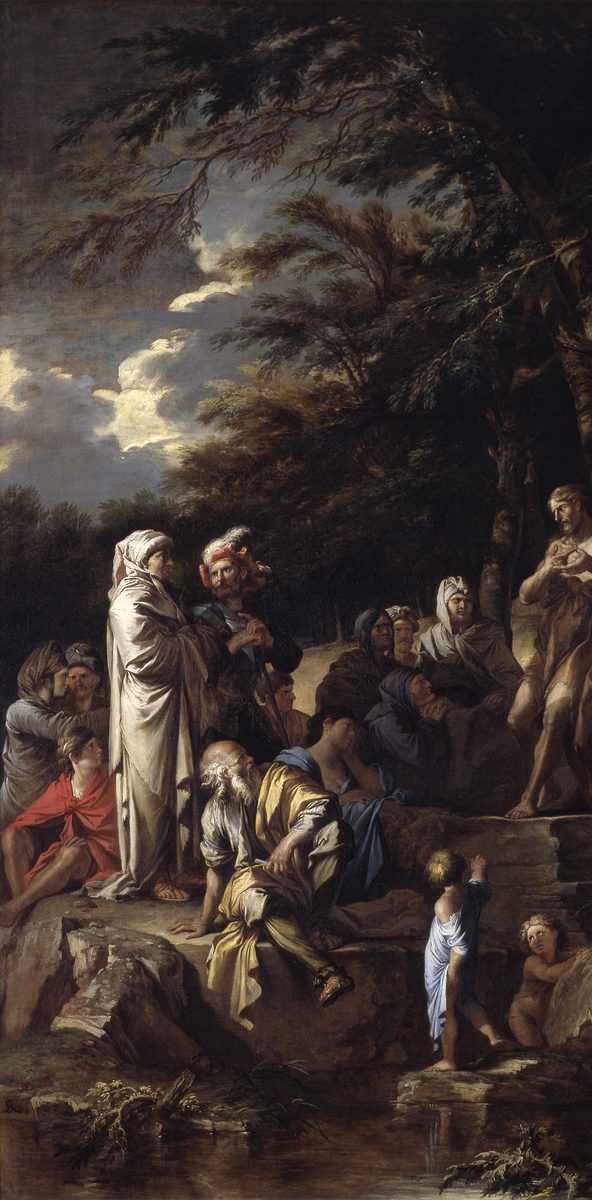
A tall, narrow landscape painting dominated by dark, wind-bent trees against a dramatic sky of grey clouds breaking to light. In the lower left, a mixed crowd sits and leans on a rocky outcrop: elderly bearded men, women in draped fabric, a soldier in armor, a bare-shouldered woman in red, children. At the right edge, a standing figure in rough dress, partly shadowed by the trees, gestures with one raised hand. In the lower right, two small children play at the edge of a stream below the rock.
Saint John the Baptist Preaching in the Wilderness
Salvator Rosa, 1660 · Saint Louis Art Museum

⚠ This is not Isaiah's own scene — nothing in chapter 40 depicts a single speaker addressing a seated crowd in a wood. It is the New Testament's fulfillment of it: John the Baptist, six centuries after Isaiah, preaching to the mixed crowd Mark and Luke describe coming out to him, in the wilderness Isaiah's voice first named. Rosa paints the audience as pointedly various — old and young, a soldier among the ordinary poor, a half-clothed woman at the base of the rock, children absorbed in the stream below and paying no attention at all — a fair match for “all flesh shall see it together” (v5). The Baptist himself is pushed to the picture's right edge, partly lost in the shadow of the trees: the landscape, not the preacher, dominates the canvas. That was Salvator Rosa's own reputation in one image — contemporaries called him “Salvator Rosa” and, less kindly, “wild Rosa,” for exactly this: rugged, unpeopled-feeling wilderness landscapes with bandits, hermits, or, here, a prophet, worked in almost as an afterthought to the trees and sky. He is now reckoned one of the more important precursors of the Romantic landscape, a century before Romanticism had a name.

Public domain (artist d. 1673) — faithful photographic reproduction of a two-dimensional work · View the original
1
נַחֲמוּ נַחֲמוּ, עַמִּי--יֹאמַר, אֱלֹהֵיכֶם.
Comfort, comfort my people, says your God.note
Consolad, consolad a mi pueblo, dice vuestro Dios.
2
דַּבְּרוּ עַל-לֵב יְרוּשָׁלִַם, וְקִרְאוּ אֵלֶיהָ--כִּי מָלְאָה צְבָאָהּ, כִּי נִרְצָה עֲוֺנָהּ: כִּי לָקְחָה מִיַּד יְהוָה, כִּפְלַיִם בְּכָל-חַטֹּאתֶיהָ. {ס}
Speak to the heart of Jerusalem, and call out to her — that her hard service is completed, that her guilt is paid off, that she has received from the hand of Jehovah double for all her sins.note
Hablad al corazón de Jerusalén, y proclamadle — que su dura servidumbre se ha cumplido, que su maldad ha sido pagada, que de la mano de Jehová ha recibido el doble por todos sus pecados.
3
קוֹל קוֹרֵא--בַּמִּדְבָּר, פַּנּוּ דֶּרֶךְ יְהוָה; יַשְּׁרוּ, בָּעֲרָבָה, מְסִלָּה, לֵאלֹהֵינוּ.
A voice calls: ‘Clear in the wilderness the way of Jehovah; make level in the desert a highway for our God.note
Voz que clama: ‘Abrid en el desierto camino a Jehová; enderezad calzada en la soledad a nuestro Dios.
4
כָּל-גֶּיא, יִנָּשֵׂא, וְכָל-הַר וְגִבְעָה, יִשְׁפָּלוּ; וְהָיָה הֶעָקֹב לְמִישׁוֹר, וְהָרְכָסִים לְבִקְעָה.
Every valley shall be lifted up, and every mountain and hill made low; the uneven ground shall become level, and the rugged places a plain.note
Todo valle sea alzado, y bájese todo monte y collado; y lo torcido se enderece, y lo áspero se allane.
5
וְנִגְלָה, כְּבוֹד יְהוָה; וְרָאוּ כָל-בָּשָׂר יַחְדָּו, כִּי פִּי יְהוָה דִּבֵּר. {פ}
And the glory of Jehovah shall be revealed, and all flesh together shall see it — for the mouth of Jehovah has spoken.’note
Y se manifestará la gloria de Jehová, y toda carne juntamente la verá — porque la boca de Jehová ha hablado.’
6
קוֹל אֹמֵר קְרָא, וְאָמַר מָה אֶקְרָא; כָּל-הַבָּשָׂר חָצִיר, וְכָל-חַסְדּוֹ כְּצִיץ הַשָּׂדֶה.
A voice says: ‘Cry out!’ And I said, ‘What shall I cry?’ ‘All flesh is grass, and all its loveliness like the flower of the field.note
Voz que decía: ‘Clama!’ Y yo dije: ‘¿Qué he de clamar?’ ‘Toda carne es hierba, y toda su hermosura como flor del campo.
7
יָבֵשׁ חָצִיר נָבֵל צִיץ, כִּי רוּחַ יְהוָה נָשְׁבָה בּוֹ; אָכֵן חָצִיר, הָעָם.
The grass withers, the flower fades, when the breath of Jehovah blows upon it — surely the people is grass.note
La hierba se seca, y la flor se marchita, cuando el aliento de Jehová sopla en ella — ciertamente como hierba es el pueblo.
8
יָבֵשׁ חָצִיר, נָבֵל צִיץ; וּדְבַר-אֱלֹהֵינוּ, יָקוּם לְעוֹלָם. {ס}
The grass withers, the flower fades — but the word of our God will stand forever.’note
La hierba se seca, y la flor se marchita — mas la palabra del Dios nuestro permanece para siempre.’
9
עַל הַר-גָּבֹהַּ עֲלִי-לָךְ, מְבַשֶּׂרֶת צִיּוֹן, הָרִימִי בַכֹּחַ קוֹלֵךְ, מְבַשֶּׂרֶת יְרוּשָׁלִָם; הָרִימִי, אַל-תִּירָאִי, אִמְרִי לְעָרֵי יְהוּדָה, הִנֵּה אֱלֹהֵיכֶם.
Go up on a high mountain, herald of good news to Zion; lift up your voice with strength, herald of good news to Jerusalem. Lift it up, do not be afraid; say to the cities of Judah: ‘Here is your God!’note
Súbete sobre un monte alto, anunciadora de buenas nuevas a Sión; levanta fuertemente tu voz, anunciadora de buenas nuevas a Jerusalén; levántala, no temas; di a las ciudades de Judá: ‘¡Aquí está vuestro Dios!’
10
הִנֵּה אֲדֹנָי יְהוִה בְּחָזָק יָבוֹא, וּזְרֹעוֹ מֹשְׁלָה לוֹ; הִנֵּה שְׂכָרוֹ אִתּוֹ, וּפְעֻלָּתוֹ לְפָנָיו.
Watch — the Lord Jehovah comes with strength, and his arm rules for him; watch, his reward is with him, and his recompense before him.note
He aquí que Jehová el Señor vendrá con poder, y su brazo señoreará; he aquí que su recompensa viene con él, y su paga delante de su rostro.
11
כְּרֹעֶה, עֶדְרוֹ יִרְעֶה, בִּזְרֹעוֹ יְקַבֵּץ טְלָאִים, וּבְחֵיקוֹ יִשָּׂא; עָלוֹת, יְנַהֵל. {ס}
Like a shepherd he will tend his flock; he will gather the lambs in his arm, and carry them in his bosom, and gently lead the nursing ewes.note
Como pastor apacentará su rebaño; en su brazo llevará los corderos, y en su seno los llevará; pastoreará suavemente a las que crían.
12
מִי-מָדַד בְּשָׁעֳלוֹ מַיִם, וְשָׁמַיִם בַּזֶּרֶת תִּכֵּן, וְכָל בַּשָּׁלִשׁ, עֲפַר הָאָרֶץ; וְשָׁקַל בַּפֶּלֶס הָרִים, וּגְבָעוֹת בְּמֹאזְנָיִם.
Who has measured the waters in the hollow of his hand, and marked off the heavens with a span, and enclosed the dust of the earth in a measure, and weighed the mountains in scales, and the hills in a balance?note
¿Quién midió las aguas con el hueco de su mano, y aderezó los cielos con su palmo, y contuvo el polvo de la tierra en una medida, y pesó los montes con balanza, y con pesas los collados?
13
מִי-תִכֵּן אֶת-רוּחַ, יְהוָה; וְאִישׁ, עֲצָתוֹ יוֹדִיעֶנּוּ.
Who has directed the spirit of Jehovah, or has instructed him as his counselor?note
¿Quién enseñó al espíritu de Jehová, o le aconsejó enseñándole?
14
אֶת-מִי נוֹעָץ וַיְבִינֵהוּ, וַיְלַמְּדֵהוּ בְּאֹרַח מִשְׁפָּט; וַיְלַמְּדֵהוּ דַעַת, וְדֶרֶךְ תְּבוּנוֹת יוֹדִיעֶנּוּ.
Whom did he consult, that he gave him understanding, and taught him the path of justice, and taught him knowledge, and showed him the way of insight?note
¿A quién pidió consejo para ser avisado? ¿Quién le enseñó el camino del juicio, o le enseñó ciencia, o le mostró la senda del entendimiento?
15
הֵן גּוֹיִם כְּמַר מִדְּלִי, וּכְשַׁחַק מֹאזְנַיִם נֶחְשָׁבוּ; הֵן אִיִּים, כַּדַּק יִטּוֹל.
Look — the nations are like a drop from a bucket, and are counted as dust on the scales; look, he lifts up the islands like fine dust.note
He aquí que las naciones le son como una gota de agua que cae de un cubo, y como menudo polvo en las balanzas; he aquí que hace desaparecer las islas como polvo fino.
16
וּלְבָנוֹן, אֵין דֵּי בָּעֵר; וְחַיָּתוֹ--אֵין דֵּי, עוֹלָה. {פ}
And Lebanon is not enough fuel, nor its animals enough for a burnt offering.note
Ni el Líbano bastará para el fuego, ni todos sus animales para el sacrificio.
17
כָּל-הַגּוֹיִם, כְּאַיִן נֶגְדּוֹ; מֵאֶפֶס וָתֹהוּ, נֶחְשְׁבוּ-לוֹ.
All the nations are as nothing before him; they are counted by him as less than nothing, and empty chaos.note
Como nada son todas las naciones delante de él; y las cuenta como cosa que nada es, y como vacío.
cross-refs⤷ Gen 1:2
18
וְאֶל-מִי, תְּדַמְּיוּן אֵל; וּמַה-דְּמוּת, תַּעַרְכוּ לוֹ.
To whom then will you liken God? Or what likeness will you compare to him?note
¿A qué, pues, haréis semejante a Dios, o qué imagen le compondréis?
19
הַפֶּסֶל נָסַךְ חָרָשׁ, וְצֹרֵף בַּזָּהָב יְרַקְּעֶנּוּ; וּרְתֻקוֹת כֶּסֶף, צוֹרֵף.
The idol? A craftsman casts it, and a goldsmith overlays it with gold, and casts silver chains for it.note
El artífice funde la imagen, y el platero le extiende oro, y le funde cadenas de plata.
20
הַמְסֻכָּן תְּרוּמָה, עֵץ לֹא-יִרְקַב יִבְחָר; חָרָשׁ חָכָם יְבַקֶּשׁ-לוֹ, לְהָכִין פֶּסֶל לֹא יִמּוֹט. {ס}
Whoever is too poor for such an offering chooses wood that will not rot; he seeks out a skilled craftsman to set up an idol that will not be moved.note
El pobre escoge, para ofrecerle, madera que no se apolille; se busca un maestro sabio que le haga una imagen que no se tambalee.
21
הֲלוֹא תֵדְעוּ הֲלוֹא תִשְׁמָעוּ, הֲלוֹא הֻגַּד מֵרֹאשׁ לָכֶם; הֲלוֹא, הֲבִינוֹתֶם, מוֹסְדוֹת, הָאָרֶץ.
Do you not know? Have you not heard? Has it not been told you from the beginning? Have you not understood the foundations of the earth?note
¿No habéis sabido? ¿No habéis oído? ¿Nunca os lo han dicho desde el principio? ¿No habéis sido enseñados desde que la tierra se fundó?
22
הַיֹּשֵׁב עַל-חוּג הָאָרֶץ, וְיֹשְׁבֶיהָ כַּחֲגָבִים; הַנּוֹטֶה כַדֹּק שָׁמַיִם, וַיִּמְתָּחֵם כָּאֹהֶל לָשָׁבֶת.
He sits above the circle of the earth, and its inhabitants are like grasshoppers; he stretches out the heavens like gauze, and spreads them out like a tent to dwell in.note
Él está sentado sobre el círculo de la tierra, cuyos moradores son como langostas; él extiende los cielos como una cortina, los despliega como una tienda para morar.
23
הַנּוֹתֵן רוֹזְנִים, לְאָיִן; שֹׁפְטֵי אֶרֶץ, כַּתֹּהוּ עָשָׂה.
He brings princes to nothing; he makes the judges of the earth like empty chaos.note
Él convierte en nada a los poderosos, y a los que gobiernan la tierra hace como cosa vacía.
24
אַף בַּל-נִטָּעוּ, אַף בַּל-זֹרָעוּ--אַף בַּל-שֹׁרֵשׁ בָּאָרֶץ, גִּזְעָם; וְגַם-נָשַׁף בָּהֶם וַיִּבָשׁוּ, וּסְעָרָה כַּקַּשׁ תִּשָּׂאֵם. {ס}
Scarcely are they planted, scarcely are they sown, scarcely has their stock taken root in the earth, when he blows on them and they wither, and the storm carries them away like stubble.note
Apenas plantados, apenas sembrados, apenas su tronco ha arraigado en la tierra, cuando él sopla sobre ellos, y se secan, y el torbellino los lleva como hojarasca.
25
וְאֶל-מִי תְדַמְּיוּנִי, וְאֶשְׁוֶה--יֹאמַר, קָדוֹשׁ.
‘To whom then will you liken me, that I should be his equal?’ says the Holy One.note
‘¿A qué, pues, me haréis semejante, o a quién seré yo igual?’ dice el Santo.
26
שְׂאוּ-מָרוֹם עֵינֵיכֶם וּרְאוּ מִי-בָרָא אֵלֶּה, הַמּוֹצִיא בְמִסְפָּר צְבָאָם; לְכֻלָּם, בְּשֵׁם יִקְרָא, מֵרֹב אוֹנִים וְאַמִּיץ כֹּחַ, אִישׁ לֹא נֶעְדָּר. {ס}
Lift up your eyes on high, and see: who created these? He who brings out their host by number, calling each one by name; because of his great might and strength in power, not one is missing.note
Levantad en alto vuestros ojos, y mirad quién creó estas cosas; él saca y cuenta su ejército; a todas llama por sus nombres; ninguna faltará, tal es la grandeza de su fuerza, y el poder de su dominio.
27
לָמָּה תֹאמַר יַעֲקֹב, וּתְדַבֵּר יִשְׂרָאֵל: נִסְתְּרָה דַרְכִּי מֵיְהוָה, וּמֵאֱלֹהַי מִשְׁפָּטִי יַעֲבוֹר.
Why do you say, Jacob, and speak, Israel: ‘My way is hidden from Jehovah, and my cause passes unnoticed by my God’?note
¿Por qué dices, Jacob, y hablas tú, Israel: ‘Mi camino está escondido de Jehová, y de mi Dios pasó mi juicio’?
28
הֲלוֹא יָדַעְתָּ אִם-לֹא שָׁמַעְתָּ, אֱלֹהֵי עוֹלָם יְהוָה בּוֹרֵא קְצוֹת הָאָרֶץ--לֹא יִיעַף, וְלֹא יִיגָע: אֵין חֵקֶר, לִתְבוּנָתוֹ.
Have you not known? Have you not heard? Jehovah is the everlasting God, the creator of the ends of the earth. He does not faint or grow weary; his understanding is beyond searching out.note
¿No has sabido? ¿No has oído que el Dios eterno es Jehová, el cual creó los confines de la tierra? No desfallece, ni se fatiga con cansancio; no hay quien alcance a comprender su entendimiento.
29
נֹתֵן לַיָּעֵף, כֹּחַ; וּלְאֵין אוֹנִים, עָצְמָה יַרְבֶּה.
He gives strength to the weary, and to him who has no might he multiplies power.note
Él da esfuerzo al cansado, y multiplica las fuerzas al que no tiene ningunas.
30
וְיִעֲפוּ נְעָרִים, וְיִגָעוּ; וּבַחוּרִים, כָּשׁוֹל יִכָּשֵׁלוּ.
Even youths shall grow faint and weary, and young men shall utterly stumble;note
Los muchachos se fatigan y se cansan, los jóvenes flaquean y caen;
31
וְקוֹיֵ יְהוָה יַחֲלִיפוּ כֹחַ, יַעֲלוּ אֵבֶר כַּנְּשָׁרִים; יָרוּצוּ וְלֹא יִיגָעוּ, יֵלְכוּ וְלֹא יִיעָפוּ. {ס}
but those who wait for Jehovah shall renew their strength; they shall mount up with wings like eagles; they shall run and not grow weary, they shall walk and not faint.note
pero los que esperan a Jehová tendrán nuevas fuerzas; levantarán alas como las águilas; correrán, y no se cansarán; caminarán, y no se fatigarán.

Translator’s Notes

The seam of the book

⚠ Chapter 40 is where nearly two thousand years of Jewish and Christian reading part company on a genuine, load-bearing question. From here to the end of the book (chs. 40–66), the setting, tone, and horizon all shift: Jerusalem's fall and exile are spoken of as accomplished fact (v2), Babylon's idols are mocked from close range, and a Persian king is later named and called Jehovah's “anointed” (45:1, forthcoming on this shelf) roughly a century and a half before Cyrus actually issued that decree. The traditional view holds that the eighth-century Isaiah ben Amoz, the prophet of chs. 1–39, wrote this too, predictively, decades before any of it happened — the position taken by the New Testament itself, which quotes both halves under Isaiah's single name (John 12:38-41 cites 6:10 and 53:1 in the same breath as one prophet's words). The critical-scholarly position, standard since the nineteenth century, holds that chs. 40–66 (or 40–55, “Deutero-Isaiah”) come from an anonymous prophet writing IN or near the exile, decades after the historical Isaiah's death, whose words were later joined to his book. Both readings take the text's own claims seriously in different ways — predictive prophecy on one side, a real audience actually living the events described on the other — and this library reports the difference rather than casting a vote.

“Comfort, comfort” doubles the imperative of nacham (see the Dictionary) — the same root behind Jeremiah's “comfort” and “relent,” here doubled for emphasis at the open of forty chapters of it. The whole block from here to the end of the book is sometimes called, on the strength of this verse alone, the Book of Comfort.

Double for her sins

“Double for all her sins”kiflayim, literally “a doubling, twofold” — is uncomfortable enough that it has been read at least three ways. Plainly: Jerusalem's punishment exceeded what her sin deserved, a reading some later rabbinic sources and not a few modern commentators accept without softening it. Commercially: the word can carry the sense of a debt considered PAID IN FULL, the kind of double receipt a creditor issues to certify nothing more is owed, without implying the payment literally doubled the debt. Textually: some propose the vowels originally read a different word close in spelling. This translation prints the plain sense and leaves the problem standing rather than resolving it for the reader.

A voice crying in the wilderness — or a voice crying, in the wilderness

Every one of the four Gospels quotes this verse for John the Baptist (Matthew 3:3, Mark 1:3, Luke 3:4, John 1:23) — the single most-quoted line from this chapter, and the reason “a voice crying in the wilderness” is proverbial English. But the Hebrew's own parallelism cuts the line differently than that famous phrase suggests. The verse pairs two clauses: “IN THE WILDERNESS, clear the way of Jehovah” and “IN THE DESERT, make level a highway for our God” — both times pairing the location with the ROAD-CLEARING, not with the calling. Read this way the voice simply calls out (location unspecified), and the wilderness is where the road gets built, not where the caller stands. The Greek New Testament (following the Septuagint) instead attaches “in the wilderness” to the voice itself — “a voice of one crying IN THE WILDERNESS: prepare the way” — which is why John the Baptist is pictured standing out in open desert rather than merely announced from somewhere unnamed. KJV follows that same Greek-shaped parsing here, while ASV, NIV, and ESV instead follow the Hebrew's own structure — “prepare the way for the Lord IN THE WILDERNESS” — which is the reading this translation follows too. Both parsings are grammatically available in the unpointed consonantal text. Matthew's quotation also swaps “our God” for “his paths” — the highway built for Jehovah in Isaiah becomes, in Matthew, a highway for the one John announces.

Grass, and the good news that outlasts it

“All its loveliness” renders chesed (see the Dictionary) in a sense this word almost never carries elsewhere on this shelf — not covenant loyalty but something closer to beauty, constancy, or charm, the bloom on the flower rather than a relationship kept. The English shelf splits four ways on it: KJV “goodliness,” ESV “beauty,” and this translation's “loveliness” matches what a modern American shelf-standard (NASB) prints there — while NIV alone prints “faithfulness,” pulling the word back toward its usual covenant sense even here, against the grain of a verse about grass and flowers.

“All flesh is grass” and “herald of GOOD NEWS to Zion” (v9) share a Hebrew root most English Bibles have no way to show: basar means both FLESH (the perishable stuff of v6-7) and, in its verbal form, TO BRING NEWS — the same root behind besorah, the Hebrew word for gospel. The chapter's structure plays on this without saying so: flesh that withers like grass, framing a herald whose news does not.

Strength, four times

Koach, “strength, power,” threads this chapter from here to its last line: the herald lifts her voice “with strength” here, God is “strong in power” at v26, he “gives strength to the weary” at v29, and those who wait for Jehovah “renew their strength” at v31 — the same word carrying the chapter from a herald's shout to the tired legs of an ordinary person, by way of the stars.

Who has instructed the Spirit

“The spirit of Jehovah” at v13 is the identical Hebrew phrase — ruach Adonai — as “the BREATH of Jehovah” that withers the grass at v7, four verses earlier: the same wind that dries up a flower is, unqualified, beyond any creature's power to instruct or direct. Paul quotes v13 twice, differently each time: Romans 11:34 (not yet on this shelf) uses it to close an argument about God's inscrutable mercy to Israel and the nations, and 1 Corinthians 2:16 (not yet on this shelf) answers its own rhetorical question — nobody has known the mind of the Lord, “but we have the mind of Christ.”

Fuel enough for what Lebanon is

Lebanon's forests were the ancient world's byword for abundance — the timber Solomon imported to build the Temple (1 Kings 5, forthcoming on this shelf) came from here. Naming it as insufficient fuel for a single burnt offering, its whole animal population insufficient as the offering itself, is the chapter's most concrete image yet for how small even the grandest human resources are against this God: not a small sacrifice that would fall short, but the richest forest on earth.

Less than nothing

“Empty chaos” renders tohu — the same word Genesis 1:2 (already on this shelf) uses for the earth's condition before the first day of creation, there rendered “formless” (paired with its usual companion word bohu, “empty” — “the earth was formless and empty”). Tohu appears alone here, without bohu, which is why this translation renders it differently in this different grammatical slot; the underlying word is identical. Nations, here, are not merely small before God; they are measured against the raw formlessness that existed before God spoke order into anything at all. KJV keeps a two-word pairing close to the Hebrew, “less than nothing, and vanity”; ESV keeps the pair but modernizes the second word to “emptiness”; NIV collapses both into “worthless and less than nothing,” losing tohu's specific echo of Genesis 1 entirely. The word recurs at v23, of rulers specifically.

An idol, built to not fall down

The idol-building instructions (vv19-20) are the most literal, workshop-level description of ancient metalworking anywhere in Isaiah: a wood core, hammered gold overlay, cast silver chain fittings, a carpenter chosen for picking rot-resistant timber. The satire is specific rather than generic — this reads like a prophet who has watched the process — and its punchline is quiet: the finished god has to be built “so that it will not be moved,” propped upright by the very craftsman who made it.

The circle of the earth

“The circle of the earth”chug ha-aretz — is sometimes cited as evidence the Bible anticipated a spherical earth centuries before Greek science confirmed it. That claim overreaches what the word can bear: chug means a circle or disk, drawn like a compass-drawn line (the same root gives the word for a drafting-compass), and is equally at home describing a flat disk as a sphere — nothing in the word itself settles the question either way. What the verse does clearly assert is scale: the one who sits enthroned above that circle, whatever its shape, sees its inhabitants as grasshoppers.

The Holy One, by his own words

V25 answers v18 nearly word for word — “to whom will you liken GOD” becomes “to whom will you liken ME” — but the speaker has changed from the narrator's question to a direct first-person claim, closed with a title used nowhere yet on this shelf: “the Holy One.” Isaiah favors this title (“the Holy One of Israel” recurs some two dozen times across the book) far more than any other prophet.

Named stars, against named gods

“He calls each one by name” is aimed at a specific rival claim: in Babylonian religion the stars were themselves divine beings, named and catalogued as gods in their own right. Naming them here as JEHOVAH'S creations, mustered like an army by number, answers Babylonian astral religion on its home ground — not by denying the stars exist or matter, but by demoting them from gods to a roll call.

Jacob and Israel's actual complaint

The chapter's cosmic argument (vv12-26) turns out to be aimed at one ordinary, human-scale complaint, finally voiced at v27: that God has stopped paying attention. “My way is hidden from Jehovah” is not doubt that God exists or is powerful — the previous fifteen verses have just established both at maximum volume — it is the far more survivable fear that a real and present God has simply looked away.

Wings like eagles

The chapter's closing promise runs in the opposite direction from its opening ones: everything from v12 on has been about how vastly God's strength exceeds any creature's, and now that same strength is offered to “him who has no might” — not to the strong but specifically to those who have none left, youths and young men included, the ones who would ordinarily be expected to out-endure everyone else. “Mount up with wings like eagles” closes a chapter that began with a voice in the wilderness and a flower that withers by promising the exact opposite of both: not a fading thing, but a renewed one; not a cry that goes unanswered, but strength that does not run out.

Notes on this translation

Decisions. “A voice calls: ‘Clear IN THE WILDERNESS the way of Jehovah’” (v3) follows the Hebrew's own parallelism rather than the famous Gospel phrasing “a voice crying in the wilderness” — explained at v3, where both readings are laid out rather than adjudicated. Chesed at v6 is rendered loveliness, not this shelf's usual loyal-love (see Psalm 51, Jeremiah 31), because this is one of the word's genuinely outlying senses. Tohu is empty chaos here — the same Hebrew word Genesis 1:2 renders formless in its own different grammatical slot (explained at v17).

⚠ A note on order: Isaiah stands on these pages at chapters 1 and 53, and now 40 — the literal seam between the book's two halves (see the note at v1). Isaiah 2–39 and 41–52, 54–66 remain the open sequence.