Ephesians 2 — The Mister Translation
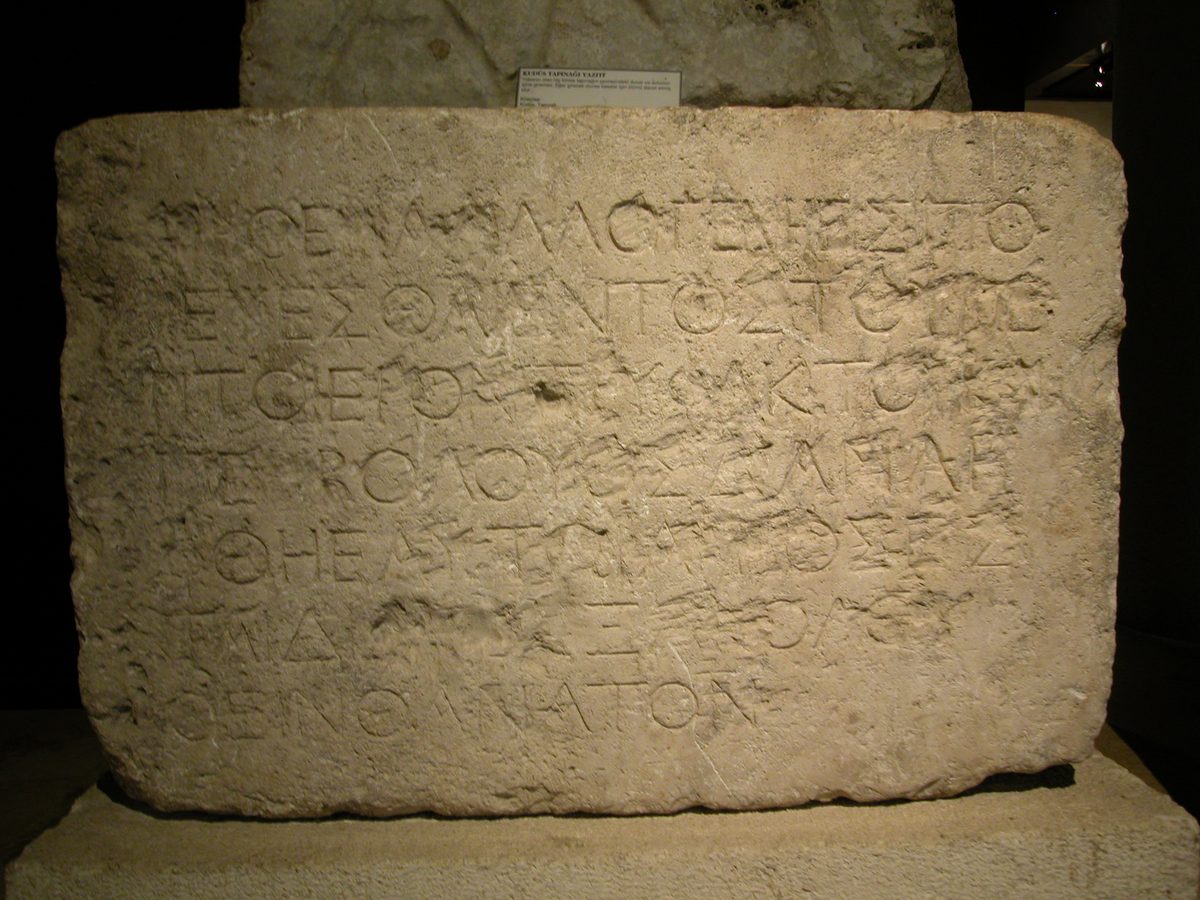
⚠ This is not a symbolic image. It is the wall. This exact stone — one of two copies ever recovered — stood on the balustrade separating the Jerusalem temple's inner courts from the outer Court of the Gentiles, the barrier this chapter's 'dividing wall of the fence' most likely refers to. Its Greek reads: no foreigner is to enter within the balustrade and enclosure around the sanctuary; whoever is caught will have himself to blame for the death that follows. Discovered in 1871 near the Lions' Gate, it has been in Istanbul since the Ottoman antiquities authority claimed it under then-current law; a second, cruder fragment found in 1936 stayed in Jerusalem and is now in the Israel Museum.
Paul had almost certainly stood beside a stone like this one. Acts 21:27-29 records the riot that nearly killed him: a mob assumed, wrongly, that he had brought a Gentile companion past exactly this line. Writing to Gentile Christians a few years later that Christ 'broke down the dividing wall' is not a metaphor picked at random — it is the most physically specific image available to him, aimed at readers who may have read this exact warning with their own eyes on a visit to Jerusalem.

Translator’s Notes
⚠ “Dead,” and the word is not softened anywhere in the " "sentence that follows. Nekrous — the ordinary word for a corpse. " "Paul does not say the readers were weak, or sick, or lost; the diagnosis is death, and death " "is not a condition a corpse can improve from from the inside. The grammar of the whole " "passage depends on this: verse 4 does not open with “and so you tried harder” but " "with “but God” — the hinge of the chapter, four verses of " "diagnosis answered by two words.
" "“The ruler of the authority of the air.” A title for the " "devil found nowhere else in the New Testament in this exact form. KJV " "“the prince of the power of the air”; NIV " "“the ruler of the kingdom of the air.” Ancient cosmology commonly placed the " "lower atmosphere, between earth and moon, under hostile spiritual powers — a physical " "picture, not only a moral one, of exactly where the “heavenly places” of 1:3 are contested territory.
" "⚠ “By nature children of wrath.” Physei, by " "nature — not by choice, not by accumulated bad acts, but as a condition prior to any " "of them. This single word has carried an enormous weight of later theology (it is one of the " "proof-texts for original sin, argued over by Augustine and Pelagius, by the Reformers and " "their opponents), and this library reports the weight rather than settling under it: the " "verse states a condition Paul says is universal (“as also the rest”) without " "explaining its mechanism.
⚠ “But God” — two words carrying the whole turn of the " "chapter. Ho de theos, positioned exactly where the syntax of vv1-3 seemed " "to be heading toward a verb and a subject dying, unanswered, under its own weight. Some " "preachers have built entire sermons on this phrase alone; the Greek earns it grammatically, " "not just rhetorically — verses 1-3 never complete their own sentence, and God's action " "in verse 5 is what finally supplies the missing main verb.
" "“Made us alive together with Christ” … “raised us up " "together” … “seated us together.” Three verbs, each built " "on syn-, “with” — synezōopoiēsen, synēgeiren, " "synekathisen — and each describing something that has, grammatically, already " "happened (aorist tense) to people the chapter has just called corpses. The resurrection and " "enthronement are not future hopes here; they are reported as already accomplished, with " "Christ, in the same three stages his own story took: death, resurrection, session at the " "right hand.
" "“By grace you have been saved” appears twice in this chapter " "(here and v8) in the identical Greek construction — a perfect passive, an action " "completed in the past with continuing effect, not an ongoing project. It interrupts its own " "sentence both times, set off, almost muttered, as if Paul cannot get three clauses into this " "argument without saying it again.
The most quoted sentence in the letter turns on a preposition most " "translations agree on and a pronoun they do not. “This” (touto) is " "neuter; “grace” and “faith” are both feminine in Greek, so “this” " "grammatically cannot refer narrowly to either word alone — it points to the whole " "preceding act of being saved by grace through faith, not to faith considered as a private " "achievement that might itself be a kind of work. The library flags this because a great deal " "of later argument has turned on whether faith itself is the gift being named.
" "⚠ “Workmanship.” Poiēma — a thing made, " "a work of craftsmanship, and yes, the direct ancestor of English poem: a made thing, " "composed rather than assembled. It is used in the New Testament only here and at Romans " "1:20, of the created world itself. The same word for what God made in six days is used here " "of what God makes of a person.
" "Not of works … for good works. Verse 9 shuts one door and verse " "10 opens another with the identical word, erga, and the juxtaposition is deliberate: " "salvation is emphatically not earned by good works, and just as emphatically it is for " "them — a purpose stated, not a payment required. KJV " "and ASV keep “workmanship”; NIV “handiwork”; NWT " "“work.”
“Uncircumcision” … “circumcision.” Both " "words in the Greek carry the marker “the so-called” (legomenoi / " "legomenēs) — Paul is naming a slur and its mirror-slur, not endorsing either " "as the real basis of the distinction he is about to erase. This translation keeps the quotation " "marks the Greek's own vocabulary supplies, where several versions print the labels as if they " "were neutral descriptions.
" "⚠ Four losses, named in a row. Apart from Christ; alienated from " "Israel's citizenship; strangers to the covenants; without hope and without God. The list is " "not rhetorical padding — each phrase names a specific, real exclusion a Gentile in " "Ephesus would have felt exactly, in a city where the distinction between citizen and " "foreigner was a matter of hard civic law, not sentiment.
“Brought near by the blood of Christ.” “Far” and " "“near” are technical rabbinic terms for Gentile and Jew, and Paul will requote " "both in v17, echoing Isaiah 57:19's “peace, peace, to the far and to the near.” " "The distance being closed is not primarily emotional; it is the same citizenship-and-covenant " "distance just listed in v12, closed by the same blood named at 1:7.
⚠ “The dividing wall of the fence” is very likely not a " "metaphor pulled from nowhere. The Second Temple's inner courts were fenced off from " "the outer Court of the Gentiles by a stone balustrade called the soreg, posted with " "inscribed warning stones in Greek and Latin: no foreigner may enter within the " "balustrade… whoever is caught will have himself to blame for the death that follows. " "Two of these actual stones have been excavated — one in 1871, now in the Istanbul " "Archaeology Museum; one in 1936, now in the Israel Museum, Jerusalem. Paul, who nearly lost " "his life in that same temple over an accusation of bringing a Gentile past that exact " "barrier (Acts 21:28-29), writes to a Gentile-majority church that Christ has broken down a " "wall his own readers may have seen with their own eyes and read the warning on.
" "“One new man.” Kainon " "— new in kind, not new in time (neos), the same distinction this library has " "tracked since Revelation. Not a merger of Jew and Gentile into a bigger version of either, " "but a third thing neither was before.
" "“Having killed the hostility in himself” (v16) and “he himself " "is our peace” (v14) frame the whole unit: hostility named at the start, killed " "at the center, replaced by a peace preached in person (v17) to two audiences who could not " "previously stand in the same court of the same building.
“Fellow citizens… members of the household.” Two " "images in one verse, civic and domestic, both correcting v12's “alienated… " "strangers” point for point: no longer excluded from the citizenship of Israel, but " "citizens; no longer strangers to the covenants, but family.
" "⚠ “Cornerstone” may not mean what a modern reader pictures. " "Akrogōniaios — literally “highest-corner-stone” — is read two " "ways by scholars of ancient architecture: the foundation stone set first, at the corner, that " "fixes the alignment of two walls; or the capstone that completes an arch or gable at the top, " "the last stone placed rather than the first. Both readings connect to the same Old Testament " "text lying behind this word, “the stone the builders rejected has become the head of " "the corner” (Psalm 118:22, quoted again at 1 Peter 2:6-7). KJV/ASV “chief corner stone”; " "NIV “chief cornerstone” — the English shelf " "does not disagree on the word, only architectural historians disagree on what it built.
" "The building is not finished. “Grows” (v21) and “are " "being built together” (v22) are both present tense, ongoing action, not a completed " "structure being described after the fact. The temple this chapter ends on is still under " "construction, and the readers are not spectators of it but material being added to it.
Patterns worth carrying forward
Where this translation keeps the exact / distinct words: “dead” for nekrous (v1), the corpse-word kept unsoftened, since the chapter's whole argument depends on the diagnosis being total; “workmanship” for poiēma (v10), the word behind English “poem”; the quotation marks kept around “uncircumcision” and “circumcision” (v11), since the Greek itself flags both as labels rather than neutral descriptions; “dividing wall of the fence” (v14), kept concrete rather than abstracted into a general metaphor for prejudice; “one new man” (v15), kainon rather than neos, new in kind and not merely in time; and “cornerstone” for akrogōniaios (v20), flagged rather than resolved between the foundation-stone and capstone readings.
Echoes paid. “By grace you have been saved” (v5), the interrupting parenthesis chapter 1 was already building toward across its two-hundred-word opening sentence; the redemption through his blood from 1:7, now the blood that brings the far near (v13); and power measured by resurrection, the yardstick 1:19-20 set by Christ's own raising, now applied to the readers themselves — “you were dead… God made you alive together with Christ.”
Echoes planted. The household of God and the temple still under construction (vv19-22), an image this letter will return to for marriage and the armor of God; the one new man (v15), which chapter 3 will call the mystery now fully disclosed; and the peace preached to far and near (v17), which reaches back to Isaiah's own words for the same two audiences.
Next in this letter: Ephesians 3 — Paul, prisoner for the Gentiles, and the mystery named but not yet explained in chapter 2 finally given its content; the reason he can pray boldly despite his chains; and a prayer for power to grasp a love that, he says, surpasses knowledge.