1 Corinthians 13 — The Mister Translation
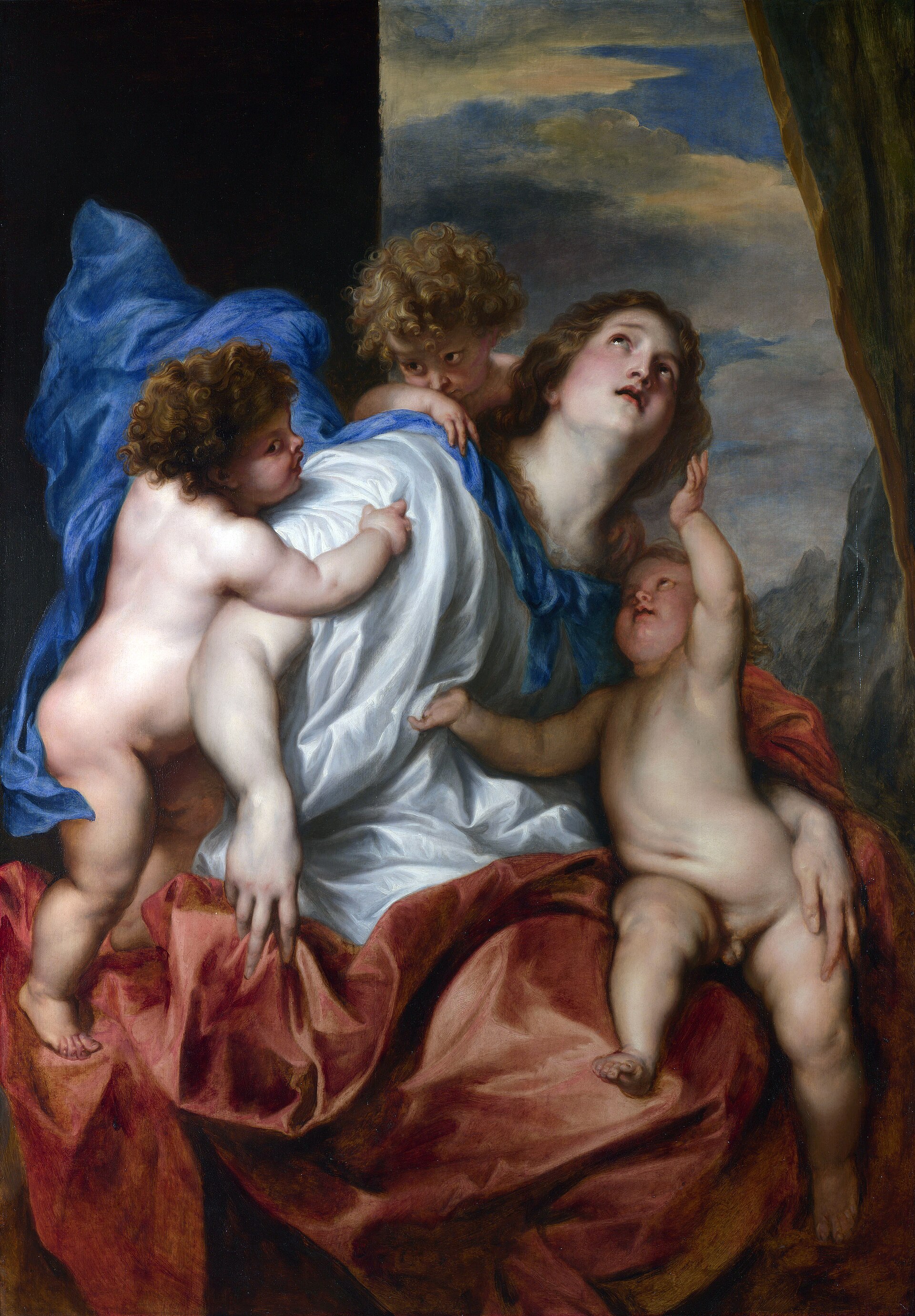
This is Caritas — the Latin word the Vulgate used for agapē, and the reason the KJV says “charity” in this chapter. So the painting is not really an illustration of the text; it is a picture of what the English word became. Caritas is personified as she almost always is: a mother, upturned eyes, dependent children, almsgiving. ⚠ And that is precisely the drift the modern versions abandoned the word to escape. Paul’s chapter is fifteen verbs about how to behave in a congregational quarrel — does not brag, does not swell up, keeps no ledger — and not one of them looks like this. Worth hanging beside the text for exactly that reason. The three children are Caritas’s conventional attribute, and readers have long tied them to the three that remain in verse 13; the tradition is older than any one reading of Paul.

Translator’s Notes
1–2 — Where this chapter actually sits
Before anything else: this is not a poem about marriage. It is the middle panel of a three-chapter argument (1 Corinthians 12, 13, 14) about a congregation fighting over rank — who has the showier gift, who gets to speak, whose spirituality outranks whose. Chapter 12 is about the body and its parts; chapter 14 is about tongues and prophecy and taking turns. Chapter 13 sits between them, and every item in its opening list — tongues, prophecy, mysteries, knowledge, faith that moves mountains — is a gift the Corinthians were competing over. Paul prices each one at nothing. Read at a wedding it sounds like a blessing; read in place it is a rebuke.
Chalkos is bronze (or copper), not brass, and Corinth was famous across the empire for its bronze. And alalazon is not a gentle word: KJV makes it a “tinkling cymbal,” which is almost the opposite — the verb alalazo is the war-shout and the shriek of mourners. ASV corrects to “clanging,” NWT to “clashing,” and the 2013 Spanish revision goes all the way to «un gong que resuena». This translation says wailing, to keep the funeral in it.
3 — ⚠ One letter, and the verse changes: burned, or boasting
The Greek manuscripts split here, and they split on a single consonant. Kauthēsomai (θ) means “that I may be burned”; kauchēsōmai (χ) means “that I may boast.” Both are ancient, and the editions divide: Westcott-Hort and NA28 print boast; Tregelles and the Byzantine text print burned.
The shelf divides with them. KJV “give my body to be burned,” and so do ASV and RV («para ser quemado»). But NWT reads “hand over my body, that I may boast,” and the Spanish TNM agrees — «para poder sentirme orgulloso». Same verse, opposite picture: a martyr at the stake, or a man doing something spectacular for the credit.
⚠ This library does not vote. Both readings are old, the difference is one letter in a word Paul never repeats, and the argument runs either way — that is precisely why it is worth printing rather than smoothing. The text above keeps burned, the reading behind four centuries of English Bibles, with the other standing here in full view. Note only this: boast is the harder reading to invent, and it happens to name the exact sin this chapter was written to treat.
Psōmisō (“dole out in morsels”) is a feeding word — to put crumbs in someone’s mouth. Even the charity in the list is described a little witheringly.
4–7 — ⚠ The famous lines are verbs, not adjectives
The one thing to carry out of this chapter. Verses 4 to 7 contain fifteen finite verbs and not one adjective. There is no “is” in the Greek at all. What everyone knows as “Love is patient, love is kind” is makrothymei, chrēsteuetai — love waits long, love acts kindly. Two verbs. Love is not being described here; it is being watched doing things.
The surprise is which versions saw it. The old ones did. KJV: “suffereth long… envieth not… vaunteth not itself… beareth, believeth, hopeth, endureth.” ASV keeps them too. It is the modern versions that flatten the verbs into adjectives — and once flattened, love stops being something that does and becomes something that is, which is a far easier thing to claim about oneself. NWT lands in between (“is long-suffering and kind,” then verbs again). RV shows the same drift in Spanish: «es sufrida, es benigna». This translation keeps all fifteen.
Physioutai (“swell up”) is not a general word: Paul uses it six times in this letter and almost nowhere else. It is a Corinthian in-joke by now — the church that was inflated (4:6, 4:18–19, 5:2, 8:1) gets the word thrown back one more time. KJV’s “puffed up” is exactly right.
Logizetai (v5) is an accounting verb — to enter in a ledger, to reckon to someone’s account. “Thinketh no evil” (KJV) loses the books entirely; ASV catches it with “taketh not account of evil,” and NWT with “does not keep account of the injury.” The wrong is real and it is not being denied — it is simply not being written down.
Stegei (v7) is a roof word: to cover, and so to shelter or to keep something in. Hence both “bears” and “covers” are defensible, and the ambiguity is Paul’s, not the translator’s.
8–10 — One verb, four times, and most versions hide it
Katargeō — to render inoperative, put out of action, abolish — appears four times in this chapter: twice in verse 8, once in verse 10, once in verse 11. It is a thread, and the thread is the argument: the gifts they are fighting over get decommissioned, and so do the things of childhood.
KJV breaks it into three different English words in verse 8 alone — “faileth… shall fail… shall vanish away” — and the reader cannot see that one verb is doing all the work. ASV and NWT both hold the line with “shall be done away” / “will be done away with,” and NWT carries it into verse 11 as well. This translation uses abolished at all four.
A separate variant sits in the first clause: “love never piptei” — falls — in Westcott-Hort, Tregelles and NA28, but ekpiptei, falls out or fails, in the Byzantine text. Nearly every English Bible prints the smoother “never fails”; the text above keeps falls, which is also what stands beside the three verbs of collapse that follow.
11 — The infant, and the word that closes the thread
Nēpios is not a child in general but an infant — etymologically the one who does not speak, which is a pointed thing to say to people who will not stop talking (chapter 14 is about exactly that). NWT alone says “babe”; KJV and ASV say “child.”
And the verse ends on katērgēka — the same katargeō from verses 8 and 10, now in the perfect tense and with Paul himself as the subject. The gifts will be abolished; the childish things have been abolished. KJV’s “I put away childish things” is a fine sentence that severs the connection completely.
12 — A bronze mirror, and a riddle
Two famous problems in one line. The first is the esoptron: KJV says “through a glass, darkly,” which has given English one of its best-loved phrases and one of its most misleading images. First-century mirrors were polished bronze, not glass — and Corinth manufactured them, which is very likely why Paul reached for the comparison in a letter to Corinth. You do not see through a bronze mirror at all; you see a dim reflection in it. ASV fixes the preposition (“in a mirror”), and NWT spells out the metallurgy: “by means of a metal mirror.” So does the Spanish TNM — «un espejo de metal».
The second is en ainigmati — literally in a riddle, the word English took as enigma. “Darkly” makes it about poor lighting. The Greek makes it about obscurity of meaning: what we have now is not a dim picture but a puzzle, something stated in a form that has to be worked out. RV reads «en obscuridad» and TNM «imágenes borrosas» — both go with the blur rather than the puzzle.
13 — ⚠ “Greater,” not “greatest”
Meizōn is a comparative, not a superlative. The Greek for “greatest” would be megistē, and Paul did not write it. Yet KJV, ASV and NWT all print “the greatest of these” — a superlative that quietly ranks love first in a list of three, which is a slightly different claim from the one on the page: love is greater than these.
Here Spanish reads the Greek better than English does. Both RV and TNM say «la mayor» — which is the ordinary Spanish comparative, the same form as meizōn, and it does not force the superlative the way English does.
Why it matters: the point of the verse is not a medal ceremony. Faith and hope, by the argument of verses 9–12, belong to the era of the partial — you do not need faith for what you can see, or hope for what you already have. Love is greater because it is the one of the three that does not get abolished. The comparative is doing real work.
Patterns worth carrying forward.
⚠ The one thing to carry out of this chapter. Verses 4–7 are fifteen finite verbs and no adjectives — there is no “is” in the Greek. Love waits long, acts kindly, keeps no ledger. And the versions that saw this are the old ones: KJV and ASV keep the verbs (“suffereth long… vaunteth not itself… beareth, believeth, hopeth, endureth”), while the modern renderings flatten them into adjectives. The wedding cadence everyone can recite is a twentieth-century reshaping, and it changes love from something that does into something that is — a much easier thing to claim about oneself.
Renderings chosen. All fifteen verbs kept as verbs. “Wailing cymbal” for alalazon, which is the mourner’s shriek and not KJV’s “tinkling.” “Keeps no ledger of the wrong” for logizetai, an accounting verb. Abolished at all four occurrences of katargeō (vv8, 8, 10, 11), which is one verb that most versions split into three or four English words. “In a riddle” for en ainigmati, not “darkly.” And greater, not greatest, at verse 13, because meizōn is a comparative.
Where Spanish reads it better. At verse 13 both RV 1909 and TNM print «la mayor» — an ordinary comparative, matching meizōn exactly, where every English version on the shelf reaches for the superlative “the greatest.”
Echoes paid. Physioutai, “swell up” (v4) — Paul’s repeated dig at this particular church, used six times in this letter (4:6, 4:18–19, 5:2, 8:1) and almost nowhere else in the New Testament.
⚠ Left open, and named rather than smoothed. Verse 3 turns on a single consonant: kauthēsomai, “that I may be burned,” against kauchēsōmai, “that I may boast.” Both readings are ancient, the critical editions divide, and the shelf divides with them — KJV, ASV and RV read burned; NWT and TNM read boast. No vote is taken here.
⚠ A note on context, since this chapter is quoted more often than it is placed: it is not about marriage. It is the middle of a three-chapter argument (12–14) to a congregation quarrelling over whose spiritual gift outranked whose, and every item in its opening list is one of the gifts they were competing over. Read at a wedding it sounds like a blessing. Read in place it is a rebuke.
⚠ A note on order: 1 Corinthians stands on these pages at chapters 1 and 13 — a deliberate jump to the most-searched chapter in the letter, not a lost stretch. The sequential thread is unchanged: next in sequence is 1 Corinthians 2, which is where the navigation above points.