CreationBefore the FloodThe FloodAfter the FloodThe PatriarchsEgypt and the ExodusThe KingdomThe ExileThe ReturnBetween the TestamentsThe GospelsThe Apostolic Age
🕰
The same letter, the same dictation in Corinth — no narrative time passes between chapters. The argument turns from the Gentile world's guilt to the Jewish reader's own, springing the trap chapter 1 set.
c. AD 56–57, continuous with chapter 1's dating — Paul's argument, not a new scene with its own date.
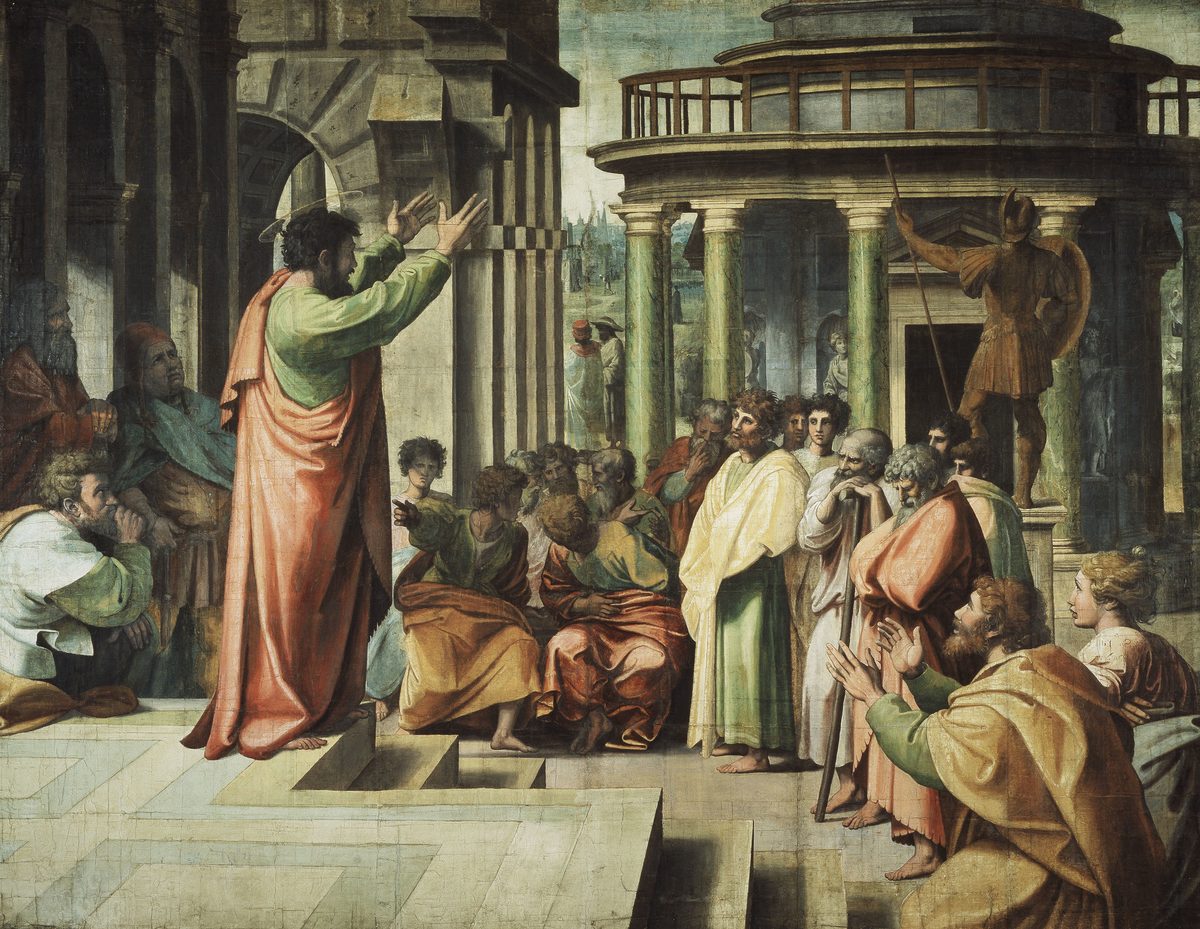
Raphael, c. 1515–1516 · Royal Collection, on long-term loan to the Victoria and Albert Museum, London
⚠ This scene is Acts 17, not Romans — Paul arguing before the Areopagus in Athens, not the letter to Rome. No painter has staged Romans 2 itself: there is no travel, no crowd, no single moment to depict, only an argument dictated to a scribe. This cartoon is chosen for what it gets right about the METHOD on display in this chapter: Paul's raised, open hands are the gesture of a man building a case point by point for an audience that includes both the persuaded and the skeptical — the same rhetorical structure as the four rhetorical blows of vv21-22 (steal, adultery, idols, temple robbery), each one landing before the next begins. Raphael painted this as a cartoon — a full-scale design, pricked and pounced for tapestry weavers — commissioned by Pope Leo X for the Sistine Chapel; the tapestries themselves still hang there on special occasions, the cartoons long since separated from the finished cloth.
Therefore you are without a defense, O man — every one of you who judges; for in that in which you judge another, you condemn yourself, for you who judge practice the same things.note
Por lo cual eres inexcusable, oh hombre, quienquiera que seas tú que juzgas; pues en lo que juzgas a otro, te condenas a ti mismo, porque tú que juzgas practicas las mismas cosas.
But according to your hardness and unrepentant heart you are storing up for yourself wrath in the day of wrath and of the revelation of the righteous judgment of God,note
Pero por tu dureza y por tu corazón no arrepentido, atesoras para ti mismo ira para el día de la ira y de la revelación del justo juicio de Dios,
who show the work of the law written on their hearts, their conscience bearing witness with them, and their thoughts among themselves accusing or even defending them,note
que muestran la obra de la ley escrita en sus corazones, dando testimonio su conciencia junto con ellos, y acusándose o defendiéndose entre sí sus pensamientos,
And the uncircumcised by nature, who fulfills the law, will judge you, who with the letter and circumcision are a transgressor of the law.note
Y el que es incircunciso físicamente, pero guarda perfectamente la ley, te condenará a ti, que con la letra y la circuncisión eres transgresor de la ley.
but he is a Jew who is one inwardly, and circumcision is that of the heart, by spirit, not by letter — whose praise is not from men, but from God.note
sino que es judío el que lo es en lo interior, y la circuncisión es la del corazón, en espíritu, no en letra; la alabanza del cual no viene de los hombres, sino de Dios.
⚠ This is the sentence Romans 1's own closing note called the single most
important thing to carry into this chapter. The list of Gentile vice in chapter 1 was
bait, delivered in the voice of standard Jewish preaching — the sort of thing a Jewish
reader would nod along to. The moment the nodding is loudest, Paul turns the sentence around:
you are without a defense, whoever you are who judges. Chapter 1's note already flagged the trap; this is where it
closes. “Without a defense” keeps anapologētous, the same courtroom word used
there, rather than switching to “without excuse” for variety.
The accusation is not that the judge is wrong about the sin. It is that the judge is
guilty of it — “you who judge practice the same things” (v1), stated as fact,
not hypothesis.
“To the Jew first and also to the Greek” (v9, v10) repeats,
word for word, the phrase chapter 1's thesis statement already
used (1:16) — and this time it cuts both ways. There the phrase named who hears the
gospel first; here it names who is judged first. Paul will not let the priority run in only
one direction. The same two words return as the letter's unfinished business at chapters 9-11,
exactly as chapter 1's note anticipated.
⚠ “No partiality” (v11, prosōpolēmpsia) is literally “receiving
the face” — judging by appearance, status, or favor rather than by fact. KJV and ASV both use the older idiom
“no respect of persons”; NIV reads “no
favoritism”; ESV reads “no partiality.” RV60 keeps the old idiom too, “no hay acepción de
personas”; NVI modernizes to “no hay
favoritismos.” This translation follows the modern sense, since the KJV-era idiom no
longer means what it once did to an English ear.
⚠ “A law to themselves” (v14) and the work of the law
“written on their hearts” (v15) is one of the most consequential sentences Paul
ever wrote for the history of ethics outside the church — the closest thing in the New
Testament to a doctrine of natural law or universal conscience, cited for centuries by
philosophers who never opened the rest of the letter. Gentiles who never received Torah can
still, Paul says, do what Torah requires, because the requirement is written into them by some
means other than revelation.
Conscience (syneidēsis, v15) is not itself the law —
it is the witness that testifies to how a person measures up against a standard already
present. Paul’s own picture is a courtroom running inside a single person: accusing
thoughts and defending thoughts, arguing the case, with no verdict reached until “the day
when God judges the secrets of men” (v16).
Verses 17–24 · the teacher who cannot teach himself
The four rhetorical questions (vv21-22) are built to fall like blows: steal, adultery,
idols, temple robbery — each one paired with the very credential just claimed a verse
earlier. A guide to the blind who cannot see his own path; a teacher of infants who has not
taught himself.
⚠ “The name of God is blasphemed among the Gentiles because of
you” (v24) is presented as a citation — “just as it is written”
— and the closest match on the page is Isaiah 52:5, where the Greek Old Testament has
God's name “blasphemed” among the nations continually because of what has happened
to Israel; Ezekiel 36:20-23, where Israel's exile causes the nations to see God's name
“profaned,” carries the same charge in different words and may stand behind it as
well. Either way the accusation is not new with Paul: he is telling a Jewish reader that their
own scripture already convicted them of exactly this, centuries earlier.
Circumcision was Abraham's own sign of the covenant (Genesis 17:11), and Paul does not
dispute its value — he disputes what it is worth WITHOUT the obedience it was meant to
mark. A lawbreaking circumcised man has, in Paul's arithmetic, subtracted the sign back to
zero; an uncircumcised man who keeps the law's requirements has the thing the sign was for,
without the sign itself. The reversal in v27 is stark on purpose: the uncircumcised outsider
becomes the judge, and the circumcised insider the one judged.
Verses 28–29 · the hardest sentence Paul wrote to his own people
⚠ This is the sentence chapter 1's own closing
note called out by name in advance as the hardest thing Paul says to a Jewish
reader in this letter: the real Jew is one inwardly, and real circumcision is of the heart,
“by spirit, not by letter.”
“By spirit, not by letter” (v29, en pneumati ou
grammati) becomes one of Paul's standing pairs, restated at 7:6 and 2 Corinthians 3:6.
⚠ Whether “spirit” here means the Holy Spirit specifically or the inward
disposition generally is a real question the Greek's lowercase-or-capital ambiguity cannot
settle by itself. RV60 keeps it lowercase and general,
“en espíritu, no en letra”; NVI capitalizes
and personifies it, “la que realiza el Espíritu” — the very
interpretive choice this note is flagging, made silently inside a single Spanish
translation's punctuation. This translation keeps the ambiguity, lowercase, unresolved.
The chapter that opened with a Gentile indictment closes by handing the hardest word to
the reader who thought this letter was about somebody else.
Patterns worth carrying forward
Where this translation keeps the words exact / distinct: "without a
defense" for anapologētous (v1), matching chapter 1's
rendering rather than varying it; "no partiality" for prosōpolēmpsia (v11),
the modern sense rather than the KJV-era idiom; "a law to themselves" and
"written on their hearts" (vv14-15), kept literal rather than paraphrased; and
"by spirit, not by letter" (v29), left lowercase and ambiguous rather than resolved
toward either reading.
Echoes paid. The trap — chapter
1's closing note named this chapter's opening verse as the single most important thing to carry
forward, and v1 is that promise cashed. "To the Jew first and also to the Greek"
(vv9-10) — the identical phrase from 1:16, now cutting toward
judgment rather than toward the gospel's advance. And the closing sentence on spirit and letter (v29)
— flagged in advance by chapter 1's own preview as the hardest line Paul writes to his own
people in this letter.
Echoes planted."To the Jew first" (vv9-10), repeated now twice
in two chapters, building toward the unfinished argument of chapters 9-11. By spirit, not by
letter (v29), restated at 7:6 and in 2 Corinthians 3:6. And the circumcision of the
heart (v29), which chapter 4 will need before it can argue that Abraham was justified before
he was ever circumcised at all.
⚠ And the places the library reports rather than decides. Whether "spirit" in
v29 names the Holy Spirit specifically or an inward disposition generally — RV60 and NVI
silently make opposite calls in their own punctuation. And the precise Old Testament source behind
v24's citation, Isaiah 52:5 or Ezekiel 36:20-23 or both at once — the library sets out the
candidates and does not choose.
Next in this book: the argument chapter 2 has been building
toward — if circumcision and law-keeping do not finally save, what advantage is there in being
a Jew at all?