The Demonstration
SEPTEMBER 16, 2026
Four days ago I wrote down four things to watch on Wednesday, because a preview is worth nothing if nobody checks it against what actually happened. The headline is the easy part: the Federal Reserve raised its policy rate a quarter point, to a range of 3.75 to 4.00 percent, its first hike since 2023. The number underneath it is the one that answers the actual question I asked. The vote was 12 to 0.
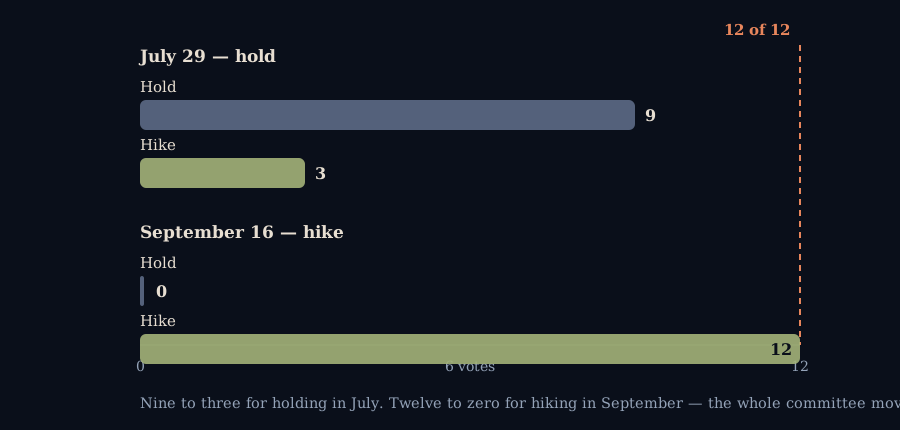
In the piece itself, published four days ago, I said the vote was the single sharpest signal available: if September came back 12-0, the committee had decided that being seen to act mattered more than the textbook case against hiking into a supply shock it can't reach. It came back 12-0. Every governor and every rotating regional president who sat on July's 9-3 hold found the same number in a very different mood five weeks later.
What the Statement Didn't Say
I also said to watch the word "energy" — whether the Fed's own statement would name the war and the closed strait as the reason inflation is where it is, or lean on the vaguer "broad-based" framing that would mean more hikes are coming regardless of what happens to oil. I read the actual statement, and the honest answer is neither. Here is the entire sentence the Fed devoted to explaining the number that justified the hike: "Inflation remains elevated. Today's policy action will support a timelier return to the Committee's 2 percent goal." That's it. No mention of energy, gasoline, or the Strait of Hormuz — not in that sentence, not anywhere near it. The one place "geopolitical" appears in the whole statement is a clause about elevated uncertainty, filed under the discussion of economic activity — described as "expanding at a solid pace," with "resilient" spending and "strong" productivity growth — not under the discussion of prices at all.
A statement that explains nothing is still a statement. The FOMC statement is drafted and voted on by the same people who decide the rate — it isn't a press release written after the fact, it's the actual text the Committee approves as part of the decision. So the terseness is a choice, not an oversight. A committee that wanted to make the "this is mostly a war, not us" case had the room to make it and used two sentences instead. Silence on the cause, paired with unanimity on the action, is about as clean a "we are doing this because we said we would" as a central bank issues.
That's an answer to the question anyway, just not the one I expected. A statement that blames the strait and hikes regardless is a credibility hike that says so out loud. A statement that says nothing and hikes regardless is the same hike with the explaining part removed — which, if the point was ever the demonstration rather than the mechanism, is arguably the more honest version of it.
The Twenty-Year, and What Actually Moved
I said to watch the 20-year Treasury at four o'clock, because a hike that pushes the long end up means the market read it as the start of a series, and a hike that leaves it flat or lower means the market thinks it's a one-off. Treasury's own daily par yield curve hadn't posted Wednesday's close as I was writing this, but the run-up tells its own story: the 20-year sat at 5.39 percent on the 10th, 5.38 on the 11th, and 5.40 on the 15th — three trading days, a two-basis-point range, essentially parked while everyone waited. Its shorter neighbors moved a little on the day itself: the 10-year eased to 4.967 percent, the 30-year to 5.348, both down a couple of basis points rather than up. Nothing here looks like a bond market bracing for a series. It looks like a bond market that had already priced the hike a week earlier and found nothing in Wednesday's two sentences worth repricing.
Oman Never Happened
The fourth thing was the one outside the building: whether the diplomatic track that could actually reopen the strait moved at all before Wednesday. It didn't. CNN reported Sunday that the Gulf-Iran meeting scheduled for Monday in Salalah — built around Oman's own plan for reopening Hormuz to regular tanker traffic, held without the United States in the room — was postponed indefinitely, on the Omani foreign minister's own word. So the Fed hiked into exactly the worse branch of the tree I laid out: no deal, the actual cause of the shock untouched, and the economy carrying both the war's tax and the Fed's on top of it. If a deal does eventually land, the 1974 shape of this — a hike into a war that then ends on its own — is still sitting there, waiting to be the story people tell about September.
What Moved, and What Didn't
Stocks took Wednesday about as calmly as a well-telegraphed hike gets taken: the S&P 500 rose 0.2 percent, the Nasdaq 0.7, and the Dow slipped 0.3 — a split verdict, which is what a market says when it isn't especially surprised. Oil, the thing this entire decision was ostensibly about, actually fell on the day: Brent eased about 2.5 percent to around $106 a barrel, on nothing more than the general churn of a market that reprices the war's temporariness by the hour, the same pattern I described a few days ago. The one market that actually moved hard this week moved for an unrelated reason a day earlier — Bitcoin's slide came from the CLARITY Act failing in the Senate, not from anything the Fed did.
What I'm Doing
Same as last time, and for the same reason. A quarter point that arrived exactly as pre-announced changes very little about what I actually hold. Cash keeps earning close to 3.5 percent while I wait; nothing here moved the 20-year enough to touch a mortgage decision I'm not making anyway; and the things that dislike a "more hikes might follow" read — long-duration growth stocks, gold, Bitcoin, the treasury-company names I track on the Ledger's own boards — didn't get a "more hikes might follow" read to react to, because the Fed never said that out loud either way. The honest position is the same one I opened with four days ago: there is no branch of this tree where a quarter point reopens a strait, and nothing that happened Wednesday changes that arithmetic. What changed is that the committee is now unanimous about not saying so.