One Watt a Terahash, and the Math It Skips
SEPTEMBER 15, 2026
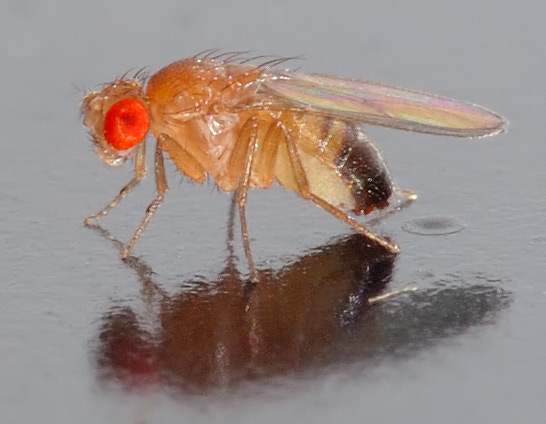
FutureBit is not a meme account. It's a real hardware company — the people behind the Apollo line of home Bitcoin miners, in business since 2014, north of 100,000 units sold, run by an engineer named John Stefanopoulos who has spent a decade arguing that mining shouldn't belong only to industrial farms. Which is what made this week's tweet land differently than the usual crypto timeline noise: a company that actually builds mining silicon for a living announced it had built a Bitcoin miner out of a fruit fly's brain, and that if the idea scaled, it would beat every ASIC on Earth by an order of magnitude.
Introducing HashFly...the first organic neuron bitcoin miner based on the fly brain.
— FutureBit (@FutureBit) September 13, 2026
Fun fact if this could be scaled on real organic neurons, it would hash at ~ 1 watt per terahash...10x the efficiency of the best silicon 3nm ASICs! pic.twitter.com/T2qxBb7XQR
I want to take this seriously enough to actually check it, because the temptation with a claim like this is to either laugh it off or repost it uncritically, and both reactions skip the interesting part. Some of what's underneath this tweet is completely real and genuinely new science. Some of it is one unsourced tweet riding that science's coattails. And the gap between those two things is where the actual Bitcoin-mining question lives.
What's Real: A Fly's Entire Nervous System, Mapped, This Month
HashFly didn't come from nowhere. Earlier in September, HHMI's Janelia Research Campus and Google Research published MaleCNS v1.0, the first complete wiring diagram of an adult male fruit fly's whole nervous system — brain, optic lobes, and ventral nerve cord together, not just the brain on its own. The numbers are worth sitting with: 166,700 neurons, 25,582,938 directed connections, 124,177,617 individual synaptic contacts, every one of them traced from electron-microscope images of an actual fly and checked by hand. It follows the female whole-brain map, FlyWire, published in Nature in October 2024 with 139,255 proofread neurons. Between the two, this is the first time in the history of neuroscience that anyone has had a complete, named, connection-by-connection map of an entire animal's nervous system to work with — a real scientific landmark, not a press-release one.
What a connectome actually is, since the word is doing a lot of work here. A connectome is a wiring diagram — which neuron connects to which, how many times, and through what kind of synapse — built by slicing an actual animal into thousands of ultra-thin sections, photographing each one under an electron microscope, and using machine learning plus human proofreaders to trace every neuron's path across every slice. What comes out the other end is data: a very large, very precise graph. It is not a living fly, it doesn't contain a living fly's biochemistry, and by itself it can't do anything — it has to be loaded into software and simulated before a single "neuron" in it fires.
People started doing exactly that within days of MaleCNS going public, and the results have been genuinely delightful. A Coinbase engineer, Alex Wormuth, wired the connectome to a video feed and called it DOOMFLY; someone got a simulated version walking a virtual Strandbeest robot; other builds have it playing Minecraft and Beat Saber. Wormuth's next project, Stonkfly, feeds Bitcoin candlestick charts into the connectome as images, stimulates its dopamine neurons when a simulated trade profits, and lets the resulting spike patterns place real trades with $100 of real money on Coinbase. Wormuth's own documentation is admirably blunt about what that has and hasn't shown: "no profitable learning, strategy improvement, biological replication, or live-funded performance has been demonstrated," and rising Bitcoin prices alone can make any buyer look skilled. That honesty is worth noticing, because it's the same honesty HashFly's tweet doesn't volunteer.
What HashFly Actually Claims — and What It Doesn't Show
Here is everything I could find that traces back to FutureBit itself: one tweet, one image, and no accompanying repository, write-up, or product page. FutureBit's own website, which otherwise documents the Apollo III miner and Solo Node in detail, has nothing about HashFly anywhere on it. There's no GitHub under the company's name with a HashFly repo, no benchmark methodology, no third party who has run the thing and reported back. What's circulating instead is secondhand: reposts describing a build that wires up 2,914 of the connectome's real neuron connections — a small, chosen slice of the full 166,700-neuron map, not the whole thing — and puts it to work attempting SHA-256 hashes, with figures floating around (not FutureBit's own words, and not independently verifiable by me) of roughly 200 kilohashes per second from one such unit, scaling in principle to the tweet's headline number once you connect enough of them in parallel. I'm stating that plainly rather than dressing it up, because a Ledger entry that can't tell you where a number came from should say so, not smooth over it.
Checking the One Number That's Actually Checkable
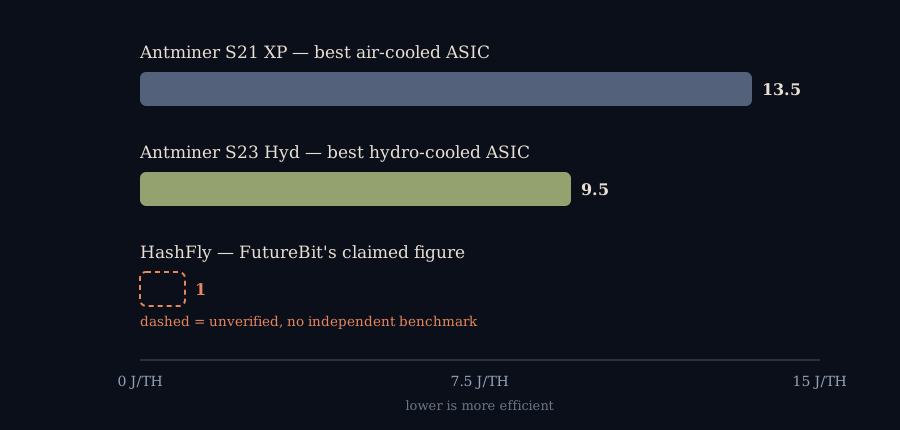
The efficiency claim, at least, is arithmetic I can hold up against real hardware. "One watt per terahash" is the same unit the mining industry quotes as joules per terahash (a watt sustained for one second is a joule, so a chip hashing continuously at 1 TH/s while drawing 1 watt is, by definition, 1 J/TH) — and the machine currently holding that title in the real world is Bitmain's hydro-cooled Antminer S23 Hyd, at 580 TH/s on 5,510 watts — 9.5 J/TH, the first commercial miner ever to break under 10. The best air-cooled chip, the Antminer S21 XP, runs a less exotic 13.5 J/TH. So HashFly's claimed 1 J/TH against the S23 Hyd's 9.5 is a 9.5x gap — FutureBit rounded to "10x," which is honest rounding, not a stretched number. Against the air-cooled S21 XP it would be closer to 13.5x. Whoever did this napkin math started from real efficiency figures, and I want to give credit where it's due: the comparison isn't invented.
The Scale the Tweet Skips Past
Take the unverified 200 KH/s figure at face value for a second, just to see what it implies. That single Antminer S23 Hyd chip — one unit, off the shelf — hashes at 580 TH/s, or 580,000,000,000,000 hashes per second. A fly-brain unit at 200,000 hashes per second would need roughly 2.9 billion copies running in parallel to match it. Not 166,700 — the size of one full connectome — and not some comfortable multiple of that. Billions of them, each one apparently a slice of a simulated nervous system, each needing its own compute to run the simulation in the first place, because none of this is happening in an actual fly's actual head. It's a digital model of a fly's wiring, executed as ordinary software on ordinary silicon — which is worth sitting with, because "organic neuron miner" is not what's being described here even on HashFly's own numbers. FlyWire's own documentation is direct about the limits of what a connectome is: it "recreates a fly's neural wirings and overall structure, but does not contain any of the complex biochemical makeup" of a living organism. There is nothing organic running this. There's a map of something organic, running on the same kind of chip everything else runs on.
The Problem That Isn't About Efficiency At All
Here's the part I think the tweet actually gets wrong, and it has nothing to do with scale or honesty about sourcing. A hash function has zero tolerance for error. SHA-256 takes an input and produces one exact 256-bit output, every single time, and Bitcoin mining is the search for an input whose output happens to start with enough zeros — a single flipped bit anywhere in the computation produces a completely different hash and an invalid, worthless attempt. That's the entire security model: the function has to be perfectly, boringly deterministic, with no wiggle room at all.
Biological neurons — and the connectome models built to imitate them — are not that. They're noisy, analog, probabilistic systems that are extraordinarily good at exactly the kind of fuzzy judgment call Stonkfly asks of them: is this chart pattern more like the ones that made money, or the ones that didn't? Being a little wrong there just means a slightly worse trade. Being a single bit wrong in a SHA-256 computation means the output isn't SHA-256 of anything, and the "hash" doesn't count. You could, in principle, harness a spiking neural network to approximate the kind of logic a hash function needs, but making it exact — reliable to the bit, every time, at scale — means burying the whole approach in error correction and redundancy, and that overhead is precisely the kind of cost that erases an efficiency advantage before it ever reaches a chip. The tweet compares two power-efficiency numbers. The thing actually standing between here and a working fly miner is a correctness problem, and correctness problems don't show up on an efficiency chart.
What Real Biological Computing Actually Does Today
It's worth being clear that biological computing itself isn't science fiction — it's just not this. Cortical Labs, an Australian company, has been running actual living neurons — not a software model of them, real cells grown from stem cells and kept alive on an electrode array — since its DishBrain experiments taught roughly 800,000 human neurons to play Pong. Its current product, the CL1, is a real, sold biological computer that reportedly runs on well under a kilowatt per rack. What it's good at is exactly what you'd expect from real neurons: adaptive pattern learning on incomplete, noisy data, the kind of task where "mostly right" is a genuinely useful answer. Nobody at Cortical Labs, as far as I can find, has pointed CL1 at SHA-256 either — because the mismatch between what living neural tissue does well and what a cryptographic hash function demands is the same mismatch HashFly's tweet runs straight past, whether the neurons involved are real cells in a dish or a digital map of a fly's wiring.
Is the 10x efficiency number plausible? The arithmetic checks out against today's actual best ASIC — 9.5 J/TH on the Antminer S23 Hyd against a claimed 1 J/TH is genuinely about a 9.5-to-1 gap. Whoever wrote the tweet did real homework on the comparison side.
Has anyone actually built and benchmarked a working fly-brain miner? Not that I can find. No repository, no write-up, no third-party benchmark, nothing on FutureBit's own site. Every specific number beyond the tweet itself is secondhand and unverifiable as I write this.
Is there a real path from here to a device that mines Bitcoin? I don't think so, and not because of scale, which is at least an engineering problem you could in principle throw billions of dollars at. SHA-256 needs a bit-perfect answer on every attempt, and the entire appeal of a neural substrate — biological or simulated — is that it isn't bit-perfect about anything. That isn't a gap this idea closes by getting bigger. It's the reason it doesn't get funded past the tweet.
None of that makes this week a waste of anyone's time. A complete, connection-by-connection map of an animal's nervous system is a real thing that happened, and watching the internet immediately turn it into a Doom player, a Strandbeest, a day trader, and now a Bitcoin miner is, honestly, the best possible use of a slow news week. I just don't own any HashFly, and the one strategy in my own book that holds Bitcoin with real money — the rebalancer I wrote about after killing twenty-five others to keep it — is going to keep doing that with silicon, not with a fly.