It Took Its Inventor a Month. The Record Is Now 2.76 Seconds.
ARTS & CULTURE · SEPTEMBER 25, 2026
In 1974 Ernő Rubik, a lecturer in interior design at the Academy of Applied Arts and Crafts in Budapest, built a small cube out of smaller blocks. He wasn't trying to make a toy. The problem that interested him was structural: how could a solid object's parts all move independently of one another without the whole thing falling apart? When he got it working, he scrambled it and found he couldn't put it back. By his own account it took him about a month. The official world record for solving the same puzzle is now 2.76 seconds, set this February by a nine-year-old in Poland. That's less time than Rubik probably spent looking for a pencil.
The cube was part of my childhood. I was about nine when it reached American toy stores in 1980, and I've since seen people solve it in less time than it takes to say "Rubik's Cube." I read a news story today about how far the fastest times have dropped, and it made me want to set the whole story down in one place, from a Budapest classroom to a nine-year-old in Gdańsk.
How the Rubik's Cube Was Invented
Rubik filed for a Hungarian patent on his "Magic Cube" (Bűvös kocka) on January 30, 1975. The trick that makes it work is invisible from outside. There is no central spindle through the middle holding the pieces on. Each piece has a shaped foot hidden inside that locks under its neighbors, so the cubes hold each other together. Only the six center squares are attached to a fixed core, and every other piece rides around them. That's why a cheap cube can survive a childhood of being dropped, forced and occasionally pried apart with a butter knife to "solve" it the other way.
A state-run Hungarian cooperative, Politechnika, put the first batches in Budapest toy shops in late 1977. The rest of the world found out largely by luck. In February 1979 a Hungarian businessman, Tibor Laczi, brought one to the toy fair in Nuremberg, where Tom Kremer, whose firm Seven Towns licensed toys, saw what it was. That September they signed with Ideal Toy Corporation, which renamed it the Rubik's Cube and launched it worldwide in 1980. From 1980 to 1983 about 200 million were sold. Then, like every craze, it collapsed, and cubes went into closets across the Western world.
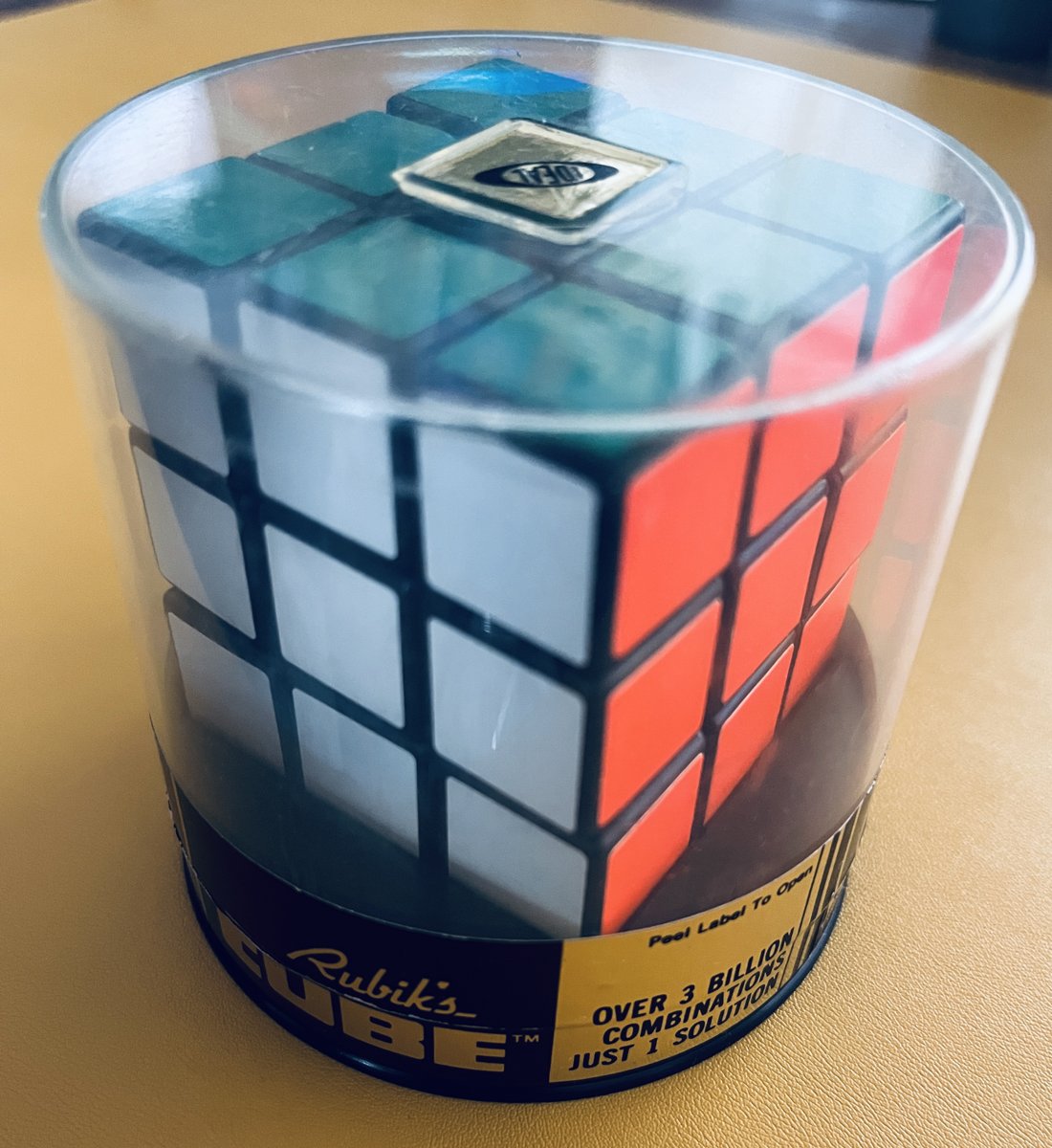
The number on the box nobody reads. Ideal's canister promised "over 3 billion combinations." A 3×3×3 cube actually has 43,252,003,274,489,856,000 possible arrangements, about 43 quintillion, so the box undersold it by a factor of roughly 14 billion. Exactly one of those arrangements is solved. In 2010 a team including the programmer Tomas Rokicki proved, with help from about 35 CPU-years of computing time donated by Google, that every one of those arrangements can be solved in 20 moves or fewer. Cubers call that "God's number." The fastest human solvers use roughly 50 to 60 moves, which is what makes their times even stranger.
The First World Championship, and the Twenty-One-Year Pause
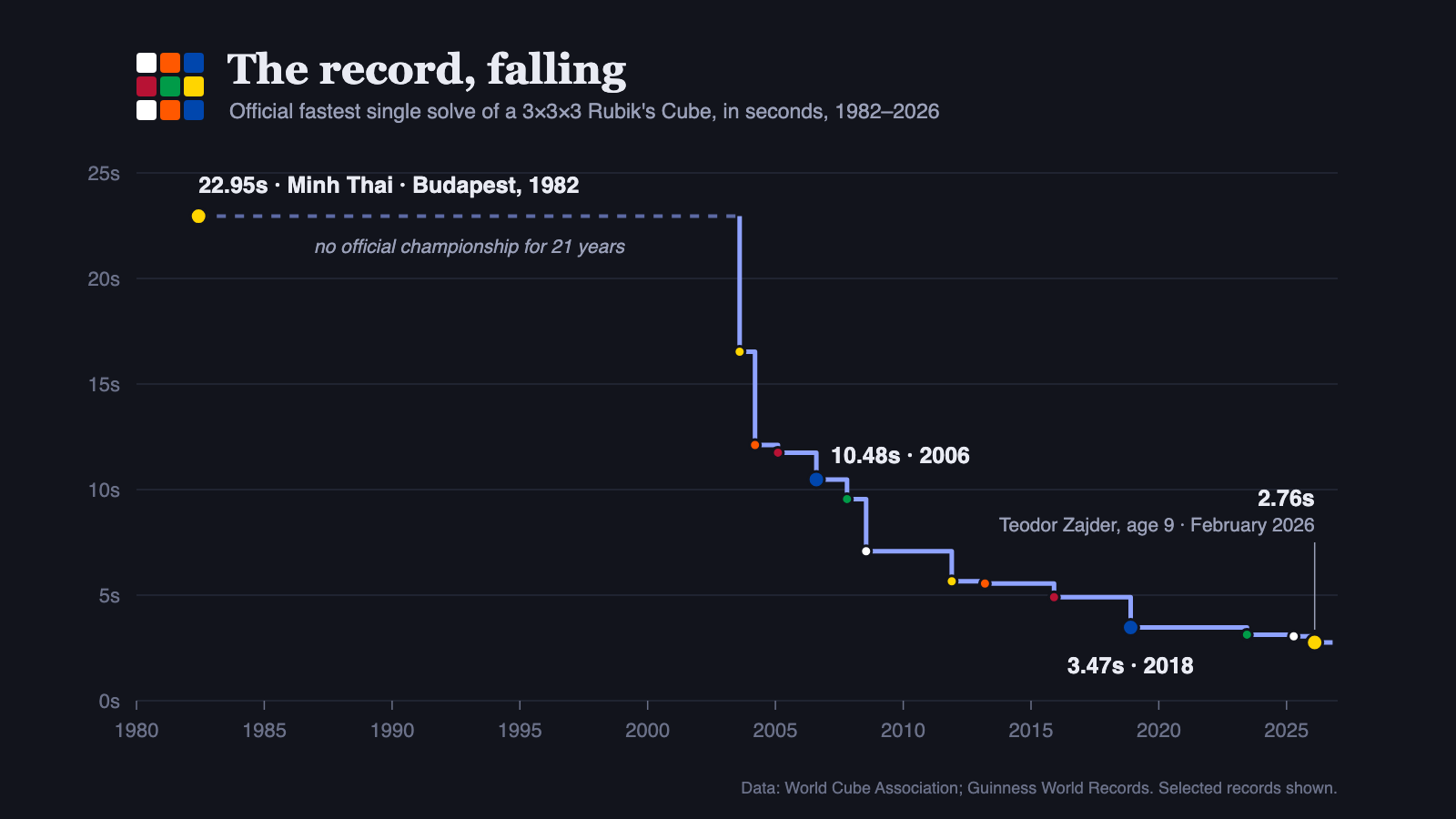
On June 5, 1982, nineteen national champions met in Budapest for the first World Rubik's Cube Championship. Minh Thai, a Vietnamese-born high-school student from Los Angeles, won with 22.95 seconds. That was the world record, and it stood for a long time. It wasn't unbeatable. Nobody was holding official contests anymore. The fad had ended, and for the next two decades speedcubing survived only as a hobby for a scattered few.
The web is where the sport came back. In 1997 a Czech mathematician, Jessica Fridrich, put her solving method online. It solves the cube layer by layer in four stages, using memorized sequences of moves called algorithms, and it later became known as CFOP. In 2003 a world championship was held in Toronto, the first in twenty-one years, with 83 competitors, and the World Cube Association was formed to keep the rules and the records. Dan Knights won the Toronto event, and the record promptly fell to 16.53 seconds. It has been falling ever since, as the chart above shows.
How Much Faster Speedcubers Have Gotten in Twenty Years
Twenty years ago, in 2006, the record was 10.48 seconds. In 2008 it went below eight, and in 2011 the Australian Feliks Zemdegs pushed it to 5.66. In November 2018 China's Yusheng Du did 3.47, a drop of more than two-thirds of a second in one go. The American Max Park took it to 3.13 in 2023, and China's Xuanyi Geng to 3.05 in April 2025. Then, on February 8, 2026, at a competition in Gdańsk, Poland, nine-year-old Teodor Zajder solved one in 2.76 seconds, the first official solve under three. Measured against 2006, the record has dropped to about a quarter of what it was.
The more telling number is the average. A single solve can be lucky, because now and then a scramble happens to be close to finished. So the World Cube Association also keeps a record for the average of five solves, with the best and worst dropped. That record is 3.51 seconds, set this June by Yiheng Wang of China. It means someone now averages faster over five tries than the single-solve record stood at right up until Yusheng Du's (4.22 seconds, set by Feliks Zemdegs in May 2018). The records keep arriving younger, too. This week a six-year-old in China, Lian Yunzhi, set the women's world record for the average at 4.27 seconds. She reportedly practices two to three hours a day and has memorized more than 1,300 algorithms.
Why Rubik's Cube Solve Times Keep Falling
No single thing did it. It was a stack of improvements, each small, and each borrowed by everyone else within months:
- Methods. Fridrich's four stages were refined into large libraries of algorithms, so the best solvers finish the last layer with one or two memorized sequences instead of four. They also look ahead, planning the next step while their hands are still doing the current one. The 15 seconds of inspection before the clock starts are used to plan the first several moves.
- Hardware. The 1980 Ideal cube was stiff and caught on its own corners. Modern speed cubes are made for the sport. They are lubricated and tuned, they cut corners (a face still turns when it is slightly out of line), and since the late 2010s most have small magnets that snap each layer back into alignment. Cubers argue about how much the equipment is worth, but nobody argues it's worth nothing.
- Video and the size of the field. A kid learning today can watch the world's best solvers slowed down, move by move, for free. The World Cube Association has more than 245,000 registered competitors, compared with the 19 finalists in Budapest. When that many people are trying, some of them will be very young and very fast.
None of that makes 2.76 seconds less amazing. The cube is the same as the one Rubik couldn't solve for a month. What changed is that a quarter of a million people spent twenty years sharing everything they learned about it.
Where I Could Be Wrong
These records move fast, and any figure here could be out of date within weeks. Everything above is as of today, September 25, 2026, checked against the World Cube Association's own records. The 1982 and 2003 events didn't run under today's rules, so the early numbers on the chart and the modern ones aren't a perfectly like-for-like comparison. The chart also shows only selected records, not every one. The month Rubik needed to solve his first cube comes from his own retelling, decades later. Lian Yunzhi's training details come from press reports, not from the record body.
Sources
- World Cube Association. Official records and competitor results (3×3×3 single 2.76, Teodor Zajder; average 3.51, Yiheng Wang). worldcubeassociation.org
- Guinness World Records. Fastest time to solve a 3x3x3 rotating puzzle cube. guinnessworldrecords.com
- ABC News (Australia). Six-year-old girl solves Rubik's Cube in just over 4 seconds, setting women's world record. September 23, 2026. abc.net.au
- TVP World. Polish 9-year-old cracks Rubik's Cube in record time. tvpworld.com
- Wikipedia. Rubik's Cube (invention, patent filing, Ideal Toy launch, sales, 1982 championship). en.wikipedia.org
- Rokicki, T., Kociemba, H., Davidson, M., Dethridge, J. God's Number is 20. 2010. cube20.org
- Ruwix. The History of the Rubik's Cube World Records. ruwix.com


