The Same Barrel
THE WORLD · SEPTEMBER 13, 2026
Costco started rationing motor oil this week. Members can now buy at most two 10-quart boxes of the warehouse chain's own Kirkland Signature full-synthetic a week — the box that cost about $30 a few weeks ago now runs $58 — and at most five 6-quart cases of Mobil 1. It is the first purchase limit Costco has ever put on motor oil. That is an odd sentence to be writing after two entries about a pipeline in the Saudi desert, but it is the same story, four steps removed from where the first entry and the second left it.
How a Closed Pipeline Ends Up in a Costco Aisle
The link is base oil — the unglamorous, unbranded liquid that makes up 75 to 98 percent of any finished lubricant, motor oil included, and carries the additive package that does the rest of the work. Nobody buys base oil at Costco; everybody who buys a case of Mobil 1 is buying mostly base oil anyway. The particular grade behind most modern synthetics is called Group III, under the American Petroleum Institute's own classification, and the United States gets about 44 percent of its Group III from three refineries on the Persian Gulf: Shell's Pearl GTL plant in Qatar, ADNOC's Ruwais complex in the UAE, and Bapco's Sitra complex in Bahrain. The Strait of Hormuz closure this newsletter has been following since the first entry has effectively shut off exports from all three, and Pearl GTL took physical damage in the strikes back in March — it's expected to run at half capacity for at least a year.
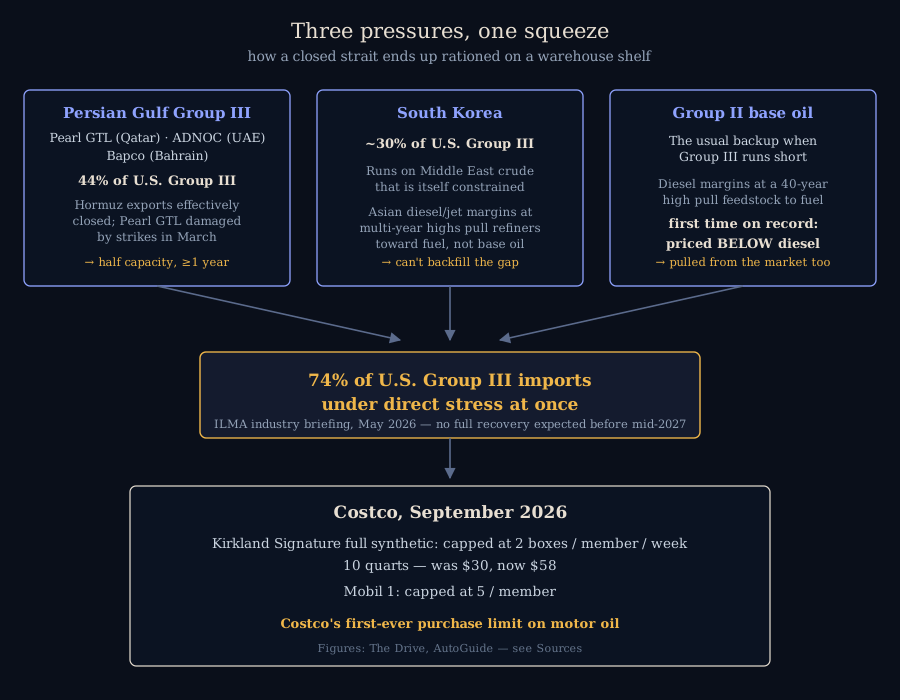
Ordinarily a Group III shortage has two safety valves, and this one has neither. The first is South Korea, which supplies another 30 percent of America's Group III — but Korean refiners run on Middle East crude too, and with Asian diesel and jet-fuel margins at multi-year highs, they are routing what crude they do get toward fuel instead of base oil. The second is Group II, the lower-grade stock blenders normally substitute in when Group III is tight — but American diesel margins are at a 40-year high of their own, so refiners are sending vacuum gas oil toward diesel too, and Group II is trading below the price of diesel for the first time on record, which is pulling it out of the lubricant market as well. Add it up, per the lubricant manufacturers' own trade association, and roughly 74 percent of the country's Group III imports are under direct stress at once, from three directions that would normally cushion each other. Their own industry briefing, written for member companies in May, didn't expect the situation to fully resolve before mid-2027.
What "Group III" actually means. The American Petroleum Institute sorts base oils into five groups by how they're refined; Group III is made by hydrocracking, which strips out more impurities than the older Group I/II process and is what most oil sold today as "full synthetic" actually is, whatever the marketing on the bottle implies. It is not the only input — additives are the other 2 to 25 percent — but it is the majority ingredient and the one in short supply.
The Question From Two Days Ago, Half-Answered
The first entry ended its "one thing to watch" box with a genuine unknown: had the drones hit the East–West pipeline's pumping stations, or the trunk line itself, since a pumping station is machinery in a building and a ruptured pipe across 1,200 kilometres of desert is a different order of repair. There is now a dedicated Wikipedia page for the strike itself, sourced to the wire reporting of the last three days, and it answers half the question: several pumping stations, in the Riyadh and Medina regions along the route, not the pipe. Technically, the less catastrophic kind of damage.
It is behaving like the worse kind anyway. In April, a strike knocked out one of the pipeline's eleven pumping stations, cutting throughput by about 700,000 barrels a day; Saudi Arabia announced the line back at its full 7 million barrels a day within about a week, and two other outlets confirmed the same timeline. This time the whole line — not one station's worth of flow, all of it — has been down since the 10th, and as of this writing, three days later, nobody has announced a reopening date. A pumping station is apparently easy to fix one at a time and much harder to fix several at once, which is either an engineering fact about spare parts and repair crews or a choice by whoever hit it, and I don't know which.
Two More Costs Since Yesterday
Two other things changed since the second entry, neither one about the pipeline. First, the U.S. Navy quietly cut back: its Naval Cooperation and Guidance for Shipping office told the shipping industry it has limited its recommended escort windows through the Strait of Hormuz to two a day, down from continuous coverage, since early September — reported the same week by a second outlet, both citing the Financial Times. Ships don't have to travel in those windows, only get the best protection if they do. The stated reason is cost, not risk: advanced U.S. military aircraft run $25,000 to $75,000 an hour to operate, according to the analyst quoted in both reports, and six months of continuous coverage is not a bill any navy pays forever. It comes days after Iran reportedly attacked ten ships near the strait on September 9 — by some counts the largest single assault on commercial shipping since the war began — which makes thinning out the escorts now a strange-looking bet, unless the bill mattered more than the timing.
Second, the International Energy Agency revised its 2026 numbers again on Friday, the 11th. A month ago it expected global oil supply to fall 4.3 million barrels a day this year; now it expects 5.7 million. Demand, too, is now forecast to contract 2.5 million barrels a day instead of 1.6 million, as the higher prices finally bite into how much people drive and fly. And the line every version of this story keeps returning to: the agency no longer expects Gulf output to get back to normal within 2026 at all. That recovery has slipped into 2027 — the same year the lubricant makers' own briefing named for their own supply to normalize. Two different industries, watching the same clock.
Two entries ago I said energy, for a household, is a cost line rather than an investment line — the price of a gallon of gas, a kilowatt-hour, eventually a bag of fertilizer folded into next spring's bread. It has a fourth name now, sitting on a warehouse shelf with a purchase limit taped next to it, and after this week I would be surprised if it's the last one this chain finds.
Where I Could Be Wrong
The Costco figures come from auto-press outlets (The Drive, AutoGuide, and others all matching on the numbers) relaying reporting I haven't traced to a Costco statement or a receipt of my own — plausible and consistent across independent write-ups, but not a primary source. The Independent Lubricant Manufacturers Association briefing is dated May 2026, four months before this entry and written by an industry group explaining rising prices to its own member companies, not an independent audit; if anything its Pearl GTL and Group II figures predate this week's pipeline strike entirely, so the true stress today could be worse than 74 percent, not better. The pumping-stations finding rests on a Wikipedia article's synthesis of wire reporting, which I have not individually traced back to a Saudi Ministry of Energy or Aramco statement. And the Navy escort story reaches me through two outlets citing the Financial Times; I could not read the original piece behind its paywall, so I can't rule out that "twice a day" is missing some nuance about which windows or which ships it applies to.
Sources
- Wikipedia. 2026 East–West Crude Oil Pipeline attack. https://en.wikipedia.org/wiki/2026_East%E2%80%93West_Crude_Oil_Pipeline_attack
- Argus Media. Saudi East–West crude pipeline back to full capacity. 12 April 2026. https://www.argusmedia.com/en/news-and-insights/latest-market-news/2813059-saudi-east-west-crude-pipeline-back-to-full-capacity
- Al Jazeera. Saudi Arabia says key oil pipeline back to full capacity after attacks. 12 April 2026. https://www.aljazeera.com/economy/2026/4/12/saudi-arabia-says-key-oil-pipeline-back-to-full-capacity-after-attacks
- Fortune. Saudi Arabia says East-West pipeline restored to full capacity. 12 April 2026. https://fortune.com/2026/04/12/saudi-arabia-east-west-pipeline-full-capacity-iran-war-attack/
- Bloomingbit. US Cuts Strait of Hormuz Escort Support Windows to Twice Daily on Rising Costs, citing the Financial Times. 2026. https://en.bloomingbit.io/feed/news/120234
- Newsy Today. US Cuts Tanker Escorts in Hormuz as War Costs Soar, citing the Financial Times. 13 September 2026. https://www.newsy-today.com/us-cuts-tanker-escorts-in-hormuz-as-war-costs-soar/
- OilPrice.com. IEA Sees 5.7 Million Bpd Oil Supply Plunge as Gulf Recovery Slips to 2027. 11 September 2026. https://oilprice.com/Latest-Energy-News/World-News/IEA-Sees-57-Million-Bpd-Oil-Supply-Plunge-as-Gulf-Recovery-Slips-to-2027.html
- Independent Lubricant Manufacturers Association. Why Lubricant Prices Are Rising: The 2026 Global Base Oil Supply Crisis — What It Means for You. Member briefing, last updated 11 May 2026. https://ilma.org/wp-content/uploads/2026/05/ILMA-Customer-Info-Base-Oil-Supply-Crisis.pdf
- The Drive. Costco Is Now Rationing Motor Oil Because the Global Shortage Is Getting Real. September 2026. https://www.thedrive.com/news/costco-is-now-rationing-motor-oil-because-the-global-shortage-is-getting-real
- AutoGuide.com. Even Oil Changes Aren't Safe From Politics Now. September 2026. https://www.autoguide.com/auto/auto-news/even-oil-changes-arent-safe-from-politics-now-44633521
- Image: Alf van Beem, Valvoline, The World's First motor Oil can, Terug in de Tijd museum, Horn, Netherlands. CC0/public domain, via Wikimedia Commons.