Pancreatic Cancer Has a Drug That Works. Now the FDA Wants It Tried First
SEPTEMBER 17, 2026
On September 14 the FDA granted Breakthrough Therapy designation to daraxonrasib — sold as Rasonque by Revolution Medicines — in combination with the chemotherapy pair gemcitabine and nab-paclitaxel, for people with metastatic pancreatic adenocarcinoma who have not yet had any treatment [1]. That sentence has a lot packed into it, so the question I wanted to answer is the plain one a person would type into a search box after a diagnosis in the family: what is daraxonrasib, does it actually work in pancreatic cancer, and what does "breakthrough" mean — legally, not as an adjective? The short version: it is the first drug ever to roughly double survival in this disease, it has been approved for three weeks, and the new designation is the FDA saying it wants to see it moved to the front of the line.
Why pancreatic cancer has needed this for forty years
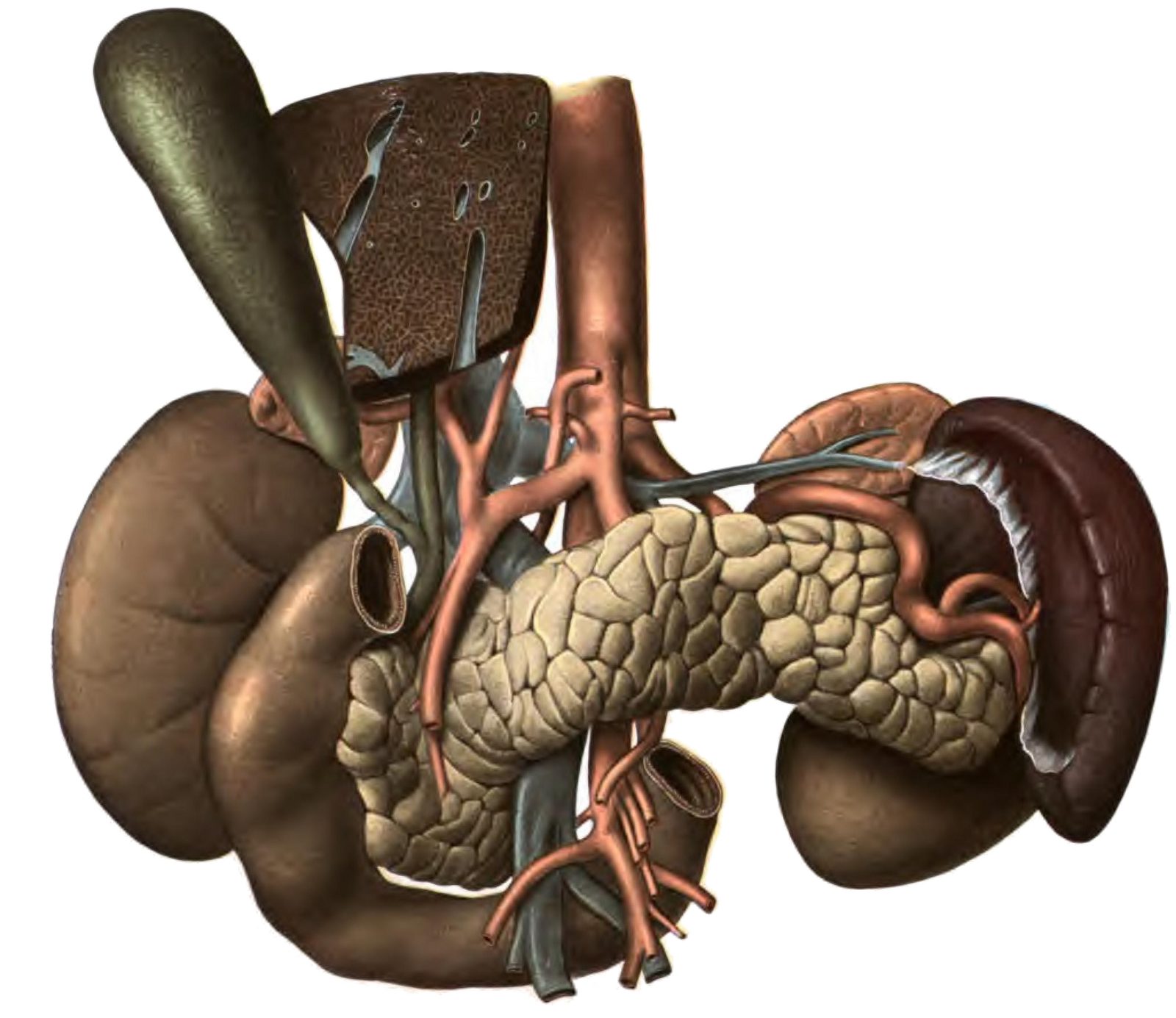
Pancreatic cancer is the disease oncologists are quietest about. The American Cancer Society expects 67,530 new cases and 52,740 deaths in the United States in 2026 — the third-leading cause of cancer death, behind only lung and colorectal, from a cancer that is nowhere near the third most common [2]. Five-year survival across all stages is 13%, the only major cancer still under 20% [2]; for disease that has already spread by the time it is found, which is most of it, the figure is in the low single digits. The pancreas sits deep behind the stomach (the plate above shows how buried it is), the early symptoms are vague, and there is no screening test.
The biology behind that record has a name. About nine in ten pancreatic adenocarcinomas carry a mutation in KRAS, a gene for a protein that acts as an on/off switch for cell growth; the mutation jams the switch on. KRAS was identified as a cancer driver in the early 1980s and then spent four decades with the label "undruggable," because the protein is a smooth ball with no obvious pocket for a drug to sit in. The first KRAS drugs, approved in 2021, hit a single rare variant (G12C) found in about one pancreatic tumour in a hundred. Everyone else waited.
What daraxonrasib is
Daraxonrasib is an oral, once-daily "RAS(ON) multi-selective, noncovalent, tri-complex inhibitor" [1]. Unpacked: it binds the active (switched-on) form of RAS rather than the resting one; it hits many RAS variants — G12D, G12V, G12R, the ones that actually occur in pancreatic cancer — rather than one; and it works by recruiting a second protein already abundant inside cells, cyclophilin A, to form a three-part complex that sits on RAS and stops it signalling. It is a different trick from the 2021 drugs, and it is the reason the label is not restricted to any particular mutation.
What the trials found
In people already treated (the approval). The pivotal trial, RASolute 302, randomised 500 people whose metastatic pancreatic cancer had progressed after one line of chemotherapy to either daraxonrasib or their physician's choice of standard second-line chemotherapy [3]. Median overall survival was 13.2 months on daraxonrasib versus 6.7 months on chemotherapy — a hazard ratio of 0.40, with a 95% confidence interval of 0.30 to 0.53 [3]. Progression-free survival was 7.2 months against 3.6 (hazard ratio 0.49), and 30% of patients had a measurable tumour response against 11% [3]. Those are not the kind of numbers this disease produces. A hazard ratio of 0.40 means that, at any given moment, a patient on the drug was 60% less likely to die than one on chemotherapy; second-line pancreatic cancer trials are usually fought over hazard ratios in the 0.8s. The results were published in the New England Journal of Medicine in May and presented at ASCO in June [4], and the FDA approved the drug on August 26, 2026 — just over a month after the application was filed, for adults "who have received at least one prior systemic therapy or who are not candidates for multiagent systemic therapy" [3].
The side effects are real and mostly on the surface. In the trial rash affected about 86% of patients (14% severe) and mouth sores 54% (12% severe); diarrhoea and vomiting were common; the label also warns of gut perforation and lung inflammation [3] [5]. And yet only about 1% stopped the drug because of side effects, against about 11% on chemotherapy [5] — a pill that gives you a bad rash is, it turns out, easier to stay on than an infusion that makes you sick.
In people not yet treated (the new designation). Here the evidence is earlier and smaller, and it is important to say so. Breakthrough status rests on a phase 1/2 study of 40 people with untreated, RAS-mutant metastatic pancreatic cancer who took daraxonrasib at 200 mg a day alongside gemcitabine and nab-paclitaxel [1] [6]. At a December 2025 cut-off, 58% had a tumour response (one of them complete), 84% were alive without progression at six months, and 90% were alive at six months; the medians had not yet been reached [6]. A parallel cohort of 38 people on the drug alone, no chemotherapy, had a 47% response rate and 71% progression-free at six months [7]. For comparison, the chemotherapy regimens that have been first-line standard for a decade — gemcitabine plus nab-paclitaxel (MPACT, 2013) and FOLFIRINOX (PRODIGE 4, 2011) — delivered median survival of 8.5 and 11.1 months and response rates of 23% and 32% in their own trials [8] [9], and the newest combination, NALIRIFOX, managed 11.1 months against 9.2 for gemcitabine/nab-paclitaxel in 2023 [10]. The most common serious side effects in the combination cohort were low red and white blood counts and fatigue — chemotherapy's signature, not the drug's [6].
Forty people with six months of follow-up is a signal, not a proof. The proof is RASolute 303, a phase 3 trial that began enrolling in April 2026 and will randomise about 900 untreated patients, of any RAS genotype, three ways: daraxonrasib alone, daraxonrasib plus gemcitabine/nab-paclitaxel, or the chemotherapy alone [1] [6]. Its primary endpoints are progression-free and overall survival. Until it reads out, first-line use is a hypothesis with a very good pedigree.
What "Breakthrough Therapy" actually means
It is a legal status, not a superlative. Congress created it in 2012 for a drug that treats a serious condition where "preliminary clinical evidence indicates that the drug may demonstrate substantial improvement over available therapy on a clinically significant endpoint" [11]. What the company gets is not approval and not money; it is access — intensive FDA guidance on the trial design from phase 1 onward, a commitment of senior agency staff, and eligibility for rolling review and priority review when the application comes [11]. In other words, the agency has looked at forty patients and decided the first-line question is important enough to help design the answer. This is the drug's third breakthrough designation (the earlier two were for treated pancreatic cancer and for RAS-mutant lung cancer) and the fifth across the company's RAS portfolio [1].
What the evidence says. For metastatic pancreatic adenocarcinoma that has already progressed on one line of chemotherapy, daraxonrasib is supported by a 500-person randomised trial showing median survival of 13.2 versus 6.7 months (hazard ratio 0.40) — the largest survival gain ever recorded in this disease, at the cost of near-universal rash and frequent mouth sores. For untreated disease, in combination with chemotherapy, the evidence is a 40-person early-phase cohort with a 58% response rate and 84% six-month progression-free survival — better than anything chemotherapy has produced historically, but uncontrolled, small, and short. Breakthrough status is the FDA's judgment that this early signal deserves a fast, well-designed phase 3, which is now running. It is not an approval for first-line use, and no one should read it as one.
The company, and the price
Revolution Medicines (Nasdaq: RVMD) is based in Redwood City, California, and until August 26 had never sold a drug [1]. It has spent extraordinarily to get here: a net loss of $644 million in the second quarter alone, $395 million of it research, on the way to $2.1–2.2 billion of operating expense guided for the year; it raised $1.7 billion in stock and $500 million in convertible notes in April, took $250 million from Royalty Pharma in May, and held $3.9 billion in cash at the end of June [12]. The market has decided that was money well spent: its market value sits around $42 billion this week [13], for a company with three weeks of revenue.
The price it set explains the valuation. A 30-day supply of Rasonque lists at $39,800, which works out to more than $477,000 a year — more than double the list price of Merck's Keytruda, the best-selling cancer drug in the world [14]. Evercore ISI's analyst expects $2.4 billion of sales next year, $15.1 billion from pancreatic cancer alone by 2034, and a peak of $20.8 billion across cancer types, calling it a candidate for "one of the fastest oncology launches in history" [14]. More than 2,000 patients had already received the drug through an expanded-access programme before approval [5]. The drug is taken until the cancer starts growing again, which in the trial took a median of 7.2 months; at list price that is roughly $290,000 of pills for the median patient, before anything else. Whether a health system pays it will be decided one insurer at a time, and the company has an insurance-navigation programme ready for exactly that conversation [14].
The other company in the headline is really a chemotherapy. Gemcitabine has been generic for years; nab-paclitaxel (Abraxane) was Bristol Myers Squibb's and is now also generic. Neither will see a cent of the upside if RASolute 303 succeeds. That is the pattern of the last decade in oncology — the old drugs become the scaffolding the new one is priced on top of.
Where the evidence is weak
The first-line data are forty people. The second-line trial was open-label, meaning patients and doctors knew who was getting what, which can nudge softer endpoints (it cannot nudge death). The survival numbers are medians, and half of patients did worse than them. Nobody knows yet what happens when the cancer adapts to a RAS(ON) inhibitor, as cancers do, and the company's own pipeline — two more RAS drugs, several combination trials — is an admission that a single agent will not be the end of it [12]. And a drug that costs more than a house per year of treatment will not reach every one of the 52,740 people a year who need something; that is not a criticism of the science, but it is part of the truth.
What I'd do. Nothing here is a recommendation and I am nobody's oncologist. But the thing I would want, if this diagnosis landed near me, is to know that the first-line phase 3 exists, where it is enrolling, and whether the person I love has a RAS mutation on their tumour report — because for the first time in forty years, that line on a pathology report describes a target rather than a verdict.
Sources
- Revolution Medicines. Revolution Medicines Announces U.S. FDA Breakthrough Therapy Designation for RASONQUE (daraxonrasib) in Combination with Chemotherapy for First Line Metastatic Pancreatic Cancer. Press release, 14 September 2026. globenewswire.com
- Siegel RL, Kratzer TB, Giaquinto AN, et al. Cancer statistics, 2026. CA: A Cancer Journal for Clinicians, 2026. doi:10.3322/caac.70043
- U.S. Food and Drug Administration. FDA approves daraxonrasib for metastatic pancreatic adenocarcinoma. 26 August 2026. fda.gov
- O'Reilly EM, et al. Daraxonrasib or Chemotherapy in Previously Treated Metastatic Pancreatic Cancer (RASolute 302). New England Journal of Medicine, 2026. doi:10.1056/NEJMoa2605555
- Pancreatic Cancer Action Network. First RAS Inhibitor Extends Survival in Previously Treated Metastatic Pancreatic Adenocarcinoma: What You Need to Know. 2026. pancan.org
- OncoDaily. FDA Grants Breakthrough Therapy Designation to Daraxonrasib Plus Chemotherapy in First-Line Metastatic Pancreatic Cancer (the RMC-GI-102 cohort numbers and the RASolute 303 design). September 2026. oncodaily.com
- BioPharma Dive. Revolution drug shows promise in early pancreatic cancer (AACR 2026 monotherapy and combination cohorts). April 2026. biopharmadive.com
- Von Hoff DD, Ervin T, Arena FP, et al. Increased Survival in Pancreatic Cancer with nab-Paclitaxel plus Gemcitabine (MPACT). New England Journal of Medicine, 2013. doi:10.1056/NEJMoa1304369
- Conroy T, Desseigne F, Ychou M, et al. FOLFIRINOX versus Gemcitabine for Metastatic Pancreatic Cancer (PRODIGE 4/ACCORD 11). New England Journal of Medicine, 2011. doi:10.1056/NEJMoa1011923
- Wainberg ZA, Melisi D, Macarulla T, et al. NALIRIFOX versus nab-paclitaxel and gemcitabine in treatment-naive patients with metastatic pancreatic ductal adenocarcinoma (NAPOLI 3). Lancet, 2023. doi:10.1016/S0140-6736(23)01366-1
- U.S. Food and Drug Administration. Breakthrough Therapy — the statutory definition and the features of the designation. fda.gov
- Revolution Medicines. Second Quarter 2026 Financial Results and Update on Corporate Progress (Form 8-K exhibit 99.1), 5 August 2026. sec.gov
- Revolution Medicines, Inc. (RVMD) — market capitalisation, as quoted 17 September 2026. Google Finance
- BioPharma Dive. Revolution pancreatic cancer drug should quickly become a blockbuster, analysts say (list price, annual cost, Evercore ISI forecasts). 27 August 2026. biopharmadive.com
This is one reader's reading of the research, not medical advice. If something here touches on your own health, take it to a clinician who knows you — and read how these entries are put together.